
In-ear analysis · Expert · as listed
64 Audio Aspire 2 Analysis
The 64 Audio Aspire 2 sits on the in-ear shortlist of 12 November 2026 in the Expert tier, now expanded to seventeen models, in rank 9 with a Vinyl BotPro index of 78 and no tier badge. This analysis takes the list record as published and does not run a second calculation.
In short
The 64 Audio Aspire 2 is a wired hybrid in-ear with a dynamic bass driver, a balanced-armature driver for midrange and treble, an ABS shell, a stainless-steel nozzle and an IPX connector. On the in-ear shortlist of 12 November 2026 it sits in the Expert tier, now expanded to seventeen models, in rank 9 with a Vinyl BotPro index of 78 and without a tier badge. The subscores and the mapping onto the 70–84 band are documented in the list package; this page repeats the list record and does not run a second calculation.
The listening report is Headfonia (Felix, 5 January 2026) in the series review of the Aspire 1, 2 and 3, at length on the second page: a dated listening review of the exact model in an independent international online specialist outlet of the same class that already supports the live pillar for the THIEAUDIO Monarch MKIV. Under the single badge rule of 12 November 2026 — including the t647s3962 addendum on YouTube listening tests by established, named reviewers — the Aspire 2 is eligible; its pillar here is the editorial text, not a video. 64 Audio lists US$499. The documented euro price used here is €499.00 at WOD Audio (shop.wodaudio.com, 12 November 2026, previously €549.00). The dollar price is not converted into euros. Headfonia would personally pick the Aspire 2 out of the three entry models.
Technical data (public)
| Type | Wired universal-fit hybrid in-ear |
|---|---|
| Drivers | One dynamic driver plus one balanced-armature driver for midrange and treble; LID, Apex Core, Helmholtz resonator (64 Audio / WOD Audio) |
| Impedance | 13 Ω at 1 kHz (WOD Audio, 12 November 2026) |
| Sensitivity | 103 dB/mW at 1 kHz (WOD Audio) |
| Frequency response | 20 Hz–18 kHz (WOD Audio) |
| Isolation | −20 dB (WOD Audio) |
| Connection | T2 / IPX, supplied cable with an angled 3.5 mm plug |
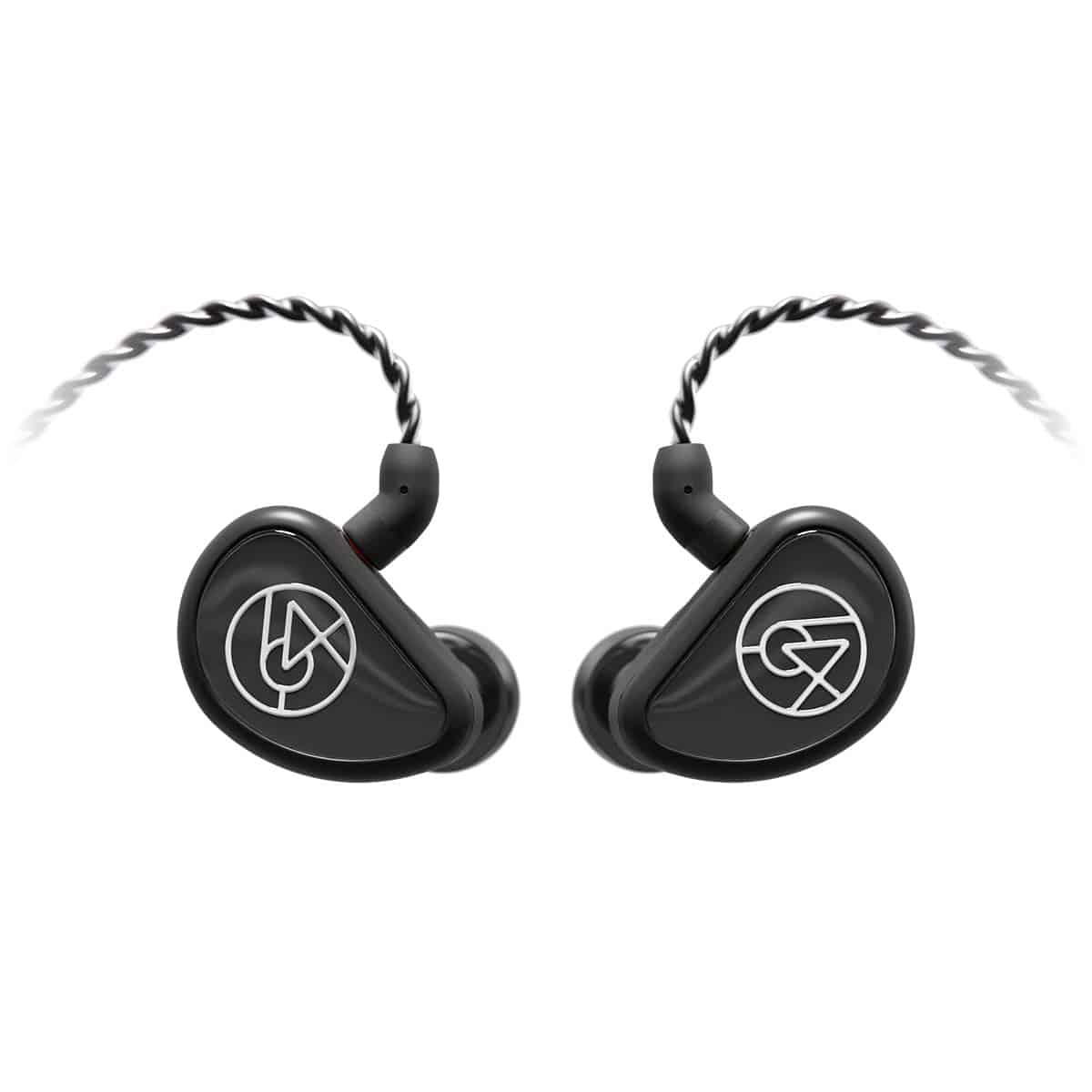
| Housing | ABS with a stainless-steel nozzle and a lip, dark-grey faceplate |
| Price as documented | €499.00 at shop.wodaudio.com, 12 November 2026 (previously €549.00, page marked in stock) |
Amplifier compatibility
At 13 Ω at 1 kHz and 103 dB/mW the Aspire 2 is easier to drive than the Aspire 1 (30 Ω, 106 dB/mW). Headfonia ran the series from the same digital audio players — the Astell&Kern SP3000M and the Lotoo PAW Gold Touch and PAW Gold Touch 2 — and does not treat drive as a hurdle on the Aspire 2 either. A dedicated headphone amplifier is not a requirement on this record; on very quiet outputs it can add headroom.
The carton includes an unbalanced 3.5 mm cable with a 90-degree plug. A balanced 4.4 mm cable is not part of the kit. On a typical vinyl chain with a headphone output the Aspire 2 hangs from the 3.5 mm plug. Whether a given phono preamp reaches the level you want remains device-dependent; the low impedance and the absence of a drive complaint point to uncritical use on ordinary outputs.
Rating criteria in detail
The Vinyl BotPro index on this page is not a second calculation but the list record of 12 November 2026. The Expert tier now holds seventeen models; the mapping uses the 70–84 band, with the indices 84, 81, 78, 75, 72 and 70.
The sound-evidence score of 7.5 rests on the Headfonia listening report: the personal favourite of the three entry models, a clear step up in resolution and precision from the Aspire 1, vocals with more air and emotion and not pushed forward, a weighty, creamy lower midrange, clear treble with shimmer, and a stage that is a little wider yet still compact. Build/comfort 7.8 follows from the same ABS construction as the Aspire 1 and Aspire 4. Drive 9.0 follows from 13 Ω / 103 dB/mW and the absence of a drive complaint. Value 7.2 follows from €499.00, above the Iris (€399.00, P 7.6) and below the MACH 30 (€549.99, P 6.6); the value badge in this tier sits with the less expensive Aspire 1.
Manufacturer and concept
64 Audio is based in Vancouver, Washington. The Aspire series is the most accessible entry into the universal line and adopts Apex Core, LID and a Helmholtz resonator for the dynamic driver. The Aspire 2 is the middle of the three entry models: a hybrid of dynamic bass and a single balanced-armature driver that covers midrange and treble together, whereas the Aspire 3 splits mid and treble across two armatures.
Outwardly it shares the ABS shell with a stainless-steel nozzle and lip with the Aspire 1 and 3; the faceplate is dark grey. Headfonia finds the move to plastic understandable because it cuts weight and cost. The IPX connector is aimed at professional use and narrows the aftermarket for typical 2-pin or MMCX cables. That robust connector is, in Headfonia’s conclusion, a limit for audiophile cable-swappers and at the same time a plus in stage work.
How the technology works
A hybrid splits the work: the dynamic driver supplies area and excursion for bass, the balanced-armature driver takes midrange and treble. Headfonia hears the change from the Aspire 1 clearly — more midrange precision and resolution, while warmth and body from the dynamic driver remain. LID is meant to keep the impedance curve comparatively linear, Apex Core eases pressure in the ear canal, and the Helmholtz resonator shapes the dynamic driver. This analysis has no measurements of its own; the figures come from the WOD Audio product page of 12 November 2026.
The stated 13 Ω at 1 kHz and 103 dB/mW describe an electrical and level specification, not a lab judgement of sound. Frequency response and isolation match the series (20 Hz–18 kHz, −20 dB). The nozzle has the same lip as the Aspire 1 so that ear-tips stay put when the in-ears are removed.
What the international specialist press hears
Character
Felix first describes the Aspire 2 in comparison: like the Aspire 1 it has good low-end body, texture and impact, without too much rumble into the sub-bass. The lower midrange and mids are warmer and fuller, but vocals are pulled back a little while the upper mids sit further forward. Treble is clear and clean, with good shimmer and brightness, yet, as on the Aspire 1, it steers away from sharpness and brittleness. Technically the Aspire 2 offers good resolution and imaging, with a stage that remains compact.
Tonal balance
The low end has good impact, drive and authority, without the gruntiest sub-bass rumble, yet it stays sufficiently solid, natural and organic, with plenty of body and density. On Digable Planets’ “Where I’m From” the bass sounds tactile, fast and impactful; on Yello’s “Electrified II” it likewise has pump, resolution and texture. Lower-pitched instruments — keys, cellos — have weight. On Radiohead’s “Everything in Its Right Place” the sound is full, resolved and weighty.
Felix calls the lower midrange weighty and physical, with good grunt and resolution: darker, creamy and dense, and to him explicitly beautiful. The change of mid/treble driver is clearly audible: more precision and resolution, while warmth from the dynamic driver remains. Vocals do not get the front-of-stage treatment heard on the Aspire 1, yet they do not feel scooped. On Moloko’s “The Time Is Now” and Faith No More’s “Easy” he hears airy, floating vocals with body, resolution and emotion — exactly what he had missed on the Aspire 1. Instruments sound full and organic, with lifelike size; the Aspire 2 is less smooth and less thick than the Aspire 1, but it is not a lightweight either.
Dynamics, bass and stage
The stage stretches a little wider and deeper than on the Aspire 1, yet it still draws a compact room. In resolution the Aspire 2 brings out finer nuances and places instruments on a dark background, with good separation and air around the musicians; imaging and layering are done very well. In the treble the Aspire 2 has speed, clarity and bite, giving cymbals, violins and other high-pitched sounds a well-formed appearance with sharpness, without sounding hot or too bright — though people with lower tolerances may still want to audition carefully. Extension into the highest registers is good but clearly rolled off, and it still brings air and resolution to that range.
Strengths and limits
In the series conclusion the Aspire 2 is Headfonia’s personal pick: well balanced, weighty and organic, with good technicalities. The three models step up clearly in fidelity, staging, layering and immersion. Strengths include the series’ price-to-performance ratio, full and harmonic mids on the Aspire 1 and 2, well-resolved mids with air on the Aspire 2 and 3, the tight bass and the clear differences between the models. Series cons remain IPX and the ABS shells; the Aspire 2 does not carry the treble and vocal reservations that Headfonia attaches to the Aspire 3.
Research consensus
This analysis rests on Headfonia’s substantial series listening review, not a second international magazine report of the same depth devoted to the Aspire 2 alone. The consensus is Felix’s finding, read against the data sheet and the euro price: a light hybrid with a creamy, weighty lower midrange, airier vocals than the Aspire 1, clear, unsharp treble, better resolution and a stage that is still compact. Eligibility follows the single rule of 12 November 2026, including t647s3962; random channels, short clips and unboxings without a listening section remain excluded. Forums, retailer copy or manufacturer pages are not used as a listening pillar. The Aspire 2 does not carry a tier badge: the value badge sits with the less expensive Aspire 1, the Sound badge with the Iris and its higher sound-evidence score of 7.6.
Features and daily use
The kit matches the series: silicone and foam tips, a cleaning tool, a shirt clip, a 6.35 mm adapter, a small carry case and the angled 3.5 mm cable. Headfonia calls it a good package without luxury. A 4.4 mm cable is not included. The fit is described as very comfortable, the shells are light, and isolation of −20 dB is a little more open than on other 64 Audio models. The lip on the nozzle keeps tips in place. The dark-grey faceplate is the outward distinction from the light-grey Aspire 1 and the dark-red Aspire 3.
Price and availability
The documented euro price is €499.00 at WOD Audio on 12 November 2026; the page showed a previous price of €549.00 and was marked in stock, with a shipping note of about one to two working days within Germany. Whether a shop has stock is a snapshot and is not recorded here as a guarantee. 64 Audio lists US$499. This analysis does not convert that amount into euros. Prices change, without guarantee.
In the Expert tier €499.00 sits above the Iris (€399.00) and the Aspire 1 (€339.00) and below the MACH 30 (€549.99). Headfonia praises the series’ value but makes the Aspire 1 the price argument of the line and the Aspire 2 the sonic choice. The P subscore of 7.2 places that mid-tier price without claiming a badge.
At the amplifier and on a vinyl system
As a wired in-ear with a supplied 3.5 mm cable, the Aspire 2 hangs from typical phono chains with a headphone output. A 4.4 mm cable is not included; IPX narrows aftermarket options. Headfonia describes no weakness in drive, and the official impedance is low. A dedicated headphone amplifier is not a requirement on the present record, though it can add headroom on quiet outputs.
The review names portable players, not a specific phono stage. Anyone listening to records will find in the report a fuller, organic midrange body with more air around vocals than on the Aspire 1, and a clear, unsharp treble that sensitive ears may still want to audition carefully. The still-compact stage renders large recordings close rather than wide; the higher resolution helps fine cutting and pressing details come through, without Headfonia turning that into a studio-reference claim.
Who is the Aspire 2 for?
The Aspire 2 suits listeners who want the organic Aspire character but more resolution, air around vocals and precision than the Aspire 1, without moving into the higher treble energy of the Aspire 3. Headfonia would personally pick exactly this model. Anyone who wants the lowest documented Expert price and the value badge stays with the Aspire 1; anyone looking for a still more mature V-shaped tuning under US$500 will find, on the same list, the Iris with the Sound badge. Anyone who often swaps cables should take the IPX connector seriously.
How it compares
Against the Aspire 1 the Aspire 2 gains resolution, air around vocals, imaging and a little stage size, and gives up some of the thick, smooth fullness. Against the Aspire 3, which sits in the Master tier, the Aspire 2 remains the more balanced, less treble-energetic choice. On the list of 12 November 2026 the Aspire 1 sits in the same Expert tier in rank 3 at index 81, without a badge; the Aspire 3 sits in Master in rank 2 at index 96 with that tier’s value badge.
The Campfire Audio Iris (€399.00) sits in Expert in rank 1 at index 84 with the Sound badge. Its sound-evidence score of 7.6 sits just above the Aspire 2’s 7.5. The Westone MACH 30 (index 75) and MACH 20 (index 72) and the Final A5000 (index 70) follow without a badge.
How it sits on the opened list
With the Aspire 1 and Aspire 2 the Expert tier grows from four models to six. The Aspire 2’s Vinyl BotPro index is 78, rank 6, without a badge. The raw score of 7.7 sits below the Iris and Aspire 1 (7.9 and 7.8) and above the 7.4 cluster of the MACH 30, MACH 20 and A5000. All nine models are eligible under the single rule. The value badge goes to the Moondrop Blessing 3, the Sound badge to the Iris (K 7.6) ahead of the Aspire 2 (K 7.5). The MACH 30 therefore loses the Sound badge it previously carried in this queue. Neither badge sat on an already live Expert page.
FAQ
What exactly is the 64 Audio Aspire 2?
A wired universal-fit hybrid with a dynamic driver and a balanced-armature driver, 13 Ω at 1 kHz, 103 dB/mW at 1 kHz, a 20 Hz–18 kHz frequency response, −20 dB isolation, IPX/T2 and an ABS shell with a stainless-steel nozzle. An angled 3.5 mm cable is in the carton.
Does the Aspire 2 need a headphone amplifier?
WOD Audio quotes 13 Ω at 1 kHz and 103 dB/mW at 1 kHz. Headfonia does not treat drive as a hurdle. A dedicated amplifier is not a requirement on this record; on quiet outputs it can add headroom.
Is it suitable for listening to records?
Yes. As a wired in-ear with a 3.5 mm plug it hangs from typical phono chains with a headphone output. The review describes an organic, weighty hybrid with airier vocals than the Aspire 1 and clear, unsharp treble. A 4.4 mm cable is not included and is not a substitute for a phono stage.
What does the Aspire 2 cost?
At WOD Audio the price on 12 November 2026 was €499.00 (previously €549.00, page marked in stock). 64 Audio lists US$499. This analysis does not convert the dollar price into euros. Prices and stock change, without guarantee.
Is the Aspire 2 eligible for a tier badge?
Yes, it is eligible: Headfonia (Felix, 5 January 2026) is a dated listening review of the exact model. It does not hold a badge in this tier, because the Aspire 1 has the higher P subscore of 8.0 and the Iris has the higher sound-evidence score of 7.6.
Does this page rest on a listening test by the VinylCination team?
No. There was no in-house listening test and no measurement of our own. The assessment draws on 64 Audio’s and WOD Audio’s data and the Headfonia listening review (Felix, 5 January 2026). The list figures (Expert, rank 9, index 78, no badge) come from the list package of 12 November 2026.
Conclusion
The 64 Audio Aspire 2 is Headfonia’s personal pick among the three entry models: a documented wired hybrid with more resolution and air around vocals than the Aspire 1, a documented euro price and a stage that remains compact. The list record of 12 November 2026 is Expert rank 9, index 78, without a tier badge. Anyone planning €499.00 and looking for the organic Aspire sound in its more balanced form will find a solid source base here. Anyone looking for the tier’s price argument stays with the Aspire 1; anyone looking for the tier’s highest sound evidence should read the Iris.
About this AI analysis
This section is an AI summary of a published international listening review and 64 Audio’s and WOD Audio’s own data. Vinyl BotPro places the findings and links them to the data sheet, the specialist-trade price and the list record; VinylCination does not have listening tests or measurements of its own, and every source is linked at the end of the page. Prices and availability change (as of 12 November 2026, without guarantee). Subscores and the index come from the list package of the same day.