
Integrated amplifier · AI analysis · Master, rank 4
Accuphase E-4000: Analysis
AI analysis (research): Accuphase mid-range AAVA Integrated Amplifier with 180 W/8 Ω, attenuation factor 800 and two option slots (Phono AD-50/60, DAC-60) — specs/retailer prices, no listening test.
Summary
The E-4000 is specified according to Accuphase with AAVA, 180 W/8 Ω and DF 800. Phono is not as standard — AD-50/AD-60 (MM/MC) DE often costs about €1,190 extra. Basic MSRP often about €9,290–9,400 (price as of check).
Assumptions
- Vinyl only with optional AD board
- Price base unit without modules
- Check the German price as of Sept 2026
Specs (public / manufacturer)
| Type | Stereo integrated amplifier · AAVA · Instrumentation Power |
|---|---|
| Power | 180 W/8 Ω · 260 W/4 Ω (manufacturer) |
| Phono | No standard · optional AD-50/AD-60 MM/MC |
| Digital | Optional DAC-60 |
| Features | 2 option slots · Balanced · Recorder · Loudness · MOS-FET Protect |
| Price guide | Base approx. €9,290–9,400 · AD board often ~€1,190 · Sept 2026 |
Manufacturer specifications (Accuphase)
| Power output | 180 W into 8 Ω · 260 W into 4 Ω (per channel) |
|---|---|
| Damping factor | 800 |
| Volume control | AAVA with ANCC |
| Power stage | four-fold parallel push-pull, Class AB |
Source: Accuphase – official specifications · As of 16 October 2026 · subject to change by the manufacturer
Scores in detail
Vinyl BotPro Index: 96 · Index band Master 85–97 · Guidance only, not a lab value.
Strengths
- AAVA volume + high DF
- Modular Phono/DAC
- Durable Accuphase platform
Weaknesses
- No phono as standard
- Modules increase system price
- No network streamer
Analysis: Accuphase E-4000 in detail
How the cited material is used
This analysis adds manufacturer data and a dated independent listening report on the Accuphase E-4000 to the short overview above. Vinyl BotPro compiled it from the sources named below; VinylCination has not carried out its own listening session or measurement of this unit. The basis is Accuphase’s official product page and English catalogue (retrieved 12 November 2026) [1] and Vincent Guillemin’s English-language VuMetre listening report (August 2025, datePublished 1 August 2025) [2].
VuMetre (English edition) meets the requirement of an international independent listening report: Guillemin describes the design, the comparison units, the loudspeakers and a dedicated sound section. A report in STEREO 07/2023, if used at all, is German-only and does not by itself satisfy the international listening-test rule; it is not used here as a listening source. Forums are left aside.
Background and place in the range
The E-4000 is Accuphase’s Class A/B integrated amplifier below the E-5000 line and replaces the E-480. The catalogue describes it as drawn from separate-amplifier technology: AAVA volume with ANCC, a balanced power stage using the instrumentation-amplifier principle, a four-fold parallel push-pull of power transistors in Class AB, 180 watts into 8 ohms and 260 watts into 4 ohms, a damping factor of 800, a large toroidal transformer and MOS-FET protection [1]. VuMetre places it a year after the E-5000, notes that it replaces the E-480, takes in techniques from the P-7500 power amplifier, lowers noise further and raises the damping factor substantially, while still offering a comfortable 2 × 180 watts into 8 ohms [2].
In our list the unit is the Master-tier value champion (Index 96, rank 4). The champion placing is an AI assessment based on the available data, not a listening seat of our own. Phono and DAC are not standard; they are optional boards in two slots.
Casework, connections and operation
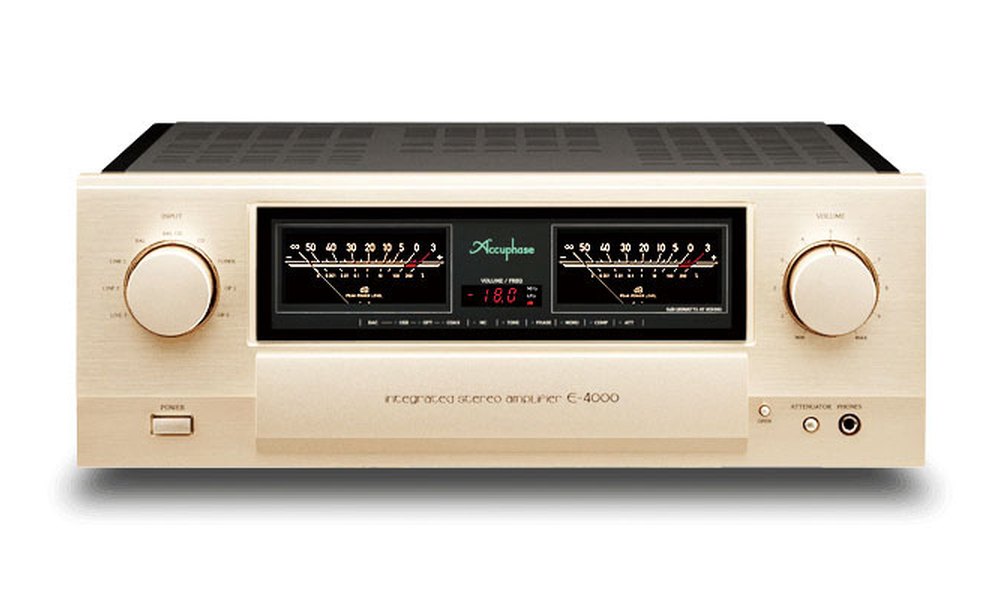
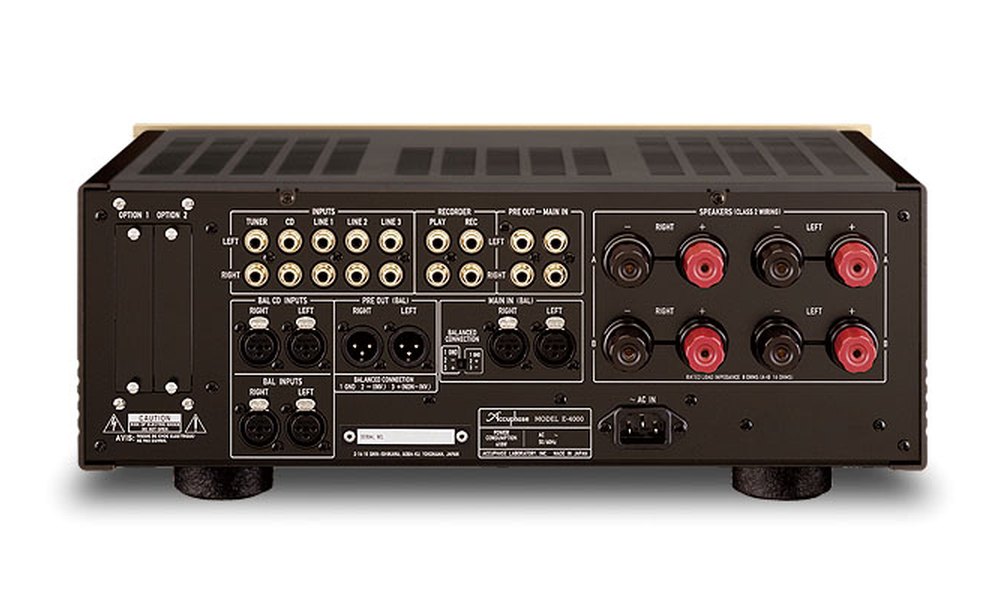
VuMetre describes the familiar champagne-coloured chassis and the large needle meters behind glass, now back in the main view and reaching down to −50 dB, with an added “5” between 20 and 10. Red LEDs below report DAC-board status, speaker pair A or B and similar states. Under the hatch sit rectangular keys; gold-coloured rings around the input and volume knobs recall the E-5000. At the rear, organisation is unchanged from the E-480: five RCA line inputs, two XLR, rec, pre out and main in also in balanced form, plus two option slots [2]. The catalogue quotes 465 × 181 × 428 mm and 24.4 kg [1].
The existing table on this page (as of 16 October 2026) carries the same power and feature data and is left unchanged. There is no standard DAC or built-in phono stage; VuMetre mentions the headphone jack without re-testing it, because Accuphase had indicated no change.
Power, AAVA and manufacturer data
Accuphase quotes 180 watts into 8 ohms and 260 watts into 4 ohms, a damping factor of 800 (according to VuMetre 33 percent above the E-480’s 600 and thus level with the E-650), 0.05 distortion and a 20 Hz to 20 kHz response (±0.5 dB), plus 102 dB signal-to-noise balanced and 109 dB unbalanced [1][2]. Volume is still handled by AAVA, without a wiper in the signal path. This generation, VuMetre writes, cuts noise by a further 20 percent, among other things with six parallel input buffers and the ANCC branch between volume and current-to-voltage conversion. MOS-FET switches of 1.6 milliohms (against 2.0 on the E-480) sit just behind the speaker terminals. Left and right run in parallel from input to output. That is manufacturer and press statement, not a measurement protocol of our own; the table is left untouched.
The catalogue also grounds the damping factor in balanced remote sensing — feeding back signal and ground close to the speaker terminals — and in a power stage that, as an instrumentation amplifier, equalises impedances on the plus and minus sides to keep interference out [1]. ANCC works in the I-V converter and in the balanced arm of the AAVA section; the catalogue quotes a helper-stage noise density of 1.5 nV/√Hz. Those are manufacturer circuit claims, not measurement curves from this analysis. They explain why VuMetre treats the very low noise as a central listening finding and why Accuphase presents the E-4000 as a quieter, not a louder, successor to the E-480.
What the specialist press heard
Guillemin heard the E-4000, just arrived in France, at distributor Hamy Sound in CTA’s rooms in Paris, with the chance to compare it with McIntosh units and, above all, with the E-380, E-650 and E-800. Sources were an Accuphase DP-570 (whose DAC also fed a 3D Lab Nano Signature transport) and a Mark Levinson 5101, cabled with Wireworld, into ProAc K6, Sonus Faber Maxima Amator, JMR Orfeo Grande and Everest Ubik 215C V3 loudspeakers. He did not re-test the phono and DAC boards or the headphone jack [2].
Sonically he sees in the E-4000 chiefly a gentle development of the E-480: all of its qualities remain, some become still more musical. It does not reach the suppleness of the E-5000; timbres seemed more balanced than on a McIntosh, especially in the bass. Above all, the very low noise produces a deeply black, pure stage — purer than on the E-650, to which one may conversely grant the charm and roundness of pure Class A. The E-4000 is more sharply drawn and very precise, without losing suppleness in the abundance of detail, from plucked strings on albums by the late Jeff Beck to the touch of Gabriel Tacchino. In Karajan’s Alpine Symphony (Strauss), brilliance and attack of rare scale appear, with instruments always clearly placed; the double basses remain fluid and slightly in the background. Against the E-380 the stage and the sense of realism improve, especially through lower distortion. Good SACD files open wide, deep spaces; less flattering recordings still remain musical. The amplifier quickly makes itself forgotten and drives every loudspeaker he heard with the same ease: deep bass and clear separation on the Maxima Amator, even more so on the ProAc, and on the JMR a more restrained delivery that does not show off power [2].
In its conclusion VuMetre writes that the E-4000 does not try to overturn one of the world’s most respected brands, but steadily improves the already strong qualities of earlier versions. Slightly less warm than an E-650 (€10,990) and less flexible than the more powerful E-5000, it sits correctly just under €10,000, especially with current-hungry or very capable loudspeakers. The soundstage has gained clearly against the previous generation; the needle meters and the ability to run two pairs of speakers or a bi-amped chain remain typically practical. In this budget range it is a must-listen [2]. That is a dated listening finding in Paris in 2025, not a listening seat of our own.
Placement, loudspeakers and options
The official 180/260 watts and the damping factor of 800 point towards a wide span of floorstanders and standmounts, including less sensitive models — exactly the circle VuMetre heard in Paris. Anyone who wants vinyl or a USB DAC inside the chassis must fit a board: VuMetre names the AD-50 (MM/MC) at €990 and the DAC-60 at €1,240, plus a Line-10 at €190 if even five line inputs are not enough [2]. The existing table on this page often quotes about €1,190 for the phono board and speaks of an AD-50/AD-60. The name and the price can differ; the table is left unchanged, and the body text records both figures. VuMetre did not listen to the boards again. There is no HDMI ARC, no streaming and no standard DAC.
Pre out and main in, including balanced, allow the preamp and power amp to be used separately or for bi-amping with a second Accuphase unit. Two speaker pairs are switchable. Those are connection limits and possibilities, not listening verdicts of this analysis. Five RCA line inputs plus two XLR already cover typical analogue and DAC chains without an extra board; the Line-10, according to VuMetre, is needed only when even that is not enough. VuMetre even quotes Verlaine (“I’ve seen it all again”) for the unchanged rear panel — a stylistic remark that mainly says: anyone who knows the E-480 will find their way at once [2].
Price and availability
VuMetre quotes €9,290 as the price of the E-4000; the existing page note gives a base of about €9,290–9,400 (as of September 2026, without guarantee) and often about €1,190 for the optional phono board [2]. Boards, loudspeakers and sources are not typically in the box. A later street price does not change the listening notes, but it does change the set of rivals in the Master class. Before a purchase, the fit-out (which boards are already installed?) and the current price should be checked.
The price fields around the E-4000 help in reading VuMetre’s placing without turning them into a ranking of our own. The E-650 in pure Class A stands at €10,990, the E-5000 at €13,490, the E-800 at €14,990, the DP-570 used as a source at €10,090; the loudspeakers heard in Paris sat between about €8,000 and €17,000 [2]. In that setting, “just under €10,000” is not a rhetorical shrinking but the exact catalogue step between the E-480’s successor and the larger siblings. Anyone reading the E-4000 as the Master-tier value champion of our list should take those neighbours as context from the source, not as a ranking we have heard ourselves. A last practical note concerns the option boards and stock: VuMetre stresses that the DAC can be updated with new boards rather than ageing as a fixture, and that the AD-50 is also revised over the years. That is an argument about modularity, not a second listening test of the boards. Anyone buying a unit with slots already filled must check the exact board names — AD-50 or AD-60, which DAC revision — because the page note and VuMetre are not word-for-word the same. The table stays unchanged; the body text makes the difference visible without declaring either figure the “right” one.
What we do not rely on
Listening reports of the E-480, E-380, E-5000, E-650 or E-800 are not a substitute for a report on the E-4000. A German-language STEREO text does not satisfy the international listening-test rule. Forums are left aside. VuMetre did not listen again to the option boards in this pass; we do not invent a sound for them. There is no track list of our own and no measurement.
Conclusion of the analysis
The sources portray the Accuphase E-4000 as a Class A/B integrated amplifier with AAVA/ANCC, 180 watts into 8 ohms, 260 watts into 4 ohms, a damping factor of 800 and two option slots without standard phono or DAC — according to the catalogue, the product page and the existing table [1]. VuMetre (Vincent Guillemin, August 2025) describes, in Paris, a quiet, precise, more spacious and less coloured presentation than the E-480 on several high-end loudspeakers, slightly less warm than an E-650 and less supple than an E-5000, and sees the unit just under €10,000 as a must-listen in this class [2]. In our list it is the Master-tier value champion — an AI assessment based on the available data, not a listening test of our own.
Sources for this analysis
- Accuphase: E-4000 product page and English catalogue (retrieved 12.11.2026). https://www.accuphase.com/model/e-4000.html · https://www.accuphase.com/cat/e-4000_e.pdf
- VuMetre (English edition): Vincent Guillemin – Accuphase E4000 (August 2025 / 01.08.2025). https://vumetre.com/en/tests/types/amplifier/accuphase-e4000/
Created by AI (Vinyl BotPro) from the sources named; no listening tests or measurements of our own. Detailed human fact-checking is still outstanding.
Comparison models
| Accuphase E-380 | Cheaper, less power/DF |
|---|---|
| Luxman L-509Z | Phono fixed, similar statement |
| Hegel H590 | Streamer/DAC fixed, no phono |
System matching
Works well with
- Systems with budget for AD-Board
- Accuphase-sources/SACD
- Difficult 4-Ω speakers
Less suited
- Plug-and-play vinyl without extra board
- If you expect all-in-one streaming
Created by Vinyl BotPro (AI) · As of Sept 2026 · Corrections: info@vinylcination.de
Read more: best amplifiers 2026 · Improve your hi-fi system · What is hi-fi?