
Active subwoofers · AI analysis · Premium, Rank 3
Argon Audio Berlin Sub 10 Review
AI analysis (research): active sealed subwoofer from Argon Audio with a down-firing 10-inch long-throw driver, 500 W RMS (1,200 W peak) class D, 14 to 250 Hz (±6 dB), DSP with Speakermatch, Real Time Bass, distance correction and 3-band notch filter. Based on manufacturer data and press reviews, no listening test.
Summary
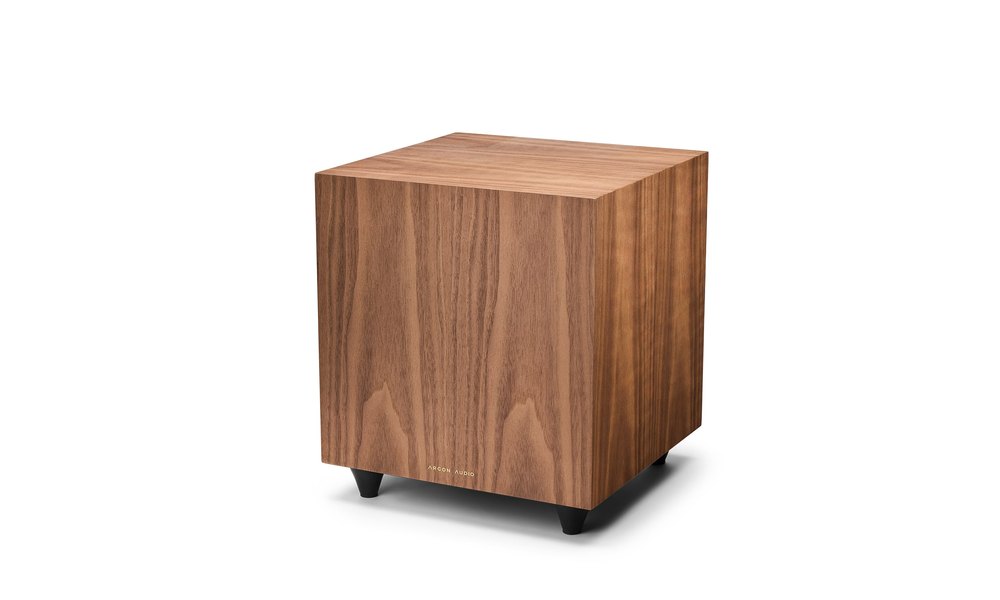
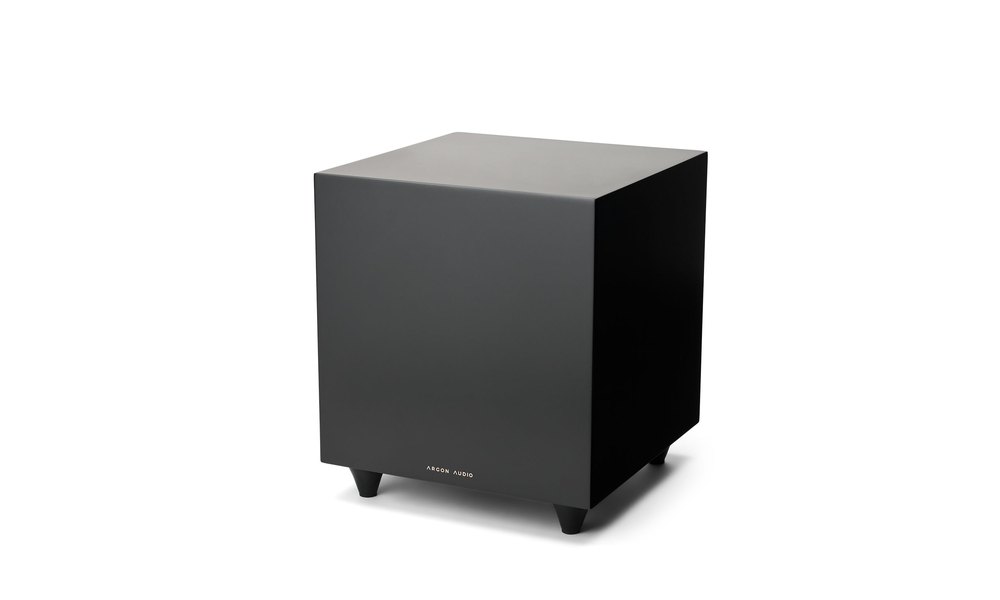
The Argon Audio Berlin Sub 10 is the smaller of the two Berlin subwoofers with which the Danish brand moved above its affordable Malmö range in late summer 2026. A 10-inch long-throw driver fires downwards from the sealed 34 × 30 × 30 cm cabinet, driven by 500 W RMS class D; Argon quotes 14 to 250 Hz (±6 dB). The DSP tailors the crossover to the type of main speakers via Speakermatch and keeps processing latency very short with Real Time Bass – crucial for dry, time-aligned bass in stereo systems. Argon quotes €899 (as of Oct. 2026, without guarantee).
Assumptions
- Price per subwoofer (piece) according to manufacturer or trade, Stand Oct. 2026, no guarantee
- Operation in addition to stereo main loudspeakers (2.1), low-pass and phase tuned at the listener's place
- Vinyl chain with Phono stage; Subsonic filter recommended
- No in-house measurements or listening tests
Specifications (manufacturer)
| Type | Active subwoofer · closed-back · down-firing |
|---|---|
| Woofer | 10-inch (approx. 25 cm) long-throw driver |
| Amplifier | 500 W RMS / 1,200 W tip · Class D |
| Frequency range | 14 – 250 Hz (±6 dB) |
| Low pass | 30 – 250 Hz |
| DSP | Speakermatch · Real Time Bass · distance 0–10 m · 3-band notch EQ · subsonic filter 10 Hz |
| Connections | RCA L/R and XLR inputs · RCA L/R output · USB-C (firmware) |
| Wireless | MATRIX Wireless receiver built in (transmitter optional, from 2027) |
| Dimensions / weight | 340 × 300 × 300 mm (H × B × T) · 13 kg |
| Finishes | Black matt, white matt, walnut veneer |
| Price guide | €899 (Argon Audio) · as of Oct. 2026 · without guarantee |
Manufacturer specifications (Argon Audio)
| Type | Active subwoofer · sealed · down-firing |
|---|---|
| Woofer | 10-inch (approx. 25 cm), long-throw driver |
| Amplifier | 500 W RMS / 1,200 W peak, class D |
| Frequency range | 14–250 Hz (±6 dB) |
| Low-pass filter | 30–250 Hz |
| DSP features | Speakermatch, Real Time Bass, distance 0–10 m, 3-band notch EQ, 10 Hz subsonic filter |
| Inputs | RCA L/R (left = LFE), XLR, USB-C (firmware) |
| Outputs | RCA L/R |
| Wireless | MATRIX Wireless receiver built in (transmitter optional, from 2027) |
| Cabinet | MDF, auto on/standby (< 0.5 W) |
| Dimensions (H × W × D) | 340 × 300 × 300 mm |
| Weight | 13 kg (gross 14.1 kg) |
| Finish | Black matt, white matt, walnut veneer |
Source: Argon Audio – official specifications · As of 30 October 2026 · subject to change by the manufacturer
Rating criteria in detail
The four criteria feed into the Vinyl BotPro Index with weights of 25/20/25/30. The index is scaled across all tiers (see Methodology); that is why we do not show individual sub-scores.
Strengths
- Very good integration with stereo speakers thanks to Speakermatch and low latency
- Dry, fast and finely resolved bass
- XLR input, distance correction and notch filters in this price class
- Compact cube with walnut veneer as a living-room friendly option
Weaknesses
- No app and no remote control – settings on the unit
- No high-level input
- Wireless transmitter only from 2027
- Down-firing needs a firm floor; a thick rug costs depth
Comparison models
| SVS SB-2000 Pro | Index 66, Rank 2, Sound champion — 12 inches · closed-back · 1,149 € |
|---|---|
| SVS SB-1000 Pro | Index 64, Rank 4, value for money champion — 12 inches · closed-back · 749 € |
| Nubert nuSub XW-1200 | Index 68, rank 1 — 12 duty · Downfire · 995 € |
| REL T/5x | Index 57, rank 5 — 8 duty · closed-back · Downfire · approx. €900 |
System matching
Works well with
- Stereo systems with bookshelf or compact floorstanding speakers
- Living rooms up to medium size
- Amplifiers with sub-out or pre-out and AV receivers
Less suited
- Integrated amplifiers without sub- or pre-out
- Who expects measurement via app
- Large home cinemas focused on maximum level below 20 Hz
Specs & Features
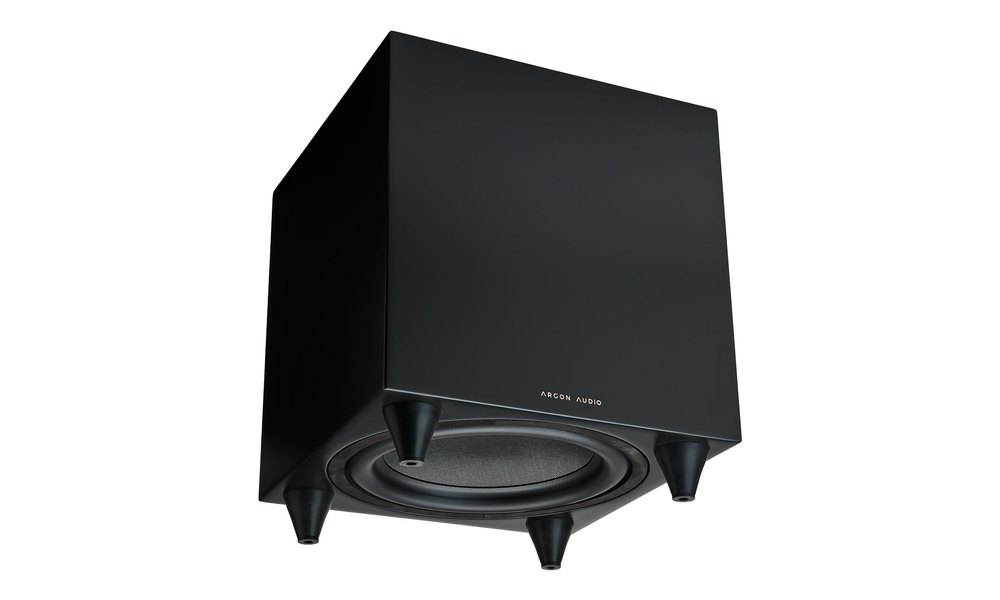
The Berlin Sub 10 relies on a sealed MDF cabinet with a downward-facing 10-inch long-throw driver. Sealed enclosures roll off more gently than bass reflex designs and therefore handle impulses more cleanly; the down-firing cone stays out of sight and couples evenly to the floor. Argon quotes 14 to 250 Hz at ±6 dB and a weight of 13 kg.
A class D amplifier by Pascal Audio delivers 500 W RMS and 1,200 W peak. The DSP offers a low-pass filter (30–250 Hz), phase, distance correction in metres, a 3-band notch filter against room modes and a switchable subsonic filter at 10 Hz. Speakermatch adapts the crossover filters to sealed, bass reflex or passive radiator speakers, and Real Time Bass minimises processing latency. It is operated via a push-and-turn knob with a display on the angled rear panel.
What international reviewers heard
International listening reviews of the Argon Audio Berlin Sub 10 are available from the international specialist press. Here we summarise the overall picture in our own words; all sources are linked at the end of the page.
Sound character
- The basic character is controlled, taut and free of any overemphasised frequency range. The bass blends in so unobtrusively that after a short while you forget a subwoofer is playing at all.
Tonal balance
- Tonally the emphasis is on clean, clearly outlined bass rather than massive cinema weight. Bass lines keep their contour, and deep piano notes or electronic bass layers stay separate instead of merging into a drone.
Dynamics, bass & staging
- The Berlin Sub 10 starts and stops quickly, and explosions and kick drums arrive with force and a clean decay. The larger 12-inch sibling delivers more pressure and depth in home cinema, while the Berlin Sub 10 feels more agile and precise.
Strengths
- Integration is seen as the greatest strength: Speakermatch smooths a peak of around 3 dB in the crossover region, and the short latency keeps the bass time-aligned with the main speakers. Add distance correction, notch filters, a reversible display and a walnut veneer that looks more upmarket than usual at this price.
Setup, room & partners
- Listening took place in stereo systems with compact speakers and in multichannel setups with an AV receiver, connected via RCA or XLR. The down-firing driver needs a firm floor: on a thick rug it loses noticeable impact, and there is no app for adjusting it from the listening seat.
Consensus & differences
- Both reviews agree on the control, speed and exceptionally good integration and recommend the Berlin Sub 10 above all for music. They differ in emphasis: one review places the Berlin subwoofers at the top of their segment overall, the other stresses more strongly that the larger model is the better choice for home cinema.
Research Consensus
Manufacturer data and international listening tests paint a consistent picture: a compact, sealed subwoofer whose strength lies less in maximum output than in timing, control and unobtrusive integration. The verdict of international reviews is assessed in detail in the section What the international specialist press hears.
For VinylCination, what matters is that the Berlin Sub 10 resolves bass cleanly without thickening the lower midrange, and that distance, phase and notch filters allow precise tuning to the room and main speakers. VinylCination sums this up as an AI assessment based on manufacturer data and published international listening tests.
For whom / Matching
Connection & Integration
At the sub or pre-out of an amplifier, via XLR on balanced preamplifiers or via the LFE input (left RCA) on an AV receiver. The phono stage from the Top list Phono preamps remains in the main branch.
Turntable & phono
Turntables from the Premium tier match on price. The subsonic filter keeps rumble from warped records away from the driver; even so, do not place the turntable on the same piece of furniture as the subwoofer.
Room & placement
Small to medium-sized rooms. Start between the speakers on a firm floor; then tune distance, phase and, if needed, the notch filter at the listening seat.
Budget & upgrade
At €899 the Berlin Sub 10 sits between the SVS SB-1000 Pro and the SVS SB-2000 Pro. SVS offers app control; the Argon offers more living-room appeal and the XLR input.
What makes this AI analysis special
This section is an AI summary of published reviews by international reviewers and the manufacturer data from Argon Audio. Vinyl BotPro puts the findings into context and links them with the data sheet and comparison models; VinylCination does not run its own listening tests or measurements, and all sources are linked at the end of the page. Prices and availability change (as of Oct. 2026, no guarantee); please check technical values against the current data sheet.
Vinyl BotPro Score Logic
The Vinyl BotPro Index runs from 0–100 across all tiers and weights build/technology, features, expected performance and value for money at 25/20/25/30. Premium typically sits at ~55–69. Argon Audio Berlin Sub 10 receives 65 (rank 3 Premium). Very good integration and plenty of features for the price; app convenience and a high-level input are missing. Rank is not Laboratory Evaluation — no Listening test. Details on weighting · Methodology.
Created by Vinyl BotPro (AI) · AI analysis · As of 30.10.2026 · Corrections: info@vinylcination.de · Prices without guarantee.
Manufacturer and concept
Argon Audio comes from Denmark and is based in Nørager, right next door to some of the country's best-known loudspeaker makers. The brand grew up with affordable turntables, active speakers and compact systems that for a long time were sold mainly through Scandinavian hi-fi specialist stores. Today Argon operates independently, ships directly from Denmark within the EU and is moving its range step by step into higher price classes.
The Berlin subwoofers are a good example. They arrived in late summer 2026 as two models: the Berlin Sub 10 with a 10-inch driver for €899 and the Berlin Sub 12 with a 12-inch driver for €1,099. Both sit above the affordable Malmö range and share the same amplifier, enclosure principle and control concept. The smaller Berlin Sub 10 was named EISA Best Buy Subwoofer 2026-2027 right at launch.
The idea behind both models is clearly defined: a subwoofer should not stand out as a separate bass source but should make the main speakers sound bigger, fuller and deeper. That is why Argon invests less in spectacular output figures and more in timing, filter tuning and integration. Two in-house technologies take centre stage: Speakermatch for a clean crossover and Real Time Bass for the shortest possible processing time.
Technology explained
Sealed enclosure with a down-firing driver
The Berlin Sub 10 is a simple MDF cube, 34 cm tall and 30 cm wide and deep, weighing 13 kg. The 10-inch long-throw driver sits in the base and fires downwards. This has two effects: visually the front stays calm with no visible cone, and acoustically the driver couples evenly to the floor and excites the wall behind it less than a front-firing bass reflex subwoofer. So that the cone can work freely, the cabinet stands on tall feet that are set inwards.
The enclosure is sealed. This principle rolls off more gently in the deep bass than a bass reflex enclosure, but it has better impulse behaviour and no port noise. For music it is usually the better choice, because bass lines stay drier and better defined. Argon quotes a frequency range of 14 to 250 Hz at ±6 dB.
Amplifier and DSP
Power comes from a class D amplifier by the Danish specialist Pascal Audio, rated at 500 W continuous and 1,200 W peak. A signal processor controls the low-pass filter (30 to 250 Hz), phase, level and a distance correction set in metres from 0 to 10 m. Three notch filter bands are available to tackle room modes, and a switchable 10 Hz subsonic filter relieves the amplifier and driver of inaudible signals.
Speakermatch asks what type of main speakers you have: sealed, bass reflex or with a passive radiator. Ready-made profiles exist for some Argon and Radiant Acoustics models. The subwoofer then adapts its filters so that its response and the natural bass roll-off of the speakers complement each other cleanly in the crossover region instead of adding up to a peak. Real Time Bass targets the time axis: because the DSP works with very low latency, the bass does not arrive audibly late.
Sound: what the reviews show
The published listening tests paint a consistent picture. The Berlin Sub 10 is not a subwoofer that wants to impress with maximum force. Its strength lies in control, speed and integration. Bass starts quickly, stops cleanly and connects so seamlessly with the main speakers that the subwoofer disappears as a separate sound source.
In home cinema the small cube delivers enough punch for explosions and effects, but puts the emphasis on clearly outlined bass rather than massive rumble. If you mainly watch films with lots of deep bass, the Berlin Sub 12 offers more pressure and depth. With music the Berlin Sub 10 plays to its full strengths: bass lines keep their contour, deep piano notes and electronic layers stay separate, and percussion decays naturally instead of stopping abruptly.
The detailed summary of the listening findings, including agreement and differences between the reviewers, is in the section on the international reviews further up; all sources are linked at the end of the page.
Features and everyday use
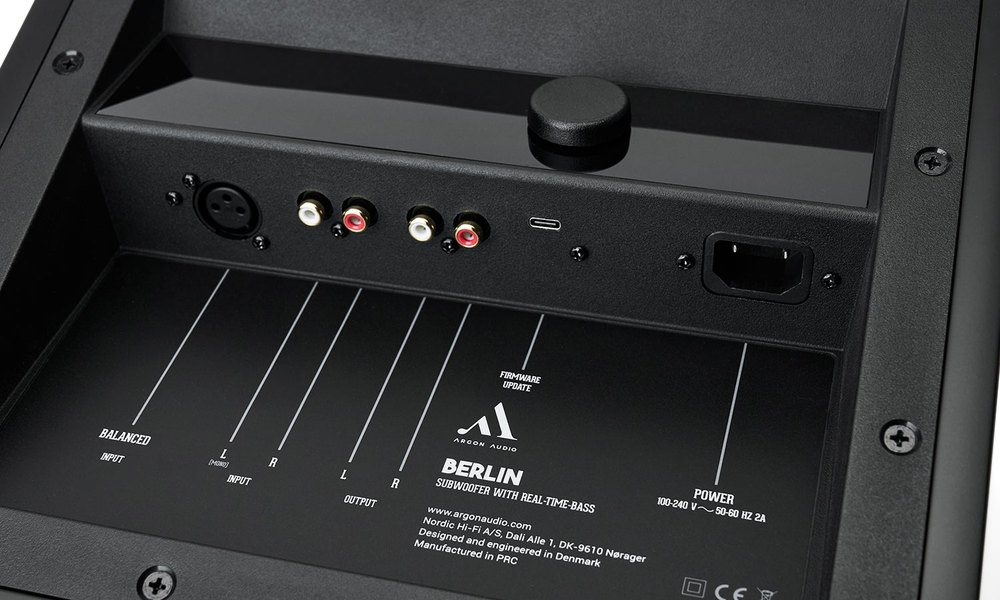
All connections and controls sit in an angled recess on the back. This lets you place the subwoofer close to the wall without kinking the cables. You connect it via an XLR input or a pair of RCA sockets; the left RCA input also serves as the LFE input for AV receivers. An RCA output passes the signal on to a second subwoofer. Firmware updates are loaded via USB-C.
Settings are made with a large push-and-turn knob and a display whose read-out can be flipped. If you look down over the cube from above, the menus then read the right way up. There is no app or remote control; all adjustments are made on the unit itself. A receiver for the MATRIX Wireless standard is already built in, and the matching transmitter is due in 2027.
The Berlin Sub 10 comes in black and white matt lacquer and in walnut veneer. The lightly textured veneer looks particularly premium and turns the subwoofer into a piece of furniture that fits well into a living room.
Tips for vinyl listeners
In a turntable system the subwoofer connects to the sub or pre-out of the amplifier, while the phono stage stays in the main signal path. Activating the subsonic filter is worthwhile with warped records, because it keeps rumble below the threshold of hearing away from the driver. It is also important not to place the turntable on the same piece of furniture as the subwoofer, so that no vibrations reach the cartridge.
A calm approach works best for tuning: first choose the speaker type in Speakermatch, then set the crossover frequency and distance and finally check the phase at the listening seat. If a single frequency still booms, one of the notch filters will help.
Who it suits
The Berlin Sub 10 suits listeners who want to add a clean bass foundation to their bookshelf or compact floorstanding speakers without the subwoofer changing the character of the system. It is ideal for small to medium living rooms, for music of every kind and for home cinemas with mixed use. Anyone with an amplifier that has a sub-out or pre-out gets a lot of fine-tuning for a fair price here.
If, on the other hand, you mainly watch action films at maximum level below 20 Hz in a large room, the Berlin Sub 12 or a larger bass reflex subwoofer is the better pick. And if you expect smartphone room calibration, SVS or Nubert will suit you.
Comparison with alternatives
Within the Premium tier the Berlin Sub 10 sits between two well-known SVS models. The SVS SB-1000 Pro costs less, has a front-firing 12-inch driver and an app with a parametric equaliser. The SVS SB-2000 Pro offers more power and depth for larger rooms. The Argon counters with an XLR input, distance correction, Speakermatch and its living-room friendly looks.
The Nubert nuSub XW-1200 is also a down-firing subwoofer and comes with room calibration. The REL T/5x and REL T/7x are the choice for anyone who wants to connect the subwoofer via a high-level input directly to the speaker terminals of an amplifier without a sub-out.
More questions about the Argon Audio Berlin Sub 10
Can I connect the Berlin Sub 10 to an integrated amplifier without a subwoofer output?
Only via a pre-out. The Berlin Sub 10 has no high-level input for speaker cables. Without a sub-out or pre-out, a subwoofer with a high-level input is the simpler solution.
Berlin Sub 10 or Berlin Sub 12?
For music in small and medium rooms the Berlin Sub 10 is the more agile and precise choice. For larger rooms and home cinema with lots of deep bass, the Berlin Sub 12 offers more pressure and depth with the same features.
Is a second Berlin Sub 10 worthwhile?
Yes, two subwoofers usually smooth out room modes much better than one. The line output allows daisy-chaining, and the distance correction lets you align both units to the listening seat.
Conclusion
The Argon Audio Berlin Sub 10 is a compact, sealed subwoofer that impresses above all through integration. 500 W, a long-throw driver, XLR input, distance correction, notch filters, Speakermatch and Real Time Bass add up to a package for €899 that is rarely this well thought out in its price class. The international listening tests confirm the concept, and the EISA award underlines the value for money. For vinyl and music listeners with compact speakers it is one of the most exciting subwoofers in its class.
Sources
- Argon Audio — Berlin Sub 10 (manufacturer page, technical data and price)
- Argon Audio — Berlin Sub 12 (sister model)
- EISA Hi-Fi Awards 2026-2027 (Best Buy Subwoofer: Argon Audio Berlin Sub 10)
- FWD (Netherlands/Belgium) — Review: Argon Audio Berlin 10 – Subwoofer met subtiliteit (9.0/10) (03.10.2026)
- Hifi.nl (Netherlands) — Review: Argon Audio Berlin Sub 10 en Sub 12 basluidsprekers (4/5) (26.10.2026)
Read more: best active subwoofers 2026 · Improve your hi-fi system · What is hi-fi?