
Cartridge · AI analysis · Master, rank 14
Audio-Technica AT-ART9XI: Analysis
AI analysis (research): low-output MC with magnetic-core coils, a nude Special Line Contact diamond and a solid boron cantilever; based on Audio-Technica and Secrets of Home Theater and High Fidelity.
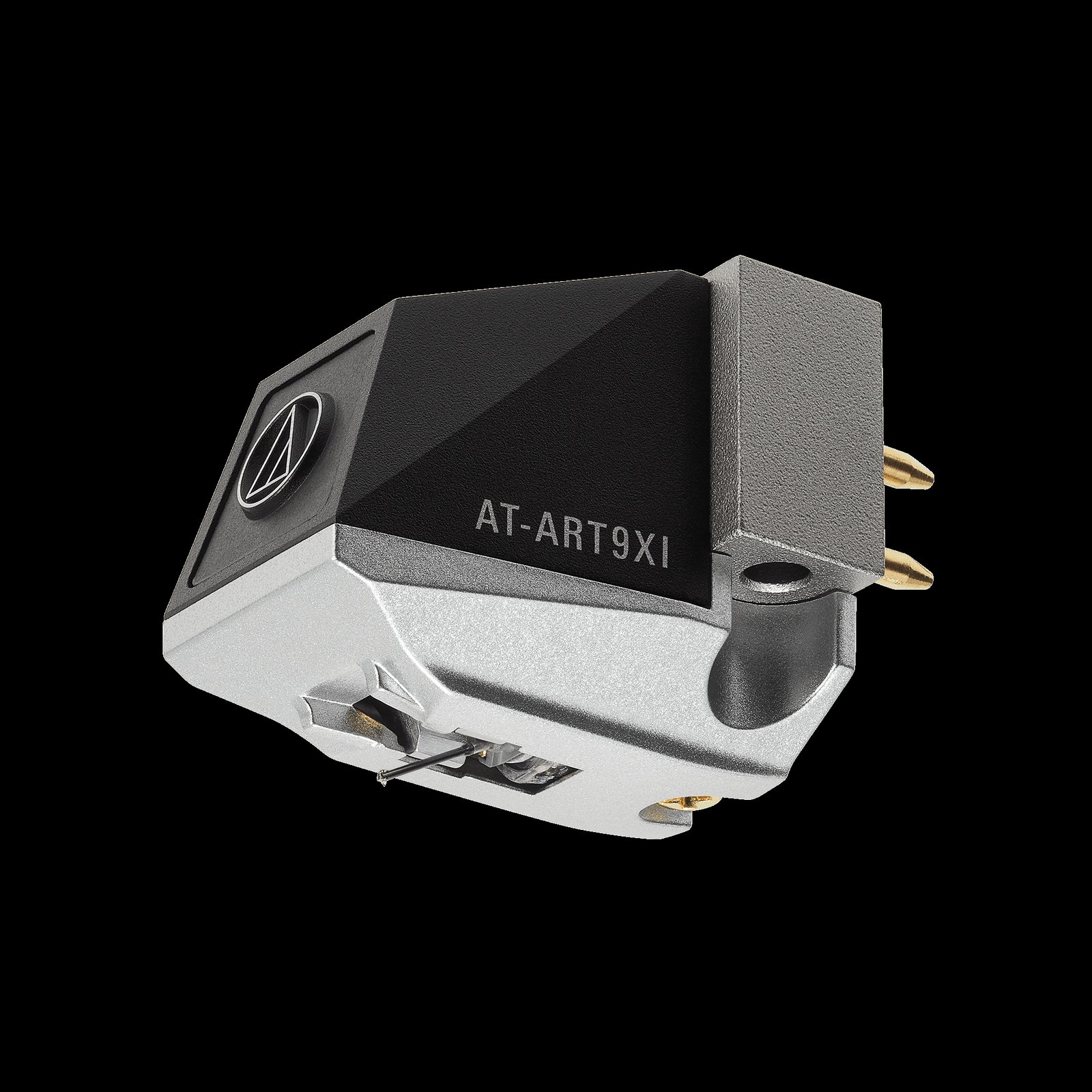
Summary
The AT-ART9XI (RRP 1,549 €) is a low-output MC with magnetic-core coils, a nude Special Line Contact diamond and a 0.28 mm boron cantilever. Audio-Technica quotes 0.5 mV, 12 Ω and a tracking force of 1.8 g. The review by Secrets of Home Theater and High Fidelity praises its dynamics, realism and imaging.
Specs (public / manufacturer)
| Type / Stylus | low-output MC with magnetic core · special line contact, nude · Boron 0.28 mm |
|---|---|
| Output | 0.5 mV (1 kHz, 5 cm/s) |
| Impedance / load | 12 Ω (1 kHz) / min. 100 Ω |
| Compliance | static 25 × 10⁻⁶ cm/dyn · dynamic 15 × 10⁻⁶ cm/dyn (100 Hz) |
| Tracking force | 1.6–2.0 g (1.8 g standard) |
| Frequency response / channel separation | 20–50,000 Hz / 30 dB (1 kHz) |
| Weight | 8.5 g |
| Price guide | MSRP €1,549 · Sept 2026 |
Manufacturer specifications (Audio-Technica)
| Type | moving coil (low output) |
|---|---|
| Output voltage | 0.5 mV (1 kHz, 5 cm/s) |
| Frequency response | 20–50,000 Hz |
| Channel separation | 30 dB (1 kHz) |
| Channel balance | 0.5 dB (1 kHz) |
| Tracking force | 1.6–2.0 g (1.8 g standard) |
| Stylus | special line contact, nude |
| Cantilever | 0.28 mm solid boron |
| Compliance | static 25 × 10⁻⁶ cm/dyne · dynamic 15 × 10⁻⁶ cm/dyne (100 Hz) |
| Recommended load | min. 100 Ω (with head amplifier) |
| Coil impedance / DC resistance / inductance | 12 Ω (1 kHz) / 12 Ω / 25 µH (1 kHz) |
| Cartridge weight | 8.5 g |
Source: Audio-Technica – official specifications · As of 16 October 2026 · subject to change by the manufacturer
Matching tips
- Fits: MC phono stages with around 60 dB of gain and a load from 100 Ω
- Good fit: Medium-mass tonearms
- Fits: High-resolution systems
- Less suited: Pure MM inputs without a step-up transformer
- Less suited: Very light tonearms designed for high-compliance cartridges
Technology in detail
Audio-Technica introduced the AT-ART9XI in 2021 together with the AT-ART9XA; both replaced the AT-ART9 and the AT-ART7. The XI is the magnetic-core version: the coils are wound on a magnetic core, which raises the output to 0.5 mV, while the coreless XA delivers only 0.2 mV.
The nude diamond with a Special Line Contact profile sits on a solid boron cantilever 0.28 mm in diameter. The machined aluminium base carries both the magnetic circuit and the moving system; the housing combines aluminium with high-rigidity plastic to reduce resonances. Threaded mounting holes make installation easier.
According to Audio-Technica, the coil impedance is 12 Ω, and a load of at least 100 Ω is recommended. The frequency response extends from 20 Hz to 50 kHz, and channel separation is 30 dB. Compliance is medium at 25 static and 15 × 10⁻⁶ cm/dyne dynamic; tracking force is between 1.6 and 2.0 g, 1.8 g as standard. The cartridge weighs 8.5 g.
What the specialist press says
Secrets of Home Theater and High Fidelity: The review (May 2021) praises the AT-ART9XI for excellent macro- and microdynamics, plenty of air in the treble, great realism and a precise, deep soundstage. Of the two new models the XI sounded the most balanced, and thanks to its higher output it works with more phono stages; around 60 dB of gain is recommended.
Analysis: Audio-Technica AT-ART9XI in detail
Scope and sources
This analysis adds manufacturer data and one dated, independent listening report to the short overview above for the Audio-Technica AT-ART9XI. Vinyl BotPro compiled it from the sources named here; VinylCination has not listened to this cartridge and has not measured it. The basis is Audio-Technica’s official European product page (retrieved 12 November 2026) [1] and Chris Groppi’s listening report on HomeTheaterHifi / Secrets of Home Theater and High Fidelity, dated 24 May 2021 [2].
Secrets meets the test of an international, independent listening report. The article is a paired review of the AT-ART9XA and the AT-ART9XI. For this analysis only the listening passages that Groppi expressly assigns to the XI count, plus the shared test chain so far as it applies to the XI. Characterisations of the XA — in particular smoothness and delicacy — are not carried over to the XI. Carlo Lo Raso’s bench measurements on a Technics testbed are measurements, not a second listening report, and they were not taken on Groppi’s listening LP12. Forums are left aside.
Place in the range
The AT-ART9XI is Audio-Technica’s magnetic-core low-output MC in the ART9 succession, not the limited ART1000 and not the air-core ART9XA. The product page presents it as the flagship of the magnetic-core line, with a nude Special Line Contact diamond on a solid 0.28 mm boron cantilever. In our list it is the Value-for-Money champion in the Master band (index 85, rank 14). That champion label is an AI assessment from the sources in front of us, not a listening session of our own.
Groppi, in 2021, hears both new cartridges as replacements for the ART9 and ART7; apart from the ART1000 they sit at the top of A-T’s MC line. The US price at the time was $1,290. The European page quotes an MSRP of €1,549 and, on 12 November 2026, listed the cartridge as out of stock. Those are two price and availability snapshots, not two products.
Construction and manufacturer data
The European product page quotes 0.5 mV output, dual PCOCC coils in an inverted-V arrangement, a neodymium magnet with a permendur yoke, a hybrid aluminium and plastic body, M2.6 threaded holes, a 20 Hz to 50 kHz frequency range, 30 dB channel separation, a tracking force of 1.6 to 2.0 g (1.8 g standard), a minimum load of 100 Ω, a 12 Ω coil resistance and 25 µH inductance, static compliance of 25 × 10−6 cm/dyne, dynamic compliance of 15 × 10−6 cm/dyne, a weight of 8.5 g and dimensions of 17.3 × 16.8 × 25.0 mm [1]. These are manufacturer figures. The existing table on this page is left unchanged.
The specification table in the Secrets report lists different compliance and inductance figures (among them 20 × 10−6 static and 2.5 µH). We record the discrepancy, follow the European product page in the body and do not change the live table. Whether Secrets here mixed the XI, the XA or an older figure is not something we have reconciled against a data sheet of our own. The stylus shape in our write-up remains the Special Line Contact of the official XI page; we do not silently carry a Shibata figure over from the paired report.
What the specialist press heard
Groppi listened to the XI on a Linn LP12 with a Valhalla power supply, a Jelco TK-850s MKII tonearm and a Rogue RP-1 phono stage, at 58 dB of gain, a 1 kΩ load and 1.8 g tracking force. The outgoing cartridge was an older Grado Reference Platinum MM; both new A-T MCs, for him, stomped all over it in every respect, as he hoped they would given the price difference. He starts expressly with the AT-ART9XI [2].
The XI was the most well-rounded of the two cartridges, with excellent macro and micro dynamics. It is the microdynamic performance of a good turntable system, he thinks, that contributes most to that feeling of aliveness, and the XI has that in spades. On Mark Lanegan’s “Whiskey for the Holy Ghost”, the richness and texture of Lanegan’s baritone sent the proverbial chills up his spine on first listen, and that continued every time he spun the record. The drive and energy of Calexico’s “Feast of Wire”, particularly his favourite track “Güero Canelo”, made him want to listen to the record over and over again. He has the same album in digital; it is good, but he had no desire to listen to it multiple times in a row in that format the way he did with the LP. Because of the dynamic performance, voices and instruments sounded alive; natural timbre, top-end air and a deep, punched bass belong to this picture, and the imaging was wide, less pinpoint than digital, with good depth [2].
As a shared downside of both cartridges the report names somewhat weaker detail extraction. In the measurements section Carlo Lo Raso, using a modified Technics SL-1200 Mk6 and a CBS STR 100 test LP, finds that the crosstalk of both cartridges missed the manufacturer’s specification; that could contribute to some limits on detail extraction, and some of the limit could also come from elsewhere. That is a bench measurement on a different deck from the listening LP12, not a second listening seat and not a claim that Groppi heard the same curve on the Linn. We keep the listening finding (well-rounded, dynamic, alive, convincing on Lanegan and Calexico, not at the top in last-level detail) separate from the measurement (crosstalk below spec on the Technics testbed) [2].
Traits the report assigns to the XA — for example a particular smoothness or delicacy — stay outside this analysis. Anyone buying the XI is buying the magnetic-core cartridge that Groppi heard as the more well-rounded of the two, not the air-core sister model.
Arm, loading and system
Groppi ran the XI at 1 kΩ, well above the 100 Ω minimum, at 1.8 g and 58 dB on the Rogue RP-1. A typical MM input is not enough for 0.5 mV; the cartridge needs an MC-capable stage with enough gain and a quiet floor. A Jelco arm on an LP12 is a fully grown, not entirely trivial combination; M2.6 threaded holes make mounting easier, but they do not replace tracking-force and anti-skate checks. 8.5 g sits in a mid-weight range; the compliance figures on the product page should be matched to the arm’s effective mass. We have not set that up ourselves.
The comparison with the Grado Reference Platinum mainly shows the gap in price and in cartridge type, not a present-day field of Master-band rivals. Anyone who wants the XI held against other low-output MCs in the same price region will not find that comparison in this report — only XI versus XA and versus the older Grado, and only the XI side enters our sound claims.
Price and availability
The existing page note quotes an MSRP of €1,549. The European product page listed the cartridge as out of stock on 12 November 2026; Groppi quoted $1,290 in 2021. Availability and exchange rates shift the street price, not the SKU. In our list the AT-ART9XI is the Master Value-for-Money champion. That follows from the sources and from the one secured international listening text, not from a group comparison we have not heard ourselves. The existing comparison table on this page places other cartridges alongside it; those are overview rows, not extra listening sources.
The ART9, ART9XA and ART1000 are different cartridges. A used ART9 is not an ART9XI, even if the name stem sounds the same.
Groppi’s chain deserves a note of its own, because it carries the listening finding. An LP12 with Valhalla, a Jelco TK-850s MKII and a Rogue RP-1 at 58 dB and 1 kΩ are not a typical MM socket on an integrated amplifier. The aliveness and the microdynamics he grants the XI were heard on exactly this chain, at 1.8 g, with a cartridge that delivers 0.5 mV. Anyone who hears the XI on a barely adequate MC stage, or in a much heavier or lighter arm, is not automatically hearing the same baritone chill on Lanegan. Conversely, the 1 kΩ load is a deliberately chosen point above the 100 Ω minimum, not proof that every higher load sounds the same.
The digital counter-check on Calexico’s “Feast of Wire” is, in the report, a personal reaction, not a formal digital-versus-analogue measurement. Groppi wanted to hear the LP again and again, and did not want to do the same with the digital copy. That supports his impression of the XI’s drive and energy on this record; it does not prove that every digital edition of the same album lags behind every XI chain. Likewise, the Grado comparison is a downward gap, not a yardstick for the Master band.
The missed crosstalk figures on the Technics testbed belong in an open decision, not in the listening sentence. Lo Raso measures on a different deck, with a test LP, not with Lanegan or Calexico. Whether the somewhat weaker detail extraction Groppi assigns to both cartridges comes from exactly that crosstalk is a point the report itself leaves open. We repeat the measurement as a measurement and the listening reservation as a listening reservation, and we do not collapse the two into a single defect.
A word on European availability: an MSRP of €1,549 with no stock on hand means the champion place on the list describes a known, but not necessarily immediately obtainable, item. Anyone reading the Value-for-Money rank should check the European page’s stock line before treating the MSRP as a current street price.
What we are not using
Listening passages about the ART9XA, the older ART9, the ART7 or the ART1000 are not a listening report on the ART9XI. Lo Raso’s bench measurements on the Technics testbed do not replace a second listening text and are not read as a listening finding from the LP12. Forums and shop copy are left aside. German texts on their own would not meet the rule; they are not used here as a second pillar. Divergent compliance and inductance figures in the paired report are flagged, not written into the live table. There is no in-house track list and no measurement.
Conclusion of this analysis
The sources portray the Audio-Technica AT-ART9XI as a magnetic-core low-output MC with a nude Special Line Contact diamond on 0.28 mm boron, 0.5 mV, 12 Ω, a standard tracking force of 1.8 g and a minimum load of 100 Ω — according to the European product page and the existing table [1]. Secrets of Home Theater and High Fidelity (Chris Groppi, 24 May 2021) describes, on an LP12 Valhalla with a Jelco TK-850s MKII and a Rogue RP-1 (58 dB, 1 kΩ, 1.8 g), the XI as the more well-rounded of the two new ART9 cartridges, with strong macro and micro dynamics and a sense of aliveness, heard among other records on Mark Lanegan and Calexico; somewhat weaker detail extraction remains as a shared limit, while missed crosstalk figures are assigned to a bench measurement on a different deck [2]. In our list the cartridge is the Master Value-for-Money champion — an AI assessment from the sources in front of us, not a listening report of our own.
Sources for this analysis
- Audio-Technica: AT-ART9XI, European product page (retrieved 12 November 2026). https://www.audio-technica.com/en-eu/at-art9xi
- HomeTheaterHifi / Secrets: Chris Groppi – Audio-Technica AT-ART9XA and AT-ART9XI Moving Coil Phono Cartridges Review (24 May 2021); bench measurements: Carlo Lo Raso. https://hometheaterhifi.com/reviews/vinyl/turntable-accessories/audio-technica-at-art9xa-and-at-art9xi-moving-coil-phono-cartridges-review/
Created by AI (Vinyl BotPro) from the sources named; no in-house listening tests or measurements. Detailed human fact-checking pending.
Who is it for?
For vinyl listeners looking for a high-end low-output MC with a line-contact profile who own a good MC phono stage with around 60 dB of gain.
What makes this AI analysis special
This AI analysis combines Audio-Technica’s specifications with the review by Secrets of Home Theater and High Fidelity. All technical values are manufacturer figures. As of October 2026.
How the score comes about
The Index reflects the magnetic-core MC design with a line-contact diamond on boron, the detailed manufacturer data and the very good review; on value it leads its tier. The Vinyl BotPro Index on this page remains 85 (Master, rank 14) — guidance from manufacturer data and the specialist press, no in-house listening session. The four criteria engineering/build, features, expected performance and value for money are weighted 25/20/25/30 and scaled across all tiers. Methodology
Sources
- Audio-Technica, AT-ART9XI product page with specifications
- Secrets of Home Theater and High Fidelity, AT-ART9XA and AT-ART9XI Review
Vinyl BotPro Index: 85 (Master 85–97) · Label: AI research · Sept 2026
Read more: best cartridges 2026 · Stylus shapes explained · What is hi-fi?