
Cartridge · AI analysis · Premium, rank 2
Audio-Technica AT-VM740ML: Analysis
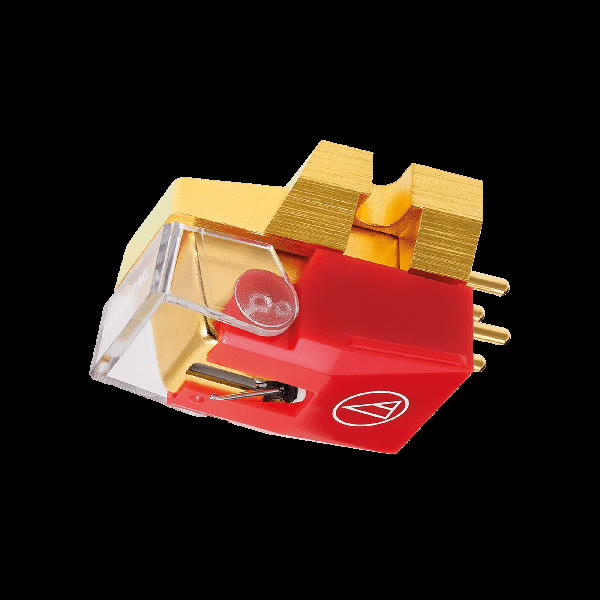
AI analysis (research): dual-magnet MM with nude MicroLine, para-toroid generator and die-cast aluminium body — manufacturer specifications, no listening test.
Summary
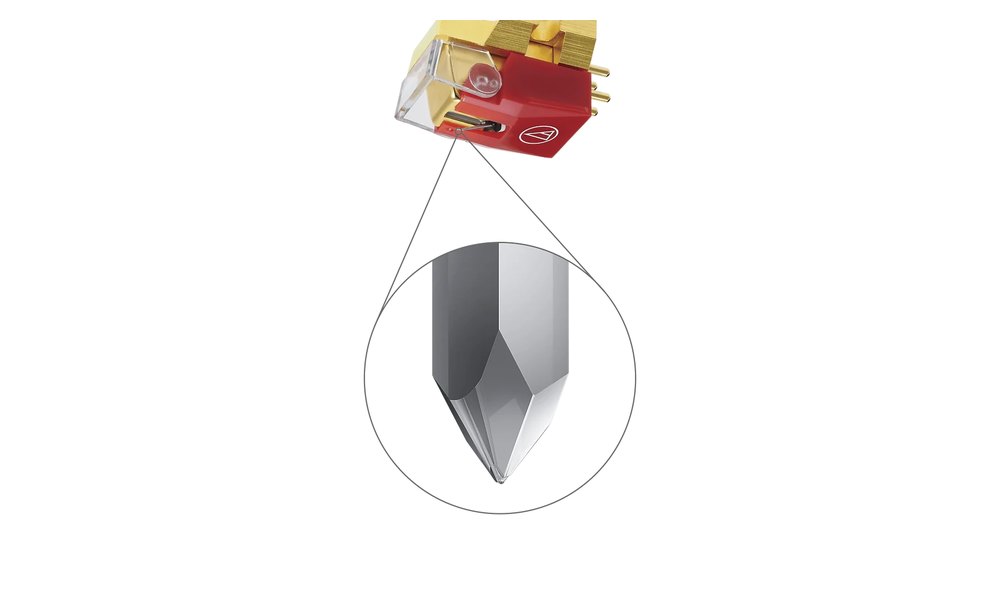
The VM740ML combines an Audio-Technica MicroLine stylus, a hardened aluminium cantilever and a die-cast body (8.0 g). Output 4.0 mV, dyn. Compliance 10 @100 Hz, load 100–200 pF. Expect more inner-groove reserve and separation than an elliptical Premium MM, but alignment and capacitance become more critical. The successor AT-VM740xML exists (different specifications and price); this page covers the classic VM740ML line.
Assumptions
- MM-Phono 47 kΩ · 100–200 pF (less than Ortofon window)
- Medium arm; @100 Hz compliance not 1:1 with Ortofon-µm/mN
- No measurements of our own
Specs (public / manufacturer)
| Type / Stylus | VM Dual-MM · Nude MicroLine 0.12×2.2 mil |
|---|---|
| Output | 4.0 mV (1 kHz, 5 cm/s) |
| Compliance | static 40 · dyn. 10×10⁻⁶ cm/dyn @100 Hz |
| VTF | 1.8–2.2 g · recommended 2.0 g |
| Load | 47 kΩ · 100–200 pF |
| Weight | 8.0 g |
| Replacement stylus | VMN40ML |
| Price guide | market price approx. €280–340 (without guarantee) · Sept 2026 — check the price date |
Manufacturer specifications (Audio-Technica)
| Type | dual moving magnet (VM700 series), die-cast aluminium body |
|---|---|
| Output voltage | 4.0 mV (1 kHz, 5 cm/s) |
| Frequency response | 20–27,000 Hz |
| Channel separation | 28 dB (1 kHz) |
| Channel balance | 1.0 dB (1 kHz) |
| Tracking force | 1.8–2.2 g (2.0 g standard) |
| Stylus | MicroLinear 0.12 × 2.2 mil, square shank, nude |
| Cantilever | aluminium tapered pipe |
| Compliance | static 40 × 10⁻⁶ cm/dyne · dynamic 10 × 10⁻⁶ cm/dyne (100 Hz) |
| Recommended load | 47 kΩ |
| Capacitance | 100–200 pF |
| Coil impedance | 2.7 kΩ (1 kHz) |
| Cartridge weight | 8.0 g |
Source: Audio-Technica – official specifications · As of 16 October 2026 · subject to change by the manufacturer
Scores in detail
Vinyl BotPro Index: 68 · Index band Premium 55–69 · Guidance only, not a lab value.
Strengths
- MicroLine profiles according to manufacturer
- Stiffer enclosure as VM95 plastic
- 4.0 mV — MM-friendly
- Replacement stylus clearly named
Weaknesses
- Narrower capacitance window
- 8 g — check counterweight
- xML-successor confused purchase decision
- An AI analysis is not an audition
Comparison models
| AT-VM95ML | Same profile idea, light/low-cost body — value for money champion |
|---|---|
| 2M Bronze | Fine Line instead of MicroLine, other generator concept |
| AT-VM740xML | Newer VMx line — Check specs/price separately |
System matching
Works well with
- Adjustable premium arms
- Phono with 100–200 pF window
- If you want MicroLine without Expert-MC
Less suited
- First stylus without scale/stencil
- Very high-capacitance setups
Technology in detail
According to the manufacturer (audio-technica.com), the Audio-Technica AT-VM740ML is the MicroLine model of the VM700 series: a dual moving magnet (VM) with a nude MicroLine 0.12×2.2 mil (nude square shank) on a tapered aluminium tube cantilever, a para-toroidal generator with PCOCC lead wires and a die-cast aluminium housing. Public key figures: frequency response 20–27,000 Hz, channel separation 28 dB (1 kHz), output 4.0 mV (1 kHz, 5 cm/s), VTF 1.8–2.2 g (standard 2.0 g), vertical tracking angle 23°, nude square-shank stylus construction, load impedance 47 kΩ, coil impedance 2,700 Ω (1 kHz), static compliance 40×10⁻⁶ cm/dyn, dynamic 10×10⁻⁶ cm/dyn @100 Hz, weight 8.0 g, recommended load capacitance 100–200 pF, replacement stylus VMN40ML, dimensions approx. 17.3×17.0×28.2 mm. Mounting with ½″ screws; accessories typically include 5/10 mm screws, washers, nuts, a non-magnetic screwdriver, a brush and a lead-wire set.
Features: MicroLine plus a stiffer enclosure and a para-toroid generator instead of the VM95’s polymer body — less stylus-family breadth than the VM95 (C→SH), but a clear step in generator and body. market price typically approx. €280–340 (as of Sept. 2026). The successor AT-VM740xML exists with its own specifications and pricing; VinylCination lists the classic VM740ML here. Price the xML specifications and market price separately. In the Premium field this is the sound-champion lever against the 2M Bronze (Fine Line, different generator), the VM95ML (same profile idea, lighter and cheaper body) and the 2M Blue/MP-150 (nude elliptical).
Critical for matching: 8.0 g requires sufficient counterweight; the 100–200 pF window is narrower than Ortofon’s 150–300 pF; dyn. Compliance at 100 Hz is not directly 1:1 comparable to Ortofon’s µm/mN figures. If you want MicroLine without an Expert MC and have an adjustable Premium arm, this is the specification focus of the tier.
What the specialist press says
Hi-Fi World (Noel Keywood, AT700 series, among others via World Radio History and Peak Hi-Fi scans) compares and evaluates the VM740ML, VM750SH and VM760SLC: very low distortion, strong tracking and a clear, detailed presentation; the 740ML appears there as the value sweet spot of the series with only slightly softer contours than the more expensive versions – magazine measurement and verdict, not a VinylCination lab. What Hi-Fi? tested the successor AT-VM740xML as a balanced, uncomplicated all-rounder for decks under £1000, with a stable stereo image and a usable stylus upgrade path; this is related series context, not identical to the classic VM740ML, but it supports the pattern of "MicroLine MM without drama".
On the manufacturer's side, Audio-Technica emphasises interior groove reserve, high separation and the die-cast housing against housing resonances. Retailer and forum consensus repeats: MicroLine rewards clean alignment and tight capacitance window; 8 g Check Counterweight; Capacitance narrower than Ortofon. Against the 2M Bronze, reviews often trade AT’s MicroLine and die-cast body for Ortofon’s Fine Line neutrality and a wider pF window; against the VM95ML, it is the same profile demand with a clearly more expensive body and para-toroid generator. Against the 2M Blue and MP-150, it is line contact versus nude elliptical — different physics, different alignment demands. VinylCination compiles only as AI summary of the specialist press: no track list, no measurements of our own, no partnership claim.
In short: if you are looking for the expected sound and resolution focus with MicroLine and a stiffer body → AT-VM740ML (Sound Vinyl BotPro Champion of this tier, research sub-score). If you want Fine Line overall winner index → 2M Bronze. If you want MicroLine for the VM95 prize → VM95ML. If you are looking for nude elliptical Ortofon cheaper → 2M Blue. If you want warm tonal balance-MP → MP-150. Index interval to Expert-MC remains deliberately.
Who is it for?
Compliance / tonearm
Dyn. A compliance of 10×10⁻⁶ cm/dyn at 100 Hz is aimed at medium-heavy modern arms: many Pro-Ject Debut PRO/X1/X2 arms, mid-range Rega Planar models (mind the spacer), the Dual CS 618Q class and the Technics SL-1500C with a matching headshell. Avoid very light vintage arms and extremely high mass without a resonance check. At 8.0 g it is noticeably heavier than the VM95 (6.1 g) and Ortofon 2M (7.2 g) — check counterweight and arm balance before purchase. MicroLine is more adjustment-critical than bonded or nude elliptical: overhang, azimuth and anti-skating seriously set. VTA: arm parallel to the record; the die-cast body changes the height compared with stock styli.
VTF
Recommended 2.0 g in window 1.8–2.2 g. Digital stylus force gauge before anti-skating; check again after playing. MicroLine forgives gross VTF errors less than elliptical entry styli. If you start without a scale, you risk exactly the specification advantage the 740ML is meant to offer in Premium.
Phono loading
47 kΩ and 100–200 pF including cable — narrower than Ortofon’s 150–300 pF. A long or highly capacitive RCA run combined with capacitive phono loading can shift the balance; if the treble sounds dull or sharp, check capacitance first. 4.0 mV is undemanding for MM inputs; gain reserve check if the tier is very "hot" on 5-mV systems. Guidance without listening claim: Fono MM MK5, Phono Box S3 B, Alva Solo, Mani 2 — capacitance and gain as per the datasheet.
Budget / upgrade
Market price ~280–340 €: compare directly with the VM95ML (MicroLine, cheaper, polymer body) and the 2M Bronze (Fine Line, different ecosystem). Replacement stylus: VMN40ML. Treat the xML successor and its stylus path separately. If you already have a VM95 body, you can first price only the ML stylus before the 740ML body comes into consideration. Stabilise the turntable and alignment first — no MicroLine will cure resonance.
Analysis: Audio-Technica AT-VM740ML in detail
How the cited material is used
This analysis adds manufacturer data and dated independent listening reports on the Audio-Technica AT-VM740ML to the overview above. Vinyl BotPro compiled it from the sources named below; VinylCination has not carried out its own listening session or measurement of this cartridge. The basis is Audio-Technica’s UK product page (retrieved 12 November 2026) [1], Noel Keywood’s comparison in Hi-Fi World (December 2017, via World Radio History) [2] and Ludwik Igielski’s listening report in the Polish magazine Audio-Video (2 January 2019) [3]. The What Hi-Fi? link already in the page footer is for the successor AT-VM740xML and does not count as a listening test of the VM740ML [4]. LowBeats (Holger Biermann, 30 July 2017) is a German listening report; it does not by itself satisfy the international rule and is mentioned only as extra context [5].
Hi-Fi World and Audio-Video meet the requirement of an international independent listening test: they name a date or issue, an author and the VM740ML. Keywood heard and measured the 700-series stylus assemblies after Audio-Technica sent a VM750SH plus replacement styli (a downgrade to the VM740ML and an upgrade to the VM760SLC) — the same body, three profiles [2]. That is a listening test of the VM740ML configuration, not a report on the later xML successor.
Background and place in the range
According to the manufacturer, the VM740ML is the entry model of the 700 VM series: a dual moving magnet with a nude MicroLine stylus in a die-cast aluminium body [1]. The 700 bodies are the stiffest, metal stage of the VM families; the 500 series uses polymer bodies with a similar generator principle [1][3]. Igielski traces the V-magnet arrangement back to the AT35X (1967) and the para-toroidal coil set that is meant to keep magnetic leakage low [3]. Above the 740ML in the 700 line sit the VM750SH (Shibata) and the VM760SLC (Special Line Contact) — a stylus-body swap on the same generator, without a new tracking force [1][2].
Body, generator and stylus
The housing is a gold-anodised die-cast aluminium body, intended to cut shell vibration and to provide electrical shielding [1]. Weight is 8.0 g, dimensions 17.3 × 17.0 × 28.2 mm, half-inch mounting [1]. Keywood describes fitting as a fiddle: no captive nuts, critical screw length because the stylus housing covers the lugs, and the supplied hexagonal nuts did not sit in the recesses of his SME 309 headshell [2]. The stylus assembly pulls off upwards and must seat fully against the body [2].
The generator is a VM dual-magnet design with para-toroidal coils and a permalloy centre shield; the manufacturer quotes suppression of electrical crosstalk below 40 dB [1]. The stylus is a nude MicroLine (0.12 × 2.2 mil) on a square shank and a tapered aluminium cantilever; the replacement stylus is VMN40ML (older texts sometimes write VNM40ML) [1][3]. Igielski relays the manufacturer figure of about 1,000 hours for the MicroLine; Shibata and Special Line Contact are said to last about 800 hours [3]. Those are manufacturer figures, not wear tests of our own.
Manufacturer data and open points
Audio-Technica quotes 4.0 mV at 1 kHz, 5 cm/s, a frequency response of 20–27,000 Hz, 28 dB separation and 1.0 dB balance (1 kHz), VTF 1.8–2.2 g (2.0 g standard), a 23° vertical tracking angle, 2,700 Ω coil impedance, a 47 kΩ / 100–200 pF load, static compliance of 40 × 10⁻⁶ cm/dyne and dynamic compliance of 10 × 10⁻⁶ cm/dyne at 100 Hz [1]. Keywood’s laboratory differs on some figures: output around 5 mV at 5 cm/s rms, separation around 24 dB, VTA of 18 degrees, very low distortion, and all three styli cleared the severe tracking bands at 2 g [2]. We flag such gaps between the datasheet and a magazine measurement as such; the table at the top of the page is left unchanged and follows the manufacturer.
The 100 Hz compliance figure must not be equated one-to-one with other brands’ µm/mN ratings. Igielski places the 8 g cartridge with medium to higher-mass arms (he mentions 11–25 g effective mass) [3]. Keywood writes that the series will suit ordinary arms but really wants something of Rega quality or better [2].
What the specialist press heard and measured
Noel Keywood heard and measured the three 700-series styli in Hi-Fi World (December 2017) on a Timestep Evo-modified Technics SL-1210 Mk2, an Icon Audio PS3 valve phono stage, McIntosh MC152 or Icon Audio Stereo 30SE power amplifiers and Martin Logan Classic ESL9 loudspeakers [2]. The almost perfectly flat frequency response translated into a natural, smooth, yet clear and forthright balance; differences between the three styli were smaller than expected [2]. The VM740ML was clearly the best value of the three, the 750 had a tad more ability and would be Keywood’s personal choice, and the 760SLC added some top-end brightness that did not justify the price gap [2]. Against an Ortofon 2M Black the Audio-Technicas sounded a little cleaner and tidier [2]. The measurements show virtually no inner-groove loss, very low distortion and uncritical tracking at 2 g — the magazine’s laboratory data, not a VinylCination lab [2].
Ludwik Igielski heard the VM740ML for Audio-Video (2 January 2019) as a model in its own right [3]. He describes a mature, colourful presentation with wide macro- and micro-dynamics, a decisive, well-differentiated bass, a full midrange integrated with the extremes, and a stable stereo image; the MicroLine retrieved fine treble cleanly where less ambitious profiles often distort [3]. He sees the cartridge as a gain in mid-price systems and especially with loudspeakers that lean warm or dark [3].
LowBeats (Holger Biermann, 30 July 2017) heard the VM740ML against the polymer-bodied VM540ML (same MicroLine stylus) and found the 740 more refined and spacious, but less lively and less tightly structured in the bass than the 540; against an Ortofon 2M Bronze it seemed reserved rather than forceful [5]. That is a German magazine finding, and it helps explain why verdicts can range from “clear and forthright” (Keywood) to “cultivated and discreet” (LowBeats). We do not rest the international rule on this text, but we mention it so the spread is not hidden.
Tonearm, tracking force and phono load
At 8.0 g plus headshell, the VM740ML needs a counterweight that can balance that range [1]. The recommended tracking force is 2.0 g in a 1.8–2.2 g window; Keywood tracked all three styli cleanly at 2 g and regards the 1.8 g minimum as practicable for anyone who prefers a lighter setting [2]. The electrical load is 47 kΩ and 100–200 pF [1]. That typical moving-magnet window is tighter than on some Ortofon cartridges; cable capacitance counts towards the total. There are no captive nuts — Keywood’s note about fiddly fitting remains practically relevant [2].
Stylus changes and the family
Because the 700-series models share a body, a worn or deliberately different stylus can be swapped without a new overhang alignment and without a change in tracking force [2]. Keywood’s comparison suggests that the step from MicroLine to Shibata or Special Line Contact is smaller than the price gap; the 740ML remained, for him, the sensible way into this body class [2]. The later AT-VM740xML is a different product; What Hi-Fi? describes it as an uncomplicated all-rounder, which does not replace a listening test of the classic VM740ML [4].
Price and availability
The UK manufacturer page showed £289.99 on 12 November 2026, at that moment marked out of stock [1]. Audio-Video quoted 1,549 złoty in 2019; LowBeats gave a 2017 recommended price of €329 [3][5]. The existing page note should be checked against current street prices. Replacement styli have to be budgeted separately.
What we do not rely on
We do not treat listening reports of the AT-VM740xML, the VM540ML or the VM750SH/VM760SLC as a substitute source for the VM740ML, except where a report expressly heard the styli against each other — as Keywood does in the series comparison [2]. Forums, retailer pages and the What Hi-Fi? successor piece remain context, not a t646u listening test. There is no track list of our own.
Conclusion of the analysis
The sources portray the Audio-Technica AT-VM740ML as a nude MicroLine dual-moving-magnet cartridge in the 700-series die-cast aluminium body: 4.0 mV, 8.0 g, VTF 2.0 g, a 47 kΩ / 100–200 pF load and interchangeable styli up to Shibata and Special Line Contact [1]. Hi-Fi World measures and hears a very clean, even, strongly tracking stylus and sees the 740ML as the value core of the series; Audio-Video describes dynamics, detail and a stable stage [2][3]. In our list the model is the Premium-tier Sound champion — an AI assessment based on the available data, not a listening test of our own.
Sources for this analysis
- Audio-Technica: VM740ML product page (EN-GB, retrieved 12.11.2026). https://www.audio-technica.com/en-gb/cartridges/type/moving-magnet/vm740ml
- Hi-Fi World: Noel Keywood – Audio Technica AT700 Series (December 2017 / 12.2017). https://www.worldradiohistory.com/UK/Hi-Fi-World/2017/Hi-Fi-World-2017-12.pdf
- Audio-Video (Poland): Ludwik Igielski – Audio-Technica VM740ML (2 January 2019 / 02.01.2019). https://www.avtest.pl/wkladki-gramofonowe/audio-technica-vm740ml
- What Hi-Fi? – Audio-Technica AT-VM740xML (successor; not a listening test of the VM740ML). https://www.whathifi.com/hi-fi/cartridges/audio-technica-at-vm740xml
- LowBeats: Holger Biermann – Audio-Technica VM740ML family comparison (30 July 2017 / 30.07.2017; German listening report, not the international-rule basis). https://www.lowbeats.de/test-audio-technica-vm740ml/
Created by AI (Vinyl BotPro) from the sources named; no listening tests or measurements of our own. Detailed human fact-checking is still outstanding.
The special features of this analysis
This AI analysis brings together manufacturer specifications, technical data and the verdicts of the specialist press in a compact assessment. It shows where the sources agree, which strengths come up again and again, and which system the product suits best. Prices as of Sept 2026.
How the score comes about
Vinyl BotPro Index 0–100; Premium ~55–69. AT-VM740ML: 68 (rank 2): very high engineering and expected performance (MicroLine, die-cast, para-toroid), solid features (VMN40ML), strong value for money in the mid-Premium range. Sound Vinyl BotPro Champion this tier = research subscore, no listening test. Weights ~25/20/25/30. The overall winner remains the 2M Bronze (69); the value-for-money champion remains the VM95ML. Details on weighting · Methodology.
Sources
- Audio-Technica — VM740ML (manufacturer specs)
- Hi-Fi World — AT700 Series (Noel Keywood, Dec. 2017)
- What Hi-Fi? — AT-VM740xML (successor context)
- Peak Hi-Fi / Hi-Fi World Scan — AT700 Series
- Audio-Technica DE — Series context VM700
Created by Vinyl BotPro (AI) · As of Sept 2026 · Corrections: info@vinylcination.de
Read more: best cartridges 2026 · Stylus shapes explained · What is hi-fi?