
Cartridge · AI analysis · Starter, rank 2
Audio-Technica AT-VM95E: Analysis
AI analysis (research): Dual MM entry of the VM95 series with elliptical bonded stylus, 4.0 mV and replaceable stylus family — guidance from manufacturer's specs, no listening test.
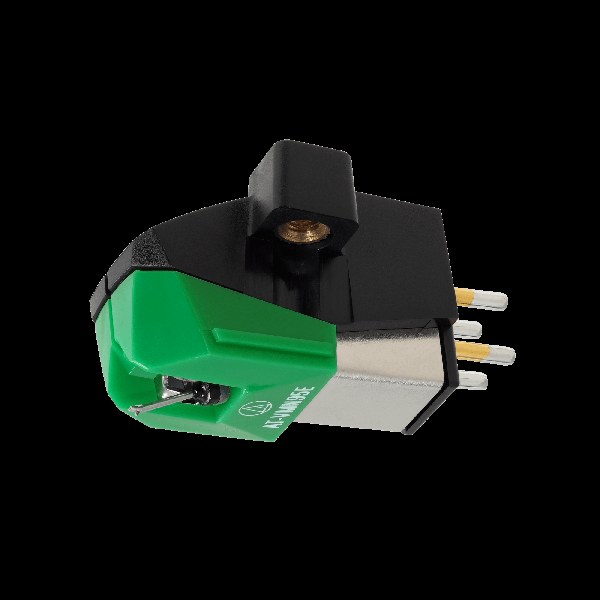
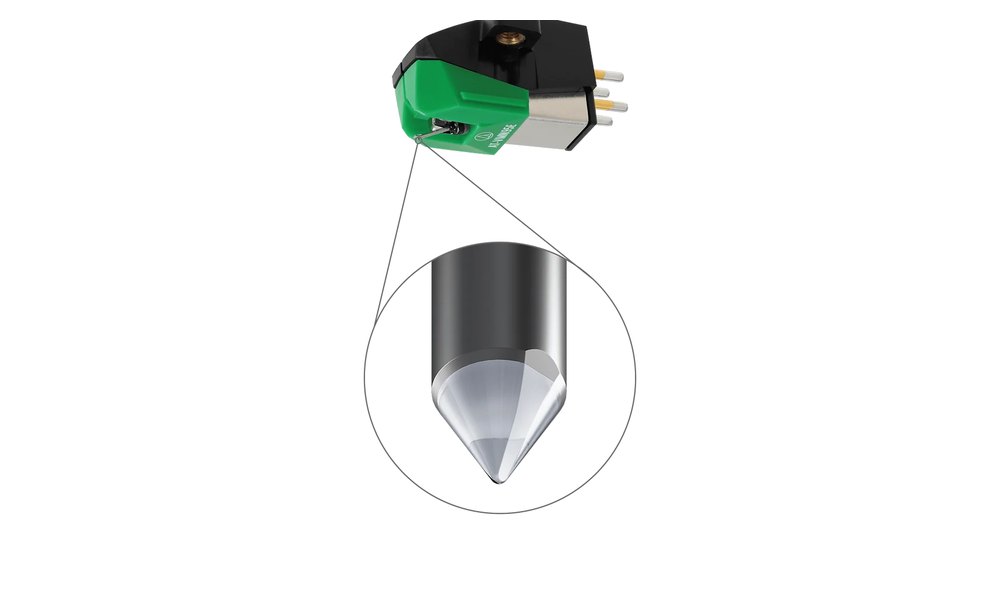
Summary
According to Audio-Technica, the AT-VM95E is the elliptical entry of the VM95 family: 4.0 mV, VTF 2.0 g, load 100–200 pF. The real lever is the Stylus family (C→E→EN→ML→SH) without body changes. Makes sense as a first serious MM cartridge on Starter and Premium arms — less so if you want a nude or Fine Line stylus immediately (then EN/ML or 2M Blue).
Assumptions
- MM-Phono 47 kΩ, capacitance rather 100–200 pF (less than many Ortofon windows)
- Medium arm; dyn. Compliance @100 Hz not 1:1 compared to Ortofon-µm/mN
- No tracking measurements of our own
Specs (public / manufacturer)
| Type / Stylus | VM Dual-MM · elliptical bonded 0.3×0.7 mil |
|---|---|
| Output | 4.0 mV (1 kHz, 5 cm/s) |
| Compliance | static 17 · Dynamic 7×10⁻⁶ cm/dyn @100 Hz (manufacturer) |
| VTF | 1.8–2.2 g · recommended 2.0 g |
| Load | not specified by manufacturer |
| Weight | 6.1 g |
| Replacement stylus | AT-VMN95E (family C/E/EN/ML/SH) |
| Price guide | MSRP often ~€59 · market price approx. €55–70 (without guarantee) · Sept 2026 — check the price date |
Manufacturer specifications (Audio-Technica)
| Type | dual moving magnet (VM95 series) |
|---|---|
| Output voltage | 4.0 mV (1 kHz, 5 cm/s) |
| Frequency response | 20–22,000 Hz |
| Channel separation | 20 dB (1 kHz) |
| Channel balance | 2.0 dB (1 kHz) |
| Tracking force | 1.8–2.2 g (2.0 g standard) |
| Stylus | elliptical 0.3 × 0.7 mil, round shank, bonded |
| Cantilever | aluminium pipe |
| Compliance | static 17 × 10⁻⁶ cm/dyne · dynamic 7 × 10⁻⁶ cm/dyne (100 Hz) |
| Cartridge weight | 6.1 g |
| Replacement stylus | AT-VMN95E |
Source: Audio-Technica – official specifications · As of 16 October 2026 · subject to change by the manufacturer
Scores in detail
Vinyl BotPro Index: 53 · Index band Starter 40–54 · Guidance only, not a lab value.
Strengths
- Clear stylus family path (C/E/EN/ML/SH)
- MSRP/market price often below €70
- Threaded inserts — assembly without nuts
- Widely used as OEM (e.g. AT-LP series)
Weaknesses
- Elliptical bonded — detail reserve under EN/ML
- Closer capacitance window (100–200 pF)
- Compliance specification at 100 Hz — do not equate matching with Ortofon’s µm/mN
- An AI analysis is not an audition
Comparison models
| Ortofon 2M Red | Higher output (5.5 mV), other motor path |
|---|---|
| AT-VM95EN | nude elliptical — Next Clear Step in the Family |
| Nagaoka MP-110 | Warmer consensus character, no stylus family |
System matching
Works well with
- Starter/premium decks with alignment
- MM-Phono in 100–200 pF window
- Who later wants ML/SH without body change
Less suited
- Expecting “as detailed as Fine Line/Shibata” without any alignment reserve
- Very capacitance-rich cable+Phono without measurement
Technology in detail
According to the manufacturer (audio-technica.com/en-de), the Audio-Technica AT-VM95E is the elliptical entry to the VM95 series and the successor to the AT95E/AT95EX: dual moving magnet (VM), a bonded elliptical 0.3×0.7 mil stylus on a hollow aluminium cantilever, a stiffer housing with low resonance and two M2.6 threaded inserts for nut-free mounting. Public key figures: output 4.0 mV (1 kHz, 5 cm/s), frequency response 20–22,000 Hz, channel separation 20 dB, channel balance 2.0 dB, VTF 1.8–2.2 g (recommended 2.0 g), vertical tracking angle 23°, coil impedance 3.3 kΩ, DC resistance 485 Ω, inductance 550 mH, coil wire T.P. copper, static compliance 17×10⁻⁶ cm/dyn, dynamic 7×10⁻⁶ cm/dyn @100 Hz, weight 6.1 g, loading 47 kΩ / 100–200 pF, replacement stylus AT-VMN95E. Dimensions according to the manufacturer around 17.2×18.9×28.3 mm; accessories typically 8 and 11 mm screws plus washers.
The real equipment lever is the stylus family: the same body accepts the AT-VMN95C/E/EN/ML/SH as well as 78 rpm variants. The VM95E is thus not a disposable entry but a platform — wear means buying a stylus, not necessarily a new generator. Typical market price in Germany approx. €55–70, against an MSRP of often ~€59 (Sept 2026). Wide OEM distribution (including the AT-LP series) makes spare parts and experience easy to find — without VinylCination deriving listening claims from it.
In the starter field the VM95E competes on modularity and street price: against the Ortofon 2M Red (5.5 mV, 150–300 pF, Blue upgrade path), against the Nagaoka MP-110 (warm-sound consensus, pricier, JN-P110 only), against the VM95EN (nude, 3.5 mV) and against the Goldring E3 (bonded elliptical, Duplex). Compliance figures at 100 Hz must not be equated with Ortofon’s µm/mN 1:1 — matching remains arm- and practice-dependent. If you later want to run the body with MicroLine or Shibata, you can save on mounting and cabling work again.
What the specialist press says
The international specialist press describes the VM95E as a noticeable advance over the classic AT95E: still on the bright side of neutral, but more civil and exceptionally refined for a sub-£50 budget. Hi-Fi Choice (byline ES, 26 March 2019, issue 444) describes agile rather than massive bass compared with the 2M Red and stress that hot pressings do not immediately tip into hardness – a magazine verdict in a specific system context (for example an SME arm), not a VinylCination listening lab and no guarantee of the same result on entry-level suitcase decks.
David Price (StereoNET, 26 May 2020) stresses an open, clean midrange, tight bass and finer treble as well as the upgrade logic of the sibling styli; the comparison with the AT95E clearly favours nuance and long-term listenability. Herb Reichert (Stereophile, Gramophone Dreams No. 44, 28 December 2020) deliberately sets the VM95E against the Shibata variant and underlines the pulse, presence and rhythmic energy of the elliptical entry stylus — including the note that pricier profiles do not automatically mean “more fun”. The consumer guide Platter & Plinth (Stephen V.) positions the VM95E as a frequent budget recommendation: affordable, a real advance over many stock styli and the entry into a stylus path usable for years on adjustable arms with a counterweight; that is a guide text, not a specialist-press listening protocol in the same sense as StereoNET, Hi-Fi Choice or Stereophile.
Phono Cartridge Reviews and other independent texts repeat the pattern of “fuller and weightier than the old AT95E, a safer entry for medium to higher arm masses”. The description varies in taste between "lightly bright" and "warm-neutral" — an indication that system context and capacitance play a strong role. VinylCination considers this to be a scattering of secondary sources, not a contradiction that one should cover with invented audio reports.
Recurring patterns across outlets: if you want to learn alignment and plan to move to ML/SH later, you often start here more cheaply than with Ortofon stylus changes. Against the 2M Red, reviews trade some bass weight for agility and upgrade depth; against the Nagaoka MP-110, they trade a warm tonal balance for modularity and market price. The Audio-Technica advantage of the longer-running stylus family stands against Goldring’s Duplex and award profile in the E3 comparison. VinylCination compiles only as AI summary of the specialist press — without partnership claim and without own tracklist.
In short: if you want value for money and a stylus-family focus → AT-VM95E (Value-for-money Vinyl BotPro Champion of this tier). Overall winner with higher output and blue path → 2M Red. Warm tonal balance → MP-110. A nude step within the same body → VM95EN. Super-elliptic bonded award all-rounder → Goldring E3.
Who is it for?
Compliance / tonearm
AT calls dyn. Compliance at 100 Hz — conversion formulas are approximations, not laboratory truth. In practice: medium-heavy modern arms (many Pro-Ject, AT, Fluance, Dual and Rega entry-level arms) are the usual match; avoid very light vintage arms and extremely high mass without a resonance check. 6.1 g are poor-friendly. Threaded inserts speed up assembly and remove the wobble of loose nuts — overhang and azimuth still have to be set. If you run firmly bonded OEM styli without any alignment options, you first need a turntable with a counterweight.
VTF
Recommended 2.0 g in narrow window 1.8–2.2 g (less than old AT95E). Use digital scales; then set anti-skating. Build up alignment discipline before any nude, ML or SH upgrade — a bonded E forgives more, but it does not train bad habits away. After each stylus change reset VTF, even if the body remains the same.
Phono loading
47 kΩ and 100–200 pF — narrower than Ortofon’s 150–300 pF. A long or highly capacitive cable combined with a capacitive phono stage can dampen the treble or shift the balance. Many modern MM stages and short RCA runs are a good fit. If the treble sounds dull, check capacitance and cable first rather than replacing the stylus straight away. 4.0 mV is undemanding for MM inputs and rarely requires extra gain. Guidance without listening claim: compact MM stages and amplifier phono inputs in the Starter/Premium budget.
Budget / upgrade
At a market price approx. €55–70 (without guarantee), the VM95E is the value-for-money champion of the tier. Next specs levels: AT-VMN95EN (Nude), then ML/SH — without body changes and without a new drill picture discussion. Parallel path 2M Red/Blue only with Ortofon ecosystem wish. Stabilise the turntable and its placement first; otherwise every stylus family remains cosmetics. Budget for a scale and a proper phono stage; otherwise the index advantage remains theoretical.
Analysis: Audio-Technica AT-VM95E in detail
Sources and how we use them
This analysis adds manufacturer data and dated independent listening reports on the Audio-Technica AT-VM95E to the overview above. Vinyl BotPro compiled it from the sources named below; VinylCination has not carried out its own listening session or measurement of this cartridge. The basis is Audio-Technica’s German and European English product pages (retrieved 12 November 2026) [1][2], David Price’s listening report for StereoNET (26 May 2020) [3], the Hi-Fi Choice listening report with the byline ES (online 26 March 2019, full article in the January issue 444) [4], and Herb Reichert’s Gramophone Dreams No. 44 in Stereophile (28 December 2020) [5]. The Platter & Plinth guide already linked in the page footer (Stephen V.) is used only as a supplementary consumer text on the upgrade path; the author states there that the unit has not been measured [6].
The three specialist-press reports meet the requirement of an international independent listening test: they name a date, an author or byline, the AT-VM95E itself, and the system in which it was heard. German shop or magazine pages are not used as a substitute. Forums, retailers and announcements without a listening protocol are left aside. Where figures or tonal comments diverge, or where the system context is narrow, that is stated in the relevant section.
Background and place in the range
Audio-Technica presents the AT-VM95E as the new elliptical entry model in the VM95 series and as the successor to the long-running AT95E; it also takes advantage of developments from the AT95EX introduced in 2015 [1][2]. Hi-Fi Choice notes that the AT95E had been in production for almost forty years and places the VM95E as the renewal of the entry line after the company had already revised mid-price and high-end moving-magnet cartridges [4]. StereoNET describes the same change of generation: the AT95E spent decades as the typical inexpensive moving-magnet cartridge — light, bright and, for the money, surprisingly tidy in the treble; the VM95E arrives as a direct replacement, and David Price notes that styli from the new range will even fit the older body [3].
Herb Reichert puts the predecessor in a line of long-lived analogue products and records that the AT95 generator was used in Linn Basik, K5 and K9 cartridges because its assertive, rhythmically direct character met customer expectations for pace and immediacy [5]. That is an assessment of the discontinued AT95E, not a listening protocol for the VM95E; for the successor, the passages that count are those in which Reichert expressly hears the new elliptical version and compares it with the Shibata sibling [5]. Within the VM95 family the VM95E remains the bonded-elliptical starting point: the same body accepts, among others, the conical C stylus, the nude elliptical EN, MicroLine (ML), Shibata (SH) and a 78-rpm stylus [1][2][3].
Body, threads and mounting
Compared with the classic AT95E, the manufacturer cites a more rigid, lower-resonance housing and two M2.6 threaded inserts in the body, so the cartridge can be mounted to a headshell or an integral tonearm with two screws and no nuts [1][2]. The package includes a pair of 8 mm and a pair of 11 mm M2.6 screws plus two plastic washers [1][2]. Audio-Technica gives the dimensions as 17.2 × 18.9 × 28.3 mm (height × width × depth) and the weight as 6.1 g [1][2]. StereoNET notes that the predecessor weighed 5.7 g; the slightly higher mass suits modern tonearms better than ultra-light designs [3].
Hi-Fi Choice describes the new body as feeling substantially more solid than the AT95E and the threaded mounting as easier than on earlier Audio-Technica cartridges the author had used; stylus-guard removal is more logical, and the models are also available pre-mounted in the AT-HS6 headshell [4]. The mount is the usual half-inch standard [1][2]. That eases the swap, but it does not replace alignment of overhang, azimuth, VTA and tracking force — the listening reports themselves make that plain by running the body in adjustable arms [3][4][5].
Generator and manufacturer data
The generator is a VM stereo dual-magnet design, Audio-Technica’s moving-magnet arrangement with separate magnets for the two channels [1][2]. The stylus is elliptical, 0.3 × 0.7 mil, bonded on a round shank and fitted to a hollow aluminium cantilever; the replacement stylus is designated AT-VMN95E [1][2]. The manufacturer quotes 4.0 mV output at 1 kHz, 5 cm/s, a frequency response of 20–22,000 Hz, 20 dB channel separation and 2.0 dB channel balance, each at 1 kHz [1][2]. StereoNET presents the output as 0.5 mV higher and the treble extension as 2 kHz wider than on the AT95E; Reichert refers to a new engine with a thicker coil and the rise from 3.5 mV to 4.0 mV [3][5].
Further manufacturer figures: coil impedance 3.3 kΩ (1 kHz), DC resistance 485 Ω, inductance 550 mH (1 kHz), coil wire T.P. copper, vertical tracking angle 23°, static compliance 17 × 10⁻⁶ cm/dyne, dynamic compliance 7 × 10⁻⁶ cm/dyne at 100 Hz [1][2]. Recommended load impedance is 47,000 Ω, recommended load capacitance 100–200 pF, tracking force 1.8–2.2 g with 2.0 g as the standard setting [1][2]. Both official product pages list those load figures. The compact data table at the top of this page still describes the load as “not stated by the manufacturer”, which disagrees with the public product pages. We leave the table unchanged and, in this text, follow the product pages [1][2].
StereoNET remarks that separation and balance are fine for the price but not special, that compliance should match most modern tonearms, and that load and capacitance sit in the usual mid-range [3]. We do not have independent laboratory measurements of the AT-VM95E’s frequency response, separation or tracking. The figures in the table and in this section remain manufacturer data.
What the specialist press heard
The three listening reports draw a recognisable but not identical picture — each in a clearly named system, not as a general promise for every deck. VinylCination summarises this as an AI compilation of the specialist press and does not transfer the verdicts to suitcase or fully automatic turntables without a counterweight.
David Price heard the AT-VM95E in a modified Rega RB300 on a Technics SL-1200/II [3]. Against the classic AT95E, the successor sounded familiar but clearer: an open, clean midband, tight bass, detailed and finely etched treble, more nuance, and less of the slightly opaque colouration of the older cartridge that had limited extended listening [3]. On Led Zeppelin’s “The Rain Song” he describes a surprisingly present image, a wide stage and a centred, textured but not harsh vocal; on Rose Royce’s “Wishing on a Star”, enough midband insight to follow the dynamic shading of the vocal line [3]. The residual tonal edge: the cartridge remained slightly well lit; kick drum and bass guitar did not punch you in the stomach, yet the presentation still sounded dynamic and engaging [3]. Price ends with a clear recommendation as a starter cartridge and a worthy successor to the AT95E; anyone wanting more detail and extension at the frequency extremes can move up the sibling range [3].
Hi-Fi Choice (byline ES) mounted the AT-VM95E on an SME M2-9 on a Michell GyroDec and likewise compares it with the AT95E [4]. The successor is still on the brighter side of neutral, but brings a refinement the older model could not achieve and, judged at a sub-£50 price, sounds unusually civil [4]. A deliberately hot live pressing of Wild Beasts (“Last Night All My Dreams Came True”, including the boisterous “He The Colossus”) did not immediately tip into congestion or hardness — a point at which, ES writes, more expensive cartridges often stumble; vocals sounded tonally convincing [4]. In the bass the VM95E trades some weight for speed: against the (dearer) Ortofon 2M Red, the struck drum in Fink’s “Sort Of Revolution” had less impact but felt highly agile; Kraftwerk’s “Electro Cardiogram” pounded along without sluggishness [4]. As a typical limit of this price range, ES notes slight sibilance towards the inner grooves of some pressings, rarely becoming truly distracting [4]. As a replacement for the AT95E the step is significant; the upgrade family comes on top [4].
Herb Reichert heard the AT-VM95E on a Dr. Feickert Blackbird with a 10.5-inch Thomas Schick arm, the moving-magnet phono stage of a Rogue Audio Sphinx V3 and GoldenEar BRX loudspeakers [5]. The extended Lead Belly and Slim Harpo passages are based first on the classic AT95E; they document Reichert’s regard for the predecessor, not automatically the successor [5]. For the VM95E itself, the direct comparison with the Shibata AT-VM95SH on Black Uhuru’s “Red” is the decisive passage: with the dearer SH stylus Reichert describes a smooth, detail-rich, spacious sound with a glowing quality similar to an Ortofon 2M Black, plus more push and better timing than the Ortofon [5]. The same album with the elliptical VM95E stylus had even more pulse, presence and rhythmic energy; to his ears the less expensive stylus made the Shibata version sound overly smooth and polite [5]. That is a listening verdict in this particular, far from cheap analogue chain, not evidence that a dearer profile generally falls behind the entry model.
Across the three reports a pattern returns: a clear step on from the AT95E in clarity and long-term listenability, a lively rather than heavy balance, and the caveat that brightness, bass weight and inner-groove behaviour depend on the arm, the capacitance and the pressing. The spread between “slightly bright” (StereoNET, Hi-Fi Choice) and Reichert’s very enthusiastic account in the Schick/Feickert chain is therefore not a contradiction to be papered over with invented listening scenes, but a reminder of system context [3][4][5].
Tonearm, tracking force and phono load
At 6.1 g plus headshell, the AT-VM95E needs an arm whose counterweight can balance that range cleanly [1][3]. The three listening reports use adjustable arms (Rega RB300, SME M2-9, Thomas Schick) [3][4][5]. A fully automatic deck without a counterweight — typical fixed-arm entry-level turntables — cannot reliably set the specified 1.8–2.2 g; this cartridge is not intended for that use. Dynamic compliance is quoted as 7 × 10⁻⁶ cm/dyne at 100 Hz [1]. Such 100 Hz figures must not be equated one-to-one with other brands’ µm/mN ratings; arm matching remains a matter of mass, tracking force and practice, not a single converted number.
The recommended electrical load is 47 kΩ and 100–200 pF [1][2]. That suits typical moving-magnet inputs, including many phono stages in integrated amplifiers. Cable capacitance counts towards the total; if the treble seems sharp, the first checks are total capacitance and tracking force, before swapping the body or the stylus. The 4.0 mV output sits comfortably in the moving-magnet range and does not require a moving-coil stage [1][3]. We have no independent measurements of how far real separation, frequency response or tracking depart from the manufacturer’s figures.
Stylus profile, family and upgrades
According to the manufacturer, the bonded elliptical tip follows the groove more precisely than a conical stylus and is intended to improve frequency and phase response while reducing distortion [1][2]. That is the manufacturer’s rationale for stepping up from the typical stock cone of many entry-level decks to the VM95E, not a VinylCination listening verdict. The real leverage in the series is the shared body: when the stylus wears or the profile is to change, the generator, the alignment and the wiring stay in place [1][2][4]. StereoNET lists, among others, the AT-VMN95C (conical), AT-VMN95ML (MicroLine), AT-VMN95SH (Shibata) and AT-VMN95SP (78 rpm), and relays manufacturer figures for service life: around 500 hours for conical, 300 for elliptical, 1,000 for MicroLine and 800 for Shibata [3]. Those hour figures do not appear on the product page we retrieved; we record them only as StereoNET’s report of the company’s figures.
Reichert shows that a stylus change can shift the character: the same record sounded smoother and more spacious with the Shibata tip, and more impulsive with the elliptical entry stylus [5]. That does not mean dearer profiles should be avoided; it means that “more stylus” does not automatically mean “more enjoyment” in every system. Anyone who wants a nude or fine-line tip immediately can fit an EN or ML stylus on the same body, or choose a different cartridge; the VM95E is then an intermediate step, not an end point.
Price and availability
On the European manufacturer pages the stated price on 12 November 2026 was €59.00 [1][2]. The existing page note cites typical street prices of about €55–70 with a recommended price often around €59 (as of September 2026, without guarantee). The older listening reports give contemporary UK and US prices: about £39.95 in StereoNET, £44 in Hi-Fi Choice, and $49 in Stereophile with a note of a later rise to $69 [3][4][5]. Those are historical price anchors, not a current shop comparison. Replacement and sibling styli have to be budgeted separately; the body alone is only half of the longer-term cost.
What we do not rely on
We do not treat listening reports of the discontinued AT95E as a substitute source for the VM95E, even though StereoNET, Hi-Fi Choice and Stereophile use the predecessor as a comparison: output, weight, body, threads and the stated frequency response have changed [1][3][5]. Nor do we use listening comments on the VM95ML, VM95EN or VM95SH as statements about the elliptical E stylus, except where a report expressly hears both variants against each other — as Reichert does in the SH comparison [5].
Platter & Plinth places the VM95E as a frequent budget suggestion and as the entry to a long-lived stylus path on arms with a counterweight, warns against fixed-arm automatic decks, and in an older wording gave the tracking range as 1.8–2.3 g; the site later corrects that in its source list to the official 1.8–2.2 g [6]. We treat this text as a consumer guide, not as a specialist-press listening test of the same standing. Forums, retailer pages and bare announcements are left aside. There is no VinylCination track list and no listening protocol of our own.
Conclusion of the analysis
The sources portray the Audio-Technica AT-VM95E as the bonded-elliptical dual-moving-magnet entry cartridge of the VM95 series: 4.0 mV, 6.1 g, VTF 1.8–2.2 g (2.0 g recommended), load 47 kΩ / 100–200 pF, threaded mounting without nuts, and a body that accepts the C/E/EN/ML/SH stylus family plus 78-rpm variants [1][2]. StereoNET, Hi-Fi Choice and Stereophile agree on a clear step beyond the AT95E and on a lively, rather lean than heavy presentation; the differences lie in system context and in how bright, bass-rich or inner-groove-sensitive each setup makes the cartridge sound [3][4][5]. In our list the model is the Starter-tier Value-for-Money champion — an AI assessment based on the available data and price, not a listening test of our own.
Sources for this analysis
- Audio-Technica: AT-VM95E product page (DE, retrieved 12.11.2026). https://www.audio-technica.com/de-de/at-vm95e
- Audio-Technica: AT-VM95E product page (EN-EU, accessed 12.11.2026). https://www.audio-technica.com/en-eu/at-vm95e
- StereoNET: David Price – Audio-technica AT-VM95E Dual Moving Magnet Cartridge Review (26 May 2020 / 26.05.2020). https://www.stereonet.com/reviews/audio-technica-at-vm95edual-moving-magnet-cartridge-review
- Hi-Fi Choice: ES – Audio-Technica AT-VM95E (26 March 2019 / 26.03.2019; January issue 444). https://www.hifichoice.com/content/audio-technica-vm95e
- Stereophile: Herb Reichert – Gramophone Dreams #44: Audio-Technica, Goldring, LP Gear phono cartridges (28 December 2020 / 28.12.2020). https://www.stereophile.com/content/gramophone-dreams-44-audio-technica-goldring-lp-gear-phono-cartridges
- Platter & Plinth: Stephen V. – Audio-Technica AT-VM95E Review (consumer guide, retrieved 12.11.2026; no in-house measurements). https://platterandplinth.com/cartridges/audio-technica-at-vm95e-review
Created by AI (Vinyl BotPro) from the sources named; no listening tests or measurements of our own. Detailed human fact-checking is still outstanding.
The special features of this analysis
This AI analysis brings together manufacturer specifications, technical data and the verdicts of the specialist press in a compact assessment. It shows where the sources agree, which strengths come up again and again, and which system the product suits best. Prices as of Sept 2026.
How the score comes about
Vinyl BotPro Index 0–100; Starter ~40–54. AT-VM95E: 53 (rank 2): very high equipment and value-for-money shares (stylus family plus market price), solid engineering and build, expected performance of a bonded elliptical below the Nude/EN/ML. The title Value-for-money Vinyl BotPro Champion refers to the value-for-money sub-score from research — no listening test. Weights ~25/20/25/30. The overall winner of the tier remains the 2M Red (54). Details: Details on weighting · Methodology.
Sources
- Audio-Technica DE — AT-VM95E (manufacturer specs)
- Hi-Fi Choice — Audio-Technica AT-VM95E
- StereoNET — AT-VM95E Dual MM Review
- Stereophile — Gramophone Dreams #44 (VM95E context)
- Platter & Plinth — AT-VM95E Review
Created by Vinyl BotPro (AI) · As of Sept 2026 · Corrections: info@vinylcination.de
Read more: best cartridges 2026 · Stylus shapes explained · What is hi-fi?