
Cartridge · AI analysis · Premium, rank 4
Audio-Technica AT-VM95ML: Analysis
AI analysis (research): nude MicroLine on the VM95 body, 3.5 mV — Audio-Technica DE specifications, no listening test.
Summary
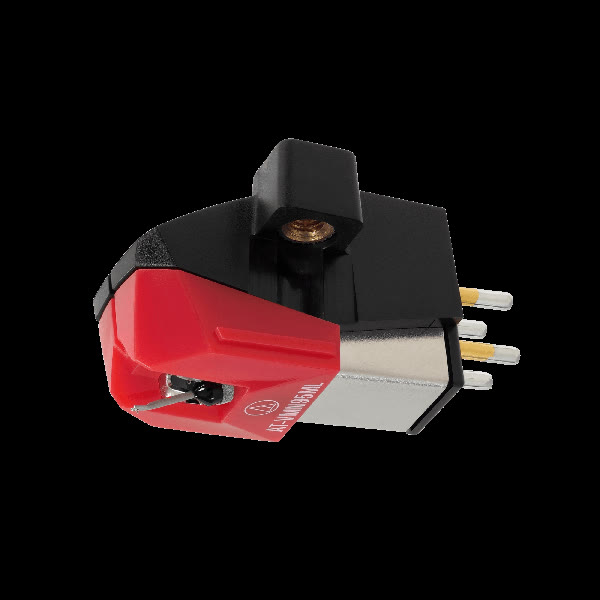
The AT-VM95ML puts MicroLine into the familiar VM95 body (6.1 g, threaded inserts). Output 3.5 mV, dyn. Compliance 10 @100 Hz, VTF 2.0 g. MSRP often €179 — making it the most efficient MicroLine entry in this list. Stylus AT-VMN95ML; body compatible with C/E/EN/SH.
Assumptions
- MM-Phono 47 kΩ · 100–200 pF
- Clean VTF/Anti-skating before MicroLine
- No measurements of our own
Specs (public / manufacturer)
| Type / Stylus | VM Dual-MM · Nude MicroLine 2.2×0.12 mil |
|---|---|
| Output | 3.5 mV (1 kHz, 5 cm/s) |
| Compliance | static 20 · dyn. 10×10⁻⁶ cm/dyn @100 Hz |
| VTF | 1.8–2.2 g · recommended 2.0 g |
| Load | 47 kΩ · capacitance not specified by manufacturer |
| Weight | 6.1 g |
| Replacement stylus | AT-VMN95ML |
| Price guide | MSRP €179 · market price approx. €150–190 (without guarantee) · Sept 2026 — check the price date |
Manufacturer specifications (Audio-Technica)
| Type | dual moving magnet (VM95 series) |
|---|---|
| Output voltage | 3.5 mV (1 kHz, 5 cm/s) |
| Frequency response | 20–25,000 Hz |
| Channel separation | 23 dB (1 kHz) |
| Channel balance | 1.5 dB (1 kHz) |
| Tracking force | 1.8–2.2 g (2.0 g standard) |
| Stylus | MicroLinear, square shank, nude |
| Cantilever | aluminium pipe |
| Compliance | static 20 × 10⁻⁶ cm/dyne · dynamic 10 × 10⁻⁶ cm/dyne (100 Hz) |
| Recommended load | 47 kΩ |
| Coil impedance / DC resistance / inductance | 3.3 kΩ (1 kHz) / 485 Ω / 550 mH (1 kHz) |
| Cartridge weight | 6.1 g |
Source: Audio-Technica – official specifications · As of 16 October 2026 · subject to change by the manufacturer
Scores in detail
Vinyl BotPro Index: 65 · Index band Premium 55–69 · Guidance only, not a lab value.
Strengths
- MicroLine at the VM95 price
- Stylus family without body change
- Light (6.1 g)
- MSRP/market price transparent
Weaknesses
- 3.5 mV — Check Gain
- Plastic body vs. VM740 die-cast
- Capacitance 100–200 pF
- An AI analysis is not an audition
Analysis: Audio-Technica AT-VM95ML in detail
Scope and sources
On the existing VinylCination page the Audio-Technica AT-VM95ML carries the title Value Vinyl BotPro Champion in the Premium tier, with Vinyl BotPro Index 65 and rank 4 (analysis 10/2026). That ranking stays the live page’s. VinylCination has neither listened to the AT-VM95ML nor measured it.
The first pillar is Stereophile, Gramophone Dreams No. 44 (Herb Reichert, online timestamp 28 December 2020): Reichert there describes several days with the VM95ML. The second is Hi-Fi World (Noel Keywood, August 2018), a VM95 stylus group test in which the MicroLine model is named, heard and measured. AVForums is a forum platform and not a pillar. AudioResurgence is not a specialist-magazine listening report under the rule. Texts on the AT-VM95E or the AT-VM740ML do not replace the ML report from the VM95 series.
Audio-Technica’s product page (AT-VM95ML, retrieved 12 November 2026) quotes a nude MicroLine stylus on the VM95 body, a 3.5 mV output, a 6.1 g weight and a tracking force around 2.0 g. The live page gives an MSRP of €179 and a street range of about €150 to €190, without guarantee.
Place in the range
The AT-VM95ML is the MicroLine variant of the VM95 series: the same body as the elliptical and other styli, with a replaceable stylus assembly. That distinguishes it from the heavier AT-VM740ML, which uses a different body. Reichert and Keywood listen to the VM95 MicroLine itself, not the VM95E and not the 700 series.
In the Premium tier of the cartridge list the AT-VM95ML is the Value champion with Index 65 and rank 4. This analysis keeps that placing and does not recalculate the index. A series overview that mentions the ML only in passing does not replace the named listening passages.
Design and manufacturer data
According to the live table and the manufacturer, a nude MicroLine stylus sits on the VM95 body. The 3.5 mV output, the 6.1 g weight and the tracking force around 2.0 g come from the datasheet, not from an in-house measurement. The stylus is interchangeable; that is the point of the VM95 series and explains how Keywood could listen to several styli on the same body in turn.
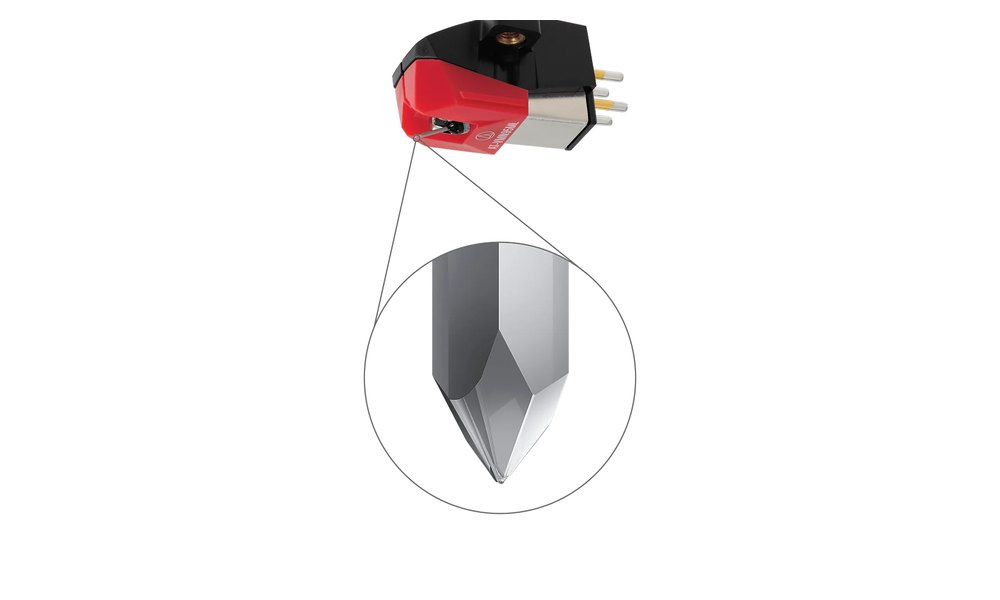
Dimensions and typical arm compatibility are taken from the live table. The MicroLine profile aims at the inner grooves and at a more even frequency response than simpler stylus shapes. That is first a manufacturer and measurement claim; Reichert’s and Keywood’s listening observations carry the sound placing.
What the specialist press heard and measured
Stereophile, Gramophone Dreams No. 44 (Herb Reichert, 28 December 2020 online): Reichert writes expressly that he used the VM95ML for several days. On choral and organ music he describes the impression as numinous — elevated, with a particular glow. That is Reichert’s listening session and his vocabulary, not a session of VinylCination’s own. The passage stands on page 2 of the column; authorship remains Reichert’s, not a comment beneath it.
Hi-Fi World (Noel Keywood, August 2018) compares the VM95 styli as a group. In his findings the ML shows the flattest frequency response, stays confident on the inner grooves and gives more treble assurance than simpler profiles; at the same time it sounds brighter than the Shibata (SH). Keywood’s personal choice in that comparison was the SH, not the ML. That difference stays visible: the ML convinces on the bench and in the inner grooves, but it is not automatically Keywood’s favourite stylus in the series.
The live page has so far leaned in part on AVForums for the VM95 series. In assembly, those sentences are attributed by name to the magazine pillars where the point is actually in those texts. The forum link outside the analysis block stays unchanged, but it does not count as a pillar.
Setup and system
The AT-VM95ML is meant for arms that will take a light moving-magnet cartridge around 6 g, and for listeners who want a fine stylus in an affordable, interchangeable body. Reichert’s choral and organ impression supports use on demanding acoustic music. Keywood’s inner-groove observation supports long sides on which simpler styli become less secure.
Anyone looking mainly for warmth and less brightness will find a clear pointer in Keywood’s preference for the SH within the same series, without our turning that into a ranking of our own. The step up to the AT-VM740ML is a different body and a different price field; texts on it do not replace the VM95ML.
Price and availability
The existing page quotes an MSRP of €179 and a street range of about €150 to €190, without guarantee. Island prices in the 2018 and 2020 magazine texts sit beside it and are not converted. This analysis does not recalculate Index 65 and does not make a purchase appeal.
In the Premium tier the AT-VM95ML remains the Value champion and rank 4. That is the live page’s list logic, supported by the named magazine reports, not by forums or retailer pages.
What we do not use
VinylCination has not listened to the AT-VM95ML and has not measured it. AVForums is not a pillar. AudioResurgence is not a specialist-magazine pillar. Texts on the VM95E or the VM740ML do not replace Reichert and Keywood, even when they describe the same stylus profile in a different body. Forums and shops are not used.
This long analysis does not change the table or the index and does not add new socket values to the live page. It makes clear which magazine text carries the listening judgements, and it keeps laboratory or awards remarks — which may still appear unnamed on the live page — separate from that pillar. Where such sentences are rewritten, existing links outside the analysis block stay in place so the live page’s outbound-link set is not altered by accident.
Figures for power, conversion, phono, HDMI, room correction and streaming come from the manufacturer page and the live table, supplemented by the named magazine’s listening observations in its own room and system. Where both layers touch the same point, the origin stays visible. VinylCination does not put its own measuring chain or listening session in their place.
Prices, currencies and availability change. The live page’s euro guide is as of October 2026, without guarantee; island prices in the magazine texts sit beside it and are not converted. Anyone buying a unit checks the current street price and the current datasheet, and does not treat this analysis as an order form.
Forums, video channels and retailer pages do not replace the named specialist magazines. Award blurbs and bench-only reports are not listening pillars either. Sibling models and predecessors are mentioned only to avoid confusion, not as a substitute for the report on the exact product.
Listening judgements are assigned to the named pillar, not to a blend of unnamed sources. Where the live page still uses anonymous wording, the analysis body replaces it with the author and the magazine, provided the sentence is actually in that text. Sentences that are not in the pillars are not invented after the fact. The same holds for superlative short formulas that appear only in forums, shops or awards boxes.
This long analysis describes the exact model on the existing page. Sibling and predecessor models appear only to prevent typical mix-ups. A system review in which the unit sits beside other components counts only if the model is named and judged by ear; combination impressions stay labelled as such. Bench-only reports without a listening run are not a pillar, even when they live on the same domain as a listening report.
Connection, power and dimension figures are taken from the manufacturer page and the live table, where they stand there. A magazine’s different laboratory values are labelled as that magazine’s laboratory values and are not merged into a third, in-house datasheet. Where the maker quotes a rated output and the magazine reports a listening-room observation, the two layers stay apart. This analysis does not add missing sockets or firmware states that are not documented.
Prices are a guide. MSRP, street prices and island prices in the magazine texts can diverge and they change. This analysis does not convert currencies and does not guarantee currency. Anyone buying checks the current price, the warranty terms and the current datasheet with the dealer or the maker. The live page’s champion placing is supported here, not recalculated.
Streaming platforms, room-correction systems and app interfaces keep changing. What a magazine heard on a given date holds for that software state, that room and that system. Later firmware may add or change functions, and we do not write that forward here. Remarks about app reliability, display size or remote-control gaps remain observations of that text, not a standing product description by VinylCination.
The existing page may contain links to forums, laboratory pages or award texts. Those links stay unchanged outside the analysis block, even when the source is not a listening pillar. Inside the analysis block itself we use only the named specialist magazines and the manufacturer page as supports for the listening judgements. That split stops an old forum link being read later as a pillar.
The long analysis is built in German and English in parallel, with the same sources and the same split between listening judgement, datasheet and list logic. Small differences of wording come from the language, not from a different source set. Both versions avoid phrasing that would pretend VinylCination ran its own measurements or its own listening session.
Conclusion of the analysis
The Audio-Technica AT-VM95ML is a moving-magnet cartridge with a nude MicroLine stylus on the VM95 body, 3.5 mV, 6.1 g and a tracking force around 2.0 g. Stereophile (Herb Reichert, Gramophone Dreams No. 44, 28 December 2020) describes several days of listening and an elevated impression on choir and organ. Hi-Fi World (Noel Keywood, August 2018) finds the ML the flattest in the series and the most secure on inner grooves, but personally chooses the Shibata.
This long analysis supports the live page’s champion placing (Premium Value, Index 65, rank 4) with those named magazine reports, without in-house measurement and without a purchase appeal. Limits remain the brighter character versus the SH in Keywood’s comparison, and the decision not to read forums or other styli in the family as a pillar.
Sources
- Stereophile, Herb Reichert, Gramophone Dreams #44, online 28 December 2020: https://www.stereophile.com/content/gramophone-dreams-44-page-2
- Hi-Fi World, Noel Keywood, Audio-Technica VM95 group test, August 2018: https://www.hi-fiworld.co.uk/index.php/vinyl/104-cartridges/1042-audio-technica-vm95-series.html
- Audio-Technica, AT-VM95ML product page, retrieved 12 November 2026: https://www.audio-technica.com/en-gb/at-vm95ml
- VinylCination, existing Audio-Technica AT-VM95ML product page (MSRP €179, street about €150–190, without guarantee; champion placing Premium Value, Index 65, rank 4).
Created by AI (Vinyl BotPro) from the sources named; no in-house listening tests or measurements. A detailed human fact-check is still outstanding.
Comparison models
| AT-VM740ML | Die-cast/Para-Toroid — more expensive, sound champion |
|---|---|
| 2M Blue | nude elliptical, higher output |
| AT-VM95SH | Shibata alternative on the same body |
System matching
Works well with
- Who comes from VM95E/EN
- Premium entry with alignment
Less suited
- First Stylus without Alignment Tool
- Expectation "VM740 bodies" at the VM95 prize
Technology in detail
According to the manufacturer (audio-technica.com/en-de), the Audio-Technica AT-VM95ML has a nude MicroLine stylus (2.2×0.12 mil) in the familiar VM95 body: dual moving magnet (VM), aluminium cantilever and a polymer housing with two M2.6 threaded inserts (nut-free mounting). Public key figures for the ML variant and the VM95 family: typical output 3.5 mV (1 kHz, 5 cm/s), frequency response often given as 20–25,000 Hz, channel separation typically in the ~23–25 dB class according to the series datasheets, VTF 1.8–2.2 g (recommended 2.0 g), compliance within the VM95 range (static often ~20×10⁻⁶ cm/dyn, dynamic approx. 10×10⁻⁶ cm/dyn @100 Hz), weight 6.1 g, loading 47 kΩ / 100–200 pF, replacement stylus AT-VMN95ML. The same body accepts the C/E/EN/ML/SH stylus family as well as 78 rpm options — the actual equipment lever of the series.
MSRP often 179 €; market price typical ca. 150–190 € (Sept 2026). Usually supplied are pairs of screws and stylus guard; check bundle. Features: MicroLine performance at the VM95 market price, plus the full stylus family without body changes. This is the strongest feature and value-for-money lever in the Premium field against the 2M Blue (nude elliptical, higher output), the VM740ML (MicroLine in a die-cast body, more expensive) and the 2M Bronze (Fine Line, upper Premium). Clarification: it is not a VM740 body at the VM95 price — the polymer body remains the conscious compromise against the para-toroid die-cast.
In the starter-to-premium path, the VM95ML is often the specs jump if someone already owns VM95E/EN and only buys the ML style — often cheaper than a completely new premium system. If you are starting from zero, compare the total price against the Blue and against a later VM740ML.
What the specialist press says
Hi-Fi World (Noel Keywood, August 2018) picks out the leap to MicroLine in a VM95 group test: the flattest frequency response in the series, confident inner grooves and more treble assurance than simpler styli; at the same time the ML sounds brighter than the Shibata, and Keywood’s personal choice in that comparison was the SH. Stereophile (Herb Reichert, Gramophone Dreams #44, 28 December 2020) describes several days with the VM95ML, an elevated impression on choir and organ, and places the cartridge in the context of a lot of resolution for little money, but qualifies this with the limits of the aluminium cantilever compared with much more expensive cartridges – magazine verdicts, not a VinylCination listening claim. The existing AVForums source link stays, but it is not a pillar.
Independent long-term comparisons (e.g. AudioResurgence (on ML versus SH) and recurring forum discussions: the ML is often more neutral and more precise in the inner grooves and easier to live with when aligning; the SH sounds subjectively rounder and more vocal – a matter of taste and set-up, not a universal winner. Against the bonded VM95E/EN, the consensus is "a clear step up in specification, but less forgiving"; against the 2M Blue, many trade the MicroLine inner-groove advantage and the stylus range for Ortofon's higher output and a different capacitance window; against the VM740ML it offers the same stylus profile in a cheaper body with a less rigid housing; against the 2M Bronze it lacks the Fine Line stylus and silver-OFC wiring, but the market and stylus-range advantage remains substantial. VinylCination compiles only as AI summary of the specialist press — without partnership claim.
In short: MicroLine at the VM95 price / best price-performance → AT-VM95ML (Value-for-money Vinyl BotPro Champion of this tier). MicroLine + Die-cast / Sound → VM740ML. Fine Line overall winner → 2M Bronze. nude elliptical Ortofon → 2M Blue. Warm tonal balance nude elliptical → MP-150. Index gap to Expert-Shibata/MC remains deliberately: Premium value for money is not expert resolution.
Who is it for?
Compliance / tonearm
Dyn. Compliance at 100 Hz — do not equate 1:1 with Ortofon’s µm/mN. In practice: medium-heavy modern arms (many Pro-Ject, AT, Fluance and Rega entry-level to Premium arms). At 6.1 g it is forgiving and lighter than the VM740ML (8.0 g) and the Ortofon 2M (7.2 g). Threaded inserts speed up assembly; MicroLine still requires clean overhang and azimuth. Avoid very light vintage arms and extremely high mass without a resonance check. VTA: check the VM95 height against stock styli — arm parallel to the record.
VTF
Recommended 2.0 g (1.8–2.2 g). Use narrower window than old AT95E — scale. MicroLine is not a “first stylus without a tool” product, even if the market price invites it. Build up before SH upgrade alignment discipline.
Phono loading
47 kΩ and 100–200 pF — tighter than Ortofon’s 150–300 pF. 3.5 mV calls for slightly more MM gain reserve than 4.0/5.5 mV systems — check weak phono stages and very short gain paths. Long/high capacitive cable plus capacitive phono can dampen heights or shift the balance. Many modern MM stages and short RCA runs are a good fit. If the treble sounds dull or sharp, check capacitance first rather than replacing the stylus straight away.
Budget / upgrade
Market price ~150–190 € makes the VM95ML a value for money champion. Who already owns VM95E/EN, often only calculates the ML style — often the cheapest way in MicroLine. Then the SH, without a body change; or move to the VM740ML if a die-cast body and para-toroid generator are a priority. Parallel 2M Blue only with Ortofon preference and higher initial request. Stabilize turntable first — resonance heals no MicroLine.
The special features of this analysis
This AI analysis brings together manufacturer specifications, technical data and the verdicts of the specialist press in a compact assessment. It shows where the sources agree, which strengths come up again and again, and which system the product suits best. Prices as of Sept 2026.
How the score comes about
Vinyl BotPro Index 0–100; Premium ~55–69. AT-VM95ML: 65 (rank 4): very high marks for features and value for money (stylus family plus MicroLine at a market price), solid engineering, expected performance behind the VM740ML/Bronze because of the polymer body and lower output. Value-for-money Vinyl BotPro Champion = research sub-score, no listening test. Weights ~25/20/25/30. Overall winner = 2M Bronze (69); sound champion = VM740ML (68). Details on weighting · Methodology.
Sources
- Audio-Technica DE — AT-VM95ML (manufacturer)
- AVForums — Audio-Technica VM95 Series Review
- Stereophile — Gramophone Dreams #44 (VM95ML)
- AudioResurgence — VM95 ML / Shibata
- Audio-Technica EN-GB — AT-VM95ML specs
Created by Vinyl BotPro (AI) · As of Sept 2026 · Corrections: info@vinylcination.de
Read more: best cartridges 2026 · Stylus shapes explained · What is hi-fi?