
Integrated amplifier · AI analysis · Expert, rank 14
Audiolab 8300A: Analysis
AI analysis (research): analogue dual-mono integrated amplifier with MM/MC phono, a 300 VA toroidal transformer and switchable operating modes; based on Audiolab, the international specialist press and Hi-Fi Choice.
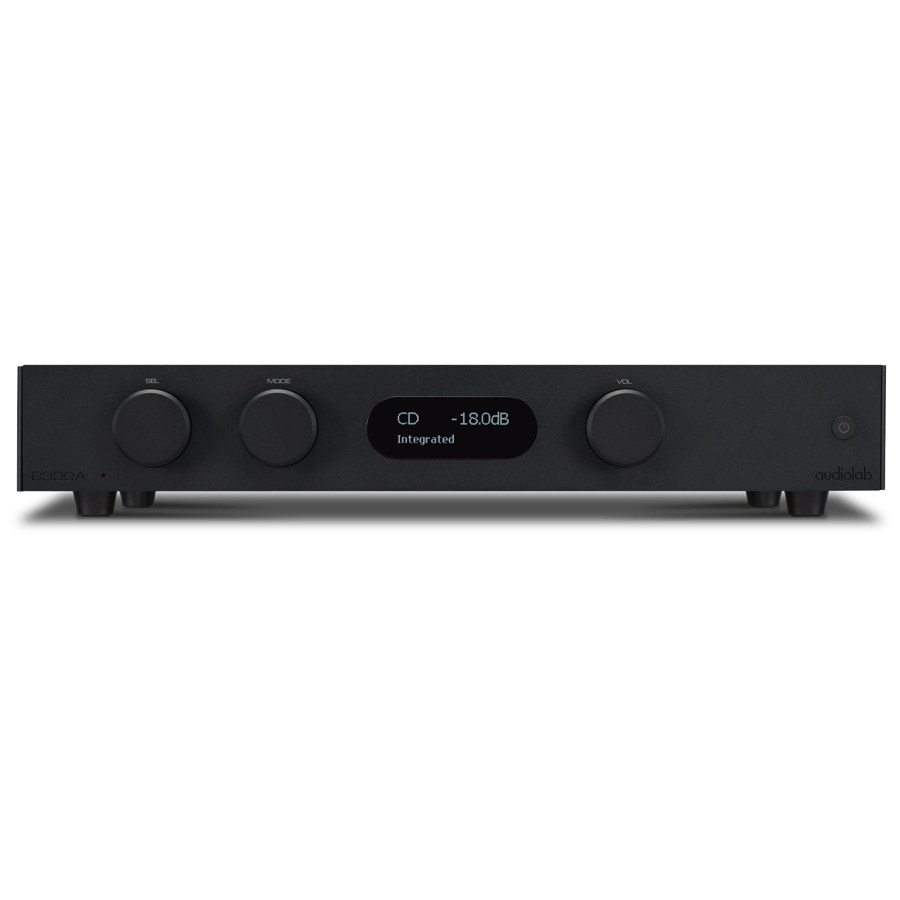
Summary
The 8300A (approx. 1,199–1,399 €) is an analogue Class AB integrated amplifier with 2 × 75 W into 8 Ω and 2 × 115 W into 4 Ω, MM/MC phono and three operating modes: integrated amplifier, preamplifier and power amplifier. What Hi-Fi? (23 November 2015, 4/5) praises power and clarity but misses some liveliness; it calls the phono stage a decent, low-noise effort with a good amount of insight that nonetheless loses some of the solidity and authority of the line stages.
Specs (public / manufacturer)
| Type | Stereo integrated amplifier · Class AB · dual-mono power stage |
|---|---|
| Power | 2 × 75 W RMS into 8 Ω · 2 × 115 W to 4 Ω (manufacturer) |
| Phono | MM 47 kΩ / 100 pF · MC 100 Ω / 1.5 nF |
| Signal-to-noise ratio | line > 109 dB (A) · MM > 78 dB (A) · MC > 73 dB (A) |
| Digital | No integrated DAC |
| Operating modes | Integrated amplifier, preamplifier or power amplifier |
| Dimensions / weight | 444 × 80 × 330 mm (B × H × T) · 7.8 kg |
| Price guide | approx. €1,199–1,399 · Sept 2026 |
Manufacturer specifications (Audiolab)
| Rated max. power output (RMS) | 2 × 75 W into 8 Ω · 2 × 115 W into 4 Ω |
|---|---|
| Peak output current | ±15 A |
| Phono | MM/MC · MM 47 kΩ//100 pF · MC 100 Ω//1.5 nF |
| Signal-to-noise ratio | line > 109 dB (A) · phono MM > 78 dB (A) · MC > 73 dB (A) |
| Frequency response | 10 Hz–20 kHz ±0.1 dB · 1 Hz–100 kHz ±3 dB |
| Damping factor | > 100 (8 Ω, 1 kHz) |
| Dimensions (H × W × D) | 80 × 444 × 330 mm |
| Weight | 7.8 kg |
Source: Audiolab – official specifications · As of 16 October 2026 · subject to change by the manufacturer
Matching tips
- Fits: MM and MC cartridges up to the mid price range
- Fits: Speakers rated 4 to 8 Ω
- Fits: Later expansion with a separate power amp or preamp
- Less suited: Anyone looking for a built-in DAC or streaming
- Less suited: Anyone looking for a particularly warm, flattering sound
Technology in detail
The 8300A follows in the tradition of the Audiolab 8000A from 1983, but is a completely new design. The power stage is a dual-mono Class AB design and, according to Audiolab, delivers 2 × 75 W into 8 Ω and 2 × 115 W into 4 Ω; peak current is quoted as ±15 A.
According to Audiolab, the damping factor is above 100 (8 Ω, 1 kHz). Besides integrated operation, the 8300A can be switched to work as a pure preamplifier or a pure power amplifier.
The built-in phono stage handles MM (47 kΩ, 100 pF) and MC (100 Ω, 1.5 nF); Audiolab quotes signal-to-noise ratios above 78 dB (MM) and above 73 dB (MC), A-weighted. The 8300A has no DAC, so digital sources need an external converter.
What the specialist press says
What Hi-Fi? (23 November 2015, 4/5) praises plenty of power, strong bass, a wide, well-layered soundstage, a very even tonal balance and a clean sound. Compared with Rega and Naim, however, it lacks some rhythmic drive; the phono stage is low in noise but a little less authoritative than the line inputs.
A Hi-Fi Choice piece on the 8300 series, listed in this page’s sources, was not used as a standalone, page-fetched listening source for this analysis; the sound claims rest on What Hi-Fi? of 23 November 2015.
Analysis: Audiolab 8300A in detail
Scope and sources
This analysis adds manufacturer data and one dated, independent listening report to the short overview above for the Audiolab 8300A. Vinyl BotPro compiled it from the sources named here; VinylCination has not listened to this unit and has not measured it. The basis is Audiolab’s official product page, which on 12 November 2026 was still live but marked “DISCONTINUED” [1], and the What Hi-Fi? listening report of 23 November 2015 (4/5) [2].
What Hi-Fi? meets the test of an international, independent listening report: the writers describe the case and the connections, name specific titles after a few days of running in, and reach a mixed conclusion without an unreserved recommendation. That reservation belongs in the body of this analysis, not only in a footnote. Forums, shop copy and the discontinuation flag on the manufacturer page do not count as a listening report. German texts on their own would not meet the rule; they are not used here as a second pillar.
Place in the range
The 8300A is Audiolab’s analogue dual-mono integrated amplifier in the 8300 series, with a built-in MM/MC phono stage, a balanced line input and a separable pre and power section. The product page names Jan Ertner as the designer. In our list the unit is the Value-for-Money champion in the Expert band (index 70, rank 14). That champion label is an AI assessment from the sources in front of us, not a listening session of our own, and it does not cancel the mixed What Hi-Fi? verdict.
What Hi-Fi? heard a current product in 2015; the manufacturer page still describes it in 2026, but marks it discontinued. The existing page note quotes around €1,199–€1,399 (as of September 2026). A leftover street price is not a statement about a successor and not a second listening report. An 8300CD or a later 9000-series amplifier does not inherit this text.
Case, connections and use
The product page lists dimensions of 80 × 444 × 330.3 mm and a weight of 7.8 kg, in black or silver [1]. What Hi-Fi? finds the build as solid and beautifully finished as they have come to expect from Audiolab; their sample was black, with silver also offered. They particularly like the crisp edges on the aluminium panels and the precise feel of the rotary controls, and they like the remote: a classy system controller that feels good to use. Around the back are line-level inputs including a balanced XLR option, an adjustable MM/MC phono stage, and two sets of speaker outputs to make bi-wiring easier. A display — according to What Hi-Fi?, the first time one of the brand’s integrated amplifiers had featured one — is useful for set-up, such as phono-stage gain or the length of standby, and is large and easy to read even from a distance. As usual with Audiolab integrated amplifiers, it is a simple matter to separate the pre and power sections if a superior external preamp or more muscle from an outboard power amp is wanted [2].
The product page adds a logarithmic ladder volume control, an OLED display, a 12 V trigger and the choice of integrated, preamplifier or power-amplifier operating modes [1]. The existing strength and weakness lines on this page are left untouched as score graphics.
Power, phono and manufacturer data
Audiolab quotes 2 × 75 W RMS into 8 Ω and 2 × 115 W into 4 Ω at THD under 1 %, a peak current of ±15 A, a complementary-feedback (CFB) output stage and microprocessor-controlled current (ACD). The phono stage is specified for MM and MC: 47 kΩ and 100 pF in MM, 100 Ω and 1.5 nF in MC [1]. What Hi-Fi? refers to a 300 VA toroidal transformer and 60,000 µF of smoothing, and notes that a claimed 75 W per channel gives little indication of how muscular the 8300A actually sounds [2]. These are manufacturer and report figures, not measurements of our own. The existing table is left unchanged.
The built-in phono stage is a fixed part of this integrated amplifier, not a separate box like the S2 Ultra or the DS3 B in the same list family. What Hi-Fi? heard it and ranked it behind the line input; that belongs in the listening section, not in a measurement of our own. Anyone who uses only the line path is not automatically hearing the same loss of solidity the writers noted on phono — and vice versa.
What the specialist press heard
After a few days of running in, What Hi-Fi? hears the muscle first. On a piece with wide dynamic extremes such as Hans Zimmer’s “The Battle” from the “Gladiator” soundtrack, the amplifier takes it all in stride; there is plenty of punch and the kind of low-frequency heft most rivals do not get close to. The presentation is big-boned, with a wide stereo stage populated by nicely layered, crisply focused instruments. The tonal balance impresses them as even as they come: the 8300A refuses to add unnatural colour or drama. On smaller-scale recordings from Eric Bibb and Satie they are impressed with the way the amp renders tonal textures; the presentation is very clean, as if distortion levels are way lower than the norm [2].
Despite all this obvious talent they are not totally bowled over. Compared with alternatives from Rega and Naim, the Audiolab is a little short in its sense of rhythmic drive; it does not communicate the changing momentum of a piece of music as well as they would like. That means the initial build-up of tension in The Dead Weather’s “60 Feet Tall” is not particularly obvious, and the energy and drive in OutKast’s “Hey Ya!” are diluted, so that a notable slice of the song’s sense of fun is lost. It does not help that the amplifier is not flawless with low-level dynamic shifts either: Nina Simone’s vocals on the haunting “Strange Fruit” come through with less passion than they are used to, and the steadily growing power in Arvo Pärt’s “Tabula Rasa” does not have the impact they would expect [2].
The story is much the same through the phono stage: a decent effort with low levels of noise and a good amount of insight, but it also loses some of the solidity and authority of the line stages. The closing verdict is expressly mixed. The 8300A is an amplifier that can impress easily, build is excellent, and its large-scale sound gives it an edge over many rivals — but it does not have enough all-round sonic talent to gain an unreserved recommendation. The score remains 4/5. That is a dated finding from British listening rooms in 2015, not a guarantee for every chain today and not a listening session of our own [2].
We keep that reservation in the body of the analysis on purpose, not only at the margin. A champion placing in the Expert Value-for-Money column does not change the fact that the only secured international listening source puts rhythmic drive and low-level dynamics behind Rega and Naim, and grants the phono stage less solidity than the line path. Anyone who reads the 8300A only as a muscular, clean amplifier is leaving the reservation out of the report.
Setup and system
What Hi-Fi? does not name a detailed speaker or turntable chain; the finding belongs to a run-in sample in the magazine’s listening rooms, on line material and on the built-in phono stage. Anyone who mainly wants large, dynamic recordings and even tonal textures will find, in “The Battle”, Bibb and Satie, the part of the report that makes the amplifier strong. Anyone who weights rhythmic drive and low-level dynamic shifts more heavily must take the passages on The Dead Weather, OutKast, Nina Simone and Pärt just as seriously. The separable pre and power section allows a different preamp or more power later; that is a feature option, not a heard comparison of such an upgrade.
The phono stage covers MM and MC with fixed loading values, not with the fine grid of a full-size external stage. What Hi-Fi? calls it a decent, quiet, insightful effort that is less solid than the line inputs. Anyone buying the 8300A chiefly as a phono chain is buying that reservation with it. Two pairs of speakers or bi-wiring are provided for on the rear panel; there is no sonic A/B of that arrangement in the report.
Price, discontinuation and availability
The existing page note quotes around €1,199–€1,399 (as of September 2026, without guarantee). The official page lists the model as discontinued. A still-visible street price is a leftover or warehouse price, not proof that Audiolab is still making the 8300A. Spares, warranty and the exact revision mark on the rear panel should be checked before a used or remainder purchase. A later Audiolab series does not inherit this listening report.
In our list the 8300A is the Expert Value-for-Money champion. That follows from the sources and from the one secured international listening text — including its reservation — not from a group comparison we have not heard ourselves. The existing comparison table on this page places other amplifiers alongside it; those are overview rows, not extra listening sources.
What Hi-Fi? describes the 300 VA toroidal transformer and the 60,000 µF of reservoir capacitance in the technical preamble, not as a quantity they heard. The 75 W into 8 Ω remains the manufacturer figure; the writers stress that this number does not predict the muscle they actually heard. “The Battle” carries the punch finding, not the data sheet. Conversely, the clean, even presentation on Bibb and Satie is a listening finding, not a measured distortion figure — the phrase about distortion seeming way lower than the norm remains an impression of the writers.
Discontinuation does not change the 2015 listening text, but it does change the buying context. Anyone looking for an 8300A in 2026 is looking for a discontinued model, possibly used or as leftover stock, without the supply situation of a current production unit. The still-open product page is helpful because it preserves the connection and power figures; it is not a promise of supply. A later Audiolab integrated amplifier that looks similar, with a display and phono, may be a different circuit.
The existing page sources also list a Hi-Fi Choice piece on the 8300 series. We have not used that text as a standalone, page-fetched listening source for this analysis. Sound claims therefore rest only on What Hi-Fi? of 23 November 2015 and on the manufacturer figures. The mixed verdict of that one listening source remains the governing reservation.
What we are not using
The short overview on this page now restates the listening findings only after What Hi-Fi? of 23 November 2015 (4/5), including the mixed note on the phono stage. We have not secured a second, page-fetched international listening text. What Hi-Fi? calls the phono stage a decent effort, not unreservedly strong, and withholds an unreserved recommendation. Forums, shop comparisons and later Audiolab models are left aside. There is no in-house track list and no measurement.
Conclusion of this analysis
The sources portray the Audiolab 8300A as an analogue dual-mono integrated amplifier with 2 × 75 W into 8 Ω and 2 × 115 W into 4 Ω, a CFB output stage, a separable pre/power section, XLR, two speaker outlets and an MM/MC phono stage — according to the still-live, discontinuation-flagged product page and the existing table [1]. What Hi-Fi? (23 November 2015, 4/5) describes, after a few days of running in, punch, low-frequency heft and a wide, even, clean presentation on “The Battle”, Eric Bibb and Satie, but finds a shortfall in rhythmic drive versus Rega and Naim (The Dead Weather, OutKast) and weaker low-level dynamics (Nina Simone, Arvo Pärt), plus a phono stage that loses some solidity against the line inputs; an unreserved recommendation is withheld [2]. In our list the unit is the Expert Value-for-Money champion — an AI assessment from the sources in front of us, not a listening report of our own.
Sources for this analysis
- Audiolab: 8300A, product page, marked discontinued (retrieved 12 November 2026). https://www.audiolab.co.uk/products/8300a
- What Hi-Fi?: Audiolab 8300A review (23 November 2015, 4/5). https://www.whathifi.com/audiolab/8300a/review
Created by AI (Vinyl BotPro) from the sources named; no in-house listening tests or measurements. Detailed human fact-checking pending.
Who is it for?
For vinyl listeners looking for a powerful, neutrally voiced integrated amplifier with MM and MC phono who don’t need a built-in DAC.
What makes this AI analysis special
This AI analysis combines Audiolab's technical data with international reviews. All technical values are manufacturer figures. As of October 2026.
How the score comes about
The Index reflects the powerful dual-mono power stage, the MM/MC phono stage, the flexible operating modes and the good reviews; on value it leads its tier. The Vinyl BotPro Index on this page remains 70 (Expert, rank 14) — guidance from manufacturer data and the specialist press, no in-house listening session. The four criteria engineering/build, features, expected performance and value for money are weighted 25/20/25/30 and scaled across all tiers. Methodology
Sources
- Audiolab, 8300A product page with specifications
- What Hi-Fi?, Audiolab 8300A review
- Hi-Fi Choice, Audiolab 8300 Series
Vinyl BotPro Index: 70 (Expert 70–84) · Label: AI research · Sept 2026
Read more: best amplifiers 2026 · Improve your hi-fi system · What is hi-fi?