
Floorstanding speaker · AI analysis · Master, rank 18
Bowers & Wilkins 702 S3: Analysis
AI analysis (research): largest floorstander of the 700 Series with tweeter-on-top and three Aerofoil bass drivers; based on manufacturer data and reviews from the international specialist press.
Summary
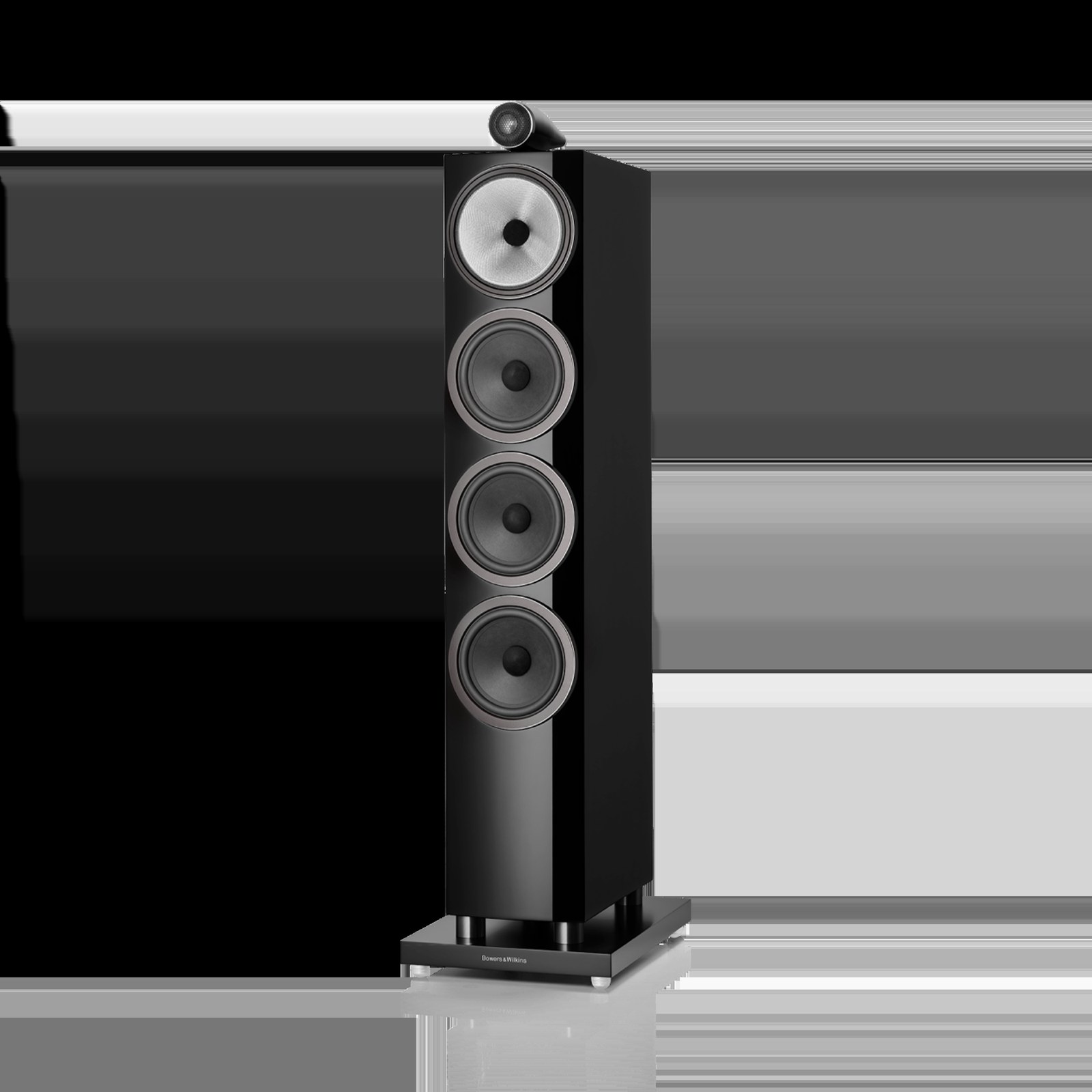
The 702 S3 (approx. 6,500–6,800 € per pair) is the largest floorstander in the 700 Series: a decoupled 25 mm carbon dome on top of the cabinet, a 150 mm Continuum midrange and three 165 mm Aerofoil bass drivers. Bowers & Wilkins quotes 90 dB and 8 Ω (min. 3.1 Ω). StereoNET (03/2023), SoundStage! Australia and Future Audiophile (08/2023) praise above all the clean bass and clarity.
Specs (public / manufacturer)
| Type | 3-way floorstanding speaker · Bass-reflex · tweeter-on-top |
|---|---|
| Sensitivity | 90 dB (2.83 V, 1 m) |
| Impedance | 8 Ω (min. 3.1 Ω) |
| Rec. Amplifier power | 30–300 W into 8 Ω |
| Frequency range | 46 Hz–28 kHz (±3 dB) · 28 Hz–33 kHz (−6 dB) |
| Chassis | 25 mm carbon dome · 150 mm Continuum FST · 3 × 165 mm Aerofoil |
| Dimensions / weight | 1138 × 290 × 391 mm (H incl. tweeter and plinth, W incl. plinth, D incl. grille and terminals) · 33.46 kg/piece |
| Price guide | approx. €6,500–6,800/pair · Sept 2026 |
Manufacturer specifications (Bowers & Wilkins)
| Type | 3-way floorstanding speaker · vented box · tweeter-on-top |
|---|---|
| Drivers | 1 × 25 mm decoupled carbon dome · 1 × 150 mm Continuum FST midrange · 3 × 165 mm Aerofoil bass |
| Frequency response | 46 Hz–28 kHz (±3 dB) · 28 Hz–33 kHz (−6 dB) |
| Sensitivity | 90 dB (2.83 V, 1 m) |
| Impedance | 8 Ω (min. 3.1 Ω) |
| Recommended amplifier power | 30–300 W into 8 Ω |
| Dimensions | 1,010 × 192 × 354 mm (H × W × D, cabinet); H with tweeter and plinth 1,138 mm, W with plinth 290 mm, D with grille/terminals 391 mm |
| Weight | 33.46 kg |
| Max. recommended cable impedance | 0.1 Ω |
Source: Bowers & Wilkins – official specifications · As of 16 October 2026 · subject to change by the manufacturer
Matching tips
- Fits: Powerful, load-stable solid-state amplifiers
- Good fit: Medium to large rooms
- Fits: Slight toe-in towards the listening position
- Less suited: Low-powered valve amplifiers
- Less suited: Listeners looking for a warm, soft sound
Technology in detail
The drivers, Flowport, connections, manufacturer data and the measurement of the Signature variant are now collected, with sources, in the analysis below.
What the specialist press says
We evaluate the reviews by StereoNET (John Pickford, 03/2023, 8/10), SoundStage! Australia (Edgar Kramer, 08/2023) and Future Audiophile (Bob Barrett, 08/2023) separately and with dates below.
Who is it for?
For listeners looking for a large, neutrally voiced floorstander with deep, clean bass who have a powerful solid-state amplifier for a medium to large room.
Analysis: the Bowers & Wilkins 702 S3 in depth
What this page is: an AI analysis, not a listening session
This page summarises what can be documented about the Bowers & Wilkins 702 S3 from manufacturer information, three reviews and one lab measurement. Vinyl BotPro has neither listened to nor measured these speakers itself. The measurements cited come from Hi-Fi News and apply to the 702 S3 Signature variant, not to the standard version analysed here. We paraphrase sound descriptions as statements by the named authors, each with a date, and flag our own assessments as such. The page's rank, index and price information stay unchanged.
Model separation
- 702 S3: the passive three-way floorstander analysed here, the largest model in the third-generation 700 Series [1][2]. It needs an amplifier.
- 702 S3 Signature: a separate, pricier variant. Hi-Fi News measured it and quotes £7,000 [5]. We do not carry its measurements over to the standard version without qualification.
- 702 S2 and 702 Signature (S2 generation): the predecessors with a rear-facing port [4][5]. SoundStage! Australia and Future Audiophile compare the 702 S3 with the previous generation's 702 Signature Edition [3][4].
- 800 Series (D4): the higher range from which technology was carried into the 700 S3 [2][3][4].
Technology according to Bowers & Wilkins
Bowers & Wilkins lists for the 702 S3 [1]:
- Design: three-way vented-box system.
- Tweeter: 25 mm carbon dome, decoupled, in a solid housing on top of the cabinet ("Solid Body Tweeter-on-Top").
- Midrange: 150 mm Continuum cone with FST suspension, decoupled.
- Woofers: three 165 mm units with Aerofoil Profile cones.
- Port: "Flowport".
- Frequency range: 28 Hz to 33 kHz. Frequency response 46 Hz to 28 kHz (±3 dB).
- Sensitivity: 90 dB (2.83 V, 1 m).
- Impedance: 8 Ω nominal, 3.1 Ω minimum.
- Recommended amplifier power: 30 to 300 W into 8 Ω on unclipped programme.
- Cable: maximum recommended cable impedance 0.1 Ω.
- Dimensions: cabinet 1,010 × 192 × 354 mm. With tweeter and plinth 1,138 mm tall; 290 mm wide and 410 mm deep with plinth; 391 mm deep with grille and terminals.
- Weight: 33.46 kg each.
- Finishes: Gloss Black, Satin White and Mocha. Grilles are black, or grey for Satin White.
The technologies explained
- Tweeter: the housing is machined from a block of aluminium and lengthened compared with the S2 to reduce reflected rear-wave energy [2][3][4]. According to StereoNET and SoundStage! Australia, the carbon dome's first break-up is at around 47 kHz, far higher than the S2's aluminium dome [2][3]. Future Audiophile mentions improved two-point decoupling [4].
- Midrange: according to StereoNET, it is the same unit as in the 800 Series, with a Continuum cone and a "Biomimetic" suspension instead of the usual fabric spider [2]. It sits in its own decoupled pod [3]. Future Audiophile adds tuned mass dampers on the aluminium chassis [4].
- Woofers: according to StereoNET, the 702 S3 uses a cost-engineered version of the Aerofoil cone with a paper skin instead of a carbon skin; the variable thickness is meant to combine stiffness and low mass [2].
- Downward Flowport: the port fires into the plinth, which is attached to the cabinet by 30 mm metal legs [2][3]. The dimpled surface is meant to prevent turbulence noise [3].
- Cabinet: narrower than the S2, with a curved baffle against diffraction. The mid and bass drivers protrude from the baffle [2][3][4].
- Connection: four binding posts for bi-wiring or bi-amping, with metal jumpers for single-wiring [2][3].
Conflicting figures
- Frequency response: SoundStage! Australia gives 46 Hz to 20 kHz (±3 dB) [3]; Bowers & Wilkins gives 46 Hz to 28 kHz [1]. We consider this a typo in the review but cannot prove it.
- Finishes: SoundStage! Australia also lists Rosenut [3]. The UK manufacturer page lists only Gloss Black, Satin White and Mocha [1].
- Plinth: Future Audiophile describes it as satin-black MDF and no longer optional [4]. According to StereoNET, stainless-steel spikes are included; according to SoundStage! Australia, either rubber feet or spikes [2][3].
Measurements of the 702 S3 Signature (Hi-Fi News)
Hi-Fi News measured the 702 S3 Signature, not the standard version [5]. According to Hi-Fi News, the Signature differs from its predecessor in, among other things, the downward-facing port. The lab report does not say whether the crossover and drivers are identical to the standard 702 S3, so the figures are only an indication [5]:
- Sensitivity: 88.1 dB at 1 kHz, 89.4 dB mean, 87.5 dB IEC (2.83 V/1 m). Bowers & Wilkins states 90 dB for the 702 S3 [1].
- Impedance: minimum 2.88 Ω at 670 Hz and 3.2 Ω at 111 Hz, with phase down to −64° at 66 Hz. Worst-case EPDR 1.25 Ω at 86 Hz. Hi-Fi News calls the load "quite tough".
- Bass: port tuned to 16 Hz, with significant pipe resonances at 275 and 530 Hz. Bass extension 42 Hz (−6 dB).
- Frequency response: ±3.8 dB with a dip around 1 kHz. Pair matching 0.6 dB. Tweeter resonance at 48 kHz.
- Distortion at 90 dB: 0.15% (100 Hz), 0.10% (1 kHz), 0.5% (10 kHz).
In our assessment, this fits the reviewers who recommend powerful, high-current amplifiers [2][3]. Sensitivity is likely below the manufacturer's figure. For the standard version, this stays open.
StereoNET (March 2023)
John Pickford, a recording engineer himself, reviewed the 702 S3 for StereoNET on 6 March 2023, then priced at £5,500, and gave it 8 out of 10 [2]. His impressions [2]:
- The cleanest, most articulate bass he has heard from any floorstander in his room, which he attributes to the port and plinth.
- No mid-bass boost and a seamless transition into the midrange. Bass-light recordings are not filled out.
- Great clarity, very accurate timbre and a stable soundstage, though not quite the pinpoint imaging of a point source.
- Neither warm nor bright. The midrange is slightly cool, which sounds fresh.
- Studio-monitor-like, but never "brutally frank" or over-analytical.
- Amplification: the 50 W Audio Research I/50 valve amplifier was a less good match; even the Naim Nait XS3 transistor amplifier sounded more controlled. He does not consider the speaker valve-friendly.
SoundStage! Australia (August 2023)
Edgar Kramer reviewed the 702 S3 for SoundStage! Australia on 15 August 2023, then priced at AU$10,900 [3]. He used the Gryphon Antileon EVO power amplifier [3]. His impressions [3]:
- The speakers disappear sonically. An open, wide and tall soundstage, with precise imaging on live recordings.
- World-class treble detail, not far from the 800 Series.
- Exemplary transient response in the mids and highs; powerful, controlled bass.
- More dynamics and a more open soundstage with a powerful, high-current solid-state amplifier.
- Larger floorstanders and the 803 D4 and up offer more scale and bass power.
- Comparison: the 702 S3 surpasses the 702 S2 and matches the 702 Signature Edition, with a little more bass and a more balanced treble.
- Criticism: the smooth binding posts are hard to tighten with spade connectors.
Future Audiophile (August 2023)
Bob Barrett reviewed the 702 S3 for Future Audiophile on 23 August 2023, then priced at $7,000 per pair [4]. He used a Denon AVR-X8500HA, in stereo and as the main channels of a 7.1.2 system [4]. His impressions [4]:
- In a direct comparison with his 702 Signature (S2 generation): wider soundstage, more precise imaging, more clarity for individual instruments.
- Deep, clean bass without audible distortion; fast, accurate dynamics.
- Thanks to the downward port, the speaker can go closer to the front wall without booming.
- Amplification: no flagship receiver needed, but more than a $500 entry-level unit.
- Criticism: the plinth is mandatory and needs a little more floor space.
What changed from the S2
The sources give the following list of changes from the 702 S2 [2][3][4][5]:
- Tweeter: carbon instead of aluminium dome, longer housing, better decoupling. Hi-Fi News sees the 16 kHz notch removed in the Signature variant thanks to a new mesh [5].
- Midrange: Biomimetic suspension from the 800 Series, decoupled pod [2][3][4]. According to Hi-Fi News, the S2's cone resonance around 4 kHz is suppressed and shifted upwards in the Signature variant [5].
- Woofers: a new generation of Aerofoil cone [2][4].
- Port: downward instead of rearward. In the Signature, tuned to 16 Hz instead of 21 Hz, but with pipe resonances [5].
- Cabinet: narrower, with a curved baffle. According to StereoNET, also upgraded motors, crossovers and terminal panel [2].
- Plinth: denser MDF, thicker and more compact than on the S2, and now mandatory [4].
Music examples from the reviewers
- Pickford [2]: Bob Dylan's "Most of the Time" with controlled, textured bass. The Beatles' 2022 Revolver remix with fluid McCartney bass lines and clear harmonies. Duke Ellington's "Far East Suite" with a stable soundstage. Neil Young's 1970 Carnegie Hall concert with a realistic sense of space.
- Kramer [3]: Sylvain Luc's "Light My Fire" with the finest string detail. Gillian Welch's "Tennessee" with a precisely placed voice. Red Hot Chili Peppers' Blood Sugar Sex Magik with punch in the bass and mids. Trifonov's Liszt recording and Reiner's "Scheherazade" with a large sense of space.
- Barrett [4]: London Grammar's "Lord It's a Feeling" (orchestral version) with pinpoint imaging and clean bass. John Mayer's "Gravity" with quick dynamics and lifelike decay.
Use in home cinema
Barrett also used the 702 S3 for two months as the main channels of a 7.1.2 system [4]. According to Future Audiophile, the 700 Series includes timbre-matched centre and surround speakers and a matching subwoofer [4]. Beyond that note, the sources make no statement about multichannel timbre matching.
Placement
- Toe-in: StereoNET recommends toeing the speakers in towards the listening position and placing them in free space, well clear of rear and side walls [2].
- Wall distance: Future Audiophile sees more latitude towards the front wall thanks to the downward port [4]. This does not directly contradict StereoNET but shifts the emphasis. We leave both in place.
- Tweeter height: with the plinth, the tweeter sits at an overall height of 1,138 mm, well above seated ear height. Pickford still found the integration impeccable once the speakers were positioned properly [2].
- Coupling: spikes or rubber feet on the plinth [2][3].
In a vinyl system
The reviews do not name a turntable as the source for their sound judgements [2][3][4]. Kramer's equipment list includes a turntable with phono stages, but he does not say whether he used it with the 702 S3 [3]. For vinyl, only what follows from the data applies: the 702 S3 is passive and needs an amplifier. A turntable needs a phono stage, built in or separate. Where the turntable stands depends on the rack and cable runs, not on the speakers. In our assessment, Pickford's note that bass-light recordings are not filled out [2] applies to older pressings as well.
Where the sources agree
- Bass: clean, deep and controlled [2][3][4].
- Clarity and imaging: very good; Pickford does not hear quite point-source precision [2][3][4].
- Amplification: powerful solid-state amplifiers recommended [2][3][4].
- Voicing: neutral to slightly cool, not warm [2].
Open points and limits of this analysis
- Measurements: published only for the Signature variant [5].
- Sensitivity: 90 dB per the manufacturer, 87.5 to 89.4 dB for the measured Signature [1][5].
- Finishes: Rosenut at SoundStage! Australia, not on the manufacturer page [1][3].
- Prices: £5,500 (03/2023), AU$10,900 (08/2023), $7,000 per pair (08/2023) [2][3][4]. The page's price information stays unchanged.
- A detailed human fact-check of this analysis is still pending.
Sources for this analysis
- Bowers & Wilkins: 702 S3 (Produktseite mit technischen Daten). https://www.bowerswilkins.com/en-gb/product/loudspeakers/702-s3/FP43052P.html
- StereoNET: Bowers & Wilkins 702 S3 (John Pickford, 06.03.2023). https://www.stereonet.com/reviews/bowers-wilkins-702-s3-floor-standing-loudspeaker-review
- SoundStage! Australia: Bowers & Wilkins 702 S3 (Edgar Kramer, 15.08.2023). https://www.soundstageaustralia.com/index.php/reviews/800-bowers-wilkins-702-s3-loudspeakers
- Future Audiophile: Bowers & Wilkins 702 S3 (Bob Barrett, 23.08.2023). https://futureaudiophile.com/bowers-wilkins-702-s3-loudspeakers-reviewed/
- Hi-Fi News: B&W 702 S3 Signature Lab Report. https://www.hifinews.com/content/bw-702-s3-signature-lab-report
Created by AI (Vinyl BotPro) from the sources listed; no listening tests or measurements of our own. Detailed human fact-check pending.
What makes this AI analysis special
This AI analysis combines the Bowers & Wilkins specifications with three dated reviews and the Hi-Fi News lab report on the 702 S3 Signature variant. Technical values are manufacturer figures unless marked as measurements of the Signature variant. As of October 2026.
How the score comes about
The Index reflects the 3-way design with a tweeter-on-top carbon dome, a Continuum midrange and three bass drivers, the build quality and the very good review; on value it leads its tier. The Vinyl BotPro Index on this page remains 85 (Master, rank 18) — guidance from manufacturer data and the specialist press, no in-house listening session. The four criteria engineering/build, features, expected performance and value for money are weighted 25/20/25/30 and scaled across all tiers. Methodology
Sources
Vinyl BotPro Index: 85 (Master 85–97) · Label: AI research · Sept 2026