
Passive subwoofers · AI analysis · Expert, Rank 2
Bowers & Wilkins CT SW12: Analysis
AI analysis (research): passive closed-box subwoofer from Bowers & Wilkins with a 300 mm long-throw driver (paper/aramid), 24 to 140 Hz (±3 dB, low-pass adjustable) and 1,000 W power handling into 8 ohms. Based on manufacturer data, no listening test.
Summary
Value-for-money Vinyl BotPro Champion Best value-for-money estimate of the tier on the data basis (no listening test).
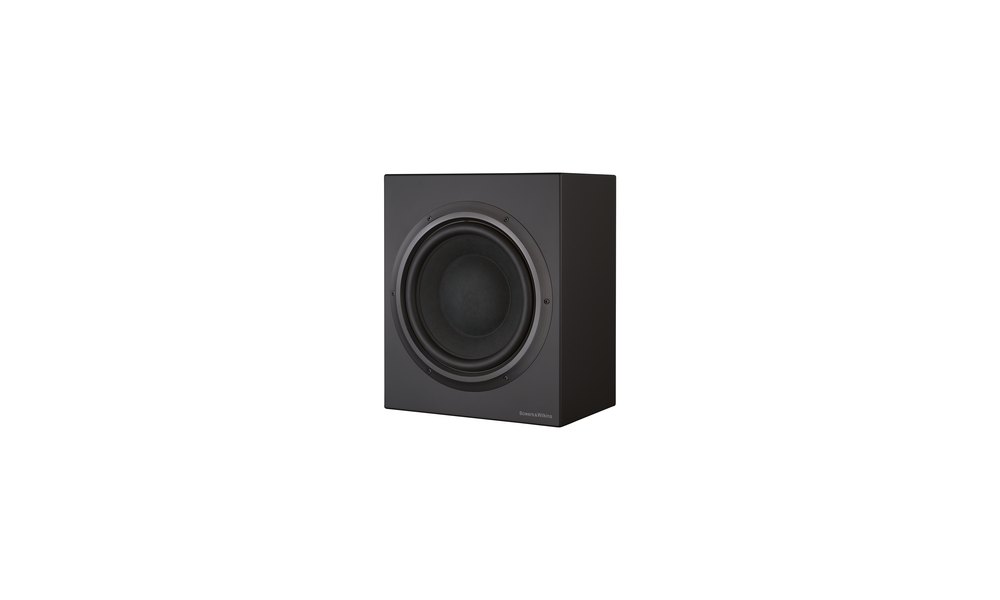
The B&W CT SW12 is a closed-back subwoofer with 300 mm long lift driver made of paper/aramid in fungal design, designed for installation in furniture. B&W specifies 24 to 40/140 Hz (±3 dB, low-pass adjustable), 17 Hz at −6 dB and 1,000 W power handling into 8 ohms; it is driven by the separate CDA-2HD amplifier. Price guide: approximately 1,400–1,700 € per piece (MSRP UK 1,200 £, US 1,750 $), plus amplifier (as of Oct. 2026, without guarantee).
Assumptions
- Price per subwoofer (piece) according to the manufacturer, without amplifier; UK/US prices converted rounded, Stand Oct. 2026, no guarantee
- Operation with an external subwoofer amplifier (low pass, phase) on the pre-out or sub-out of a stereo amplifier (2.1)
- Vinyl chain with phono stage; subsonic filter or high pass recommended in the amplifier
- No in-house measurements or listening tests
Specifications (manufacturer)
| Type | Passive subwoofer · Sealed Enclosure |
|---|---|
| Drivers | 1 × 300 mm (12 inches) Paper/aramid, long stroke |
| Frequency response | 24 – 40/140 Hz (±3 dB, low-pass adjustable) · 17 Hz (−6 dB) |
| Power handling | 1,000 W (8 Ohm) |
| Dimensions / weight | 465 × 396 × 260 mm (H × B × T), with grid 290 mm · 25 kg |
| Amplifier | external: CDA-2HD (per information sheet and product page) |
| Price guide | approx. 1,400–1,700 € per piece · ==References== Amplifier · as of Oct. 2026 · without guarantee |
Manufacturer specifications (Bowers & Wilkins)
| Type | passive subwoofer · closed box |
|---|---|
| Drivers | 1 × 300 mm paper/aramid bass unit |
| Frequency response | 24–40/140 Hz (±3 dB, low-pass adjustable) · −6 dB at 17 Hz and 25/140 Hz |
| Power handling | 1,000 W (8 Ω) |
| Amplifier | external: CDA-2HD |
| Dimensions | 465 × 396 × 260 mm (H × W × D); D with grille 290 mm |
| Weight | 25 kg |
| Max. recommended cable impedance | 0.1 Ω |
| Sensitivity | not specified by manufacturer |
Source: Bowers & Wilkins – official specifications · As of 16 October 2026 · subject to change by the manufacturer
Rating criteria in detail
The four criteria feed into the Vinyl BotPro Index with weights of 25/20/25/30. The index is scaled across all tiers (see Methodology); that is why we do not show individual sub-scores.
Strengths
- 12-inch long lift driver in closed-back enclosure
- Bass extension up to 24 Hz (±3 dB)
- Compact for furniture installation
- Low-pass adjustable 40–140 Hz
Weaknesses
- Amplifier added
- 25 kg and 26 cm depth: furniture must fit
- Designed for home cinema
- No App Measurement
Analysis: Bowers & Wilkins CT SW12 in detail
Scope and sources
On the existing VinylCination page the Bowers & Wilkins CT SW12 holds the Value-for-Money Vinyl BotPro Champion title in the Expert tier, with Vinyl BotPro Index 79 and rank 2 (analysis 09/2026). That ranking remains the live page’s; this long analysis adds a named international listening report and the manufacturer data. VinylCination has neither listened to nor measured the CT SW12 itself.
Two international listening reports carry the pillar, both in CT 700 systems, both with a named judgement on the CT SW12. Andrew Robinson at HomeTheaterReview.com, published 18 May 2009 (the host page notes a later update on 31 October 2020), heard a 5.1 system with a single CT SW12 on the then SA 1000 amplifier, three CT7.3 speakers at the front and two CT7.5 speakers at the rear. AudioVideo.fi (Samu Saurama, 21 June 2012) heard two CT SW12 subwoofers on one SA 1000, on the same wall as three CT7.3s, in a Finnish distributor’s demo room. Remarks about the bass of the whole chain stay flagged as combination findings. Where Robinson and Saurama name the CT SW12, place it or describe its bass work, the link to the exact model remains.
The manufacturer page and the information sheet cited on the live page (product page retrieved 12 November 2026) specify a sealed 300 mm paper/aramid bass driver, 24 to 40/140 Hz (±3 dB, low-pass adjustable), 17 Hz at −6 dB, 1,000 W power handling into 8 ohms, a cabinet of 465 × 396 × 260 mm (290 mm deep with the grille) and 25 kg. The current product page names the CDA-2HD as the partner amplifier, not the SA 1000 of Robinson’s 2009 report. The live table, which already lists the CDA-2HD as the present pairing, is left unchanged. We do not merge the two amplifier names.
Place in the range
The CT SW12 belongs to Bowers & Wilkins’s CT 700 custom theatre line: a passive, sealed installation subwoofer meant for cabinetry, a fabric wall or a place behind a screen, not as a living-room object. Robinson describes the series as a bridge between studio monitors and home-theatre speakers and places it below the CT 800 line on price. The subwoofers in the range were passive from the start and needed a separate rack amplifier.
In the current official description the CDA-2HD supplies the power; in 2009 it was the SA 1000, which Robinson describes as a roughly 1,000 W class-D rack unit that could at the time drive two identical CT subwoofers at once. That is a historical operating frame, not proof that every present CDA-2HD hook-up sounds the same. We keep the two amplifiers distinct.
Robinson mistakenly calls the CT SW12 the largest subwoofer in the CT 700 range. That is wrong: the CT SW15, with its 380 mm driver, is the larger model in the same family and has its own VinylCination entry. We do not repeat that error.
Construction and manufacturer data
The live table, backed by the information sheet and the product page, lists a 300 mm long-throw paper/aramid driver in B&W’s mushroom diaphragm, a sealed cabinet, 24 to 40/140 Hz (±3 dB) depending on the low-pass setting, 17 Hz at −6 dB, 1,000 W into 8 ohms, 465 × 396 × 260 mm, 290 mm deep with the grille, and 25 kg. These are manufacturer figures, not measurements of our own.
The CT SW12 is passive. Without an external amplifier it makes no sound. The present official partner is the CDA-2HD; Robinson’s listening report is tied to the SA 1000. Anyone reading the historical observations has to keep that difference in mind. We have no comparison of the two amplifiers and do not invent one.
The shallow depth is aimed at furniture installation. Weight and size call for a firm footing or a load-bearing niche. Robinson placed the CT SW12 just left of centre, between the centre and left front speakers, and called that the best bass position in his studio; that is his room, not a general building instruction.
What the press heard and measured
Robinson used the CT 700 system not only for playback but in post-production on his film “April Showers”, with an Integra processor, Outlaw amplifiers and Transparent Reference cable, and sources from Pro Tools or the mixing desk. The setting is a studio and mixing context, not a typical living room, and the observations carry that frame.
On the “The Dark Knight” Blu-ray he describes bass as about as visceral as he had heard in a home or studio environment, yet with poise, composure and balance throughout. Dynamically the system was a juggernaut, without shouting at the extremes. Because the speakers and the subwoofer ran together, we treat the bass and dynamics remarks as findings of the combination. He also names the join: the CT7.3s had monitor-like focus and mated so naturally with the CT SW12 that the gap was not noticed. That sentence ties the CT SW12 by name to the sound, but it remains an integration observation in that exact chain.
On the film score, mostly piano and solo violin, he describes the bass as deep yet nimble, without bloat and without overpowering the midrange. That too is a system finding in which the subwoofer carries the lowest range. The text does not offer an isolated CT SW12 measurement or a direct comparison with the CT SW15.
Samu Saurama in AudioVideo.fi (21 June 2012) gives a subwoofer-specific observation in a different room, with two CT SW12s. The demo room leaked low frequencies, including into a stairwell; a pair of 12-inch subwoofers therefore could not match the punch of the three sturdy CT7.3s at the front. The wildly moving cones showed that the subs were working hard — he admits he may have “got a little carried away” with the volume — but no real sense of bodily pressure arrived. In a better room, he writes, the stomach would surely have churned; those three CT7.3s are unusually beefy, though. That is a judgement on the two CT SW12s plus SA 1000 in this leaky demo room, not a general laboratory curve and not a stand-alone single-sub report. The text itself flags the room: the showroom is not a fully finished home theatre, the left and right channels sat too high and too wide, and the acoustics had not been thought through very far.
VinylCination has no measurements of its own. The Robinson text, in the form we retrieved, does not present a separate laboratory protocol beyond the manufacturer ratings. Awards, shop pages and forums do not replace this listening report.
System and use
The CT SW12 is an installation subwoofer. Robinson himself notes that the CT 700 cabinets look imposing in a living room and are meant for cabinetry, a wall or a perforated screen. Without that integration the shallow form is wasted.
The amplifier sits separately in a rack. In 2009, on Robinson’s account, the SA 1000 could drive two identical CT subwoofers at once; the current product page points to the CDA-2HD. Whether and how the CDA-2HD handles a dual-sub hook-up is not re-checked in this pass; we do not invent a connection list.
For music use Robinson offers a note from the mixing sessions: the bass stayed deep and mobile, without overrunning the midrange, when the CT7.3s replayed the score as a stereo pair. That is not a turntable report and not a full two-channel survey, but an observation in that studio.
The 1,000 W power handling and the sealed 300 mm driver set an expectation of control rather than maximum efficiency. How far a single CT SW12 will go in a large, lightly furnished living room is not in the report, because Robinson heard it in a studio and in a matched 5.1 set.
Price and availability
The live page quotes a guide of about €1,400 to €1,700 per unit (UK MSRP £1,200, US $1,750), plus the amplifier, as of October 2026, without a guarantee. Robinson quoted $1,000 for the subwoofer and $1,500 for the SA 1000 in 2009; those are historical US prices and are not converted into the present euro band.
In the Expert tier the CT SW12 stands at Index 79, rank 2, as the value champion. This long analysis does not re-score that index; it sets out which international listening report supports the assessment. It is not a buying appeal.
What we are not using
VinylCination has not listened to the CT SW12 and has not measured it. Manufacturer language about “explosive punch” remains marketing. Robinson’s error that the SW12 is the largest sub in the range is not repeated. A Dutch CT 700 system article that appeared in the search could not be fetched reliably in full text in this pass and therefore does not carry the core claims.
German shop or magazine copy alone would not be enough under t646u. HomeTheaterReview.com and AudioVideo.fi supply two international listening reports in which the exact CT SW12 was part of the system under review, each with a named judgement on the bass work or the integration. The limits remain the system and room framing and the change of the nominated amplifier from the SA 1000 to the CDA-2HD.
Robinson’s studio work makes clear why a custom-theatre subwoofer has to be read differently from a free-standing living-room sub. The CT7.3 and CT7.5 cabinets stood on purpose-built stands at ear height, the CT SW12 on the floor in a tried position, the cabling was Transparent Reference throughout, and the amplifiers were Outlaw units. In that fixed frame he asked not only how films sounded, but whether mixes that worked in the studio still held up at home and later in a commercial theatre. The report says that a finished mix in a true digital theatre differed mainly in scale, not in quality. That is a claim about the CT 700 system including the CT SW12, not an isolated level comparison and not a substitute for a living-room curve.
For the subwoofer itself, the lasting point is the integration note: in that set the CT SW12 filled the range below the CT7.3s so that Robinson did not hear the join as a break, and the bass stayed composed in music and in film cues. We may not infer more physical reserve than the 1,000 W rating and the 17 Hz at −6 dB on the data sheet. Nor does the studio level to which Robinson pushed the system become a licence for any living room, or for two SW12 cabinets without the SA 1000 configuration he described.
The existing live page had based its short account mainly on manufacturer data and noted that there was no listening test of our own. This long analysis changes that by adding Robinson’s report as an international pillar, without rewriting the table or the rated figures. Anyone planning a CT SW12 today has to think in terms of the current CDA-2HD amplifier and a furniture installation; the 2009 report remains tied to the SA 1000 and to the 5.1 studio described. That limit is part of the source picture, not a blemish to be covered over.
The same care applies to price. The historical system price Robinson quoted for a complete CT 700 5.1 set covers three CT7.3s, two CT7.5s and one CT SW12, and does not belong in the live page’s per-unit band. The present guide of €1,400 to €1,700 plus the amplifier applies only to the subwoofer. Whether street prices sit below or above that band does not change the listening observations and is not resurveyed here.
The CT SW12 therefore stands as a passive Expert-tier model with a documented international system listening report, not as a free-standing all-round subwoofer with an isolated laboratory file. The live page’s value-champion ranking in the Expert tier remains in place; the long analysis supplies the missing named pillar and the clear limits of that pillar.
Conclusion of the analysis
The Bowers & Wilkins CT SW12 is a passive, sealed 300 mm furniture-installation subwoofer, officially 24 to 40/140 Hz (±3 dB), 17 Hz at −6 dB, 1,000 W into 8 ohms, 25 kg, and today paired with the CDA-2HD. Robinson in 2009 heard a single CT SW12 on the SA 1000 in a CT 700 5.1 system and described a seamless join with the CT7.3s; the very visceral, composed bass is a system finding. Saurama in 2012 heard two CT SW12s on the SA 1000 and judged that, in a leaky demo room, the pair could not match the punch of the three CT7.3s despite hard-working cones; in a better room the stomach would have churned.
The long analysis supports the live page’s Value ranking with these named international reports, without a measurement of our own and without a buying appeal. Limits are the system and room frame, the historical SA 1000, and the lack of an isolated laboratory comparison with the CT SW15.
Sources
- HomeTheaterReview.com (HomeTechnologyReview), Andrew Robinson, 18 May 2009, page later updated 31 October 2020: https://hometechnologyreview.com/bowers-wilkins-ct-700-series-loudspeakers-reviewed/
- AudioVideo.fi, Samu Saurama, 21 June 2012, “Bower Wilkins CT7.3 LCRS, CCM7.5 ja DS3 -kaiuttimet sekä CT SW12 ja ISW3 -subwooferit testissä”: https://audiovideo.fi/testi/bower-wilkins-ct7-3-lcrs-ccm7-5-ja-ds3-kaiuttimet-seka-ct-sw12-ja-isw3-subwooferit-testissa/
- Bowers & Wilkins, CT SW12 manufacturer page, retrieved 12 November 2026: https://www.bowerswilkins.com/en-gb/product/in-wall-in-ceiling-speakers/ct-700-series/ct-sw12/150070.html
- VinylCination, existing Bowers & Wilkins CT SW12 product page (guide price about €1,400–1,700 plus amplifier, as of October 2026; Expert Value champion, Index 79, rank 2).
Created by AI (Vinyl BotPro) from the cited sources; no listening tests or measurements of our own. Detailed human fact-checking pending.
Comparison models
| Bowers & Wilkins CT SW15 | Index 83, Rank 1, Sound champion — Enclosure · 380 mm · closed-back · approx. € 1,800 (MSRP UK £ 1,550) |
|---|---|
| Klipsch PRO-1000SW | Index 71, Rank 3 — Installation · 10 Inch Cerametallic · closed-back · approx. € 1,900 (MSRP US 1,899.99 $) |
System matching
Works well with
- Lowboards and wall furniture
- B&W systems with 700 or CT loudspeakers
- Medium to larger rooms
Less suited
- If you want to get along without additional amplifiers
- Turntable on the same furniture
- Very small rooms
Specs & Features
The 300 mm driver uses a membrane made of paper, aramid fibres and resin in fungal form, which, according to B&W, withstands the forces in closed-back enclosure. The enclosure measures 465 × 396 × 260 mm and weighs 25 kg.
According to the current information sheet it is driven by the separate CDA-2HD amplifier; the low-pass cut-off is adjustable between 40 and 140 Hz.
Research Consensus
The Manufacturer data show a harmonious combination of closed-back 12-inch subwoofer and matching amplifier.
For VinylCination, what counts is lowpass, phase and subsonic in the signal path. VinylCination summarizes this as AI classification on the basis of the manufacturer specifications, without own listening test.
For whom / Matching
Amplifier & Installation
The B&W amplifier takes the signal from the pre-out or sub-out of the stereo amplifier and handles the low-pass filtering. The main speakers remain on the stereo amplifier.
Turntable & phono
Suits to drives of the Expert stage. With bass extension down to 17 Hz (−6 dB), a subsonic filter belongs in the phono preamp.
Room & placement
Medium to larger rooms. In the furniture do not push directly into a corner without checking the bass at the listening place.
Budget & upgrade
Value for money champion of the expert level. More membrane area offers the CT SW15.
What makes this AI analysis special
This section is an AI summary from Manufacturer data. Vinyl BotPro had no physical access, no measurement of our own chain and no listening test. The basis are product page and info sheet from Bowers & Wilkins. The expected performance is derived from construction, datasheet. Prices and availability change (as of Oct. 2026, no guarantee); please check technical values against the current data sheet.
Vinyl BotPro Score Logic
The Vinyl BotPro Index runs from 0–100 across all tiers and weights build/technology, features, expected performance and value for money at 25/20/25/30. Expert typically sits at ~70–84. Bowers & Wilkins CT SW12 receives 79 (Rank 2 Expert). Highest value for money share of the expert level. In the stage, the model bears the title Value for money Vinyl BotPro Champion. Rank is not Laboratory Evaluation — no Listening test. Details on weighting · Methodology.
Sources
Created by Vinyl BotPro (AI) · AI analysis · As of 08.10.2026 · Corrections: info@vinylcination.de · Prices without guarantee.
Read more: best passive subwoofers 2026 · Improve your hi-fi system · What is hi-fi?