
Floorstanding speaker · AI analysis · Premium, rank 4
DALI Oberon 5: Analysis
AI analysis (research): slim floorstanding speaker, 88 dB / 6 Ω, 30–150 W, 2×130 mm wood-fibre drivers — specifications and prices, no listening test.
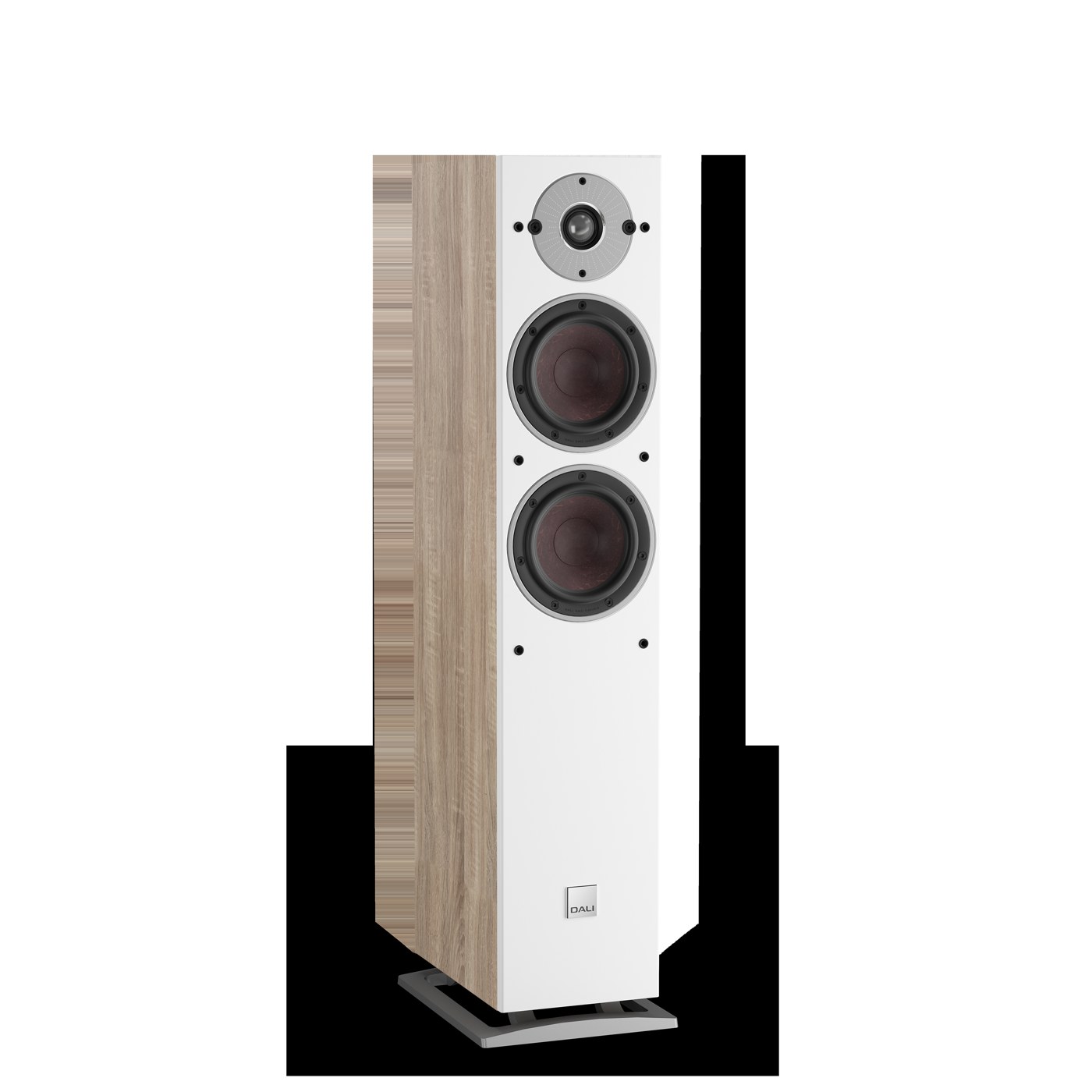
Summary
The Oberon 5 is the elegant floorstanding sibling: two 130 mm wood-fibre drivers, 88 dB, 6 Ω, 30–150 W, 39–26,000 Hz. Market price often approx. €798–898/pair. Less bass pressure than the 7, but narrower — balanced with very different amplifiers according to StereoNET.
Assumptions
- Price per pair Sept 2026
- Living room, floor placement
- Amplifier 30–150 W to 6 Ω
- No measurements of our own
Specs (public / manufacturer)
| Type | 2-way floorstanding speaker · Bass-reflex |
|---|---|
| Sensitivity | 88 dB (2.83 V/1 m) |
| Impedance | 6 Ω nominal |
| Rec. Amplifier power | 30–150 W |
| Frequency range | 39–26,000 Hz (±3 dB) |
| Chassis | 2×130 mm wood fibre · 29 mm fabric dome |
| Dimensions / weight | 830 × 162 × 283 mm · 10.8 kg/piece |
| Price guide | Market price approx. €798–898/pair · Sept 2026 |
Manufacturer specifications (DALI)
| Type | 2-way floorstanding speaker, bass reflex (tuned to 43 Hz) |
|---|---|
| Drivers | 1 × 29 mm soft dome · 2 × 5¼″ wood-fibre SMC woofers |
| Frequency response | 39–26,000 Hz (±3 dB) |
| Sensitivity | 88 dB (2.83 V/1 m) |
| Impedance | 6 Ω nominal |
| Recommended amplifier power | 30–150 W |
| Max. SPL | 108 dB |
| Crossover frequency | 2,400 Hz |
| Dimensions | 830 × 162 × 283 mm (H × W × D) |
| Weight | 10.8 kg |
| Data sheet | DALI OBERON white paper 2020 (spec table) |
Source: DALI – official specifications · As of 16 October 2026 · subject to change by the manufacturer
Scores in detail
Vinyl BotPro Index: 66 · Index band Premium 55–69 · Guidance only, not a lab value.
Strengths
- 88 dB / 6 Ω amp-friendly
- Slim enclosure
- Warm, dynamic voicing (StereoNET, TAS)
Weaknesses
- Less bass than Oberon 7
- No Bi-Wiring
- Not the Meta precision of an LS50
Comparison models
| vs. Oberon 7 | Smaller, cheaper, less bass |
|---|---|
| vs. Oberon 3 | Floorstander vs. bookshelf |
| vs. Silver 100 | Floorstanding speaker vs. large bookshelf speaker |
System matching
Works well with
- Premium amplifiers 40–100 W
- Medium-sized living spaces
- DALI fans below the Oberon 7 budget
Less suited
- Very large rooms without reserve
- Ultra-compact placement
- If you only want a bookshelf speaker
Analysis: the DALI Oberon 5 in depth
What this page is: an AI analysis, not a listening session
This page summarises what can be documented about the DALI Oberon 5 from manufacturer information and three international reviews. Vinyl BotPro has neither listened to nor measured these speakers. We paraphrase sound descriptions as statements by the named authors, each with a date and under their conditions. We flag our own assessments as such. The page's rank, index and price information stay unchanged.
Model separation and status
- Oberon 5: the passive floorstander analysed here, with two mid/bass drivers. It needs an amplifier [1].
- Oberon 7: the larger floorstander with two 7-inch mid/bass drivers [3].
- Oberon 1 and Oberon 3: the two compact models in the series [3][4].
- Oberon Vokal and On-Wall: centre and on-wall speakers [3][4].
- Oberon 9: linked on DALI's page as the range-topping model [1]. None of the three reviews mentions it.
According to StereoNET and The Absolute Sound, the Oberon 5 was the smaller of two floorstanders in the series [3][4]. On DALI's UK site, the Oberon 5 sat in the "Discontinued" section when we accessed it on 8 November 2026 [1]. We have not checked whether it is still regularly available in Germany. The page's price information stays unchanged.
Technology according to DALI
DALI lists for the Oberon 5 [1]:
- Design: two-way, bass reflex.
- Tweeter: 29 mm fabric dome, which DALI says was developed specifically for the Oberon series and is very light.
- Mid/bass drivers: two 5¼-inch units with a new wood-fibre structure and a low-loss suspension.
- Motor: a patented SMC (Soft Magnetic Composite) disc in the woofer's pole piece. It is meant to sharply reduce mechanical distortion from hysteresis and eddy currents, for a relaxed midrange with plenty of detail.
- Crossover frequency: 2,400 Hz.
- Frequency range: 39 Hz to 26 kHz (±3 dB).
- Sensitivity: 88 dB (2.83 V/1 m).
- Impedance: 6 Ω nominal.
- Maximum SPL: 108 dB (1 m).
- Recommended amplifier power: 30 to 150 W.
StereoNET adds, citing the manufacturer [3]:
- Port: rear-facing, tuned to 43 Hz.
- Voice coil: four layers, with an aluminium core and a thin-walled outer copper tube.
- Tweeter: ferrofluid cooling and an ultra-lightweight woven membrane.
- SMC at entry level: Oberon was DALI's first entry-level range with SMC, which had previously been reserved for pricier ranges.
The Absolute Sound reports that elements of the pricier Epicon series informed the Oberon design, chiefly SMC [4].
Conflicting figures
- Driver size: DALI says 5¼ inch [1], What Hi-Fi? 13 cm [2] and StereoNET 135 mm [3]. The page's specs table says 130 mm.
- Sensitivity: What Hi-Fi? writes 88 dB/W/m [2]. DALI measures at 2.83 V [1], which is about 1.3 W into 6 Ω.
- Amplifier power: The Absolute Sound considers amplifiers from about 50 W per channel appropriate [4]. DALI recommends 30 to 150 W [1].
Cabinet and dimensions
According to StereoNET, the Oberon 5 is 830 mm tall, 162 mm wide and 283 mm deep and weighs 10.8 kg each [3]. What Hi-Fi? gives a rounded 83 × 16 × 28 cm [2]. The Absolute Sound lists 6.4 × 32.7 × 11.2 inches and 23.8 pounds, about 10.8 kg [4]. The cabinet is CNC-machined MDF with internal cross-bracing [1][3]. The drivers are mounted flush in the baffle [3].
According to DALI, an aluminium base defines the look and gives the speaker a lighter, raised appearance [1]. StereoNET says spikes and rubber bumpers are included [3]. There is no bi-wiring; a single pair of binding posts sits at the rear [2][3]. The finish is vinyl wrap, not real wood [3]. According to The Absolute Sound, Oberon was DALI's first entry-level series with four finishes: black, dark walnut, light oak and white, plus fabric grilles in black or grey [4]. The Absolute Sound described fit and finish as very, very good [4].
What the figures mean
- 88 dB / 6 Ω: What Hi-Fi? calls these typical figures that should not trouble any good, price-compatible amplifier [2]. StereoNET considers the speaker easy to drive for most amplifiers [3].
- 43 Hz port tuning: in our assessment this fits the stated bass roll-off at 39 Hz. According to The Absolute Sound, the bass audibly reached into the 40 Hz region [4].
- 108 dB maximum SPL: according to The Absolute Sound, most listeners will reach their limits before the Oberon 5 does [4].
What Hi-Fi? (Award 2020, dated online 17 August 2021)
What Hi-Fi? labels the Oberon 5 as a 2020 Award winner. The online version is dated 17 August 2021, and it was tested at £699 [2]. The scores: 5 each for sound, compatibility and build [2]. The impressions [2]:
- After a few days of settling in, very musical, engaging and above all fun.
- Dynamic subtlety, rhythmic precision and transparency.
- Detailed yet organised. Leading edges of notes are well defined without being unnaturally highlighted.
- Crisp treble with plenty of bite that does not turn brittle, even with weaker recordings.
- Plenty of punch and authority in the bass. The speaker sounds notably larger than it is.
What Hi-Fi? compared it with the Q Acoustics 3050i. The 3050i digs deeper into the bass and has the edge in large rooms; in most other situations What Hi-Fi? preferred the Oberon 5 for its greater sense of fun [2]. The only drawback What Hi-Fi? lists is tough competition [2].
StereoNET (January 2020)
Mark Gusew reviewed the Oberon 5 for StereoNET on 20 January 2020, then priced at £699 [3]. His impressions [3]:
- Big and fun straight out of the box. DALI says it needs up to 100 hours to run in.
- Deep, well-extended bass with a warm character that defines the speaker. The bass is slightly forward.
- Rhythmically agile. Snare drums had good attack and cymbals had sparkle.
- A large soundstage with height and depth that stays stable across much of the room.
- High resolution and wide dynamic range.
- At high volume, the large tweeter sounded somewhat harder.
- Consistently even-handed with tube and transistor amplifiers, Class AB and Class D, low and high power.
StereoNET gave it an Applause Award and summed it up as a little floorstander with a big sound: full-bodied, musical, spacious and balanced [3].
The Absolute Sound (September 2019)
Neil Gader reviewed the Oberon 5 for The Absolute Sound on 6 September 2019, then priced at $1,099 per pair [4]. His impressions [4]:
- A somewhat warmer tonal balance, good extension, well-focused detail and good timing.
- Well-integrated drivers, very good soundstaging and imaging.
- Rich timbral cues in the midrange. The lower mids lack the colour saturation of real instruments, though, and large orchestras are too much for two five-inch drivers.
- Smooth, slightly dry and somewhat shaded treble. Gader sees that as a smart choice at this price.
- Bass into the 40 Hz region, surprisingly weighty with good midbass punch.
- At very high levels the port can be excited and bass grip loosens. At reasonable levels the speaker stays composed.
- The low height makes the soundstage seem slightly lower, so listening height matters.
Music examples from the reviewers
The authors name specific tracks, which makes their impressions easier to follow:
- What Hi-Fi?: Radiohead's In Rainbows. The Oberon 5 handled complex rhythms and dense production and brought out the mood of "Videotape" and the bassline change in "15 Step" [2].
- StereoNET: Neil Young's "Double E" with full, defined guitar. George Benson's "Breezin'" with crisp snares. Ruggiero Ricci's violin concerto with a soundstage beyond the speakers. Pryda's "Rebel XX" at high volume, controlled but with somewhat harder treble [3].
- The Absolute Sound: voices by Holly Cole and Shelby Lynne natural and well placed. Bass-baritones like Bryn Terfel lacked some body. Daft Punk's "Get Lucky" at very high level with loosening bass grip. Vaughan Williams and Copland with surprising dynamics [4].
Comparisons in the sources
- Q Acoustics 3050i: What Hi-Fi? compares them directly. The 3050i is larger and goes deeper; the Oberon 5 is more expressive in the mids and highs [2].
- Pricier DALI ranges: StereoNET found the Oberon 5 as much fun as much more expensive DALI models [3]. The Absolute Sound recalls the Rubicon and MegaLine without comparing directly [4].
- The page's comparison table (Oberon 7, Oberon 3, Silver 100) is not based on these reviews.
Wide dispersion as a design goal
DALI explains that driver materials and geometry are designed for wide dispersion, and that the crossover is tuned so the sound stays coherent off axis [1]. As a side effect, DALI cites less harmonic distortion and fewer diffraction effects that distort the frequency response. According to DALI, this is also why its speakers should not be toed in [1]. StereoNET confirms by ear an even soundstage across many seats, not just between the speakers [3]. What Hi-Fi? heard a focused, layered soundstage even without toe-in [2]. In our assessment, this is mainly useful in living rooms where more than one seat matters.
Use in home cinema
The Absolute Sound describes Oberon as a stereo and home-cinema series [4], which includes the Vokal centre and the On-Wall speaker [3][4]. None of the three reviews, however, heard the Oberon 5 in a multichannel system. No conclusions about timbre matching with a centre or subwoofer can therefore be drawn from these sources.
Running in
StereoNET quotes DALI as saying it needs up to 100 hours to run in [3]. What Hi-Fi? found the Oberon 5 clearly more convincing after a few days [2]. The sources offer no measurements showing whether or how much the sound changes.
Placement
- Orientation: DALI designs its speakers for wide dispersion and therefore explicitly does not recommend toe-in [1]. According to StereoNET, the manual says to position them parallel to the wall, and StereoNET had no problems listening that way [3]. What Hi-Fi? also recommends firing straight ahead [2].
- Wall distance: according to StereoNET, DALI recommends 15 to 80 cm from the rear wall. The closer to the wall, the more bass. In the larger listening room about 50 cm sounded best, in the smaller one 30 cm [3]. What Hi-Fi? recommends a little distance from the back wall [2]. DALI describes the rear ports as a way to use the rear wall to support the bass [1].
- Grille: according to StereoNET, DALI recommends leaving the grille on [3].
- Coupling: spikes or rubber bumpers are included [3]. In our assessment, whether spikes suit depends on the floor.
- Listening height: Gader points to the low height of about 83 cm [4].
Room size
What Hi-Fi? sees the larger Q Acoustics 3050i ahead in large rooms [2]. StereoNET stresses that the Oberon 5 also works in small rooms where you would normally choose standmounts [3]. The Absolute Sound praises the small footprint for tight spaces [4]. The sources therefore agree in describing the Oberon 5 as a floorstander for small to medium rooms.
Amplifier choice according to the sources
What Hi-Fi? names the Marantz PM6006 as an entry point and heard the Oberon 5 clearly improve with the Rega Elex-R and Moon 240i; you get out what you put in [2]. StereoNET found the speaker consistently balanced with very different amplifiers [3]. The Absolute Sound recommends quality amplifiers from about 50 W per channel [4]. We do not derive a specific product choice from this.
In a vinyl system
None of the three reviews names a turntable as a source [2][3][4]. For vinyl, only what follows from the data applies: the Oberon 5 is passive and needs an amplifier. A turntable needs a phono stage, built into the amplifier or as a separate unit. Where the turntable stands depends on the rack and cable runs, not on the speakers. In our assessment, a floorstander with warm bass and no subwoofer is practical for vinyl, but the sources make no statement on this.
Where the sources agree
- Musicality and dynamics: the core strengths [2][3][4].
- Soundstage: large and stable [2][3][4].
- Bass: full and strong for the size. StereoNET hears it slightly forward; The Absolute Sound hears it loosen at very high levels [3][4].
- Treble: What Hi-Fi? describes it as having bite, The Absolute Sound as slightly shaded, StereoNET as somewhat harder at high volume. Here the sources hear differently [2][3][4].
Open points and limits of this analysis
- Treble: the sources' assessments remain contradictory.
- Availability: DALI UK lists the Oberon 5 under "Discontinued" [1]. We have not checked the German market.
- Measurements: none of the sources publishes measurements.
- Prices: $1,099 per pair (09/2019) and £699 (2020) [3][4]. The page's price information stays unchanged.
- A detailed human fact-check of this analysis is still pending.
Sources for this analysis
- DALI: Oberon 5 (Produktseite). https://www.dali-speakers.com/en-gb/products/oberon/oberon-5
- What Hi-Fi?: Dali Oberon 5 review. https://www.whathifi.com/reviews/dali-oberon-5
- StereoNET: DALI Oberon 5 Floorstanding Loudspeaker Review (Mark Gusew). https://www.stereonet.com/reviews/dali-oberon-5-floorstanding-loudspeaker-review
- The Absolute Sound: Dali Oberon 5 Loudspeaker Review (Neil Gader). https://www.theabsolutesound.com/articles/dali-oberon-5-loudspeaker/
Created by AI (Vinyl BotPro) from the sources listed; no listening tests or measurements of our own. Detailed human fact-check pending.
Created by Vinyl BotPro (AI) · As of Sept 2026 · Corrections: info@vinylcination.de