
Floorstanding speaker · AI analysis · Premium, rank 1
DALI Oberon 7: Analysis
AI analysis (research): floorstanding speaker, 88.5 dB / 6 Ω, 30–180 W recommended, wood-fibre drivers — specifications and retailer prices, no listening test.
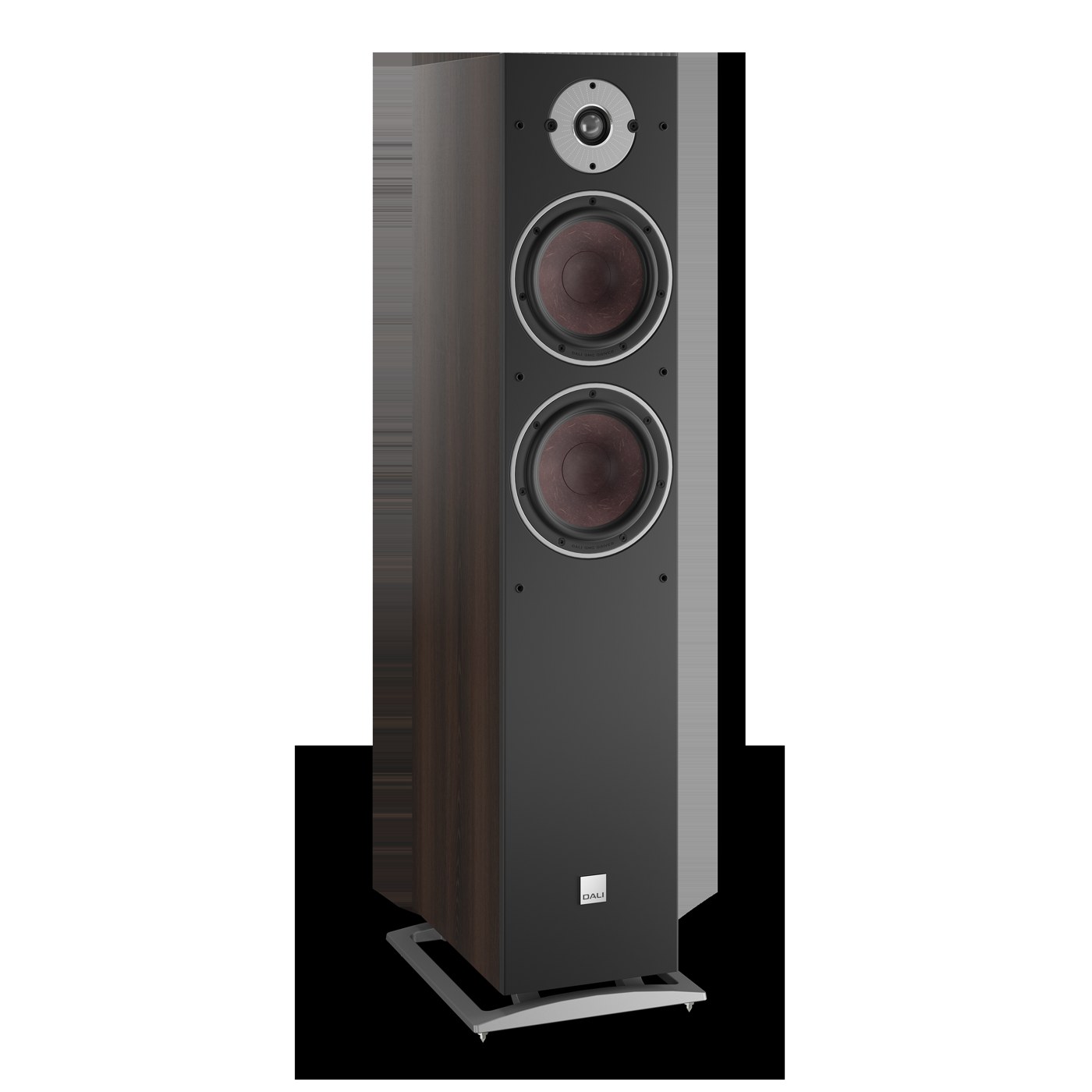
Summary
The Oberon 7 was the largest floorstander in the Oberon series (DALI now lists the Oberon 9 as the top model): two 180 mm wood-fibre woofers, 29 mm fabric dome, 88.5 dB (2.83 V/1 m), 6 Ω, recommended 30–180 W, 36–26,000 Hz (±3 dB). Market price often approx. €898–1,098/pair. According to Lyd & Bilde and HiFiReport dynamic, room-filling and easy to drive — no substitute for high-end Expert speakers.
Assumptions
- Price per pair Sept 2026
- Living room, floor placement / some distance from the wall
- Amplifier 30–180 W to 6 Ω
- No measurements or listening tests of our own
Specs (public / manufacturer)
| Type | 2-way floorstanding speaker · Bass-reflex |
|---|---|
| Sensitivity | 88.5 dB (2.83 V/1 m) |
| Impedance | 6 Ω nominal |
| Rec. Amplifier power | 30–180 W |
| Frequency range | 36–26,000 Hz (±3 dB) |
| Chassis | 2×180 mm wood fibre · 29 mm fabric dome |
| Dimensions / weight | 1015 × 200 × 340 mm · 14.8 kg/piece |
| Price guide | Market price approx. €898–1,098/pair · Sept 2026 · Check the price date |
Manufacturer specifications (DALI)
| Type | 2-way floorstanding speaker, bass reflex (tuned to 39.5 Hz) |
|---|---|
| Drivers | 1 × 29 mm soft dome · 2 × 7″ wood-fibre SMC woofers |
| Frequency response | 36–26,000 Hz (±3 dB) |
| Sensitivity | 88.5 dB (2.83 V/1 m) |
| Impedance | 6 Ω nominal |
| Recommended amplifier power | 30–180 W |
| Max. SPL | 110 dB |
| Crossover frequency | 2,300 Hz |
| Dimensions | 1.015 × 200 × 340 mm (H × W × D) |
| Weight | 14.8 kg |
| Data sheet | DALI OBERON white paper 2020 (spec table) |
Source: DALI – official specifications · As of 16 October 2026 · subject to change by the manufacturer
Scores in detail
Vinyl BotPro Index: 69 · Index band Premium 55–69 · Guidance only, not a lab value.
Strengths
- High sensitivity 88.5 dB — amp-friendly
- Dynamic, room-filling sound (consensus of the reviews)
- Strong floorstander bass (slight 100–200 Hz colouration per Lyd & Bilde)
Weaknesses
- Cabinet size needs space
- No Bi-Wiring
- No Expert-level high-end refinement
Comparison models
| vs. Oberon 5 | More bass/level reserve, larger |
|---|---|
| vs. LS50 Meta | Easier to drive, less meta-precision |
| vs. BR08 | Warmer; BR08 louder (92 dB) |
System matching
Works well with
- Premium integrated amplifier 50–120 W (A-S801, PM8006, A14MKII)
- Medium/large rooms
- Vinyl systems with warm chain
Less suited
- Very small rooms / near field
- Ultra-analytic monitor fans
- Weak starter amps below 30 W
Analysis: the DALI Oberon 7 in depth
What this page is: an AI analysis, not a listening session
This page summarises what can be documented about the DALI Oberon 7 from manufacturer information and three reviews from Norway, Russia and Taiwan. Vinyl BotPro has neither listened to nor measured these speakers. We paraphrase sound descriptions as statements by the named authors, each with a date and under their conditions, and flag our own assessments as such. The Norwegian and Russian reviews are paraphrased in translation. The page's rank, index and price information stay unchanged.
Model separation and status
- Oberon 7: the passive floorstander analysed here, with two 7-inch mid/bass drivers. It needs an amplifier [1].
- Oberon 5: the smaller floorstander with two 5¼-inch drivers. hi-fi.ru listened to both models together [3].
- Oberon 3: the standmount, which uses the same 7-inch driver as the Oberon 7 [4].
- Oberon 9: linked on DALI's page as the range-topping model [1]. When the reviews were written, the Oberon 7 was the largest model [2][4]. By DALI's own account, the "flagship" label now belongs to the Oberon 9.
The Oberon series launched in 2018 [4]. According to hi-fi.ru it replaced the Zensor series [3]. Lyd & Bilde places it on price between Zensor/Spektor and Opticon [2]. On DALI's UK site, the Oberon 7 sat in the "Discontinued" section when we accessed it on 8 November 2026 [1]. We have not checked the German market. The page's price information stays unchanged.
Technology according to DALI
DALI lists for the Oberon 7 [1]:
- Design: two-way, bass reflex. Both 7-inch drivers cover the same bass and midrange band [1][2].
- Tweeter: 29 mm fabric dome, developed specifically for the Oberon series.
- Mid/bass drivers: two 7-inch units with a new wood-fibre structure and a low-loss suspension.
- Motor: a patented SMC disc in the pole piece, meant to sharply reduce mechanical distortion from hysteresis and eddy currents.
- Crossover frequency: 2,300 Hz.
- Frequency range: 36 Hz to 26 kHz (±3 dB).
- Sensitivity: 88.5 dB (2.83 V/1 m).
- Impedance: 6 Ω nominal.
- Maximum SPL: 110 dB (1 m).
- Recommended amplifier power: 30 to 180 W.
According to Lyd & Bilde and HiFiReport, the speaker measures 101.5 × 20 × 34 cm (H × W × D) and weighs 14.8 kg each [2][4]. That matches the page's specs table.
Details from the reviews
- Tweeter: HiFiReport, citing DALI, gives a diaphragm mass of 0.060 mg/cm², about half that of typical domes this size. It adds ferrofluid cooling and damping behind the dome. The faceplate geometry comes from Rubicon and Opticon [4].
- Why 29 mm: according to Lyd & Bilde and HiFiReport, the larger dome can play lower. That puts the 2.3 kHz crossover below the sensitive region around 3 kHz and makes the woofers less directional [2][4].
- Voice coil: four layers of copper-clad aluminium wire [4].
- SMC: according to Lyd & Bilde, SMC first appeared in the expensive Epicon series; Oberon uses a simpler variant [2]. hi-fi.ru calls SMC the key difference from the previous Zensor series [3].
- Damping: according to HiFiReport, DALI damps the top, bottom and sides but not behind the baffle, so that bass between the drivers and the port is not choked [4].
- Cabinet: MDF with internal bracing, rear port, a single pair of binding posts, no bi-wiring [1][4]. The finish is vinyl wrap with a matte front [3].
- Base: aluminium with spikes at each corner for levelling [1][4]. According to Lyd & Bilde, spikes and rubber feet are included [2].
- Grille: Lyd & Bilde criticises push-in pegs instead of magnets; without the grille, the holes in the baffle remain visible [2].
Finishes
Lyd & Bilde lists black ash, white, light oak and dark walnut [2]. HiFiReport describes a walnut sample with a matte black front and mentions other versions, but does not make clear whether it means veneer or foil [4]. hi-fi.ru speaks of vinyl wrap with a wood look [3]. We assume foil, as across the whole Oberon series.
SMC explained in more detail
Lyd & Bilde describes SMC (Soft Magnetic Compound) as a material that is ground to powder and then baked. It conducts magnetism but hardly conducts electricity [2]. Conventional iron pole pieces do conduct current, and differently at different frequencies, so the magnetic field varies with the music signal and creates harmonic distortion [2]. hi-fi.ru adds, citing DALI, that SMC consists of tiny coated metal spheres and can be shaped freely, so it can sit exactly where it best stabilises the field in the gap. DALI promises above all lower third-order distortion and better thermal stability at high power [3]. According to hi-fi.ru, SMC had been too expensive for budget ranges until rising volumes made it possible [3]. HiFiReport stresses that it cannot verify the effect by measurement and relies on listening [4]. The same applies to this analysis: the distortion claims are manufacturer claims.
Wide dispersion as a design goal
DALI explains that driver materials, geometry and crossover are designed for wide, even dispersion. The sound is meant to stay coherent well off axis, with fewer diffraction effects and less harmonic distortion [1]. hi-fi.ru cites the baffle shape, mounting and driver layout as part of this concept [3]. HiFiReport writes that this means you are not tied to a narrow sweet spot [4]. In our assessment, this is mainly useful in living rooms with several seats.
Use in home cinema
The Oberon series also includes centre and on-wall speakers. hi-fi.ru announced that it would listen to the series in various scenarios, but this article only assesses stereo [3]. HiFiReport imagined an Oberon home cinema while playing "Brothers in Arms", but also listened only in stereo [4]. No conclusions about multichannel matching can therefore be drawn from these sources.
What the figures mean
- 88.5 dB / 6 Ω: Lyd & Bilde ran the Oberon 7 from a Denon PMA-800NE at 2 × 50 W, and drive and attack were surprisingly well preserved [2]. HiFiReport reached high levels with the Linear Acoustic LAV-60MK2 with the volume control at about 10 o'clock and calls the speaker easy to drive [4].
- 36 Hz: with two 7-inch drivers, this is the deepest figure in the original Oberon series [1][3].
- Difference from the Oberon 5: according to hi-fi.ru, the Oberon 7 is more solid in the bass and creates a larger soundstage, while the Oberon 5 places instruments slightly more precisely [3].
Lyd & Bilde (January 2019)
Geir Gråbein Nordby reviewed the Oberon 7 for Lyd & Bilde on 9 January 2019; the Norwegian list price was NOK 9,996 [2]. He listened with the Denon PMA-800NE and the Hegel H190 [2]. His impressions [2]:
- Crisp, clear overtones that do not turn sharp.
- Springy bass; the speaker copes well with a medium-powered amplifier.
- Good stereo width. Acoustic music sounds very good because timbres come through clearly.
- Weaknesses: the huskier vocal register lacks some fullness compared with the System Audio Saxo 50. A slight lift between 100 and 200 Hz can make bass instruments a little "boomy" and less differentiated.
- Verdict: with a bit more midrange scale and better bass linearity, the Oberon 7 would have been right at the top.
hi-fi.ru (November 2018)
hi-fi.ru listened to the Oberon 7 and Oberon 5 together in autumn 2018. The online article is dated 20 November 2018; the Russian price of the Oberon 7 was RUB 76,300 [3]. The system: DALI Sound Hub as source and preamplifier, Densen B-120 as power amplifier, in a large, acoustically treated room [3]. The impressions [3]:
- First impression: "correct". Natural attack, fundamental and decay without artificial emphasis.
- Balanced, finely resolved treble. Calm, even midrange suited to long sessions.
- With some distance from the wall, the bass is fast, deep and clear, excellent for the price. The speaker cannot convey the full scale of a large organ.
- A convincing three-dimensional soundstage.
- hi-fi.ru suggests the Oberon 7 for rock, large-scale classical and bass-heavy electronica, and the Oberon 5 for music where timbre and space come first.
HiFiReport (Taiwan)
HiFiReport published the review online on 10 March 2025. The text, however, refers to the 2018 launch and "this year's" High End show, so it is probably a later publication of an older text. The date stays open [4]. The price was NT$45,800 [4]. The amplifier was the Linear Acoustic LAV-60MK2 [4]. The impressions [4]:
- Clean, articulate, dynamic, energetic and expressive.
- A focused, powerful sound without the typical looseness of budget speakers.
- Open and spacious, without compression even at high levels.
- Weight and warmth, but without artificial emphasis at the expense of naturalness. Clear, realistic vocals.
- Limits: compared with pricier DALI models, texture and density in the mids and highs are slightly less refined, and bass resolution does not quite match them.
- As references in the listening room, HiFiReport names the Wilson Audio Alexia 2 and Dynaudio Contour 60, which it found superior in scale and punch respectively.
Music examples from the reviewers
- Lyd & Bilde [2]: Savannah Conley's "Same Old Eyes" with a bright voice and crisp, nuanced guitar picking. Anderson .Paak's "Tints" with Kendrick Lamar, with a strong rhythm section and bass with bite and weight, but audible colouration.
- HiFiReport [4]: Schumann's Piano Concerto with Radu Lupu: focused and powerful, with clear, shimmering piano. Sibelius's "Finlandia" (Ashkenazy) with a large soundstage even at high level. Dire Straits' "Money for Nothing" and "Brothers in Arms" with clear vocals and springy drums. Eivør's "Min Modir" (on DALI CD 4), live and without harshness.
- hi-fi.ru [3]: cites bass guitar and double bass with clean attack, and organ music as a limit.
Placement
- Orientation: DALI designs the drivers for wide dispersion and recommends no toe-in [1]. Lyd & Bilde explains that the low crossover point makes dispersion more even and toe-in less important [2].
- Wall distance: DALI describes the rear ports as a way to use the rear wall for bass [1]. hi-fi.ru heard the best bass with some distance from the wall [3]. In our assessment, given the 100–200 Hz lift that Lyd & Bilde describes [2], it is worth choosing the wall distance carefully.
- Coupling: spikes if the floor allows, otherwise the included rubber feet [2].
- Room size: DALI presents the Oberon 7 as its model for deep bass and large rooms [1]. Lyd & Bilde sees it in normal-sized living rooms [2].
Amplification according to the sources
- Lyd & Bilde: Denon PMA-800NE (2 × 50 W) and Hegel H190. With the Hegel, Nordby says, the speaker came close to its best [2].
- hi-fi.ru: Densen B-120 as power amplifier [3].
- HiFiReport: Linear Acoustic LAV-60MK2 [4].
The page's system-matching list names integrated amplifiers of 50 to 120 W with examples. Those examples do not come from the reviews and stay unchanged.
In a vinyl system
None of the reviews names a turntable as a source [2][3][4]. Lyd & Bilde mentions that the Denon PMA-800NE it used has an MM and MC phono input, but did not use it for the review [2]. For vinyl, only what follows from the data applies: the Oberon 7 is passive and needs an amplifier. A turntable needs a phono stage, built in or separate. Where the turntable stands depends on the rack and cable runs, not on the speakers. Given the strong bass, in our assessment a vibration-isolated turntable position makes sense, regardless of its distance from the speakers.
Where the sources agree
- Dynamics and energy: strong [2][3][4].
- Soundstage: wide and spacious [2][3][4].
- Bass: powerful and room-filling. Lyd & Bilde hears slight colouration between 100 and 200 Hz; hi-fi.ru praises its speed and clarity [2][3].
- Treble: clear, without harshness [2][3][4].
- Limits: the midrange and fine resolution do not match pricier models [2][4].
Open points and limits of this analysis
- Bass: colouration (Lyd & Bilde) versus very good clarity (hi-fi.ru). The room may explain it; the sources do not settle it.
- HiFiReport date: online 2025, text probably from 2018.
- Availability: DALI UK lists the Oberon 7 under "Discontinued" [1].
- Measurements: none of the sources publishes measurements.
- Prices: NOK 9,996 (01/2019), RUB 76,300 (11/2018), NT$45,800 [2][3][4]. The page's price information stays unchanged.
- A detailed human fact-check of this analysis is still pending.
Sources for this analysis
- DALI: Oberon 7 (Produktseite). https://www.dali-speakers.com/en-gb/products/oberon/oberon-7
- Lyd & Bilde: Dali Oberon 7 (Geir Gråbein Nordby, 09.01.2019). https://www.lydogbilde.no/test/hoyttalere/dali-oberon-7-2/
- hi-fi.ru: DALI OBERON 7 und OBERON 5. https://www.hi-fi.ru/magazine/audio/test-dali-oberon-5-7/
- HiFiReport: Dali Oberon 7 Floorstanding Loudspeaker Review. https://www.hifireport.com/dali-oberon-7-floorstanding-loudspeaker-review/
Created by AI (Vinyl BotPro) from the sources listed; no listening tests or measurements of our own. Detailed human fact-check pending.
Created by Vinyl BotPro (AI) · As of Sept 2026 · Corrections: info@vinylcination.de