
Floorstanding speaker · AI analysis · Expert, rank 2
DALI Rubikore 6: Analysis
AI analysis (research): floorstanding speaker, 88.5 dB / 4 Ω, 40–200 W, hybrid soft-dome and planar design, Clarity Cone — specifications and prices, no listening test.
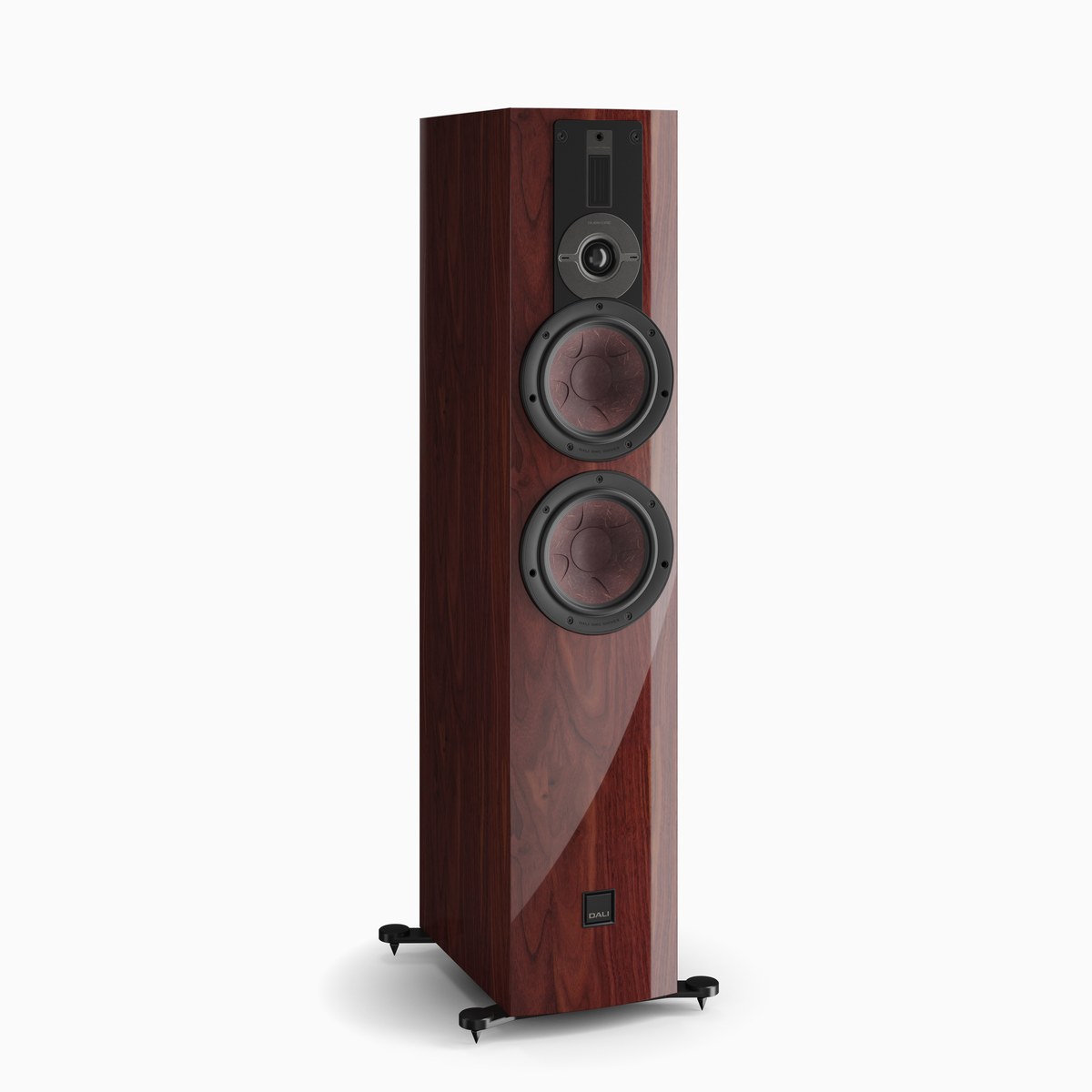
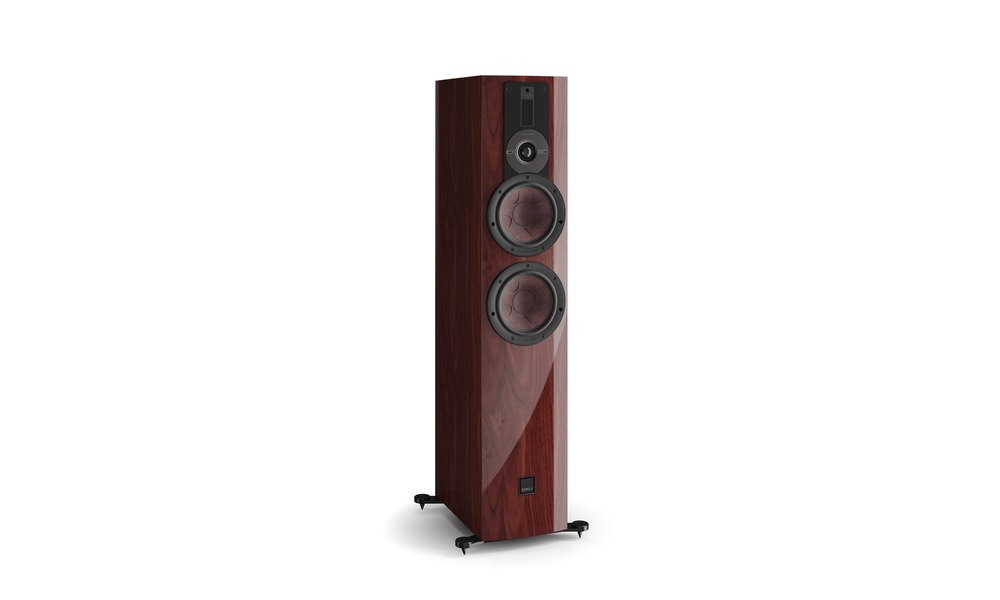
Summary
The rubikore 6 follows the Rubicon line: two 6½″ Clarity Cone wood-fibre drivers, hybrid tweeter (29 mm fabric + 17×45 mm planar), 88.5 dB, 4 Ω, 40–200 W, 38–34,000 Hz (±3 dB). MSRP often approx. €4,998/pair, outlet partly ~€4,298. For VinylCination, attractive with vinyl: wide dispersion, slightly warm voicing (per hifi.nl) — 4 Ω clearly marked.
Assumptions
- Price per pair Sept 2026
- Living room stand / distance from the wall 20–180 cm
- Amplifier 40–200 W to 4 Ω
- No measurements of our own
Specs (public / manufacturer)
| Type | 2½+½-way floorstanding speaker · Bass-reflex |
|---|---|
| Sensitivity | 88.5 dB (2.83 V/1 m) |
| Impedance | 4 Ω nominal |
| Rec. Amplifier power | 40–200 W |
| Frequency range | 38–34,000 Hz (±3 dB) |
| Chassis | 2×6½″ Clarity Cone · Hybrid soft domes + planar |
| Dimensions / weight | 990 × 200 × 380 mm · 23 kg/piece |
| Price guide | MSRP approx. €4,998 · Outlet part ~€4,298/pair · Sept 2026 |
Manufacturer specifications (DALI)
| Type | 2½+½-way floorstanding speaker, bass reflex |
|---|---|
| Drivers | 17 × 45 mm planar + 1 × 29 mm soft dome · 2 × 6½″ Clarity Cone bass/mid drivers |
| Frequency response | 38–34,000 Hz (±3 dB) |
| Sensitivity | 88.5 dB (2.83 V/1 m) |
| Impedance | 4 Ω nominal |
| Recommended amplifier power | 40–200 W |
| Max. SPL | 110 dB (1 m) |
| Crossover frequency | 800 / 2,600 / 14,000 Hz |
| Dimensions | 990 × 200 × 380 mm (H × W × D) |
| Weight | 23 kg |
| Data sheet | dimensions/weight: DALI product catalogue 2025–2026 |
Source: DALI – official specifications · As of 16 October 2026 · subject to change by the manufacturer
Scores in detail
Vinyl BotPro Index: 83 · Index band Expert 70–84 · Guidance only, not a lab value.
Strengths
- Hybrid Soft/Planar — wide radiation
- 88.5 dB/2.83 V; reviewers recommend a capable amplifier
- Successor to the Rubicon 6 with KORE-derived technology
Weaknesses
- 4 Ω nominal — plan for a 4 Ω-stable amplifier
- MSRP close to 5 k€
- Deep bass can overpower small rooms
Comparison models
| vs. Rubicon 6 (predecessor) | per hifi.nl same cabinet, largely new internals |
|---|---|
| vs. R7 Meta | different concept (KEF Uni-Q coaxial driver); no documented direct sound comparison |
| vs. Opticon 8 MK2 | larger 3+½-way floorstander (2×8″ bass, 6½″ midrange, hybrid tweeter) per DALI |
System matching
Works well with
- Capable integrated amplifier, stable into 4 Ω
- Medium to large living rooms
- Vinyl chains with focus on musicality
Less suited
- Very weak amps
- Ultra-analytic monitor fans only
- If you only want a bookshelf speaker
Analysis: the DALI Rubikore 6 in depth
What this is: an AI analysis, not a listening test
This page summarises what can be documented about the DALI Rubikore 6 from manufacturer material and international reviews. Vinyl BotPro has neither listened to nor measured these loudspeakers. Where we talk about sound, we paraphrase what named reviewers described under their own conditions. We explain the technology with general acoustics and mark which statements come from the manufacturer and which are our own interpretation. This analysis does not change any score, rank or index: the Rubikore 6 remains in second place in the Expert tier with an index of 83 and keeps its Sound Champion title.
Context: the successor to the Rubicon 6
DALI introduced the Rubikore series at High End 2024 in Munich. It comprises five models, including the floorstanders Rubikore 6 and Rubikore 8 [8]. The series follows the Rubicon range. What stayed the same is notable: according to hifi.nl, DALI kept the Rubicon cabinets, so from a distance the new series hardly looks new [3]. Almost everything inside is new, however – drivers, crossover, tweeter module and reflex ports [3][8]. DALI describes the Rubikore 6 as a loudspeaker for "ambitious" stereo and home-theatre systems in medium to larger rooms and stresses technology derived from its flagship, the KORE [1].
The Rubikore 6 is the smaller of the two floorstanders: just under a metre tall (990 × 200 × 380 mm) and 23 kg per speaker [1][2]. The narrow 20 cm front is matched by a depth of 38 cm. The cabinet is internally braced; DALI calls it rigid and low in resonance [1]. It is built at DALI's factory in Denmark [1].
Layout: 2½ + ½ ways
DALI calls the concept "2½ + ½-way", with crossover points at 800, 2,600 and 14,000 Hz [1]. Behind this is a clear division of labour:
- The lower 6½-inch driver works in the bass only and is rolled off above roughly 800 Hz [2][6].
- The upper 6½-inch driver covers bass and midrange and hands over to the tweeter only at 2,600 Hz [2][6].
- The 29 mm fabric dome takes over from 2,600 Hz [1].
- From about 14,000 Hz the planar tweeter (17 × 45 mm) joins in [1][6].
The "½" refers to the driver that only helps in the bass. Why do it this way? At low frequencies two diaphragms together increase the radiating area and thus the achievable sound pressure, without either having to move as far. In the midrange, by contrast, a second driver a few centimetres away would be more of a hindrance: two sources at a distance combine differently depending on the listening angle, which can make the off-axis response less even. If only one driver runs up to 2,600 Hz, the vocal range stays with a single source. That is a general explanation of the principle; DALI puts it as both woofers combining in the bass for volume, while in the midrange one of them alone handles "the core of the music" [2].
A second, frequently cited reason for this layout is baffle step: at low frequencies a loudspeaker radiates in all directions, at higher frequencies mainly forwards, so on-axis bass level drops. An additional bass driver can compensate for this loss. Whether and how DALI uses this in the crossover is not published – we offer it as a plausible but undocumented interpretation.
Two chambers, two reflex ports
There are two bass reflex openings on the back, one at the top and one at the bottom (see manufacturer photo). The British reviewer behind the YouTube channel "A British Audiophile" explains this with two separate internal chambers: one for the upper three drivers and one for the lower woofer [6]. DALI's manual gives the tuning frequency as 34 Hz [5].
A reflex port uses the mass of air in the port and the volume of air in the cabinet as a resonator. Around the tuning frequency the port does a large part of the radiating, and the cone moves comparatively little. Below the tuning frequency this reverses: the output falls steeply and the cone is hardly held back by the air cushion any more. This matters for vinyl listeners – more on that below.
DALI calls the ports "Continuous-Flare" ports [1]. hifi.nl describes them as tubes with a narrower middle and wide openings, designed so that deep, loud notes do not cause airflow noise [3]. Wide, rounded openings lower the air velocity at the edges where turbulence would otherwise form – the principle is common, the specific execution is DALI's own. DALI states a frequency range of 38 to 34,000 Hz (±3 dB) [1]; how much of it arrives in your own room depends heavily on room and placement.
Drivers: Clarity Cone and SMC
The two bass/midrange drivers have diaphragms made of paper and wood fibre, which DALI calls "Clarity Cone" [1][5]. hifi.nl describes a revised shape with subtle arcs in the cone and a new coating, both first used in the KORE; according to the designers this is meant to make the driver more linear, particularly in the upper midrange [3]. That documents the manufacturer's intent, not a measured effect.
The second building block is SMC (Soft Magnetic Compound), a material DALI has used for years. hifi.nl explains the essence: SMC conducts magnetic flux well but hardly conducts electricity, and here it is used in the pole piece [3]. SoundStage! describes it the same way – magnetic, but not electrically conductive [7].
Why this matters can be explained physically. In a loudspeaker motor the voice coil, carrying the signal current, moves in a magnetic field. The changing field of the coil induces so-called eddy currents in the surrounding iron. These in turn create fields that oppose the drive and change with excursion and frequency. That can cause distortion and a frequency-dependent impedance. A material that conducts magnetism well but electricity poorly suppresses these currents. DALI states low losses and low distortion as the goal [1][8]. We had no independent measurements quantifying the effect in the Rubikore 6.
The Rubikore 6 motor also uses a dual-magnet system that, according to hifi.nl, likewise comes from the top model [3]. In the crossover DALI uses inductors with SMC cores ("SMC-KORE" inductors) [1]; according to a launch report, Mundorf capacitors are added [8].
The hybrid tweeter: dome plus planar
The tweeter module combines a 29 mm fabric dome with a 17 × 45 mm planar magnetostatic tweeter [1][5]. What is new about the dome is that it does without ferrofluid [1]. Ferrofluid is a magnetic liquid in the gap that, in many tweeters, carries away heat and damps the movement. Without it, that damping is gone; DALI therefore calls the dome "low loss", and The Ear links this to lower damping losses and better transient response [1][4]. Whether that difference is audible depends on the overall voicing – there is no isolated proof.
Why two tweeters? Physics helps here. At 14,000 Hz the wavelength in air is about 2.5 cm – less than the diameter of the 29 mm dome. When a diaphragm becomes large relative to the wavelength, it increasingly beams sound forward, and less treble reaches the sides. The planar tweeter is only 17 mm wide. A narrow surface disperses more widely in the horizontal plane, while its 45 mm height narrows dispersion vertically. This fits DALI's wide-dispersion concept [1][5]; The Ear also credits the planar element with contributing to horizontal dispersion [4]. Beyond that, The Ear attributes mainly air and spatial information to it, rather than extra "detail" [4].
One caveat belongs here: many adult listeners hear little above 14 kHz. The Ear notes this with some self-irony [4]. The planar's contribution is therefore likely to lie mainly in dispersion – in what reaches the listener via room reflections – rather than in direct level.
Reading the manufacturer data correctly
Sensitivity: 88.5 dB at 2.83 V and 1 m [1]. The figure refers to a voltage, not a power. As an approximation only: taking the nominal impedance of 4 Ω, 2.83 V corresponds to about 2 W, which converts to roughly 85.5 dB per watt. Because the real impedance varies with frequency, this is not a true wide-band efficiency measurement but a reference point for comparing with spec sheets quoted in dB/W. Conversely, an 8 Ω loudspeaker rated at "88 dB/2.83 V" nominally draws only about half the power at the same voltage.
Nominal impedance: 4 Ω [1]. Nominal impedance is a simplified rating. The actual curve varies with frequency, and that curve decides how much current an amplifier has to deliver. DALI's manual states that all DALI loudspeakers are designed with a linear impedance [5]. We had no independent impedance measurement from an approved source.
Recommended amplifier power: 40–200 W [1]. The lower limit does not mean 40 W is always enough, and the upper limit is not a power-handling rating. DALI explains in the manual that loudspeakers are more often damaged by small amplifiers driven into clipping than by powerful ones, because a clipping signal sends a lot of energy into the tweeter [5].
Maximum SPL: 110 dB at 1 m [1]. DALI does not state the measurement method – neither signal type and bandwidth, nor duration, distortion limit, or whether a single speaker is meant. Such figures therefore cannot simply be extrapolated from sensitivity: real loudspeakers compress at high levels, music has a high peak-to-average ratio, and impedance changes with frequency. For practical purposes, a rough guide is enough: in free field, level drops by about 6 dB per doubling of distance, so at 3 m it is roughly 9.5 dB lower than at 1 m; a second speaker and the room raise the level at the listening seat again. How much amplifier power someone actually needs depends on room, distance, music and desired volume.
What international reviewers describe
For the sound description we rely on two detailed written reviews: The Ear from the UK [4] and hifi.nl from the Netherlands [3]. We use the video review by "A British Audiophile" [6] only for technical details. The two reviews agree on some points and differ on others – often for understandable reasons.
Common ground. Both describe a coherent, well-integrated presentation. James Palmer of The Ear calls it unshowy and aimed at rightness rather than effect; the midrange sits cleanly on top of the bass and voices come across clearly [4]. Jamie Biesemans of hifi.nl highlights coherence and a slightly warm, engaging presentation [3].
Bass. The Ear reports very deep, fast and controlled bass, for example with electronic music and organ [4]. hifi.nl describes the upper bass as somewhat full, with "body" even at low volume, and better bass control and extension than the Rubicon 6 [3]. The two observations are not mutually exclusive: deep extension and a slightly emphasised upper bass can coexist in the same voicing, and rooms reinforce individual ranges differently.
Treble and resolution. The Ear praises the hybrid tweeter for airy, open treble [4]. hifi.nl, by contrast, sees "no ultimate resolution in the treble" and writes that analytically minded listeners might not find the presentation spacious enough [3]. At the same time hifi.nl calls the Rubikore 6 forgiving of mediocre recordings and compressed files, unlike some rivals [3]. These points belong together: a voicing that keeps weak recordings from sounding harsh usually also presents fine detail less aggressively.
Character. hifi.nl speaks of a typically DALI, "slightly laid-back" sound [3]. The Ear sees the lack of "wow factor" as a possible drawback for some listeners but as an advantage for long, fatigue-free listening [4].
Conditions. The Ear listened in a 3.5 × 5 m room with a 100 W Class A amplifier [4]. hifi.nl used, among other things, a Technics SL-1200GR2 with an Audio-Technica VM750SH into a Musical Fidelity integrated amplifier, plus an NAD pre/power combination, without room correction [3]. Differences between the reviews should be read against this background: different rooms, different amplifiers, different music, different ears.
Amplification: what "needs power" means here
The Ear recommends an amplifier with muscle and grip and advises against low-powered valve amplifiers [4]. hifi.nl reaches a similar conclusion: the Rubikore 6 needs a fair amount of power, and the 4 Ω nominal impedance has to be taken into account [3].
What does that mean in practice? With a nominal sensitivity in this range, a few watts are usually enough for normal room levels. Power is needed for peaks and deep bass. More important than the wattage on the spec sheet is whether an amplifier stays stable into 4 Ω and delivers enough current. Manufacturers usually quote a 4 Ω power figure; if it nearly doubles compared with 8 Ω, that suggests a strong power supply. Low-powered valve amplifiers with a high output impedance can audibly bend the frequency response of a 4 Ω loudspeaker if its impedance varies strongly with frequency.
Bi-wiring and bi-amping. The Rubikore 6 has two pairs of terminals: the upper pair feeds the crossover's treble section, the lower pair the bass section [5]. For bi-wiring or bi-amping, the metal jumpers must be removed [5]. Whether bi-wiring brings audible benefits is disputed; there is no solid evidence for this model. Bi-amping with two separate power amplifiers is the more significant step technically, but also a question of cost.
Placement and room
DALI recommends a distance of 20 to 180 cm from the rear wall [5]. The manual explicitly advises against toeing the speakers in towards the listening position and recommends placing them parallel to the rear wall; the wide dispersion is meant to cover the listening area evenly and reduce distortion in the main listening zone [5].
In practice there is a counter-example: James Palmer had to toe the Rubikore 6 in considerably and move them further apart in his room before the imaging snapped into focus [4]. That is not a contradiction but a question of the room. A wide-dispersion speaker produces stronger reflections from the side walls. In a large room with distant walls that is desirable. If the side walls are close, early reflections can blur the image; toe-in reduces them. The sensible approach is to start with DALI's recommendation and experiment step by step – as the manual itself suggests [5].
Room size. DALI targets medium to larger rooms [1]. The Ear warns that the bass can overwhelm smaller rooms [4]. The closer a loudspeaker is to the wall, the more the room reinforces bass; deep notes also excite room modes, which, depending on the seat, cause boom or dips. In small rooms, more distance from the wall is often the first lever, with room correction or bass traps the next.
Spikes or bumpers. A Premium Spike Set is supplied; the spikes screw into aluminium feet [2][5]. DALI suggests trying spikes or rubber bumpers and points out that spikes can damage delicate floors [5].
Running-in. DALI states up to 100 hours until best performance is reached [5]. That is a manufacturer claim we cannot verify.
The Rubikore 6 in a vinyl system
For record listeners there are three points that go beyond the choice of loudspeaker.
Subsonic signals. Warped records and tonearm/cartridge resonances produce signals below 20 Hz that you cannot hear. With a bass reflex speaker tuned to 34 Hz [5], such frequencies are particularly unwelcome: below tuning the cabinet hardly restrains the cone, which can visibly "pump". That eats into headroom and can muddy the sound. A phono stage with a subsonic filter, or a well-matched tonearm and cartridge, helps.
Acoustic feedback. A loudspeaker that plays powerfully into the deep bass can excite the turntable through the floor or furniture. The cartridge picks up the vibration, which is amplified and radiated again. Distance between turntable and speakers and a stable, isolated support help prevent this.
Tonal match. hifi.nl played records on a Technics SL-1200GR2 with an Audio-Technica VM750SH into a Musical Fidelity integrated amplifier, noting the Rubikore 6's slightly warm touch and a convincing atmosphere with voices and small sonic details [3]. hifi.nl places the NAD combination used later considerably higher in the market [3]. That is a single observation, not a recipe. It does suggest, however, that the Rubikore 6 does not necessarily need the most expensive electronics, as long as the amplifier drives the 4 Ω load securely.
Limitations and open points
- No independent measurements in this analysis. We could not document frequency response, impedance minimum or distortion from approved sources.
- Weight and handling. 23 kg per speaker; according to The Ear, the distributor asked in advance whether a second person would be available to help with installation [4].
- Grilles. hifi.nl would have liked magnetically attached grilles [3].
- Voicing. Anyone looking for maximum treble resolution or a very taut, matter-of-fact sound will find indications in the reviews that the Rubikore 6 is voiced more for coherence and warmth [3][4].
- Price. The Rubikore 6 sits in a range where room, electronics and placement shape the sound at least as much as the loudspeaker itself.
Placement in the Vinyl BotPro Index
The index of 83 and the sub-scores remain unchanged and are explained in the "Points in detail" section. The evidence gathered here particularly supports the high sub-scores for technology and expected performance: manufacturer data and several independent reviews describe elaborate technology derived from more expensive models and a consistently positive, if differently nuanced, description of the sound. The lower value-for-money sub-score reflects the price class. A purchase decision should depend on your own room, amplifier and taste – ideally after an audition.
Sources
- DALI: RUBIKORE 6 – Produktseite / product page (Specifications, Features). https://www.dali-speakers.com/en/products/rubikore/rubikore-6/
- HORN Distribution: DALI RUBIKORE 6 – Produktdaten / product data (Abstimmfrequenz, Zubehör). https://eu.horn.eu/en/EU/PRODUCTS/SPEAKERS/FLOORSTANDING/RUBIKORE_6?s1=1
- Biesemans, J. (17.08.2024): Review DALI Rubikore 6: Deen met high-end in z’n lijf. hifi.nl. https://hifi.nl/artikel/review-dali-rubikore-6-deen-met-high-end-in-zn-lijf
- Palmer, J.: Dali Rubikore 6: Greater Than The Sum Of Its Parts. The Ear. https://the-ear.net/review-hardware/dali-rubikore-6-greater-than-the-sum/
- DALI: RUBIKORE Series Manual (PDF, bereitgestellt von / hosted by Richer Sounds). https://www.richersounds.com/content/product_files/RUBIKORE_Manual.pdf
- A British Audiophile (YouTube): KORE IMPROVEMENT? DALI Rubikore 6 Speaker Review. https://www.youtube.com/watch?v=mFGjbscWk_8
- SoundStage! Global: UK Hi-Fi Show Live 2024, Days 1 and 2 (Messebericht / show report). https://www.soundstageglobal.com/index.php/shows-events/uk-hi-fi-show-live-2024-…
- HiFi Hype: Dali presents Rubikore product line at High End Munich (2024). https://www.hifihype.com/speakers/dali-presents-rubikore-product-line-at-high-en…
Created by AI (Vinyl BotPro) from the sources listed; no listening tests or measurements of our own. Detailed human fact-check pending.

Created by Vinyl BotPro (AI) · As of Sept 2026 · Corrections: info@vinylcination.de