
Bookshelf speaker · AI analysis · Master, rank 2
Dynaudio Confidence 20: Analysis
AI analysis (research): standmount speaker from the Confidence series with an Esotar 3 tweeter, an MSP mid/bass driver and a down-firing bass port; based on manufacturer data, the international specialist press and The Absolute Sound.
Summary
The Confidence 20 (approx. 11,000 € per pair) is the standmount of the Confidence series: a 28 mm Esotar 3 tweeter and an 18 cm MSP mid/bass driver in a 2-way bass-reflex cabinet with a down-firing port. Dynaudio quotes 87 dB and 6 Ω (min. 5 Ω). The Absolute Sound (02/2024) recommends it explicitly; What Hi-Fi? (09/2021) praises detail and bass but misses some verve. In October 2026 Dynaudio announced the successor Confidence 20i (see analysis).
Specs (public / manufacturer)
| Type | 2-way compact speaker · bass reflex (down-firing port) |
|---|---|
| Sensitivity | 87 dB (2.83 V/1 m) |
| Impedance | 6 Ω (min. 5 Ω @ 155 Hz) |
| Power handling | IEC long-term power handling 250 W |
| Frequency range | 42 Hz–22 kHz (±3 dB) |
| Chassis | 28 mm Esotar 3 · 18 cm MSP mid/bass driver |
| Dimensions / weight | 233 × 520 × 414 mm · 27 kg (manufacturer figure) |
| Price guide | approx. €11,000/pair · Sept 2026 |
Manufacturer specifications (Dynaudio)
| Type | 2-way bookshelf speaker, bass reflex (down-firing port) |
|---|---|
| Drivers | 28 mm Esotar 3 · 18 cm MSP mid/woofer |
| Frequency response | 42 Hz–22 kHz (±3 dB) |
| Sensitivity | 87 dB (2.83 V/1 m) |
| Impedance | 6 Ω (min. 5 Ω at 155 Hz) |
| IEC long-term power handling | 250 W |
| Crossover frequency | 2,325 Hz (2nd order) |
| Dimensions | 233 × 520 × 414 mm (W × H × D); with stand 368 × 1,140 × 457 mm |
| Weight | 27 kg (manufacturer figure, no split speaker/stand) |
Source: Dynaudio – official specifications · As of 16 October 2026 · subject to change by the manufacturer
Matching tips
- Fits: Load-stable Master amplifiers
- Fits: The matching Confidence stand
- Suits: Medium sized rooms
- Less suited: Weak amplifiers
- Less suited: Placement in a bookshelf or right against the wall
Analysis: the Dynaudio Confidence 20 in depth
What this is: an AI analysis, not a listening test
This page summarises what can be documented about the Dynaudio Confidence 20 from manufacturer material and international specialist publications. Vinyl BotPro has neither listened to nor measured the speaker. Where we describe sound, we paraphrase the named publications, as they phrased it under their own conditions, with date and source. Our own assessments are marked as such. This section changes nothing about the rating, rank or index.
The most important distinction first: this page covers the passive Confidence 20 from the Confidence generation introduced in 2019. Dynaudio also offers the active Confidence 20A, and in October 2026 the company announced a successor generation, the Confidence i series, which includes a Confidence 20i [3][4]. The 20A and the 20i are different products. Their data, prices and characteristics do not apply to the speaker analysed here, and vice versa. All reviews we evaluate refer to the passive Confidence 20.
Where the model stands in November 2026
On 8 November 2026 Dynaudio's product page lists the Confidence 20 with the status "Current" [1]. At the same time, the same website points to the new Confidence i series. According to the announcement in Dynaudio Magazine in October 2026, the original Confidence series has been the company's reference for passive loudspeakers since 2018; after eight years of development, Confidence i now follows [3]. As recommended retail prices, the manufacturer gives 15,000 euros per pair for the Confidence 20i including stands, 25,000 euros for the 30i and 35,000 euros for the 50i. Availability depends on finish: Blonde Wood and Ruby Wood High Gloss from 24 November 2026 in Europe and from January 2027 globally, Space High Gloss expected in early 2027 [3].
For readers this means: anyone considering a Confidence 20 today should know that a successor has been announced. The sources do not say whether, or for how long, the current Confidence 20 will remain available new. We cannot say how the 20i differs in sound from the 20, because we have no independent reviews of it. The information on the 20i comes solely from the manufacturer.
What Dynaudio set out to achieve with the Confidence 20
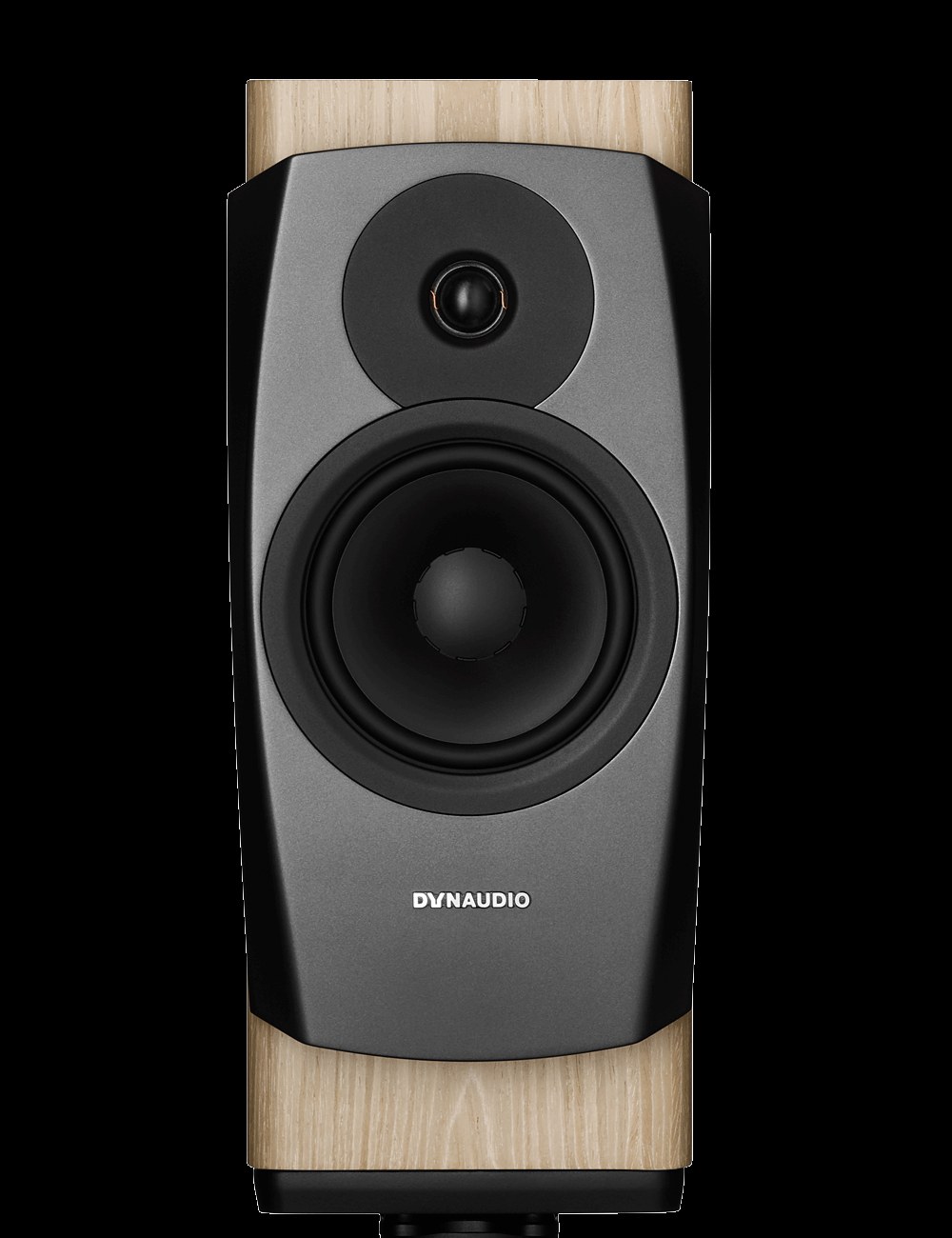
The Confidence 20 is the only two-way model in the series. Dynaudio describes it as a compact speaker meant to bring the performance and ambition of the larger floorstanders onto a stand [1]. According to the manufacturer, the series comprised the three floorstanders Confidence 30, 50 and 60 alongside it, plus the active 20A [2]. The Absolute Sound confirms this line-up: three slim three-way floorstanders and the Confidence 20 as the only compact model [6].
Dynaudio stresses that the series was developed over years in its own labs in Skanderborg, including the "Jupiter" measuring facility, simulation suites and listening rooms [1][2]. These are manufacturer statements. They explain the intent but do not, on their own, prove sonic superiority.
The tweeter: Esotar3 with Hexis
Dynaudio calls the 28 mm soft-dome Esotar3 the best tweeter the company has made so far [1][2]. It is described as an evolution of the Esotar2 used in the 2016 Contour and the previous Confidence series, drawing on lessons from the Esotar Forty, the tweeter of the Special Forty anniversary model [2].
The manufacturer highlights several technical points [2]:
- The rear chamber is much larger to reduce resonances, and the damping has been revised.
- A powerful neodymium magnet is meant to increase sensitivity and control.
- A lower resonant frequency is meant to reduce the overlap with the mid/bass driver and smooth the transition.
- According to Dynaudio, the Esotar3 does without the ferrofluid used in every Esotar tweeter until now. Higher sensitivity is said to mean the voice coil heats up less quickly.
- The "Hexis" is a small, dimpled plastic inner dome behind the main dome. It replaces the Esotar2's felt ring and is meant to suppress standing waves in the cavity without absorbing as much treble as felt does.
What Hi-Fi? summarised these points similarly in 2021: neodymium motor, control of the airflow behind the 28 mm diaphragm via the Hexis dome, and a large damped chamber to absorb rearward radiation [5]. On sound, What Hi-Fi? calls the tweeter "something of a gem", sweet-sounding and finely textured [5]. The Absolute Sound attributes the wide dispersion and the slightly lower crossover point of 2.3 kHz to the oversized tweeter [6].
One caveat about the series page: there Dynaudio also describes the "DDC Lens", an aluminium waveguide. That passage explicitly refers to the floorstanders with midrange drivers [2]. The Confidence 20 data sheet lists "Compex" and "DDC 2" under "Baffle" [1], but we find no description of the lens specific to the Confidence 20. We therefore leave open how much the lens contributes in the two-way model.
The mid/bass driver: NeoTec MSP with aluminium voice coil
The mid/bass driver measures 18 cm and has a cone made of MSP (Magnesium Silicate Polymer), the material Dynaudio has used for decades [1][2]. In the Confidence 20 it covers everything from bass to midrange, so it is the decisive driver for voices and instruments.
According to the manufacturer, the driver in the Confidence 20 deliberately differs from the woofers of the floorstanders [2]:
- The Confidence 20 uses an aluminium voice coil, the larger models a copper one. The reason given: in the floorstanders the force factor was to be increased, and copper adds a little moving mass there to suit the cabinet tuning. In the Confidence 20, the lighter aluminium is meant to allow both controlled bass and refined midrange [1][2].
- The voice-coil former contains glass fibre, up to three layers according to the series page, for stiffness [1][2].
- The cones of the floorstanders' woofers are slightly thicker because they work purely as bass drivers. In the Confidence 20, by contrast, the driver also covers the midrange [2].
- The motor uses one machined neodymium magnet per driver, with a venting system machined into it to guide airflow [1][2].
What Hi-Fi? notes that sticking with MSP can look like stagnation at first glance. The material has, however, been refined over the years, and Dynaudio still considers it the best balance of low weight, stiffness and damping [5]. That is the manufacturer's reasoning as relayed by What Hi-Fi?, not an independent materials comparison.
Cabinet, Compex baffle and down-firing bass reflex
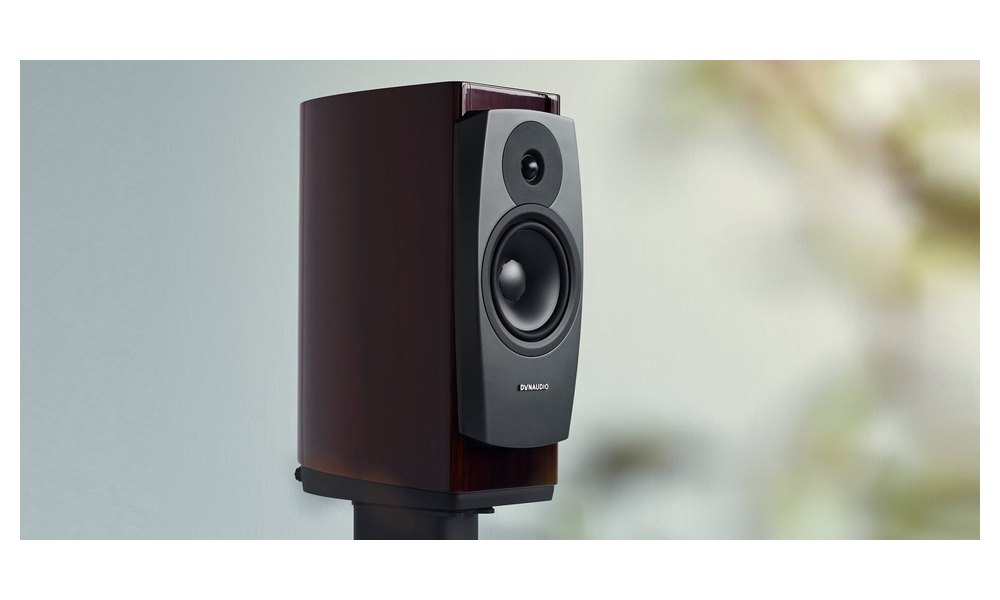
The cabinet is slim and curved. According to Dynaudio North America, quoted by The Absolute Sound, it is made mainly of multiple bonded MDF layers machined into the rounded shape. Together with internal bracing, this "exoskeleton" structure is meant to be inert and low in diffraction [6].
The baffle is made of "Compex", a composite material. Dynaudio describes it as light, very strong, rigid and well damped [2]. The manufacturer does not disclose its exact composition; The Absolute Sound calls it a corporate secret [6]. According to the same review, all Confidence models have a layer of Poron, a dense polyurethane foam, between the Compex baffle and the cabinet. It is meant to decouple the tweeter and mid/bass driver from the cabinet as far as possible [6].
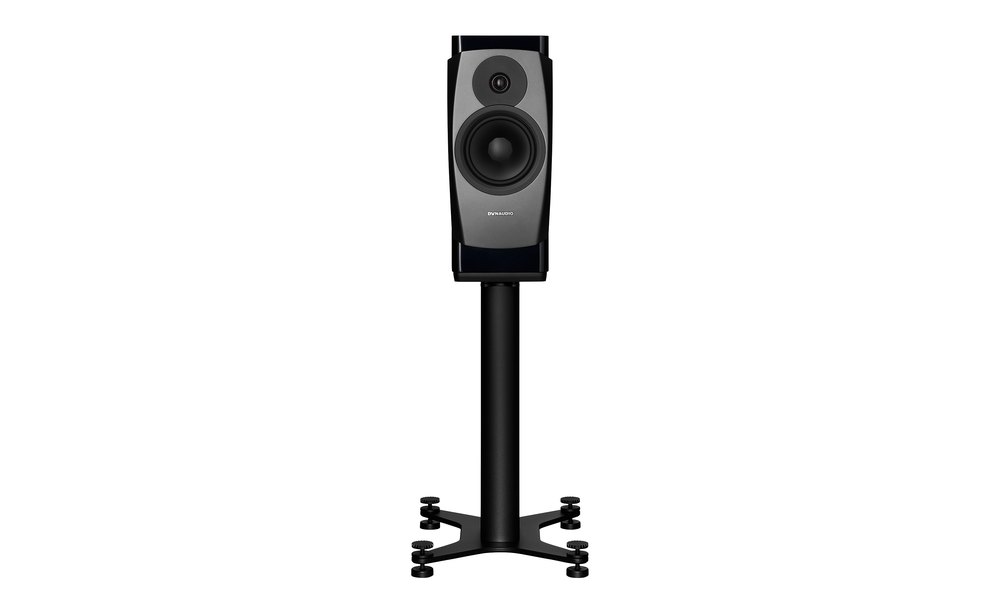
The most striking design decision is the bass reflex port firing downwards [1]. Two things follow from this:
- The stands are part of the concept. What Hi-Fi? writes that the down-firing port makes the supplied stand necessary. A conventional stand with a solid top plate would block the port [5]. The Absolute Sound describes the stands as very stable and highly adjustable, with spikes and floor-protecting pads, and optionally sand-fillable. They lift the speaker slightly so the port can work freely [6].
- Wall proximity is less critical. According to What Hi-Fi?, this makes the Confidence 20 less sensitive to rear-wall proximity than a rear-ported design. In its own listening room it still sounded more balanced well away from all walls [5].
Crossover and connection
Dynaudio specifies a two-way, second-order crossover at 2325 Hz [1]. What Hi-Fi? and The Absolute Sound give a rounded 2.3 kHz [5][6]. Both reviews confirm a single pair of high-quality binding posts, i.e. no bi-wiring [5][6]. What Hi-Fi? states explicitly that it has no issue with this [5].
Specifications according to the manufacturer
The product page lists the following values [1]:
- Sensitivity 87 dB (2.83 V/1 m)
- IEC long-term power handling 250 W
- Nominal impedance 6 ohms, minimum 5 ohms at 155 Hz
- Frequency response 42 Hz to 22 kHz (±3 dB)
- Bass reflex, down-firing port
- Tweeter 28 mm Esotar3, mid/bass 18 cm MSP
- Dimensions 233 × 520 × 414 mm (W × H × D), with stand 368 × 1140 × 457 mm
- Weight 27 kg (59.5 lb)
There is a contradiction on weight that we disclose. Dynaudio and The Absolute Sound give 27 kg and 59.5 lb respectively [1][6]. What Hi-Fi? lists 15.2 kg in its spec box [5]. No source says clearly whether the 27 kg includes the stand. We cannot resolve the contradiction and treat neither value as established for the speaker alone.
Also notable: What Hi-Fi?'s spec box gives the sensitivity as "7dB" [5]. That is obviously a typo; Dynaudio and The Absolute Sound both give 87 dB [1][6].
Amplification: what the data suggest
With 6 ohms nominal and a 5-ohm minimum, the Confidence 20 is a fairly benign load according to the manufacturer [1]. What Hi-Fi? draws the same conclusion: not an unduly difficult speaker. Even so, the magazine recommends an amplifier with at least 100 watts per channel, especially for larger rooms or high volume levels [5]. We have no independent impedance measurements from a publication. The 87 dB sensitivity is a manufacturer figure.
For context, not as a recommendation: What Hi-Fi? listened with a Burmester 088/911 Mk3 as reference amplifier and also tried the Musical Fidelity M8xi and Naim Supernait 3 [5]. The Absolute Sound lists integrated amplifiers from Aesthetix and MBL and Pass Labs pre/power amplifiers in its associated equipment [6]. In Stereophile's show report, the Confidence 20 was driven by Octave Jubilee monoblocks [7].
How What Hi-Fi? heard the Confidence 20 (September 2021)
What Hi-Fi? published its review on 10 September 2021, at a price of £9000, $11,999 or AU$19,500 [5]. These are historical prices from the UK, the US and Australia, not current euro prices.
On the positive side, the magazine highlights [5]:
- Resolution, control and refinement on a par with the best standmounters it had heard.
- Great stability and composure even with large orchestral works; it cites Mahler's Second Symphony as an example.
- Seamless integration between the drivers and instruments with palpable presence and good dynamic shading.
- Deep, powerful bass for the size and wide dynamic swings.
- Very good vocal reproduction.
What Hi-Fi?'s reservation is just as clear. From the midrange upwards, the speaker sounds restrained with powerful transients, as if pulling its punches to preserve its smoothness. As a result, the music loses some energy and rhythmic drive [5]. The verdict: technically the most accomplished Dynaudio standmounters the magazine had heard and hard to beat for outright analysis, but not the most musically engaging listen in every respect [5].
As comparisons, What Hi-Fi? used the ATC SCM50 as its benchmark, plus the Fyne Audio F1-8 and ProAc K1 [5].
How The Absolute Sound heard the Confidence 20 (February 2024)
Neil Gader published his review for The Absolute Sound on 22 February 2024. He gives a price of $13,000 including stands [6]. This too is a dated US price.
Gader's impressions in brief [6]:
- Tonality: balanced, with a slight midrange-forward tilt, on the warmer side of neutral; explicitly not lean or cold.
- Integration: he considers the transition between tweeter and mid/bass as unified as he has heard in this type of speaker; only the best coaxial drivers do better.
- Voices: he calls the Confidence 20 a superb voice speaker.
- Dynamics: with rock and large orchestral works it stayed unusually composed. On some tracks he found himself looking for a third driver.
- Bass: well controlled and extended into the 40 Hz region. The down-firing port showed little bloat or overhang. Naturally it could only partly convey organ down to 20 Hz, but he heard little port noise or chuffing.
- Space: he describes a scale and spatiality normally reserved for larger multi-driver designs, attributing this to the off-axis behaviour.
- Reservation: at times the treble sounded a little dry during hard peaks.
His verdict: more musical and emotionally moving than any other Dynaudio compact in his experience, and an easy and enthusiastic recommendation [6].
Stereophile's show report (April 2019)
As far as our research shows, Stereophile has not published a full review of the Confidence 20 with measurements. There is a short show report by Herb Reichert dated 13 April 2019 [7]. He heard the Confidence 20 there at $12,900 with stands, driven by Octave Jubilee monoblocks and an analogue front end around a VPI Avenger Reference turntable, and credited the system with "championship elocution" [7].
We deliberately give this impression little weight. It comes from an unfamiliar show room with a system costing many times the price of the speakers. It says little about how the Confidence 20 behaves at home.
Where the reviews agree and where they differ
Agreement: both detailed reviews credit the Confidence 20 with high resolution, very coherent driver integration, good vocal reproduction and unusual bass and dynamics for its size [5][6]. Both praise build and finish [5][6]. Both confirm the crossover point of about 2.3 kHz and the single pair of terminals [5][6].
Difference: What Hi-Fi? misses some verve and energy from the midrange upwards and describes the sound as rather analytical [5]. Gader, by contrast, hears a slightly warm, midrange-forward balance and plenty of dynamics; he only criticises occasionally dry treble [6]. The two verdicts are two and a half years apart and were formed with entirely different systems and rooms. Which description applies in a given room cannot be decided remotely. We present both side by side instead of averaging them.
Finishes
In 2021 What Hi-Fi? lists five finishes: Blonde Wood and the high-gloss options Midnight, Raven Wood, Ruby Wood and Smoke [5]. In November 2026 the Dynaudio product page shows product images in Blonde Wood, Midnight, Ruby and Smoke [1]. We have not checked which finishes are still available from retailers. For the Confidence 20i, Dynaudio names Blonde Wood, Ruby Wood High Gloss and Space High Gloss [3].
Who the Confidence 20 suits
Based on the sources evaluated, the Confidence 20 suits listeners who
- want a compact speaker on stands but expect bass, dynamics and scale closer to a floorstander [5][6];
- value high resolution and very good vocal reproduction [5][6];
- can place the speakers freely, since the stands are part of the concept and What Hi-Fi? heard the best balance away from the walls [5][6];
- use a capable amplifier; What Hi-Fi? suggests at least around 100 watts per channel [5].
According to these sources it is less suited to listeners looking for a particularly punchy, rhythmically driving presentation; this is What Hi-Fi?'s main criticism [5]. Anyone who wants to use their own stands or a shelf is also poorly served by this concept, because the down-firing port needs free space [5][6].
For turntable listeners: this is a passive speaker without a phono or digital section. The quality of a vinyl system here depends on cartridge, phono stage and amplifier. What Hi-Fi? and The Absolute Sound both listened with turntables among their sources (Technics SL-1000R and SOTA Cosmos Eclipse respectively) [5][6].
Open points and limits of this analysis
- No independent lab measurements. We have no independent measurements of impedance, frequency response or distortion. All measured values above are manufacturer figures.
- Weight unclear. 27 kg [1][6] versus 15.2 kg [5]; whether the stand is included remains open.
- Successor announced. The Confidence 20i is a different product; its details come only from the manufacturer [3][4].
- Prices. All prices in the reviews are historical and apply to other markets. The prices in the tables on this page remain unchanged and are dated separately.
- Manufacturer statements on technology, development effort and goals are labelled as such; they do not replace independent assessment.
- A detailed human fact-check of this analysis is still pending.
Sources for this analysis
- Dynaudio: Confidence 20 (Produktseite/product page). https://dynaudio.com/home-audio/confidence/confidence-20
- Dynaudio: Confidence (Serienseite, Technik/series page, technology). https://dynaudio.com/home-audio/confidence
- Dynaudio Magazine (Oktober/October 2026): Announcing Confidence i. https://dynaudio.com/magazine/2026/october/announcing-confidence-i
- Dynaudio: Confidence i (Serienseite/series page). https://dynaudio.com/home-audio/confidence-i
- What Hi-Fi? (10.09.2021): Dynaudio Confidence 20 review. https://www.whathifi.com/reviews/dynaudio-confidence-20
- The Absolute Sound (22.02.2024, Neil Gader): Dynaudio Confidence 20 Loudspeaker. https://www.theabsolutesound.com/articles/dynaudio-confidence-20-loudspeaker/
- Stereophile (13.04.2019, Herb Reichert): Messebericht/show report: Dynaudio Confidence 20 speakers, Octave Jubilee amplifiers, VPI Avenger Reference turntable. https://www.stereophile.com/content/dynaudio-confidence-20-speakers-octave-jubilee-amplifiers-vpi-avenger-reference-turntable
Created by AI (Vinyl BotPro) from the sources listed; no listening tests or measurements of our own. Detailed human fact-check pending.
Technology in detail
The technical details on the Esotar3, the NeoTec MSP mid/bass driver, the Compex baffle and the down-firing port are now collected in the analysis above, with sources.
What the specialist press says
We evaluate What Hi-Fi? (10 September 2021) and The Absolute Sound (22 February 2024) in detail and separately above, including their differing assessments.
Who is it for?
For listeners who want big dynamics, plenty of detail and strong bass from a standmount on its matching stand and who have a high-quality, powerful amplifier. The analysis above lists the limitations.
What makes this AI analysis special
This AI analysis combines Dynaudio's technical data with international reviews. All technical values are manufacturer figures. Sources and limits are set out in the analysis above; a detailed human check is still pending.
How the score comes about
The Index reflects the 2-way design with Esotar 3 and MSP woofer, the elaborate build quality and the very good reviews; on value it leads its tier. The Vinyl BotPro Index on this page remains 92 (Master, rank 2) — guidance from manufacturer data and the specialist press, no in-house listening session. The four criteria engineering/build, features, expected performance and value for money are weighted 25/20/25/30 and scaled across all tiers. Methodology
Sources
- Dynaudio, Confidence 20 product page with specifications
- What Hi-Fi?, Dynaudio Confidence 20 review
- The Absolute Sound, Dynaudio Confidence 20 Loudspeaker
Vinyl BotPro Index: 92 (Master 85–97) · Label: AI research · Sept 2026
Read more: best bookshelf speakers 2026 · Improve your hi-fi system · What is hi-fi?