
Active subwoofers · AI analysis · Starter, rank 3 · Product of the day
Elipson Classic Sub 12 Review
AI analysis (research): active bass reflex subwoofer from Elipson with a 30 cm woofer (glass fibre composite cone), 300 W Class D, 25 to 160 Hz (±3 dB), DSP lift of 6 dB at 33 Hz, subsonic filter at 23 Hz and adjustable low-pass from 40 to 160 Hz. Based on manufacturer data and press reviews, no listening test.
Summary
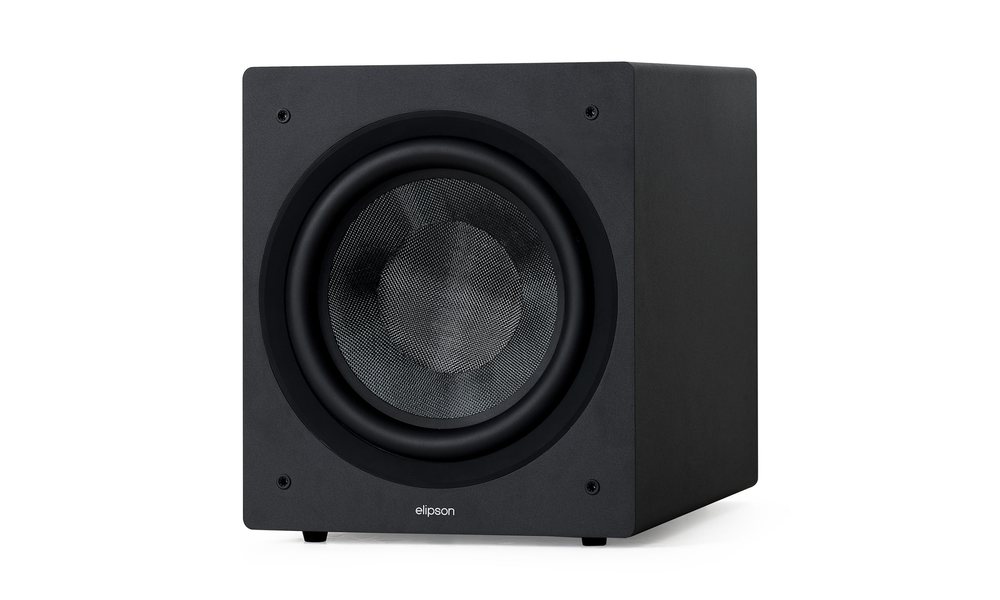
The Elipson Classic Sub 12 is the largest model of the new Classic Sub series, which Elipson introduced in October 2026 below its Premium Sub range. A 30 cm woofer with glass fibre composite cone works in an internally braced bass reflex cabinet, driven by 300 W Class D; Elipson quotes 25 to 160 Hz (±3 dB). A DSP lifts the range around 33 Hz by 6 dB, and a subsonic filter at 23 Hz (12 dB/octave) protects the driver from signals below the port tuning. Elipson quotes €699 (as of Oct. 2026, without guarantee).
Assumptions
- Price per subwoofer (piece) according to manufacturer or trade, Stand Oct. 2026, no guarantee
- Operation in addition to stereo main loudspeakers (2.1), low-pass and phase tuned at the listener's place
- Vinyl chain with Phono stage; Subsonic filter recommended
- No in-house measurements or listening tests
Specifications (manufacturer)
| Type | Active subwoofer · Bass-reflex · Front-Firing |
|---|---|
| Woofer | 300 mm (12-inch) glass fibre composite cone |
| Amplifier | 300 W · Class D |
| Frequency range | 25 – 160 Hz (±3 dB) |
| DSP | +6 dB at 33 Hz · Subsonic filter 23 Hz, 12 dB/octave |
| Low pass | 40 – 160 Hz adjustable · Phase 0/180° |
| Connections | Line input L/R (RCA, left = LFE) · Line output L/R |
| Dimensions / weight | 356 × 422 × 470 mm (W × H × D, 486 mm with grille) · 20.4 kg |
| Price guide | €699 (Elipson) · as of Oct. 2026 · without guarantee |
Manufacturer specifications (Elipson)
| Type | Active subwoofer · bass reflex · front-firing |
|---|---|
| Woofer | 300 mm (12-inch), glass fibre composite cone |
| Amplifier | 300 W Class D |
| Frequency response | 25–160 Hz (±3 dB) |
| Low-pass filter | 40–160 Hz continuously variable |
| DSP boost | +6 dB at 33 Hz |
| Subsonic filter | 23 Hz, 12 dB/octave |
| Phase / standby | 0°/180° · auto standby |
| Inputs | Line L/R (RCA, left = LFE) |
| Outputs | Line L/R (RCA) |
| Dimensions (W × H × D) | 356 × 422 × 470 mm (486 mm with grille) |
| Weight | 20.4 kg (gross 23.6 kg) |
| Finish | Black, removable fabric grille |
Source: Elipson – official specifications · As of 28 October 2026 · subject to change by the manufacturer
Rating criteria in detail
The four criteria feed into the Vinyl BotPro Index with weights of 25/20/25/30. The index is scaled across all tiers (see Methodology); that is why we do not show individual sub-scores.
Strengths
- 12-inch woofer and 300 W for €699
- 25 Hz (±3 dB) according to the manufacturer
- Subsonic filter protects against rumble below the port tuning
- Line output for daisy-chaining a second subwoofer
Weaknesses
- No high-level input
- No app, no remote control, no room correction
- Bass reflex with a large cabinet: needs floor space
- Only available in black
Comparison models
| DALI SUB E-9 F | Index 47, Rank 2, value for money champion — 9 inches · Front-Firing · approx. €650 |
|---|---|
| Klipsch R-120SW | Index 41, rank 4 — 30 cm · Bass-reflex · approx. €400–550 |
| Nubert nuSub XW-900 | Index 53, Rank 1, Sound champion — 10 inches · Downfire · 695 € |
| Yamaha NS-SW100 | Index 40, rank 5 — 25 cm · Bass-reflex · approx. €260 |
System matching
Works well with
- Medium to large rooms
- Floorstanding speakers and larger standmounts
- Music and home cinema on a limited budget
Less suited
- Integrated amplifiers without sub- or pre-out
- Who expects room measurement via app
- Very small rooms or desktop setups
Specs & Features
The Classic Sub 12 uses a 300 mm woofer whose cone is made of a glass fibre composite: stiff and light at the same time, so that even strong transients start and stop cleanly. The bass reflex cabinet is braced internally at several points; Elipson quotes 25 to 160 Hz (±3 dB) at a weight of 20.4 kg.
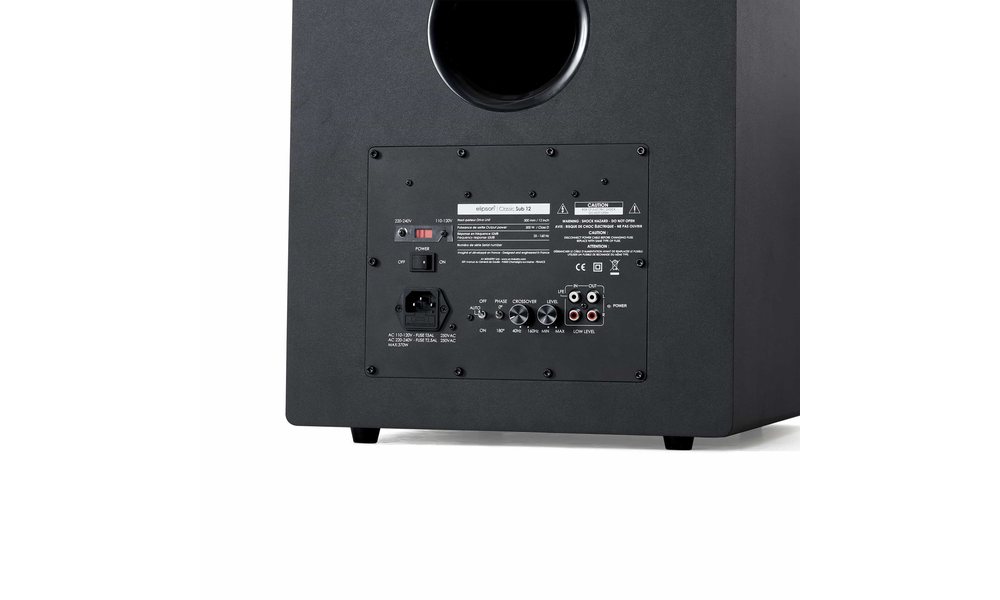
A Class D amplifier delivers 300 W. The DSP lifts the range around 33 Hz by 6 dB so that the deep bass stays present even at low volume, and a subsonic filter at 23 Hz with 12 dB/octave blocks signals below the port tuning. Low-pass (40–160 Hz), phase (0/180°) and auto standby sit on the back panel; connection is via line inputs, and the line output passes the signal on to a second subwoofer.
Research Consensus
The manufacturer data show an entry-level subwoofer clearly designed for cone area and extension: 12 inches, 300 W and 25 Hz at ±3 dB are rare in this price class. The international specialist press places the Classic Sub series at launch as an affordable addition below the Premium Sub range, aimed at music and home cinema alike.
For VinylCination, what matters most for vinyl is the subsonic filter, which keeps record warps and rumble away from the woofer, and a low crossover setting. VinylCination summarises this as an AI assessment based on manufacturer data and international launch reports, without an own listening test.
For whom / Matching
Connection & Integration
At the sub or pre-out of an amplifier or at the subwoofer output of an active speaker; on an AV receiver via the LFE input (left RCA). The phono stage from the Top list Phono preamps remains in the main branch.
Turntable & phono
Decks from the Starter level fit in price. The built-in subsonic filter helps with warped records; even so, do not place the turntable on the same furniture as the subwoofer.
Room & placement
Medium to large rooms. Start next to one speaker with some distance from the wall so that the port can breathe freely; then adjust phase and level at the listening position.
Budget & upgrade
At €699, the Classic Sub 12 sits between the DALI SUB E-9 F and the Nubert nuSub XW-900 in price. The Nubert offers more features with app room correction, the Elipson more cone area.
What makes this AI analysis special
This section is an AI summary from Manufacturer data and reports from international specialist media. Vinyl BotPro had no physical access, no measurement of our own chain and no listening test. The basis is the manufacturer data from Elipson and the international launch reports on the Classic Sub series. The expected performance is derived from construction, datasheet and the judgements of the Specialist press. Prices and availability change (as of Oct. 2026, no guarantee); please check technical values against the current data sheet.
Vinyl BotPro Score Logic
The Vinyl BotPro Index is multi-level 0–100 and weighted Technology/Build, features, expected performance and value for money with 25/20/25/30. Starter is typically ~40–54. Elipson Classic Sub 12 receives 46 (rank 3 Starter). Lots of cone area and extension for the price; the features remain without app, high-level input and room correction. Rank is not Laboratory Evaluation — no Listening test. Details on weighting · Methodology.
Created by Vinyl BotPro (AI) · Novelty of the Day 28.10.2026 · AI analysis · As of 28.10.2026 · Corrections: info@vinylcination.de · Prices without guarantee.
Manufacturer and concept
Elipson is one of France's most storied loudspeaker brands. It made its name in the 1950s with spherical loudspeakers, and today its range runs from the Chroma turntables through amplifiers and streaming systems to classic standmount and floorstanding speakers. Development takes place in France, and the back panel of the Classic Sub 12 accordingly reads "Designed and engineered in France".
Elipson now offers two subwoofer lines. The Premium Sub range with 10, 12 and 15-inch models arrived in autumn 2025. In October 2026 the Classic Sub series follows below it with three models: Classic Sub 8 (20 cm, 150 W, €299), Classic Sub 10 (25 cm, 200 W, €499) and Classic Sub 12 (30 cm, 300 W, €699). The Classic Sub 12 is the largest and most powerful model of the new series and is aimed at larger living rooms, at floorstanding speakers and at home cinemas where a small cube reaches its limits.
The idea behind the series is simple: plenty of cone area, solid amplifier power and a carefully tuned bass reflex cabinet at a price that is closer to compact subwoofers. Elipson deliberately leaves out convenience features such as an app, wireless or room calibration, and puts the money into the driver, the amplifier and the cabinet instead.
Technology explained
A 30 cm driver with a glass fibre cone
At its heart is a 300 mm woofer, in other words a 12-inch driver. Its cone is made of a glass fibre composite. The material is stiff and light at the same time: the cone barely deforms at large excursions, and it can be accelerated and stopped quickly. For the sound this mainly means clean transients on kick drum, bass guitar and timpani. The large area has a second advantage: to reach a given level, a 12-inch driver has to move less than an 8 or 10-inch model. That keeps distortion lower at high volume.
Bass reflex cabinet with internal bracing
The cabinet measures 356 × 422 × 470 mm and weighs 20.4 kg. It is braced internally at several points so that the panels do not vibrate under sound pressure and colour the bass. The bass reflex port sits at the front and supports the driver in the lowest frequency range. Elipson quotes 25 to 160 Hz at ±3 dB. That tolerance is strict: many manufacturers state bass extension at −6 or even −10 dB, which looks deeper on paper. A figure of 25 Hz at ±3 dB is remarkable at around €700.
Amplifier and DSP
A 300 W Class D amplifier drives the woofer. Class D works efficiently, stays cool and saves space and weight in the cabinet. A digital signal processor adds two functions. First, it lifts the range around 33 Hz by 6 dB. Human hearing is insensitive to deep bass at low volume, and the lift keeps the foundation present when listening quietly. Second, a subsonic filter works at 23 Hz with 12 dB per octave. It blocks signals below the port tuning, where a bass reflex driver would lose control.
Sound: what the concept and data suggest
The analysis is based on the manufacturer data and the international launch coverage of the series. From the combination of large cone area, 300 W and a bass reflex cabinet with 25 Hz at ±3 dB, a powerful, deep-reaching bass with high level reserves can be expected. Bass reflex subwoofers usually deliver more deep-bass output per euro than sealed designs, while sealed models often sound a little drier on fast transients. The stiff glass fibre cone and the internal bracing of the cabinet target exactly this point: the bass should be not only deep, but also controlled and well defined.
The DSP lift at 33 Hz is a double-edged tool. With films and electronic music it gives the deep bass extra weight, but in rooms with pronounced room modes it can also make the bass thicker. Here it helps to adjust level and crossover frequency in small steps and check the result at the listening position.
Features and everyday use
The connections are deliberately simple. On the back there is a stereo line input (RCA) and a line output. The left input also serves as the LFE input for AV receivers. The output passes the signal on to a second subwoofer, for example another Classic Sub 12 for more even bass across the room. The low-pass filter is adjustable from 40 to 160 Hz, the phase switches between 0 and 180 degrees, and an auto-standby function puts the subwoofer to sleep when there is no signal.
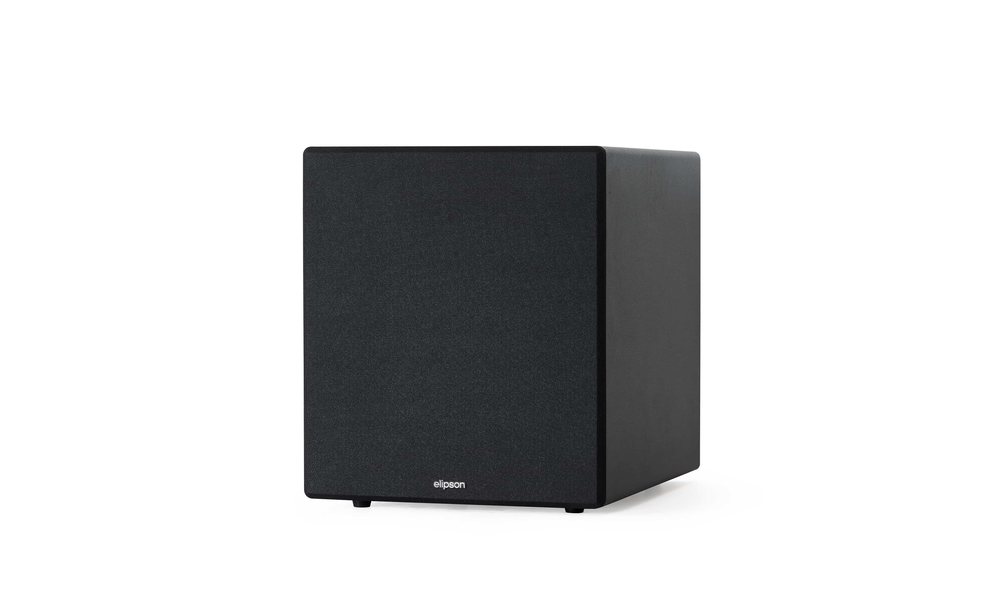
There is no high-level input for speaker cables. Anyone using a classic integrated amplifier without a subwoofer or preamp output therefore needs a different subwoofer or an adapter. There is also no app, no remote control and no automatic room calibration; all settings are made with the controls on the back. For placement this means: tune it carefully once, and then everything stays as it is. The Classic Sub 12 comes in black with a removable fabric grille.
Tips for vinyl listeners
Turntables produce interference below 20 Hz, for example from slightly warped records or footfall. A bass reflex subwoofer reacts sensitively to this because its driver is hardly damped below the tuning frequency. The built-in subsonic filter at 23 Hz is therefore a real plus for vinyl. It is also worth choosing a fairly low crossover, for example 60 to 80 Hz with floorstanding speakers, and not placing the turntable on the same furniture as the subwoofer.
Who it suits
The Classic Sub 12 suits listeners who want a lot of deep bass for their money in a medium to large room. It complements floorstanding speakers and larger standmounts that already reach down to around 40 or 50 Hz, and it fits systems that serve music and film equally. Anyone with an amplifier that has a subwoofer output, or with an AV receiver, can connect it without accessories.
It is less suitable for very small rooms, for desktop setups and for systems that only have an integrated amplifier without a pre-out. Anyone who wants to correct room modes with an app and microphone will find better-suited solutions from other manufacturers.
Comparison with alternatives
In the Starter tier of the ranking, the Classic Sub 12 meets three well-known models. The Nubert nuSub XW-900 costs almost the same and uses a smaller 10-inch driver, but adds wireless, an app and genuine room calibration. The DALI SUB E-9 F is more compact and slightly cheaper, but with its 9-inch aluminium driver and 37 Hz (±3 dB) it does not go as deep. The Klipsch R-120SW also offers 12 inches for less money, though with 400 W peak rather than continuous power and without a DSP lift in the deep bass. With a larger budget, the Premium tier offers the SVS SB-1000 Pro, a sealed subwoofer with app control.
More questions about the Elipson Classic Sub 12
Can I connect the Classic Sub 12 to an integrated amplifier without a subwoofer output?
Not directly, because the subwoofer only has line inputs. The amplifier needs a subwoofer or preamp output. Alternatively, high-level adapters bring the speaker signal down to line level.
Is a second Classic Sub 12 worthwhile?
In larger rooms, yes. Two subwoofers in different positions excite room modes more evenly, and the bass becomes more balanced across several seats. The line output allows daisy-chaining without extra accessories.
What is the lift at 33 Hz for?
It gives the deep bass more weight, especially at low volume and with films. In rooms with strong room modes, the level should then be reduced slightly so that the bass does not boom.
Verdict
The Elipson Classic Sub 12 brings a 12-inch glass fibre driver, 300 W and 25 Hz at ±3 dB into the living room for €699. That is a lot of substance for the money, combined with a subsonic filter that helps vinyl listeners in particular. Anyone who can do without an app, wireless and room calibration and owns an amplifier with a subwoofer output gets a powerful, deep-reaching subwoofer for medium and large rooms. In the Vinyl BotPro Index it scores 46 points and ranks third in the Starter tier.
Sources
- Elipson — Classic Sub 12 (manufacturer page, technical data and price)
- Elipson — subwoofer overview (Classic Sub and Premium Sub)
- StereoNET — Elipson Classic Sub Range Digs Deep Without Breaking the Bank (17.10.2026)
- ON-mag — Elipson Classic Sub 8, 10 et 12 (10.10.2026)
- Audiograde — Classic bass (14.10.2026)
Read more: best active subwoofers 2026 · Improve your hi-fi system · What is hi-fi?