
Floorstanding speaker · AI analysis · Expert, rank 12
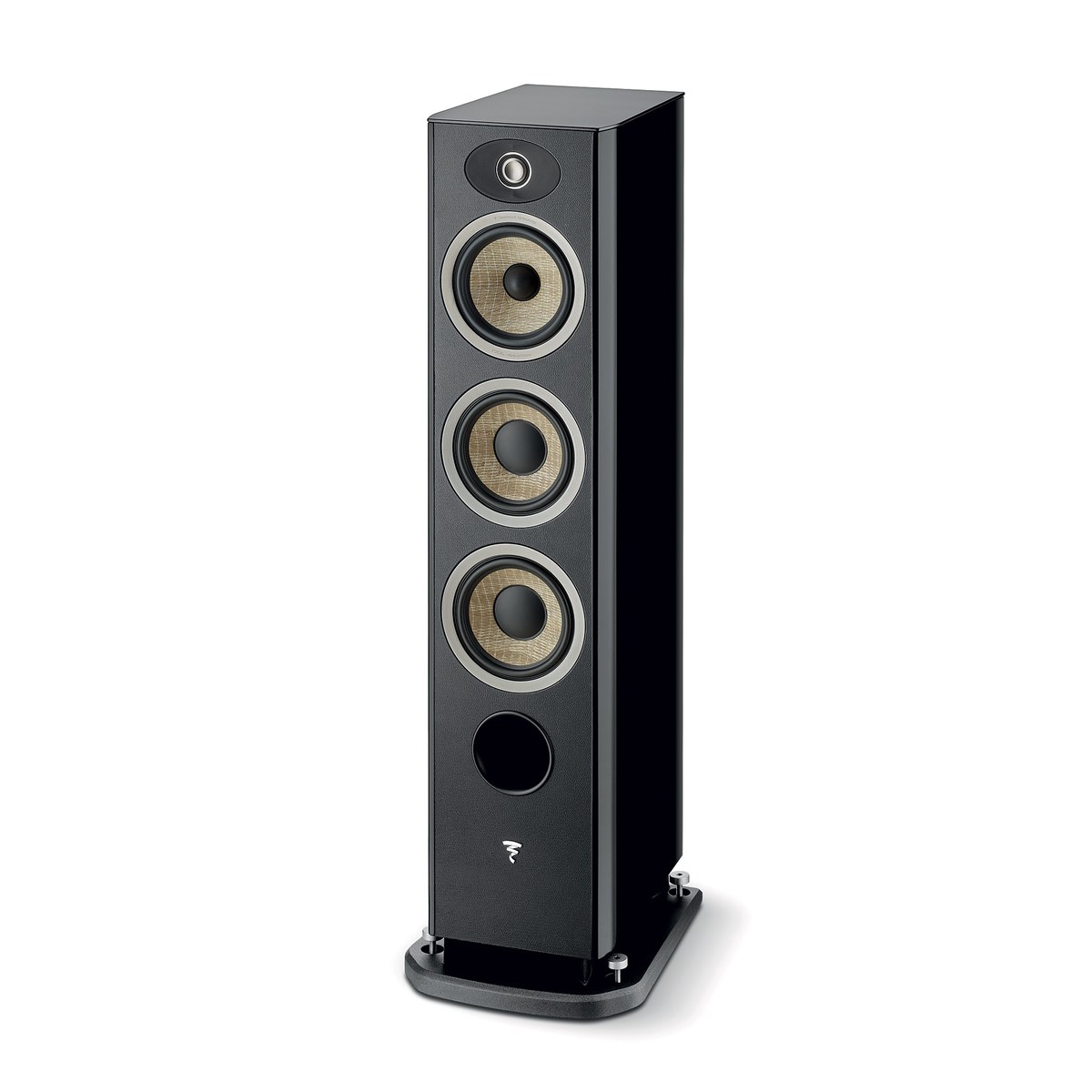
Focal Aria Evo X N°2: Analysis
AI analysis (research): 3-way floorstander from the Aria Evo X series with an inverted Al/Mg dome and flax cones; basis: Focal data sheet and reviews from the international specialist press.
Summary
The Aria Evo X N°2 (approx. 3,398 € per pair) is a 3-way floorstander with an inverted aluminium/magnesium TAM dome, a 16.5 cm Flax midrange and two 16.5 cm Flax bass drivers. Focal quotes 91.5 dB and 8 Ω (min. 2.9 Ω). Reviews by HiFi and Music Source (05/2024), HomeTechnologyReview (07/2024), Sound & Vision (11/2024) and TNT-Audio (06/2025) praise above all detail and build; verdicts on the sound character diverge.
Specs (public / manufacturer)
| Type | 3-way floorstanding speaker · bass reflex (Power Flow) |
|---|---|
| Sensitivity | 91.5 dB (2.83 V/1 m) |
| Impedance | 8 Ω nominal (min. 2.9 Ω) |
| Rec. Amplifier power | 40–250 W |
| Frequency range | 45 Hz–30 kHz (±3 dB) · 37 Hz (−6 dB) |
| Chassis | TAM Al/Mg · 16.5 cm Flax midrange · 2 × 16.5 cm Flax bass |
| Dimensions / weight | 1035 × 294 × 371 mm · 25 kg/piece |
| Price guide | approx. €3,398/pair · Sept 2026 |
Manufacturer specifications (Focal)
| Type | 3-way floorstanding speaker · bass reflex (Power Flow, front and floor-facing ports) |
|---|---|
| Drivers | Al/Mg TAM inverted M-shaped dome · 1 × 16.5 cm Flax midrange with TMD · 2 × 16.5 cm Flax bass |
| Frequency response | 45 Hz–30 kHz (±3 dB) · 37 Hz (−6 dB) |
| Sensitivity | 91.5 dB (2.83 V/1 m) |
| Impedance | 8 Ω nominal (min. 2.9 Ω) |
| Recommended amplifier power | 40–250 W (manufacturer recommendation) |
| Crossover frequency | 290 Hz / 2.400 Hz |
| Dimensions | 103.5 × 29.4 × 37.1 cm (H × W × D) |
| Weight | 25 kg |
| Room recommendation | from 20 m², listening distance 3 m |
Source: Focal – official specifications · As of 16 October 2026 · subject to change by the manufacturer
Matching tips
- Suits: Strong, load-stable amplifier
- Fits: Rooms from about 20 m²
- Fits: A listening distance of about 3 m
- Less suited: Weak or not very load-stable amplifiers
- Less suited: Small rooms with placement close to the wall
Technology in detail
The drivers, Powerflow ports, manufacturer data and conflicting figures (such as 92.5 dB at Sound & Vision) are now collected, with sources, in the analysis below.
What the specialist press says
We evaluate the reviews by HiFi and Music Source (Simon Wilce, 05/2024), HomeTechnologyReview (Daniel Chadwick, 07/2024), Sound & Vision (Mark Henninger, 11/2024) and TNT-Audio (Piero Canova, 06/2025) separately and with dates below.
Who is it for?
For listeners looking for a highly efficient floorstander with plenty of detail and strong bass who have a load-stable amplifier for a room from about 20 m².
Analysis: the Focal Aria Evo X N°2 in depth
What this page is: an AI analysis, not a listening session
This page summarises what can be documented about the Focal Aria Evo X N°2 from manufacturer data and four reviews from the USA, Italy and the UK. Vinyl BotPro has neither listened to nor measured these speakers. Descriptions of the sound are reported as statements by the named authors, each with a date. Our own assessments are marked as such. The page's rank, index and price figures remain unchanged.
Model boundaries
- Aria Evo X N°2: the passive three-way floorstander analysed here, the smallest of three towers in the range [3][5][6]. It needs an amplifier.
- Aria Evo X N°3 and N°4: the larger towers. According to HomeTechnologyReview, the N°4 has two 8-inch bass drivers [5].
- Aria Evo X N°1 and Center: a compact speaker and a centre channel [3][6]. TNT-Audio also lists a subwoofer and a bipolar surround speaker in the same family [4].
- Aria 900 (older generation): not covered on this page. We do not carry over data from predecessors.
TNT-Audio places the Aria Evo X as the third Focal series from the bottom, between Theva and Utopia [4]. Focal's product sheet is dated 07/11/2023 [2]. The first reviews appeared in spring 2024 [6].
Technology according to Focal
Focal gives the following for the Aria Evo X N°2 [1][2]:
- Principle: three-way bass-reflex floorstander.
- Tweeter: TAM, an inverted aluminium/magnesium dome with an "M" profile. A urethane tweeter plate with a waveguide improves horizontal directivity.
- Midrange: 16.5 cm (6.5 in), Flax cone. The TMD surround is listed directly under the midrange in the product sheet [2]; HiFi and Music Source assigns it to both midrange and bass drivers [6]. The sheet does not make the assignment unambiguous.
- Bass: two 16.5 cm drivers with Flax cones.
- Bass reflex: "Powerflow" multi-port with one opening at the front (more impact) and one facing the floor (more depth).
- Frequency response: 45 Hz to 30 kHz (±3 dB), 37 Hz at −6 dB.
- Sensitivity: 91.5 dB.
- Impedance: 8 Ω nominal, 2.9 Ω minimum.
- Recommended amplifier power: 40 to 250 W.
- Crossover frequencies: 290 Hz and 2,400 Hz.
- Dimensions and weight: 103.5 × 29.4 × 37.1 cm (H × W × D), 25 kg each.
- Cabinet: ultra-rigid MDF with non-parallel side panels, leather-effect front, magnetic grille.
- Base: aluminium alloy with height-adjustable spikes, key supplied.
- Origin: drivers developed and manufactured in France according to Focal [2]. The product page says "Made in France" [1].
- Finishes: Black High Gloss, Prime Walnut and Moss Green High Gloss [1][2].
- Room: according to Focal, for rooms of at least 20 m² and a listening distance of about 3 m [2].
The technologies explained
- Flax: a layer of French flax fibre between two thin sheets of glass fibre. Focal introduced the cone in 2013 and promises lightness, rigidity and damping [1][6]. TNT-Audio notes that flax fibres are rigid but hollow, and therefore light [4].
- TMD (Tuned Mass Damper): weights on the surround are meant to stabilise its own motion. According to HiFi and Music Source the technology comes from the Kanta series [6].
- TAM tweeter: HiFi and Music Source gives the dome as 25 mm and says the inverted shape limits rear-wave reflections [6]. Focal's product sheet gives no size [2].
- Waveguide and urethane plate: intended to control directivity and improve imaging [1][2][4].
- Powerflow: according to Sound & Vision, the metal base is mandatory because of the down-firing port [3].
Conflicting figures
- Sensitivity: Sound & Vision states 92.5 dB and derives about 116 dB peak at 1 m and around 107 dB at 3 m with 250 W [3]. Focal states 91.5 dB [1][2]. The Sound & Vision calculation therefore rests on a different number.
- Tweeter material: TNT-Audio speaks of a magnesium dome [4], Focal of aluminium/magnesium [1][2].
- Size: the product page gives a height of 1,035 mm [1], the product sheet 103.5 cm [2]. These are identical.
- Prices: $4,800 per pair at Sound & Vision and HomeTechnologyReview [3][5], £2,999 or $4,798 at HiFi and Music Source [6], €3,060 at TNT-Audio [4].
What the numbers mean
- 91.5 dB and a 2.9 Ω minimum: the speaker is fairly sensitive, but the impedance minimum is low. Sound & Vision therefore calls for a robust amplifier [3]. HomeTechnologyReview recommends 75 to 100 quality watts that remain stable down to 2 Ω. At 60 to 80 dB listening levels, the reviewer rarely needed more than 45 W from his McIntosh MC462 [5]. TNT-Audio reached the same levels with significantly less power than with his Thiel CS 3.6 [4].
- 290 Hz crossover: the midrange covers the range from 290 Hz to 2.4 kHz, the bass drivers only the bass [2].
- 37 Hz (−6 dB): HomeTechnologyReview and HiFi and Music Source suggest a subwoofer for the deepest bass [5][6]. Sound & Vision did not need a subwoofer for New Order's "Substance" [3].
Sound & Vision (November 2024)
Mark Henninger reviewed the Aria Evo X N°2 on 18/11/2024 for Sound & Vision, at $4,800 per pair at the time [3]. He listened with a Marantz AV10 and a bridged AMP10 (400 W per channel into 8 Ω), and also with the Aria Evo X Center and a Perlisten R18s subwoofer [3]. His impressions [3]:
- Seamless, engaging sound that stays fluid and free of fatigue even at high volume.
- Detail, nuance, depth, holographic imaging and dynamics at the level of a premium speaker.
- Powerful bass that moves air, even without a subwoofer.
- The centre matches tonally but may run out of headroom before the N°2.
- Connection: only one pair of binding posts, so no bi-wiring or bi-amping.
- Minus: expensive relative to capability.
HomeTechnologyReview (July 2024)
Daniel Chadwick reviewed the speaker on 17/07/2024 for HomeTechnologyReview [5]. He used a McIntosh MC462 power amplifier and an SVS subwoofer in a room of about 12 × 12 feet [5]. His impressions [5]:
- Very neutral, with highly precise imaging and great clarity.
- Tight bass without boom, even near a wall.
- A slight emphasis in the treble, bright and detailed. Toeing the speakers slightly away from the listening seat fills out the sound.
- Less composed at very high levels above 95 dB, at times sibilant.
- Comparison: clearer and more precise than the B&W 703 S3, which has warmer mids. The KEF R7 Meta has wider dispersion, smoother highs and more volume headroom.
HiFi and Music Source (May 2024)
Simon Wilce reviewed the N°2 on 10/05/2024 for HiFi and Music Source, at £2,999 at the time [6]. He listened with a Naim NSC 222, NPX 300 and Moor Amps Angel 6, later a Naim NAP 250. The speakers stood 2.5 m apart and 70 cm from the wall, with a listening distance of about 3 m [6]. His impressions [6]:
- A wide, full soundstage, rather soft and laid-back. Suited to relaxed late-night listening.
- A big presentation with little use of the volume control, which he links to the high sensitivity.
- In places somewhat less precise, but with enough detail. Female vocals very engaging.
- A warmer presentation.
- For deep bass at low volume he sees a subwoofer as worthwhile.
- Wilce considers wall distance almost irrelevant because of the front and downward ports.
TNT-Audio (June 2025)
Piero Canova reviewed the N°2 in June 2025 for TNT-Audio, at an Italian price of €3,060 [4]. He listened with two NuPrime ST10M monoblocks and, for comparison, a valve integrated amplifier [4]. His impressions [4]:
- Very precise and detailed, almost monitor-like. Highs reminiscent of studio monitors, but less sharp.
- Excellent mids with highly three-dimensional presentation.
- Very present bass, for him exuberant. The best result came when the spikes were set so that the reflex ports sat as far from the floor as possible. Raising the speakers by about 30 cm improved the bass further; Canova sees this as an effect common to almost all floorstanders with low-mounted woofers or ports.
- Dynamically very fast, with impactful transients. In the deep bass, the speaker finds it slightly harder to stop impulses.
- The valve amplifier made an excellent combination.
- Canova suspects the voicing seeks a compromise between multichannel and stereo use. Compared with his Thiel CS 3.6 the low end is simply too much; he concedes that the Thiel would cost around €20,000 today.
Home cinema and subwoofer
Several reviewers point to the range as a home-cinema system. HiFi and Music Source notes that pricing, literature and marketing are aimed heavily at cinema installations [6]. Sound & Vision listened to the N°2 both as a pure full-range 2.0 system and with a centre and subwoofer [3]. Henninger argues that front speakers should reach about 40 Hz so that their slope aligns symmetrically with the subwoofer at the usual 80 Hz crossover [3]. According to Focal the −6 dB point is 37 Hz [2]. As a minus, Sound & Vision notes that the range has no Atmos or dedicated surround speakers and that the centre is a two-way model [3]. TNT-Audio, by contrast, mentions a bipolar surround speaker in the family [4]. Whether Sound & Vision means a different type of speaker cannot be determined from the texts. We leave this contradiction open.
Build and handling
All sources agree on build quality. TNT-Audio says it has never seen such a high level of finish. The glass top, the leather-effect front and the non-parallel side walls that taper towards the back stand out [4]. Canova also praises the manual, which clearly explains unpacking, base assembly and placement [4]. HiFi and Music Source gives the unboxing full marks but notes that the red levelling key is slightly awkward to turn close to the cabinet. He could not get the plastic inserts out of the binding posts [6]. HomeTechnologyReview describes the cabinet as well braced with little resonance; the terminals accept banana plugs, spades and bare wire [5]. At 25 kg per speaker, two reviews find the N°2 easy to move [5][6].
Who the sources speak to
Profiles can be derived from the reviews without making a buying recommendation:
- Listeners after detail and exact imaging will recognise themselves in HomeTechnologyReview and Sound & Vision [3][5].
- Those who prefer a warmer, relaxed voicing find support in HiFi and Music Source [6].
- Anyone listening in a room with bass build-up should note TNT-Audio's remarks on floor clearance and bass [4].
- Anyone planning to add a subwoofer later will find positive experiences in three sources [3][5][6].
Placement
- Room and distance: Focal recommends at least 20 m² and a listening distance of about 3 m [2]. HomeTechnologyReview got on well in a smaller room [5]. The page's matching tips advise against small rooms with placement near a wall; this evidence partly contradicts that. We leave it open.
- Wall distance: according to TNT-Audio, the manual shows that corners boost bass by 6 dB [4]. HomeTechnologyReview heard no boomy bass even near a wall [5].
- Listening height: according to the manual, the tweeter has a 30° dispersion angle. Sitting too high or too low muffles the highs [4].
- Floor clearance: TNT-Audio got the best result with the reflex ports as far from the floor as possible [4].
- Toe-in: HomeTechnologyReview recommends aiming slightly away from the listening seat [5].
In a vinyl system
None of the reviews names a turntable as a source [3][4][5][6]. For vinyl, only what follows from the data applies: the Aria Evo X N°2 is passive and needs an amplifier. A turntable needs a phono stage, built in or separate. Where the turntable stands depends on the rack and cable runs, not on the speakers. Given the bass TNT-Audio describes as exuberant [4], our own assessment is that a low-vibration turntable setup makes sense, regardless of the distance to the speakers.
Where the sources agree
- Detail and imaging: very good [3][4][5].
- Build: excellent [3][4][5][6].
- Amplifier: should be load-stable because of the 2.9 Ω minimum [3][5].
- Sound character: here the verdicts diverge: neutral to slightly bright (HomeTechnologyReview), precise and monitor-like with exuberant bass (TNT-Audio), warm and laid-back (HiFi and Music Source), seamless and detailed with powerful bass (Sound & Vision) [3][4][5][6].
Open points and limits of this analysis
- Sound character: conflicting verdicts; rooms and electronics differ greatly.
- Sensitivity: 91.5 dB according to Focal versus 92.5 dB at Sound & Vision [1][3].
- Measurements: none published in the sources used here.
- Prices: see above, dated 2024 to 2025. The page's price figures remain unchanged.
- A detailed human fact-check of this analysis is still pending.
Sources for this analysis
- Focal: Aria Evo X N°2 (Produktseite). https://www.focal.com/products/aria-evo-x-n2
- Focal: Aria Evo X N°2 Product Sheet (07/11/2023, v1, PDF). https://dam.focal-naim.com/m/f34a0f7f5aab0fd/original/FP_Aria_Evo_X_N-2_EN-pdf.pdf
- Sound & Vision: Focal Aria Evo X No.2 (Mark Henninger, 18.11.2024). https://www.soundandvision.com/content/focal-aria-evo-x-seamless-sound-meets-striking-design
- TNT-Audio: Focal Aria Evo X N°2 (Piero Canova, Juni 2025). https://www.tnt-audio.com/casse/focal_aria_x2_e.html
- HomeTechnologyReview: Focal Aria Evo X No.2 (Daniel Chadwick, 17.07.2024). https://hometechnologyreview.com/focal-aria-evo-x-no-2-review/
- HiFi and Music Source: Focal Aria Evo X No.2 (Simon Wilce, 10.05.2024). https://hifiandmusicsource.com/2024/05/focal-aria-evo-x-no-2/
Created by AI (Vinyl BotPro) from the sources listed; no listening tests or measurements of our own. Detailed human fact-check pending.
What makes this AI analysis special
This AI analysis combines Focal's technical data sheet with four dated reviews. Technical values are manufacturer figures; differing figures from reviews are marked below. As of October 2026.
How the score comes about
The Index reflects the 3-way design with TAM tweeter and Flax cones, the high sensitivity and the very good reviews; on value it leads its tier. The Vinyl BotPro Index on this page remains 75 (Expert, rank 12) — guidance from manufacturer data and the specialist press, no in-house listening session. The four criteria engineering/build, features, expected performance and value for money are weighted 25/20/25/30 and scaled across all tiers. Methodology
Sources
- Focal, Aria Evo X N°2 technical data sheet (PDF)
- Sound & Vision, Focal Aria Evo X No.2 review
- TNT-Audio, Focal Aria Evo X N°2 review
Vinyl BotPro Index: 75 (Expert 70–84) · Label: AI research · Sept 2026