
Floorstanding speaker · AI analysis · Master, rank 3
Focal Sopra N°2: Analysis
AI analysis (research): 3-way floorstanding speaker, beryllium IHL, 91 dB / 8 Ω (min. 3.1 Ω), 40–300 W — specs/retail prices, no listening test.
Summary
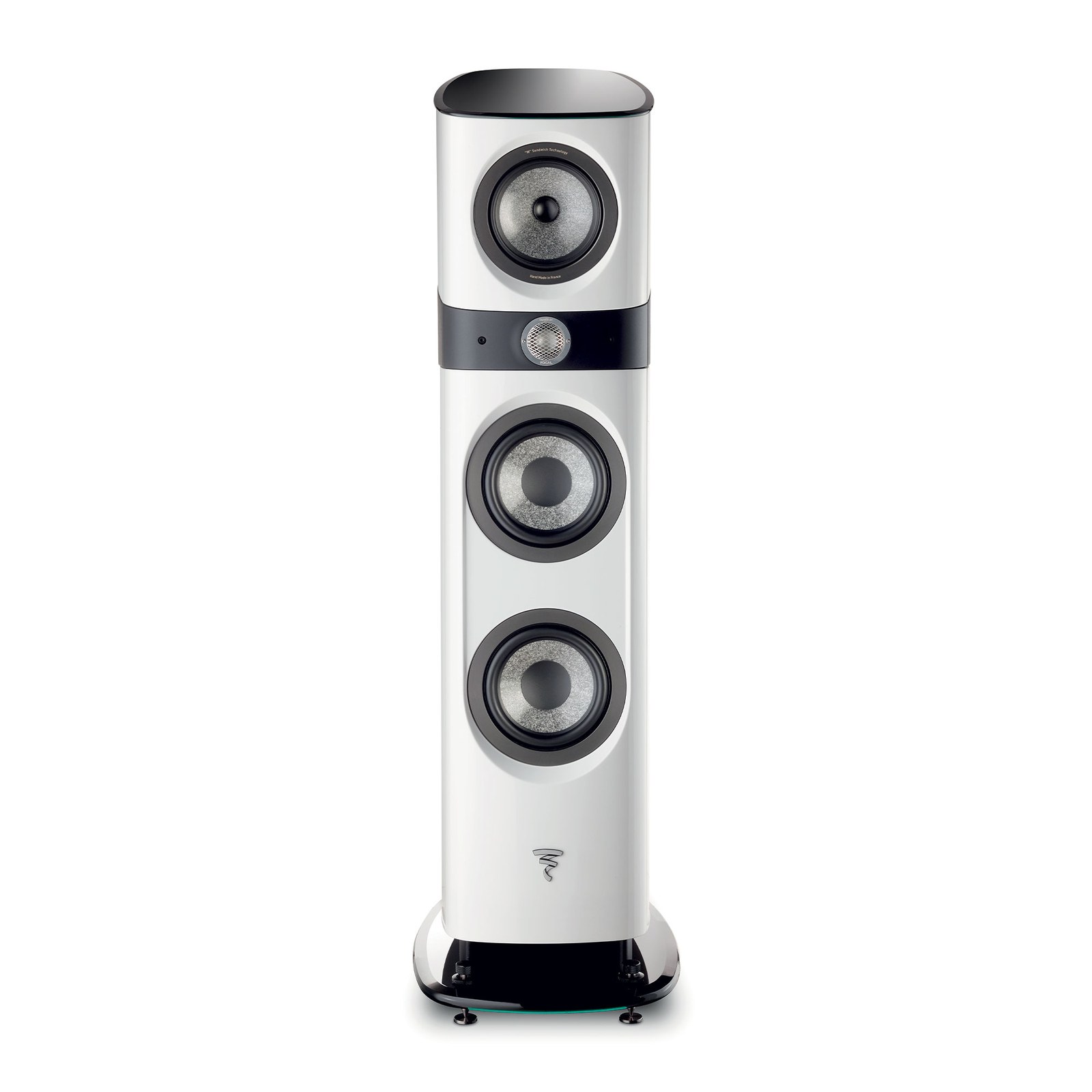
The Sopra N°2 is Focal's Sopra floorstander: 27 mm beryllium IHL tweeter, 16.5 cm W midrange with TMD/NIC, two 18 cm W bass drivers. 91 dB, 8 Ω nominal, recommended 40–300 W. DE price per pair often about €16,998. NRC measured 87.5 dB for SoundStage! rather than the stated 91 dB; with a 3.1 Ω minimum it needs a stable amplifier. SoundStage! Hi-Fi and SoundStage! Australia stress imaging, midrange and bass (sound champion).
Assumptions
- Price per pair Sept 2026
- Living room, floor placement
- Amplifier with reserves at minimum impedance
- No measurements of our own
Specs (public / manufacturer)
| Type | 3-way floorstanding speaker · Bass-reflex |
|---|---|
| Sensitivity | 91 dB (2.83 V/1 m) |
| Impedance | 8 Ω nominal (min. 3.1 Ω) |
| Rec. Amplifier power | 40–300 W |
| Frequency range | 34 Hz–40 kHz (±3 dB) |
| Chassis | 27 mm Be IHL · 165 mm W Mid · 2×180 mm W bass |
| Dimensions / weight | 1190 × 358 × 540 mm · 55 kg/piece |
| Price guide | approx. €16,998/pair · Sept 2026 · Check the price date |
Manufacturer specifications (Focal)
| Type | 3-way floorstanding speaker, bass reflex |
|---|---|
| Drivers | 27 mm IHL beryllium inverted dome · 16.5 cm W midrange (TMD, NIC) · 2 × 18 cm W woofers |
| Frequency response | 34 Hz–40 kHz (±3 dB) · 28 Hz (−6 dB) |
| Sensitivity | 91 dB |
| Impedance | 8 Ω nominal (min. 3.1 Ω) |
| Recommended amplifier power | 40–300 W |
| Dimensions | 119 × 35.8 × 54 cm (H × W × D) |
| Weight | 55 kg |
Source: Focal – official specifications · As of 16 October 2026 · subject to change by the manufacturer
Scores in detail
Vinyl BotPro Index: 95 · Index band Master 85–97 · Guidance only, not a lab value.
Strengths
- 91 dB per Focal (NRC: 87.5 dB)
- Beryllium treble signature
- Precise imaging (SoundStage! consensus)
Weaknesses
- Weight/shipping
- Min-impedance not "8-Ω-simple"
- Finish surcharge possible
Comparison models
| vs. Kanta N°2 | Sopra higher, more expensive, more statement |
|---|---|
| vs. Blade Two | Heat/musicality vs. SAS coherence |
| vs. Confidence 20 | Stand vs. Monitor |
System matching
Works well with
- Master amp incl. strong tube/hybrid
- Medium/large rooms
- Listeners focused on timbre
Less suited
- Very small rooms
- If you want maximum neutrality à la Blade
- Budget under ~12 k€
Analysis: the Focal Sopra N°2 in depth
What this page is: an AI analysis, not a listening session
This page summarises what can be documented about the Focal Sopra N°2 from manufacturer information, two reviews from the SoundStage! group and one published lab measurement. Vinyl BotPro has neither listened to nor measured these speakers itself. The measurements cited come from the National Research Council of Canada (NRC), commissioned by SoundStage!. We paraphrase sound descriptions as statements by the named authors, each with a date, and flag our own assessments as such. The page's rank, index and price information stay unchanged.
Model separation
- Sopra N°2: the passive three-way floorstander analysed here. It needs an amplifier [1].
- Sopra N°1: the standmount in the same series, launched alongside the N°2 at High End 2015 in Munich [2].
- Larger Sopra models and the Sopra Center: Focal's page links further Sopra models, including a centre [1]. We do not carry their data over to the N°2.
- Utopia: Focal's higher range. Focal says Sopra approaches its performance [1], and SoundStage! Hi-Fi sees "more than a hint" of Utopia in the cabinet [2].
- Kanta N°2: a different, cheaper Focal series. Its measurements do not apply to the Sopra N°2.
Technology according to Focal
Focal lists for the Sopra N°2 [1]:
- Design: three-way bass-reflex column.
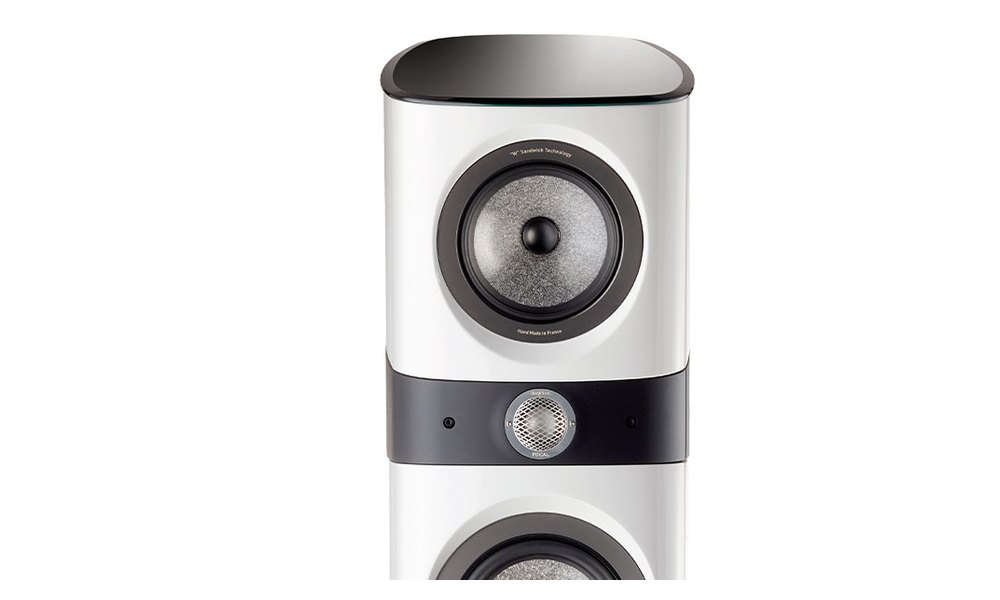
- Tweeter: 27 mm inverted dome of pure beryllium with IHL (Infinite Horn Loading). Focal says the dome covers more than five octaves, from 1,000 to 40,000 Hz.
- Midrange: 16.5 cm with a "W" sandwich cone, TMD suspension and NIC motor. Focal calls it the best midrange driver it had developed up to then.
- Woofers: two 18 cm units with "W" cones.
- Frequency response: 34 Hz to 40 kHz (±3 dB), low-frequency point 28 Hz (−6 dB).
- Sensitivity: 91 dB.
- Impedance: 8 Ω nominal, 3.1 Ω minimum.
- Recommended amplifier power: 40 to 300 W.
- Dimensions and weight: 119 × 35.8 × 54 cm (H × W × D), 55 kg each.
- Accessories: four spikes with counter-spikes (already fitted) and magnetic front grilles.
SoundStage! Hi-Fi gives the crossover points, per Focal, as 250 Hz and 2,200 Hz [2].
The technologies explained
- "W" cone: two layers of woven glass fibre around a foam core. Focal promises lightness, rigidity and damping in one [1][2].
- NIC (Neutral Inductance Circuit): a Faraday ring in the motor. It is meant to keep the magnetic field independent of voice-coil position, current and frequency, lowering harmonic distortion [1][2]. According to SoundStage! Hi-Fi, the woofers use NIC too [2].
- TMD (Tuned Mass Damper): two ring-shaped weights on the midrange surround. Focal says they stabilise the surround's behaviour between 1 and 2 kHz; the technology was introduced in 2015 [1].
- IHL: a horn deep inside the cabinet, filled with damping material, absorbs the rear wave from the tweeter dome so that no energy is reflected back onto it. Focal says this gives the tweeter proper loading despite the compact cabinet, because most of the volume is left for the woofers [1][2].
- Beryllium: according to SoundStage! Hi-Fi, the material is light and stiff enough to push the dome's resonance above the audible band. Focal has used beryllium in tweeters since 2002 [2].
- Gamma Structure: Focal's name for its low-vibration cabinet concept [1].
Cabinet and construction
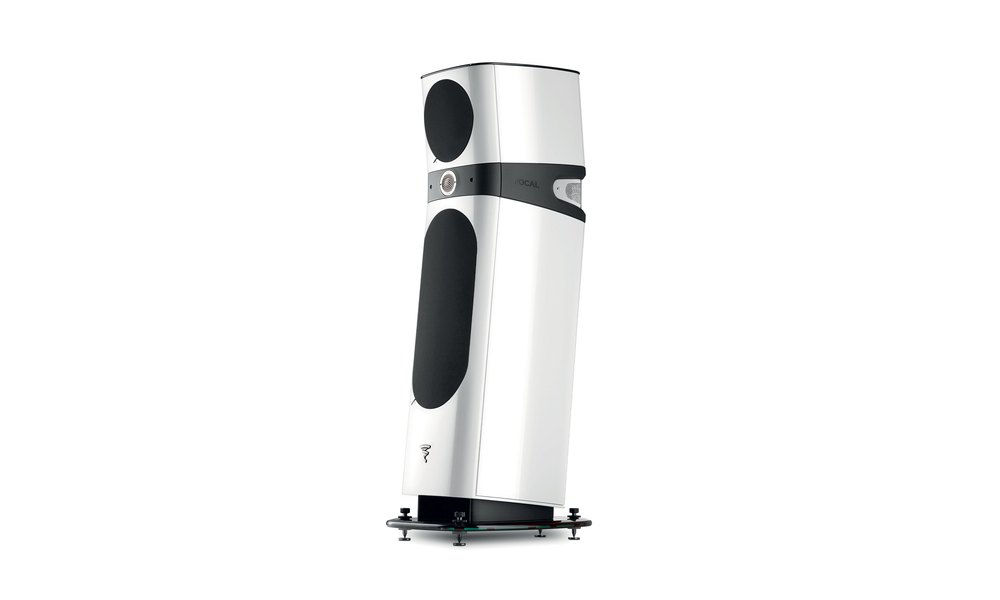
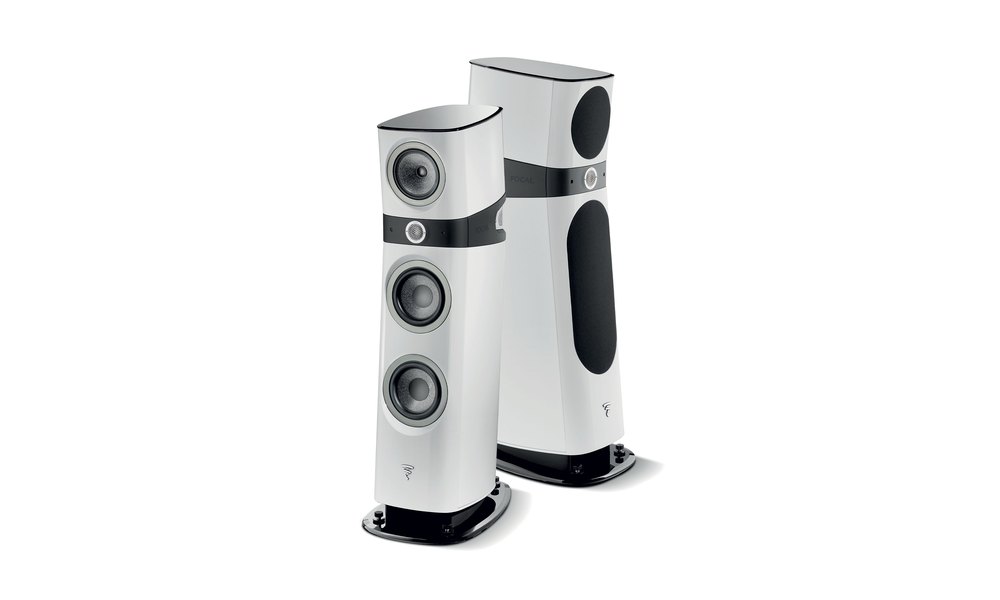
According to SoundStage! Hi-Fi, the cabinet is mainly MDF and divided into three sections, one each for bass, midrange and treble [2]:
- Bass section: tilted back slightly and raised on two legs above a plinth of tempered glass, about 19 mm thick [2][4].
- Bass reflex: a large port sits in the bottom panel. The air exits between the legs to the front and rear [2].
- Midrange section at the top: tilted forward so that the acoustic centres of all drivers are roughly the same distance from the listener. Focal calls this "Focus Time" [1][2].
- Tweeter section in the middle: wedge-shaped, with the tweeter below the midrange [2][4].
- Baffle: SoundStage! Australia cites a 69 mm machined sandwich front panel, no parallel side walls inside, and small Helmholtz resonators in the lower section against vertical standing waves [4].
- Connection: a single pair of binding posts, no bi- or tri-wiring [2].
- Origin: all parts, including the drivers, are made in France according to SoundStage! Hi-Fi [2]. Focal says its own cabinetmakers build the cabinets in France [1].
Finishes
In 2015 SoundStage! Hi-Fi listed a standard Dogato Walnut real-wood veneer with a Graphite Black front, plus four high-gloss lacquers: Carrara White, Black Lacquer, Imperial Red and Electric Orange [2]. The middle section is always matte black [2]. We have not checked the current colour range in detail; Focal's page shows Carrara White among others [1].
Measurements: manufacturer figure and NRC
The NRC measurement for SoundStage! found a sensitivity of 87.5 dB (2.83 V/1 m), averaged from 300 Hz to 3 kHz in the listening window [3]. Focal states 91 dB [1]. The 3.5 dB difference may relate to different averaging ranges, but the sources do not show that, so the question stays open.
The NRC page also shows on-axis and off-axis responses out to 75°, distortion at 90 and 95 dB, and impedance and phase [3]. These curves are published only as graphics, so we do not quote specific values from them. Focal states a 3.1 Ω impedance minimum [1]; SoundStage! Hi-Fi considers that fairly typical [2].
In our assessment, this means the Sopra N°2 is less efficient than 91 dB suggests. Together with a 3.1 Ω minimum, that points to an amplifier that can drive low impedances stably. Focal recommends 40 to 300 W [1].
SoundStage! Hi-Fi (October 2015)
Doug Schneider reviewed the Sopra N°2 for SoundStage! Hi-Fi on 1 October 2015, then priced at $13,999 per pair [2]. He listened with Simaudio Moon Evolution electronics (870A, 300 W into 8 Ω) and at times with tube components from JE Audio and Audio Research [2]. His impressions [2]:
- Highly precise imaging and a wide, deep soundstage. He drew parallels with the liveliness of the Vivid Audio Giya G2.
- A lively, immediate sound, with the four drivers blending into one.
- A midrange with plenty of presence and body and no loss of detail. Especially strong with voices.
- Powerful, deep and clean bass. He found the 28 Hz (−6 dB) figure realistic. Compared with the Sonus Faber Olympica III, the bass went even deeper and was more detailed.
- Treble: the very top end was a touch "hot" and livelier than his neutrality reference, the KEF Reference 1, which he called typical of Focal. It still sounded very clean and never edgy.
- With a tube preamplifier, the midrange became somewhat richer [2].
Schneider's verdict: an outstanding speaker, not just for the price but outright [2].
Tube components in SoundStage! Hi-Fi's listening
Towards the end of his listening, Schneider swapped individual components for tube units, one at a time [2]. With the JE Audio Reference 1 tube preamplifier in place of the Moon 740P, the Sopra N°2's already full midrange sounded somewhat richer. Voices imaged a little more holographically, and cymbals and guitars gained a little shimmer [2]. With the Audio Research GS150 power amplifier in place of the Moon 870A, the sound was no warmer but somewhat more spacious [2]. We do not quote a power rating for the GS150 here. In our assessment, this single session only shows that the Sopra N°2 worked with these two tube units; it is not a general statement about tube amplifiers into 3.1 Ω.
SoundStage! Australia (December 2019)
Barry Jones reviewed the Sopra N°2 for SoundStage! Australia on 1 December 2019; the Australian price was AU$22,300 [4]. He listened in a heavily treated room of about 21 m² [4]. His impressions [4]:
- Very fast from treble to bass, with precise rhythm.
- Voices at the right height and size, precisely focused.
- Deep, taut bass, surprisingly clean and powerful for the driver size.
- Complex orchestral works such as Mahler's "Titan" without signs of congestion.
- Only a slight trace of "box" compared with open baffles.
- Greatest strength: almost "Wilson-like" imaging. Very well balanced overall rather than specialised in one area.
Jones names the Wilson Audio Sabrina and Magico A3 as pricier rivals [4].
Music examples from the reviewers
- Schneider [2]: Van Morrison's "Spanish Steps", with the sax precisely centred. "Some Peace of Mind", a slightly bright recording, stayed free of harshness. Sting's "Angel Eyes" from Leaving Las Vegas with great stage depth and natural piano and bass. Musica Nuda's "Blackbird" with an effortless voice even at high volume. Chopin's "Raindrop" Prelude with weight and seamless transitions between drivers.
- Jones [4]: Intuit's "Joybringer" with precise, powerful rhythms. Joe Jackson's "You Can't Get What You Want" with large dynamic swings. Pat Metheny's "The Sound of Silence" with very precise localisation. Pink Floyd's "Things Left Unsaid" with firm deep bass. Chopin's Nocturne Op. 9 No. 2 (Claudio Arrau) with full piano sound.
Comparisons in the sources
- Sonus Faber Olympica III: Schneider heard it as more laid-back and distant. The Sopra N°2 went deeper in the bass and sounded more detailed [2].
- KEF Reference 1: Schneider's neutrality reference. The Sopra N°2 was livelier in the extreme highs [2].
- Wilson Audio Sabrina, Magico A3: named by Jones as pricier rivals [4].
- The page's comparison table (Kanta N°2, Blade Two, Confidence 20) is not based on these reviews.
Placement
- Room size: Focal says the Sopra N°2 is ideal for living rooms up to 30 m² and also suits larger rooms up to 70 m² [1]. Jones reads Focal's recommendation as a 30 m² minimum; his 21 m² room was smaller and heavily treated [4]. We leave this difference in reading open.
- Jones's distances: 1.08 m from the front wall, 0.6 m from the side wall, 18° toe-in, 3.35 m listening distance [4].
- Schneider's distances: large room, about 2.6 m between tweeters, 20° toe-in, about 1.8 m from the front wall, 1.2 m from the side walls, about 2.6 m listening distance [2].
- Toe-in: both reviewers toed in clearly, by 18 to 20° [2][4]. We do not have a Focal specification on this.
- Port: the bass-reflex port fires down onto the glass plinth, with air exiting to the front and rear [2]. In our assessment, this makes the speaker less sensitive to rear-wall distance than a rear-ported design; no source states this.
- Coupling: spikes with counter-spikes are included [1]. Focal highlights the visible decoupling spikes [1].
- Listening height: the tilted sections are meant to time-align the drivers at the listening position [1][2]. In our assessment, a listening seat at normal sitting height makes sense.
Amplification according to the sources
Schneider listened with a 300 W power amplifier and with tube components; both worked well [2]. Focal suggests a Naim combination on its product page (NSC 222, NAP 250, NPX 300) [1]. That is manufacturer marketing within the same group, not an independent recommendation. Given the 3.1 Ω minimum and the 87.5 dB measured sensitivity [1][3], we consider the description "easy to drive" unsupported.
In a vinyl system
None of the sources mentions a turntable [2][4]. For vinyl, only what follows from the data applies: the Sopra N°2 is passive and needs an amplifier. A turntable needs a phono stage, built in or separate. Where the turntable stands depends on the rack and cable runs, not on the speakers. Given the powerful bass [2][4], in our assessment it makes sense to isolate the turntable from footfall, regardless of how close it is to the speakers.
Where the sources agree
- Imaging and soundstage: exceptionally precise [2][4].
- Voices and midrange: present and clear [2][4].
- Bass: surprisingly deep and clean for the size [2][4].
- Treble: Schneider heard it as slightly raised but clean [2]. Jones praises the beryllium treble without reservation [4].
Open points and limits of this analysis
- Sensitivity: 91 dB per Focal versus 87.5 dB per NRC [1][3]. The reason stays open.
- Room size: Focal's figure is read differently [1][4].
- Finishes: the current range has not been checked in detail.
- Prices: $13,999 per pair (10/2015) and AU$22,300 (12/2019) [2][4]. The page's price information stays unchanged.
- A detailed human fact-check of this analysis is still pending.
Sources for this analysis
- Focal: Sopra N°2 (Produktseite). https://www.focal.com/products/sopra-n2
- SoundStage! Hi-Fi: Focal Sopra No2 Loudspeakers (Doug Schneider, 01.10.2015). https://www.soundstagehifi.com/index.php/equipment-reviews/890-focal-sopra-no2-loudspeakers
- SoundStage! Network: NRC Measurements Focal Sopra No2. https://soundstagenetwork.com/index.php?Itemid=153&catid=77&id=1445%3Anrc-measurements-focal-sopra-no2-loudspeakers&option=com_content&view=article
- SoundStage! Australia: Focal Sopra N° 2 Loudspeakers (Barry Jones, 01.12.2019). https://soundstageaustralia.com/index.php/reviews/348-focal-sopra-no2-loudspeakers
Created by AI (Vinyl BotPro) from the sources listed; no listening tests or measurements of our own. Detailed human fact-check pending.
Created by Vinyl BotPro (AI) · As of Sept 2026 · Corrections: info@vinylcination.de