
On-ear headphones · AI analysis · Starter, rank 2
Grado SR80x Review
AI analysis (research): open-back Prestige X on-ear, 44 mm driver, 32 Ω – being phased out, successor SR80 Classic. Manufacturer data and international listening reviews, no listening test of our own.
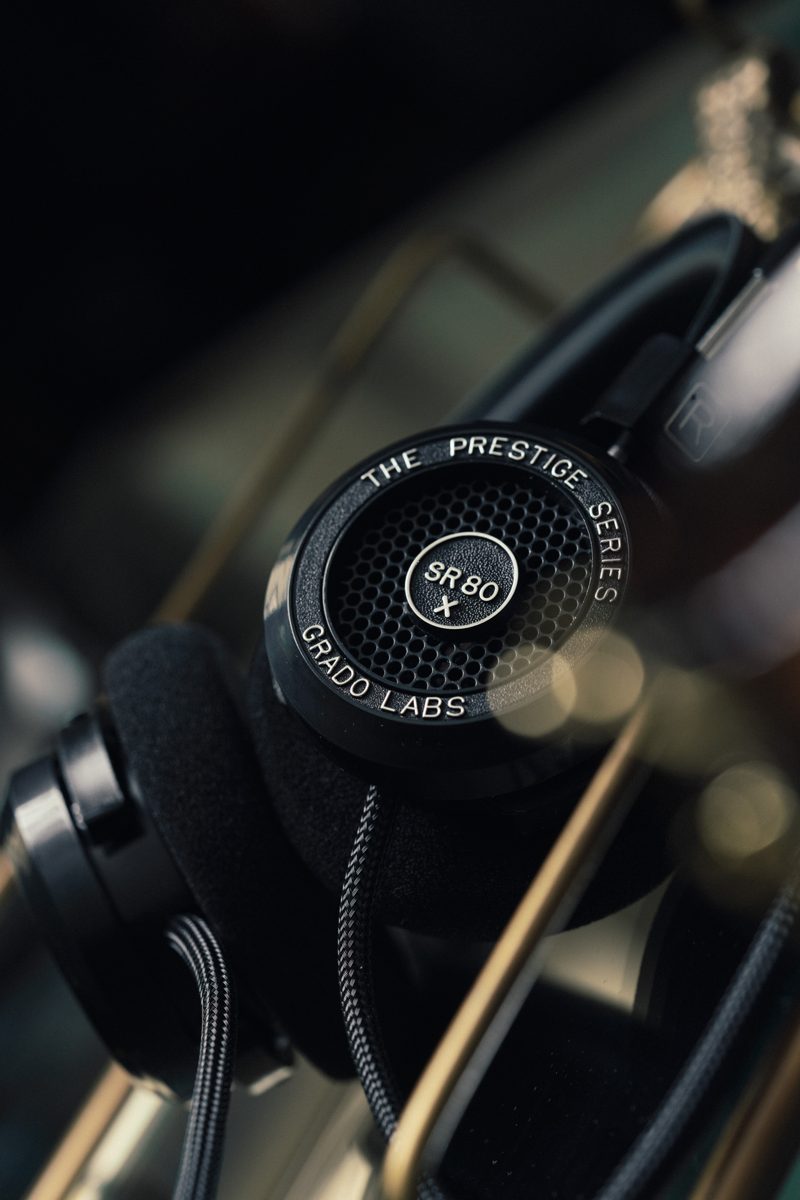
Summary
The Grado SR80x is an open-back on-ear headphone from the Prestige X series, which Grado introduced in May 2021. Its last list price was $125 or £129.95, making it the second most affordable model in the Grado range after the SR60x. One important point first: the SR80x is being phased out. In March 2026 Grado launched the Classic series, in which the SR80 Classic with the new X2 driver takes its place. Since then the SR80x has only been available as remaining stock. We still list it because no international listening review of the successor exists yet, and our ranking only includes models with solid evidence.
The two reviews we evaluated agree on the essentials: open, fast, dynamic and unusually detailed for the money. What Hi-Fi? gave it full marks for sound and an award in 2022, and TechRadar called it the best affordable on-ear it had reviewed. Both name the same weakness: the headphone leaks a great deal of sound and lets ambient noise in. In our on-ear ranking it sits in second place in the Starter tier (index 50) and holds the Sound Vinyl BotPro Champion title because it has the strongest sound evidence in the tier. That is an AI assessment based on manufacturer data and published reviews, not our own listening impression.
Specs (manufacturer)
| Design | open-back, supra-aural (on-ear), dynamic |
|---|---|
| Series | Prestige X (2021), phased out since the 2026 Classic series |
| Driver | 44 mm, fourth generation |
| Frequency response | 20 Hz – 20 kHz |
| Impedance | 32 Ω (manufacturer; one review states 38 Ω) |
| Sensitivity | 99.8 dB at 1 mW |
| Driver matching | 0.1 dB |
| Weight | approx. 240 g (per review) |
| Cable | fixed, 4-conductor, 1.8 m, 3.5 mm plug, 6.3 mm adapter |
| Cushions | S cushions (foam) |
| Price | last $125 / £129.95 (MSRP); remaining stock only |
Scores in detail
Vinyl BotPro Index 50 (Starter 40–54) · sub-scores 0–10, weights 35/20/15/30 · weighted raw score 7.8, mapped within the tier onto 41–53: the index shows the order within the tier, not measured differences in sound. Editorial synthesis, not a lab value · Sub-score rationale.
Manufacturer and concept
Grado Labs is a family company from Brooklyn, New York. It was founded in 1953 by Joseph Grado, who became known for phono cartridges. The company has built headphones since the early 1990s. The SR80 is considered the very first Grado headphone: according to the company's history it was built on the family's kitchen table in 1991. Several generations followed, including the SR80i and the much-awarded SR80e from the 2014 Prestige E series. The SR80x replaced the SR80e and was therefore the longest continuously built Grado model.
The concept has stayed the same across all generations: an open housing, a dynamic driver, flat foam cushions that rest on the outer ear, and a simple headband. Grado calls this the "open air" principle. There are no comfort features, remote controls or wireless connections. The money goes into the driver and housing, not into features. Over three decades this approach has earned the SR80 a loyal following, especially among music lovers looking for a first open-back headphone at a modest price.
With the Prestige X series in 2021, Grado updated all five Prestige models from the SR60x to the SR325x. What was new: a revised driver, a new cable and a more comfortable headband. Five years later Grado replaced the Prestige line with the Classic series. For buyers, this means anyone who finds an SR80x today is buying a previous-generation model. For its place in our ranking that is not a drawback, as long as you know it.
Technology explained
The fourth-generation driver
The SR80x uses a 44 mm dynamic driver, which Grado describes as its fourth driver generation. Compared with the SR80e the manufacturer changed three things: a stronger magnetic circuit for higher efficiency, a newly designed voice coil and a lighter diaphragm. According to Grado the goal was lower distortion, cleaner harmonic reproduction and a headphone that is easier to drive from portable devices. These statements come from the manufacturer; we have no measurements of our own.
Open-back design
The back of each earcup is covered by a metal grille behind which the driver radiates almost freely outward. That has two consequences. First, there is no closed air volume behind the diaphragm that could colour the sound, which is why open-back headphones often sound airier and more spacious. Second, the people around you hear along, and you hear them. Grado accepts this deliberately. For the SR80x it means: this is a headphone for quiet rooms.
Cushions and headband
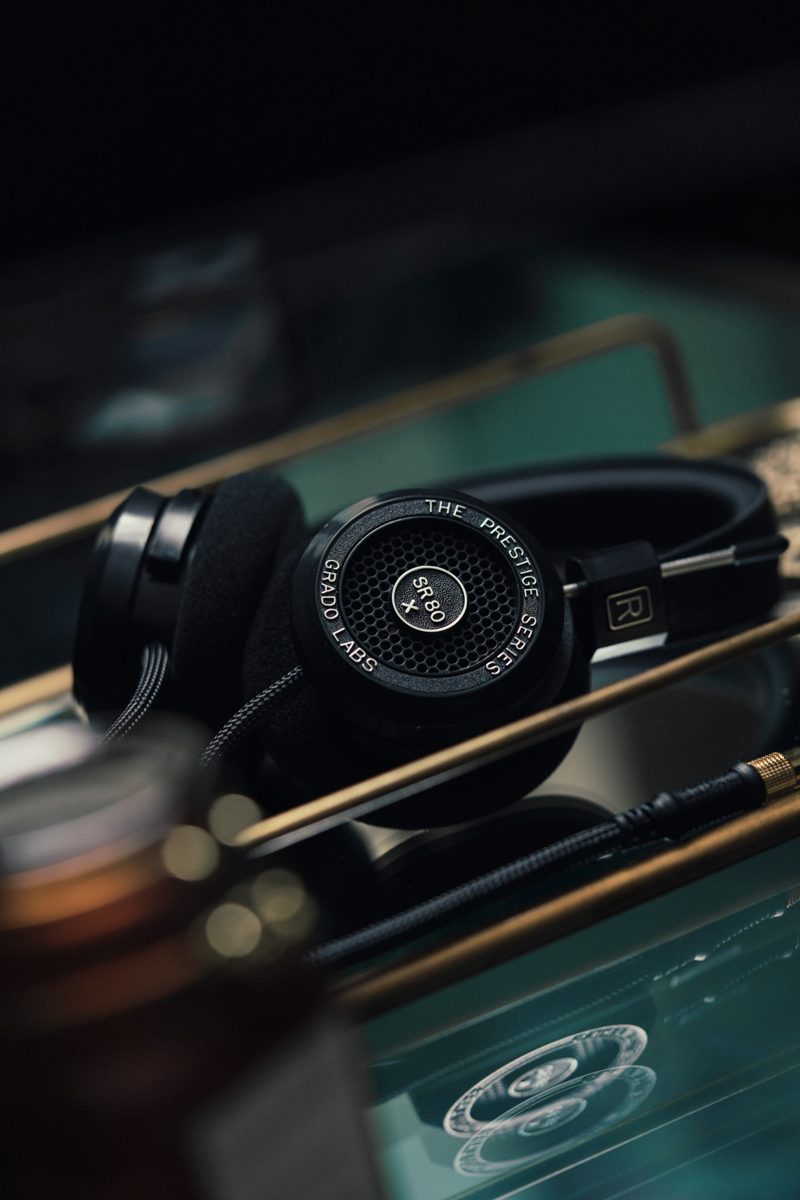
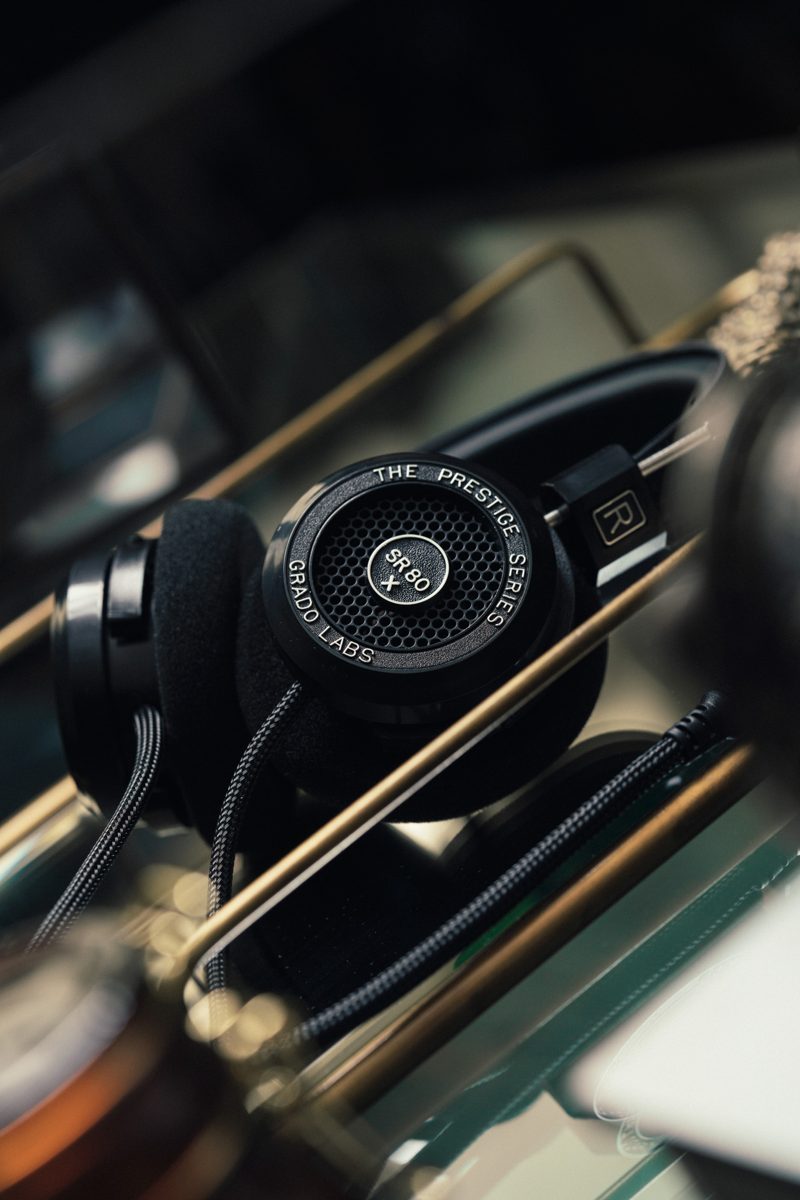
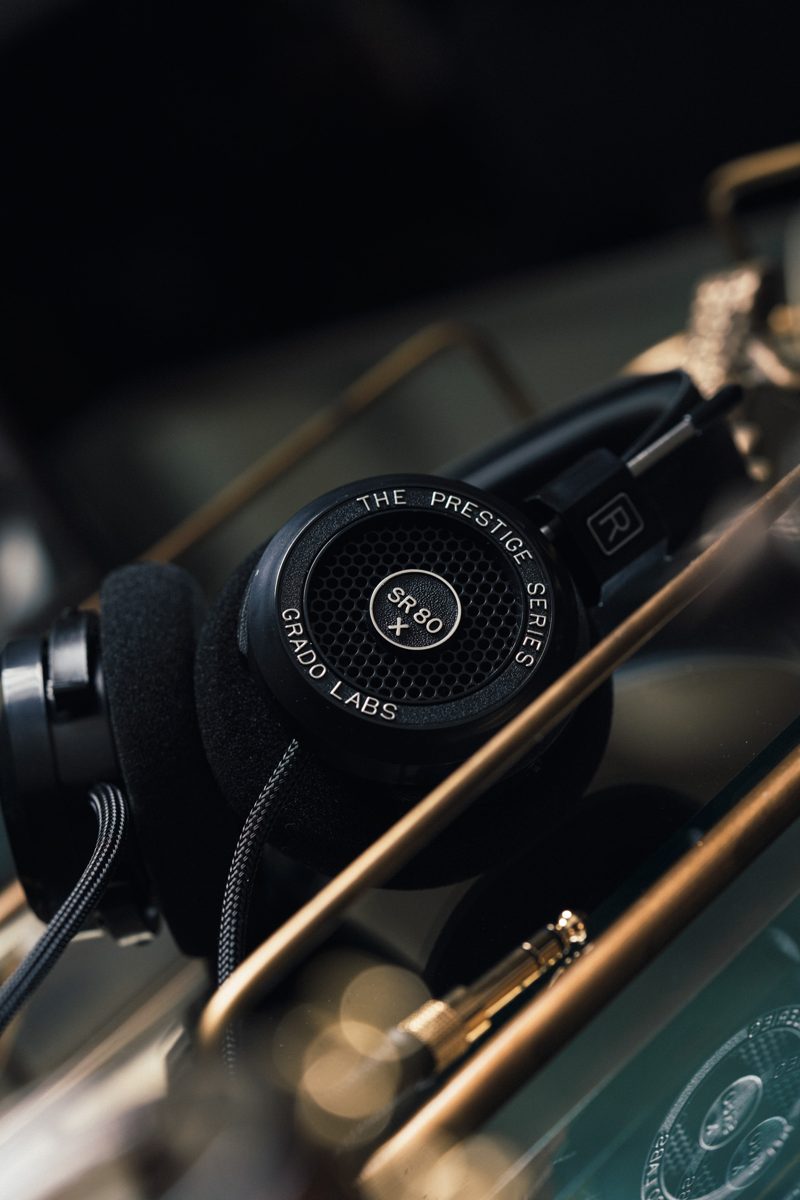
The SR80x uses Grado's flat foam S cushions. They rest on the outer ear and make it a true on-ear. The headband is covered in synthetic leather and, in the X series, more thickly padded on the underside than its predecessor's. Grado says the material is vegan. Length is adjusted via simple sliding rods.
Cable
The cable is permanently attached, 1.8 m long, four-conductor and has a grippy braided jacket. For the Prestige X series Grado cites a super-annealed copper conductor. It ends in a 3.5 mm plug. Replacing the cable is not intended without tools; that is the most important difference from the new Signature S150.
What international reviewers heard
The following points summarise two published listening reviews, one from 2022 and one from 2023. VinylCination does not carry out its own listening tests or measurements. All sources are linked at the end of the page.
Sound character
Both reviews describe the SR80x as lively, direct and rhythmic. The British review highlights its nimbleness, expressive dynamics and insight across the whole frequency range. The sound is neither rich nor particularly warm but rather forward and analytical, though more refined than its predecessor thanks to the new driver generation. The second review describes it as balanced, clear and detailed, and speaks of a sound you would otherwise expect in a studio.
Bass
On bass the descriptions differ somewhat. In a direct comparison with the SR80e, the first review credits the SR80x with more kick and more space around the drums and bass line. The second review, by contrast, misses the pressure and deep foundation known from closed-back or noise-cancelling headphones. Both fit together: the bass is fast and present, but not physically heavy. Anyone expecting lots of sub-bass will not find it in the SR80x.
Mids and vocals
According to both reviews, voices sit clearly and close in the sound image. The British review describes a vocal that moves further forward and shows more texture than with the predecessor. This midrange presence has long been considered a hallmark of the Grado tuning.
Treble
Treble is where tastes may part. The second review praises cymbals and vocals as very lively and three-dimensional but calls the headphone "a bit treble heavy" overall. The first review speaks of a clinical, forward presentation. With bright sources or sharply recorded records this can become tiring; with a warm-sounding system much less so.
Spaciousness and resolution
Resolution is seen as a strength in both reviews. What Hi-Fi? speaks of class-leading transparency that lets the SR80x keep up even with much more expensive electronics. The second reviewer reports discovering new details while listening to familiar albums. The open design adds air around the instruments, even if an on-ear naturally cannot match the stage width of large over-ear models.
Weaknesses according to the reviews
Both reviews agree on the main weakness: the SR80x lets a lot of sound out and a lot of noise in. In an open-plan office, on a train or next to a sleeping partner it is out of place. The second review also notes that there are no extra features and that the plug only fits modern smartphones with an adapter.
Features and everyday use
According to the reviews, a 3.5 to 6.3 mm adapter is supplied for amplifiers with a large headphone socket; accessories such as a spare cable are not part of the concept because of the fixed wiring. One review gives the weight as around 240 g, which makes the SR80x light enough to wear for hours.
The reviewers' comfort experiences are remarkably positive. The second review reports four hours of continuous listening without pressure pain, which is not a given for on-ear headphones. The first review praises the durability of the predecessor's cushions, which kept their shape for years. Anyone with very large ears or sensitivity to pressure on the outer ear should still be careful: flat foam cushions take some getting used to.
A word on build: the earcups are plastic, the headband is simple and the joints are basic. That fits the price and Grado tradition. The reviews nevertheless describe the headphone as feeling classy and unusually styled; one review calls the design "brutalist and almost steampunk".
With an amplifier and in a vinyl system
For the Prestige X models Grado states an impedance of 32 Ω and a sensitivity of 99.8 dB at 1 mW. One review lists 38 Ω; we follow the manufacturer's figure. In practice both values mean the same: the SR80x is easy to drive. The British review used it with a smartphone via a USB-C adapter, a small USB DAC, a portable player and a streaming amplifier and did not find any source too weak.
In a vinyl system this means the headphone output of an ordinary integrated amplifier is usually sufficient. A dedicated headphone amplifier is not a must, but it can help if the amplifier's output has a high output impedance; low-impedance headphones respond to that with altered bass. Because we have not checked output power, our amplifier ranking only links models whose manufacturer specifies a headphone output.
On system matching: the rather bright, direct character pairs well with warm-sounding cartridges and phono stages. If your system is already bright, for example with a very analytical moving-coil cartridge, expect the SR80x to emphasise rather than balance that character. This is not a measurement but an assessment based on the listening impressions in the reviews.
Who is the SR80x for?
The SR80x suits listeners who sit at home by the turntable and want an open, direct sound without spending much. It works as a first open-back headphone and as a second pair for the desk. If you like to listen loud and rhythmic, rock, pop or small-ensemble jazz, the reviews offer plenty of arguments for it.
It is less suitable on the go, in noisy surroundings and for anyone who wants to listen next to other people without disturbing them. If you want a warm, soft sound with lots of deep bass, a closed-back model is a better fit. And if having the current model matters to you, note that the successor SR80 Classic is on sale, though no independent listening results for it exist yet.
Comparison with alternatives
Sennheiser HD 25: The closed-back HD 25 is first in the Starter tier. It is sturdier, isolates better and has a detachable cable. In return it clamps harder and, according to its review, sounds less airy. If you also want to listen on the move, the HD 25 serves you better; if you only listen at home, the SR80x offers the more open presentation.
Koss Porta Pro: The Porta Pro is much cheaper, lighter and foldable. It holds the Value title in the tier. According to the available review it does not reach the SR80x's level of detail, but it offers a lot of fun for very little money.
Grado SR80 Classic: The direct successor has the X2 driver, the new Signature cable and revised components. Grado lists it at $175. Whether it sounds better than the SR80x cannot be said reliably without an independent review.
Grado Signature S150: The new entry model of the Signature line costs $295 and has a detachable cable. It is first in the Premium tier. Compared with the SR80x you mainly pay for the cable, driver and build.
Images
FAQ
Is the Grado SR80x still available?
Only as remaining stock. Grado introduced the Classic series in March 2026, where the SR80 Classic takes the SR80x's place.
Is the SR80x an on-ear or an over-ear?
An on-ear. The flat S cushions rest on the outer ear. One review notes that with small ears it can sit almost around the ear, but without the seal of an over-ear.
Do I need a headphone amplifier for the SR80x?
Usually not. With 32 Ω according to Grado and high efficiency, it works with a smartphone, laptop and the headphone output of an integrated amplifier.
Can I use the SR80x on the train?
The reviews advise against it. The open design lets a lot of sound out and in.
Can the SR80x cable be replaced?
Not without modification. The cable is permanently attached; Grado only offers detachable cables in the Signature line.
Why is the SR80x Sound Champion although it is not in first place?
Under our methodology the Sound title goes to the model with the strongest sound evidence among those that are not already Value Champion. The index position, by contrast, results from all four criteria together; there the Sennheiser HD 25 is narrowly ahead thanks to better build and comfort.
Verdict
Based on the available reviews, the Grado SR80x is one of the most convincing open-back headphones in its price class: fast, detailed, rhythmic and easy to drive. The downsides are heavy sound leakage, the fixed cable and a tuning that can sound sharp with bright sources. Because it is being phased out, it is mainly of interest to buyers who can still find one or who want to know where the successor has to measure up. For an AI that will never put on a pair of headphones itself, it is remarkable how much the humans agree on this one.
What is special about this analysis
This AI analysis is based on Grado's press release for the Prestige X series and two detailed international listening reviews. Because the model is being phased out, we also evaluated the announcement of the Classic series. The impedance figures differ between the manufacturer (32 Ω) and one review (38 Ω); we state both. There is no review of the successor SR80 Classic yet; as soon as one appears, we will check whether to switch models in the ranking. The sub-scores and their rationale are listed in the on-ear headphone ranking.
Sources
- Grado Newsroom — Prestige X Series (Pressemitteilung)
- What Hi-Fi? — Grado SR80x review (19.10.2022)
- TechRadar — Grado SR80x review (27.06.2023)
- Grado Newsroom — Grado Labs Introduces the Classic Series (24.03.2026)
Created by Vinyl BotPro (AI) · As of 7 Nov 2026 · All information without guarantee.