
Bookshelf speaker · AI analysis · Master, rank 1
Harbeth M40.5 XD2 Review
AI analysis (research): 3-way monitor M40.5 XD2 (40.2/40.3 succession), 86 dB, 6–8 Ω — specifications and retailer prices, no listening test.
Summary
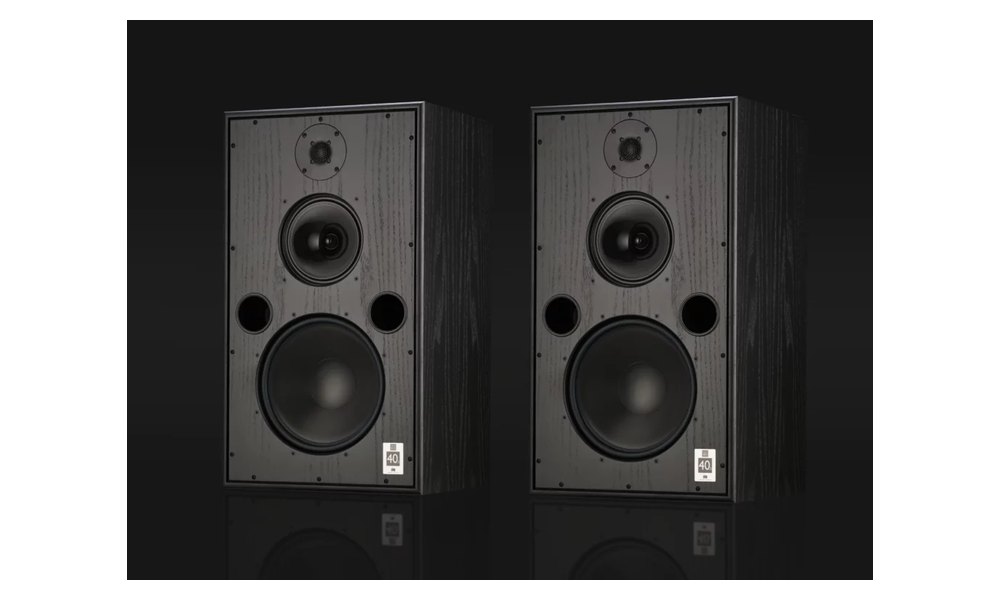
The M40.5 XD2 is Harbeth’s current large monitor reference in the 40.x line (successor to the M40.2 / M40.3 XD): 300 mm bass driver, 200 mm RADIAL midrange, 25 mm tweeter, 3-way, vented. Typical ~86 dB, 6–8 Ω, recommended from approx. 35 W. DE/NL pair often approx. €20,800–21,400 per finish. Specialist press (Positive Feedback 05/2025, U-Audio 01/2026): very strong midrange, wide soundstage, BBC monitor heritage. Needs sturdy stands and distance from the wall. Details and sources in the analysis below.
Assumptions
- Price per pair/NL Sept 2026 per finish
- Stands recommended
- Patient run-in period
- No measurements of our own
Specs (public / manufacturer)
| Type | 3-way monitor · Bass-reflex |
|---|---|
| Sensitivity | 86 dB (2.83 V/1 m) |
| Impedance | 6–8 Ω nominal |
| Rec. Amplifier power | from 35 W/channel |
| Frequency range | 35 Hz–20 kHz (±3 dB) |
| Chassis | 300 mm bass · 200 mm RADIAL4 mid · 25 mm Tweeter |
| Dimensions / weight | 750 × 432 × 388 mm · 38 kg/piece |
| Price guide | approx. €20,800–21,400/pair · Sept 2026 · Check the price date |
Manufacturer specifications (Harbeth)
| Type | 3-way monitor |
|---|---|
| Drivers | 1 × 300 mm Harbeth bass unit · 1 × 200 mm RADIAL4 mid unit · 1 × 25 mm ferrofluid-cooled tweeter |
| Frequency response | 35 Hz–20 kHz (±3 dB, free space, grille on) |
| Sensitivity | 86 dB/2.83 V/1 m (axial) |
| Impedance | 6–8 Ω |
| Recommended amplifier power | suggested from 35 W/channel |
| Power handling | 650 W programme |
| Dimensions | 750 × 432 × 388 mm (H × W × D; +12 mm grille/binding posts) |
| Weight | 38 kg each (unpacked) |
| Data sheet | Harbeth technical information sheet M40.5 XD2 (PDF) |
Source: Harbeth – official specifications · As of 16 October 2026 · subject to change by the manufacturer
Scores in detail
Vinyl BotPro Index: 93 · Index band Master 85–97 · Guidance only, not a lab value.
Strengths
- BBC/Monitor Heritage for Voices/Jazz
- Current XD2 generation
- Amp friendly relative to 4-Ω monsters
Weaknesses
- 86 dB not "loud-cheap"
- Large monitor footprint
- Finish prices
Comparison models
| vs. M40.3 XD / 40.2 | XD2 successor |
|---|---|
| vs. Spendor Classic 100 | Harbeth vs. Spendor BBC School |
| vs. Confidence 20 | Large standmount monitor vs. Esotar standmount |
System matching
Works well with
- Clean class A/AB or good tube
- Stand, distance from the wall
- Acoustics/jazz/voice
Less suited
- Expecting party levels
- Tiny rooms without stand
- Who only wants meta-precision
Analysis: the Harbeth M40.5 XD2 in depth
What this is: an AI analysis, not a listening test
This page summarises what can be documented about the Harbeth Monitor 40.5 XD2 from manufacturer material and international specialist publications. Vinyl BotPro has neither listened to nor measured the loudspeaker. We paraphrase sound descriptions in our own words as the named publications formulated them under their own conditions. Our own assessments are marked as such. This section does not change the rating, rank or index: the M40.5 XD2 remains at index 93 in first place in the Master tier and holds the sound champion award.
Model separation matters here. The Monitor 40 has existed since 1998 in several generations: M40, M40.1, M40.2, M40.2 Anniversary, M40.3 XD and now the M40.5 XD2 [7][8]. This page covers only the M40.5 XD2. Where sources describe older versions, we say so explicitly. We quote prices only as dated figures; they are not current euro market prices.
Background: Harbeth and the BBC
According to the manufacturer, Harbeth was founded in 1977 [1]. According to Positive Feedback, the company was founded by Dudley Harwood, previously head of loudspeaker research at the BBC; the name combines "HARwood" with his wife's first name, Elizabeth [7]. Alan Shaw has run the company since 1986 [5][7].
According to Harbeth, Harwood led the BBC's loudspeaker development in the 1960s and 1970s [5]. Positive Feedback quotes Harbeth as saying that Harwood filed a patent on polypropylene as a cone material on 19 March 1976, and that Harbeth was founded to commercialise this invention [7]. The BBC heritage page explains why the broadcaster needed many matching studio monitors and therefore researched loudspeakers itself [6].
Harbeth's BBC heritage page explains the background: the British Broadcasting Company was formed in 1922 by a consortium of radio manufacturers and became the public British Broadcasting Corporation in 1927 [6]. According to Harbeth, the rapidly growing studio network needed hundreds of studio monitors, all meeting the same technical standard and sounding the same [6].
Positive Feedback places Harbeth in the so-called BBC school, to which it also assigns Spendor, Rogers, Graham Audio and Falcon Acoustics [7]. The BBC monitors were intended as studio tools and classified by listening distance, for the near field like the LS3/5A or for greater distances; that is why even the largest of these models are nominally stand-mounted monitors [7].
The RADIAL cone
After Shaw took over, Harbeth looked for a better cone material than polypropylene, according to the manufacturer [5]. A research programme with a university and government funding produced the RADIAL project (Research and Development into Advanced Loudspeakers) [5]. According to Harbeth, the team systematically tested some fifty low-mass candidates [5]. Positive Feedback gives 1990 as the year of the research grant [7].
U-Audio describes RADIAL as a blend of a metal for stiffness and a polymer for damping; the formulation is meant to convert fine vibrations into heat [8]. That is the publication's account; Harbeth itself does not disclose the composition [5].
The Monitor 40 generations
Positive Feedback describes the development as follows [7]: the Monitor 40 arrived in 1998 as the direct successor to the two-way BBC LS5/8 monitor and was designed as a three-way speaker. The first version used a modified SEAS tweeter, a RADIAL midrange and a 300 mm Vifa bass driver. When Vifa stopped supplying in 2006, Harbeth developed its own bass drivers.
The further sequence according to the sources:
- M40 (1998): first version, successor to the LS5/8 [7][8].
- M40.1 (2008): according to Positive Feedback with the RADIAL2 midrange and in-house bass drivers, built until 2017 [7].
- M40.2 (2015) and M40.2 Anniversary (2017): according to Positive Feedback, the anniversary version introduced WBT binding posts [7]. U-Audio cites higher efficiency and better bass extension for the M40.2 [8].
- M40.3 XD: XD stands for eXtended Definition, with a revised crossover and cabinet bracing [7][8].
- M40.5 XD2 (March 2025): launched in March 2025 according to Positive Feedback [7]; U-Audio also gives 2025 [8].
Construction: a large three-way monitor
Harbeth lists the M40.5 XD2 as a standmount speaker, meaning a loudspeaker for stands [1]. According to the technical information sheet, it uses three Harbeth-made drivers in a bass reflex cabinet [2][7].
The manufacturer's specifications:
- Bass driver: 300 mm, Harbeth-made [2].
- Midrange driver: 200 mm with RADIAL4 cone, Harbeth-made [2].
- Tweeter: 25 mm, ferrofluid-cooled [2].
- Frequency range: 35 Hz to 20 kHz (±3 dB), free-space with grille on, with smooth off-axis response according to Harbeth [2].
- Impedance: 6 to 8 ohms, easy to drive according to Harbeth [2].
- Sensitivity: 86 dB at 2.83 V and 1 m, on axis [2].
- Amplifier: works with a wide range of amplifiers according to Harbeth, suggested from 35 watts per channel [2].
- Power handling: 650 watts programme [2].
- Connectors: two Harbeth-branded 4 mm binding posts [2].
- Dimensions and weight: 750 × 432 × 388 mm (H × W × D), plus 12 mm for grille and binding posts, 38 kg each without packing [2].
- Finishes: Black Ash, Cherry, Oak, Walnut and Rosewood [2].
RADIAL4 midrange and new crossover
According to Harbeth, the new midrange driver with RADIAL4 cone is at the heart of the revision [1]. Positive Feedback reports from the press material that the new range is based on a revised material formulation and an improved injection moulding process [7]. U-Audio writes that RADIAL4 replaces RADIAL2, used for over 15 years; Harbeth does not specify the differences [8].
On the crossover, Harbeth writes that every XD2 speaker has a newly refined crossover intended to improve integration between bass, midrange and treble and to make the sound more open and clear [1][4]. Harbeth does not state crossover frequencies; U-Audio notes this explicitly [8]. Positive Feedback quotes Alan Shaw as saying the XD2 models are the most transparent Harbeths ever produced [7]. That is a manufacturer statement.
Tweeter and cabinet
According to the data sheet, the 25 mm tweeter is ferrofluid-cooled [2]. U-Audio describes a soft dome with a metal mesh in front, meant to protect the dome and improve dispersion [8]. According to Positive Feedback, the tweeters still come from SEAS [7].
According to Positive Feedback, the cabinet follows the BBC idea: thin walls, damped only in selected places and bolted so that they resonate in a controlled way in certain frequency ranges rather than suppressing vibration [7]. For the M40.5 XD2, Positive Feedback says the internal changes concerned damping, tuning and added cabinet rigidity [7]. U-Audio describes a grille that fits into a groove in the baffle without pins [8].
Connections
Harbeth specifies two 4 mm binding posts [2]. U-Audio points out that despite three ways, the M40.5 XD2 has only one pair of terminals; bi-wiring or tri-wiring is not provided for [8]. The Harbeth user guide recommends clearly colour-coded cable and careful attention to polarity, because incorrectly connected channels make natural reproduction impossible [3]. Where banana plugs are considered a hazard, the guide suggests spade connectors or neatly trimmed bare wire as an alternative [3].
Placement according to Harbeth
The data sheet recommends free-space placement away from walls [2]. Stands should bring the ears level with the tweeter; the tweeter is 660 mm above the base of the cabinet [2]. The user guide calls this height the reference axis and acknowledges that many listeners compromise between looks, stability and ideal height [3]. It recommends stable stands of non-resonant material with an adequately large top plate, and felt or rubber dots between speaker and stand [3].
According to the guide, a little toe-in changes the balance between direct sound and wall reflections in the mid and high frequencies [3]. Near a wall, the speaker couples acoustically to the surface, and the low-mid range is raised [3]. Well-stocked bookcases behind or beside the speakers, or an asymmetrical placement, can improve the bass [3]. According to the guide, the M40 is very heavy and should be unpacked by two people in the listening room [3].
The guide also gives advice on the room [3]: the more absorption in the room, the less it influences the sound. Parallel surfaces such as opposite walls, floor and ceiling can reinforce particular notes, and flexible plasterboard walls or wooden floors over cavities can resonate and boom. According to the guide, echoes can be found by clapping in the room; soft furnishings damp a lively room in the mids and highs. Damping should be added gradually and not overdone [3]. For care, the guide advises avoiding direct sunlight and radiators; the veneer colour will mature over time [3].
Amplifier choice
Harbeth suggests from 35 watts per channel [2]. The user guide describes Harbeth speakers as an easy load for solid-state amplifiers; with valve amplifiers the interaction cannot be determined in advance [3]. For normal daytime listening it suggests about 45 watts into 8 ohms as a good choice, and 100 watts as reserve for louder passages in bigger rooms [3].
Positive Feedback drove the M40.5 XD2 with a Soulution 710 power amplifier and concludes that it would play even better with a top-class valve amplifier, not necessarily a powerful one [7]. U-Audio listened with a PrimaLuna EVO 300 with EL34 valves, which according to the publication delivers 24 watts in triode mode and 42 watts in pentode mode; even in triode mode it did not lack power [8]. These are single observations in specific systems.
On loudness, the user guide says the volume control works like a zoom lens: as the level rises, the performers move closer. Every recording has an optimum replay loudness at which the recorded tonal colours appear in their intended proportion [3].
How the reviews were made
On 28 May 2025, Positive Feedback published the English version of a review by Wojciech Pacuła from the Polish magazine High Fidelity [7]. He has used the M40.1 privately since 2011 and used it and the YG Acoustics Vantage 3 for comparison [7]. The speakers stood 252 cm from the listening seat, 232 cm apart and 56 cm from the rear wall, toed in towards the listening position [7].
U-Audio published a review by Dai Tiankai on 26 January 2026 [8]. According to the publication, the listening took place in a large open space at the Taiwanese distributor, with an Aurender A20 streamer and the valve amplifier mentioned; a Burmester solid-state amplifier was also used [8]. A review on the distributor's premises is not an independent listening environment; we note this as a limitation.
Dated prices
- U-Audio, January 2026: recommended retail price in Taiwan NT$810,000 [8].
- Positive Feedback, May 2025: no specific price; Pacuła calls the price "more than modest" for the class of sound [7].
The price guide at the top of this page (as of Sept 2026) is not affected.
What the specialist press writes about the sound
The following statements paraphrase the respective publication; they are not our own listening results.
Positive Feedback / High Fidelity (May 2025): compared with his M40.1, Pacuła describes the M40.5 XD2 as higher-resolution, clearer and more precise with similar tonality. He calls the bass deeper and more accurate, but less physical; the slight lift around 60 Hz of his older version is absent. The new version is less forgiving of technically weaker recordings because it shows the upper midrange more clearly. He calls them the best speakers in Harbeth's history and very well suited to medium-sized and even smaller rooms [7].
U-Audio (January 2026): Dai Tiankai describes a full, dense basic character with plenty of substance in the midrange and a wide soundstage. He calls the bass relaxed and deep, but rather restrained at the very bottom, though sufficient for most music. He particularly highlights the midrange, above all with voices [8].
What both reviews share is the picture of a large monitor with a very strong midrange, a wide soundstage and deep but not exaggerated bass. This is a summary of other people's impressions, not a measurement.
Musical examples from the reviews
Both publications describe their impressions with specific recordings; we summarise them briefly.
Positive Feedback first played Frank Sinatra's album "Nice 'n' Easy" and initially found both Harbeth generations very similar [7]. With longer listening, Pacuła describes more clearly presented phrasing and more accurately accented word endings with the M40.5 XD2. On Patricia Barber's "Black Magic Woman", the percussion was more precise and more finely graded [7]. The speaker reproduced recordings from the 1920s to the 1940s surprisingly well, and large phantom images filled the room with sound [7].
On Schubert's "Trout" Quintet, U-Audio describes a solid piano tone, dense strings and a double bass with a scale that smaller bookshelf speakers rarely show [8]. On Orff's "O Fortuna", Dai Tiankai compared the amplifier's two modes: pentode mode brought more impact, triode mode a more focused, three-dimensional choir in the quiet passages [8]. Rhythmic pop music was also reproduced with plenty of drive [8].
These examples show what the authors paid attention to. They describe their systems and rooms, not universal properties.
Distinction: M40.5 XD2 and older versions
The M40.5 XD2 is the current version of the Monitor 40 [1][2]. According to Harbeth, it builds on the M40.3 XD [1].
The M40.3 XD is the direct predecessor. Reviews of the M40.3 XD and older versions do not automatically apply to the M40.5 XD2. Positive Feedback stresses that all versions since the M40.1 look almost identical outside but were revised inside each time [7].
Sources and conflicts
- Year of the M40.3 XD: Positive Feedback gives 2022 [7], U-Audio 2020 [8]. We cannot resolve this.
- Bass driver of the first M40: Positive Feedback names a 300 mm Vifa unit [7]; U-Audio writes that the bass driver grew from 10 to 12 inches only with the M40.1 [8].
- Weight: Positive Feedback writes that the weight rose from 30 to 34 kg over the generations [7]; Harbeth's data sheet gives 38 kg without packing [2]. We follow the data sheet.
- Generation: Positive Feedback calls both the M40.3 XD and the M40.5 XD2 the fifth generation [7].
Limits and compromises
- Large and heavy: 750 mm tall and 38 kg each [2]; the user guide recommends two people for unpacking [3].
- Room and stands: free-space placement, tweeter at ear level [2][3].
- Less forgiving: according to Positive Feedback, the new version shows weaknesses in recordings more clearly than the M40.1 [7].
- No bi-wiring: only one pair of terminals [2][8].
Who the M40.5 XD2 suits
This assessment is guidance, not a buying recommendation.
Based on the sources reviewed, the M40.5 XD2 suits people looking for a large three-way monitor in the BBC tradition who have room for sturdy stands away from the walls. The reviews describe a particularly strong midrange and a wide soundstage. Anyone short of space or wanting to bi-wire should, going by the data sheet and user guide, consider other solutions.
Sources for this analysis
- Harbeth: Monitor 40.5 XD2 (Produktseite/product page). https://harbeth.co.uk/monitor-40-5-xd2-loudspeaker/
- Harbeth: M40.5 XD2 Technical Information sheet (PDF). https://harbeth.co.uk/wp-content/uploads/2025/01/M40.5-XD2-Technical-Information-sheet.pdf
- Harbeth: User Guide (PDF). https://harbeth.co.uk/wp-content/uploads/2022/05/Harbeth-User-Guide-edit-2-with-speaker-drawings.pdf
- Harbeth: XD2 loudspeakers. https://harbeth.co.uk/xd2-loudspeakers/
- Harbeth: Technology. https://harbeth.co.uk/harbeth-about-us-harbeth-technology/
- Harbeth: The BBC Heritage. https://harbeth.co.uk/harbeth-about-us-harbeth-the-bbc-heritage/
- Positive Feedback / High Fidelity (28.05.2025, Wojciech Pacuła): Harbeth M40.5 XD2 Loudspeakers. https://positive-feedback.com/high-fidelity/harbeth-m40-5-xd2-loudspeakers/
- U-Audio (26.01.2026, Dai Tiankai / 戴天楷): Harbeth M40.5 XD2 (Chinesisch/Chinese). https://review.u-audio.com.tw/reviewdetail.asp?reviewid=4661
Created by AI (Vinyl BotPro) from the sources listed; no listening tests or measurements of our own. Detailed human fact-check pending.
Created by Vinyl BotPro (AI) · As of Sept 2026 · Corrections: info@vinylcination.de
Read more: best bookshelf speakers 2026 · Improve your hi-fi system · What is hi-fi?