
Bookshelf speaker · AI analysis · Premium, rank 1
KEF LS50 Meta: Analysis
AI analysis (research): compact speaker, 12th-generation Uni-Q with MAT, 85 dB / 8 Ω (min. 3.5 Ω), 40–100 W — specifications and prices, no listening test.
Summary
The LS50 Meta brings the 12th-generation Uni-Q and metamaterial absorption: 85 dB, 8 Ω nominal (min. 3.5 Ω), recommended 40–100 W, 79 Hz–28 kHz (±3 dB). RRP/market price approx. €1,199–1,499/pair. Stereophile (12/2020) and What Hi-Fi? (updated 11/2024) praise its imaging and transparency; the Stereophile and Hi-Fi News labs show about 84.5 dB and a demanding load, so the amplifier should drive 4 Ω securely. Details and sources in the analysis below.
Assumptions
- Price per pair Sept 2026
- Stands recommended
- Amp ≥40 W, load stable at ~3.5 Ω
- No measurements of our own
Specs (public / manufacturer)
| Type | 2-way compact speaker · bass reflex |
|---|---|
| Sensitivity | 85 dB (2.83 V/1 m) |
| Impedance | 8 Ω nominal (min. 3.5 Ω) |
| Rec. amplifier power | 40–100 W |
| Frequency range | 79 Hz–28 kHz (±3 dB) |
| Chassis | 12th-gen Uni-Q · 25 mm aluminium dome + MAT · 130 mm aluminium cone |
| Dimensions / weight | 302 × 200 × 280.5 mm · 7.8 kg per speaker |
| Price guide | RRP/market price approx. €1,199–1,499/pair (without guarantee) · Sept 2026 |
Manufacturer specifications (KEF)
| Type | 2-way compact speaker, bass reflex |
|---|---|
| Drivers | Uni-Q: 130 mm (5.25″) aluminium cone · 25 mm (1″) vented aluminium dome with MAT |
| Frequency response | 79 Hz–28 kHz (±3 dB) · 47 Hz–45 kHz (−6 dB) |
| Sensitivity | 85 dB |
| Impedance | 8 Ω (min. 3.5 Ω) |
| Recommended amplifier power | 40–100 W |
| Max. SPL | 106 dB |
| Crossover frequency | 2.1 kHz |
| Dimensions | 302 × 200 × 280.5 mm (H × W × D) |
| Weight | 7.8 kg |
Source: KEF – official specifications · As of 16 October 2026 · subject to change by the manufacturer
Scores in detail
Vinyl BotPro Index: 68 · Index band Premium 55–69 · Guidance only, not a lab value.
Strengths
- MAT/Uni-Q technology highlight
- Very precise imaging (Stereophile, What Hi-Fi?)
- Compact yet high-end
Weaknesses
- Only 85 dB — needs a capable amplifier
- Min. 3.5 Ω load demanding
- Limited deep bass without a subwoofer
Comparison models
| vs. Oberon 7 | More analytical, harder to drive |
|---|---|
| vs. Q Concerto Meta | Smaller, pricier, more iconic |
| vs. EVO4.2 | More precise, lower value for money |
System matching
Works well with
- Load-stable premium amps
- Stands + careful placement
- Listeners who prefer precision to warmth
Less suited
- Weak Class D or budget amplifiers
- Large rooms wanting deep bass without a subwoofer
- If you want maximum sensitivity reserve
Analysis: the KEF LS50 Meta in depth
What this is: an AI analysis, not a listening test
This page summarises what can be documented about the KEF LS50 Meta from manufacturer data, two independent lab reports, a further set of measurements and international reviews. Vinyl BotPro has neither listened to nor measured the speaker. Where we describe sound, we paraphrase the named publications as they phrased it under their own conditions, each with a date. Our own assessments are marked as such. This section changes nothing about the rating, rank or index.
To keep the models apart: the passive LS50 Meta arrived in 2020 as the successor to the passive LS50 of 2012 [2][4]. There are also active and wireless versions in the LS50 family, such as the LS50 Wireless II, with their own electronics [4][7]. This page covers only the passive LS50 Meta. Where sources use the old LS50 or other KEF models such as the R3 Meta for comparison, we say so explicitly.
From LS50 to LS50 Meta
The original LS50 appeared in 2012 as an "Anniversary Edition". John Atkinson of Stereophile reviewed it at the time and wrote that, within its limits of dynamic range and bass extension, it offered a rare combination of clarity and neutrality [2]. Hi-Fi News calls the passive LS50 a much-loved default purchase in the under-£1000 sector [4].
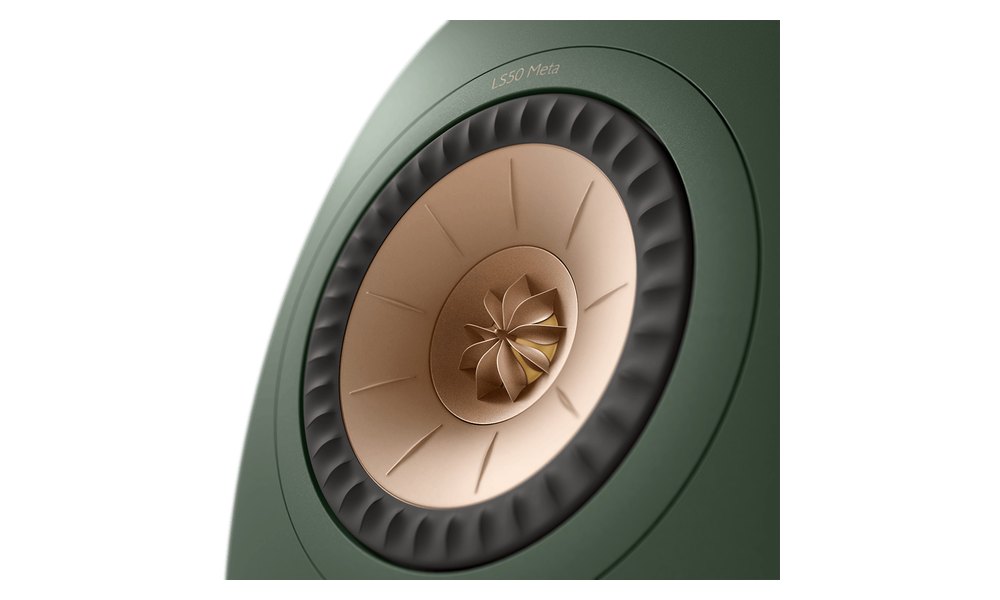
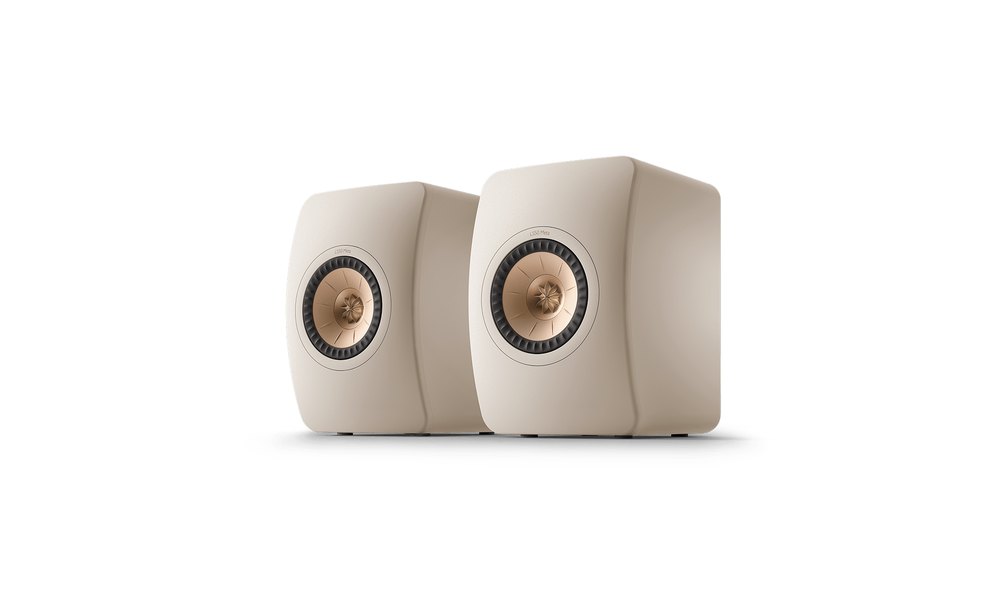
The successor kept the size and basic concept [4][7]. Ken Kessler of Hi-Fi News writes that side by side the two are almost impossible to tell apart, apart from the driver colour, which has changed from orange/copper to a more muted hue [4]. The main differences are inside: a revised 12th-generation Uni-Q driver, MAT behind the tweeter, a revised crossover and details of the cabinet [2][4][7].
According to Hi-Fi News, in July 2021 the LS50 Meta cost £999, £200 more than the outgoing LS50 [4]. Kessler stresses that the old LS50 remains a magnificent speaker; he does not want owners to feel anxious just because a successor has arrived [4].
Uni-Q: background and 12th generation
Uni-Q is KEF's coaxial arrangement in which the tweeter sits at the centre of the mid/bass cone. According to Hi-Fi News, KEF introduced it in 1988 [4]. Laurie Fincham, then chief engineer, explains there that only neodymium magnets made such a compact coaxial driver possible. One goal was to make dispersion independent of the speaker's orientation [4].
The LS50 Meta uses the 12th generation [2][4][7]. The changes compared with the LS50, according to the sources:
- Hi-Fi News lists a revised motor system, suspension, surround and cone for the mid/bass driver, plus an enlarged duct behind the tweeter that acts as a "waveguide" to the MAT [4].
- Stereophile describes a new decoupler at the neck of the cone and a more symmetrical motor system [2].
- What Hi-Fi? notes a slight shift in crossover frequency from 2.2 kHz to 2.1 kHz; the other specifications stayed the same [7].
According to KEF, a 130 mm aluminium cone works with a 25 mm aluminium dome [1]. What Hi-Fi? describes the mid/bass cone as a magnesium/aluminium alloy [7].
MAT: what happens behind the tweeter
MAT stands for "Metamaterial Absorption Technology". In conventional tweeters the rearward sound goes into a chamber with damping material. Some of it is reflected back through the dome and adds colouration [7].
In the LS50 Meta, a disc sits behind the tweeter instead [2][7]:
- Stereophile describes it as about 3 inches in diameter and 0.43 inches thick, with 30 channels acting as Helmholtz resonators [2].
- What Hi-Fi? compares it to a hockey puck and a circular plastic maze; each of the 30 tubes is tuned to a different frequency [7].
- According to KEF, MAT is effective from around 600 Hz upwards [7]; Stereophile gives about 620 Hz [2].
- KEF states that MAT absorbs 99 per cent of the rearward sound [1]. That is a manufacturer figure.
For the technology, Stereophile refers to an AES paper by KEF engineers Sebastian Degraeve and Jack Oclee-Brown from June 2020 [2]. Hi-Fi News also ran an interview with Oclee-Brown [4]. What MAT measurably achieves is best seen by comparing the lab results with the old LS50 (see below).
Cabinet and bass reflex
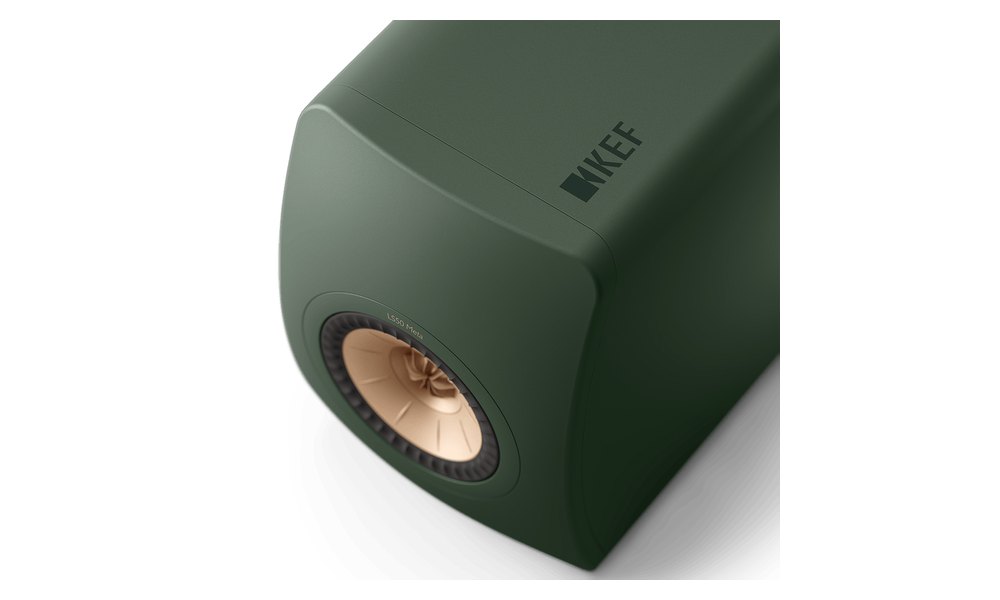
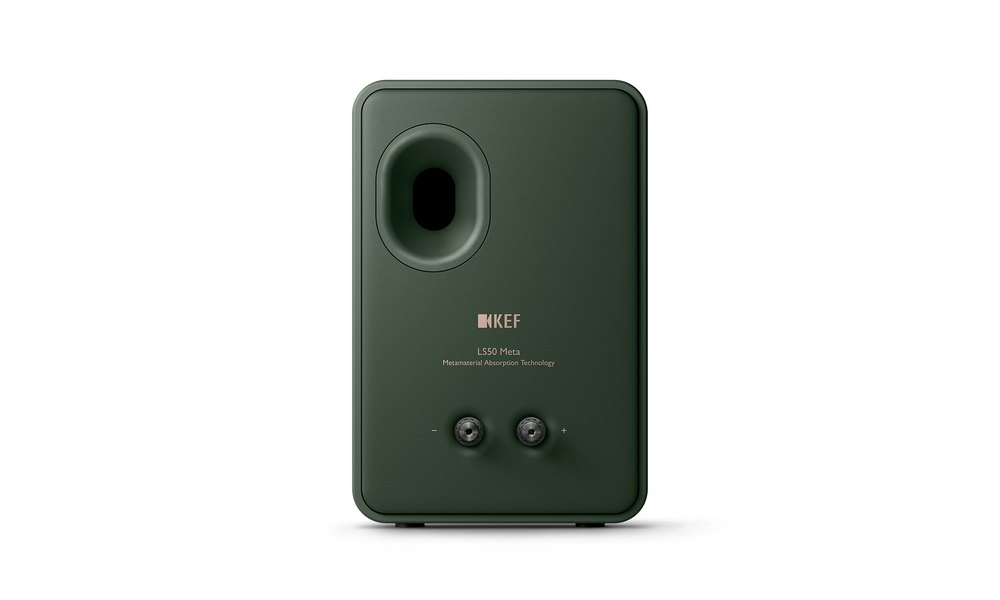
According to KEF, the baffle is made of DMC, a composite material; inside, bracing with constrained-layer damping keeps the cabinet quiet [1]. The bass reflex port is at the rear; KEF describes it as a flexible, patented port [1]. Hi-Fi News lists several changes for the Meta [4]:
- The port opening is now flush to further reduce turbulence.
- The cavities in the corners for the baffle retention bolts have been eliminated.
- The rear surface is slightly domed, with a step between the rear panel and the cabinet sides.
Kessler explicitly leaves open whether these cabinet details are audible [4].
Specifications according to the manufacturer
KEF's EU product page lists on 8 November 2026 [1]:
- Frequency response 79 Hz to 28 kHz (±3 dB), frequency range 47 Hz to 45 kHz (−6 dB)
- Typical in-room bass response 26 Hz (−6 dB)
- Sensitivity 85 dB (2.83 V/1 m)
- Nominal impedance 8 ohms, minimum 3.5 ohms
- Maximum output 106 dB
- Crossover frequency 2.1 kHz
- Recommended amplifier power 40 to 100 W
- Dimensions 302 × 200 × 280.5 mm (H × W × D)
- Weight 7.8 kg per speaker
What Hi-Fi?'s spec box gives 7.2 kg [7]. Hi-Fi News, like KEF, gives 7.8 kg [5]. We use the manufacturer figure and disclose the discrepancy.
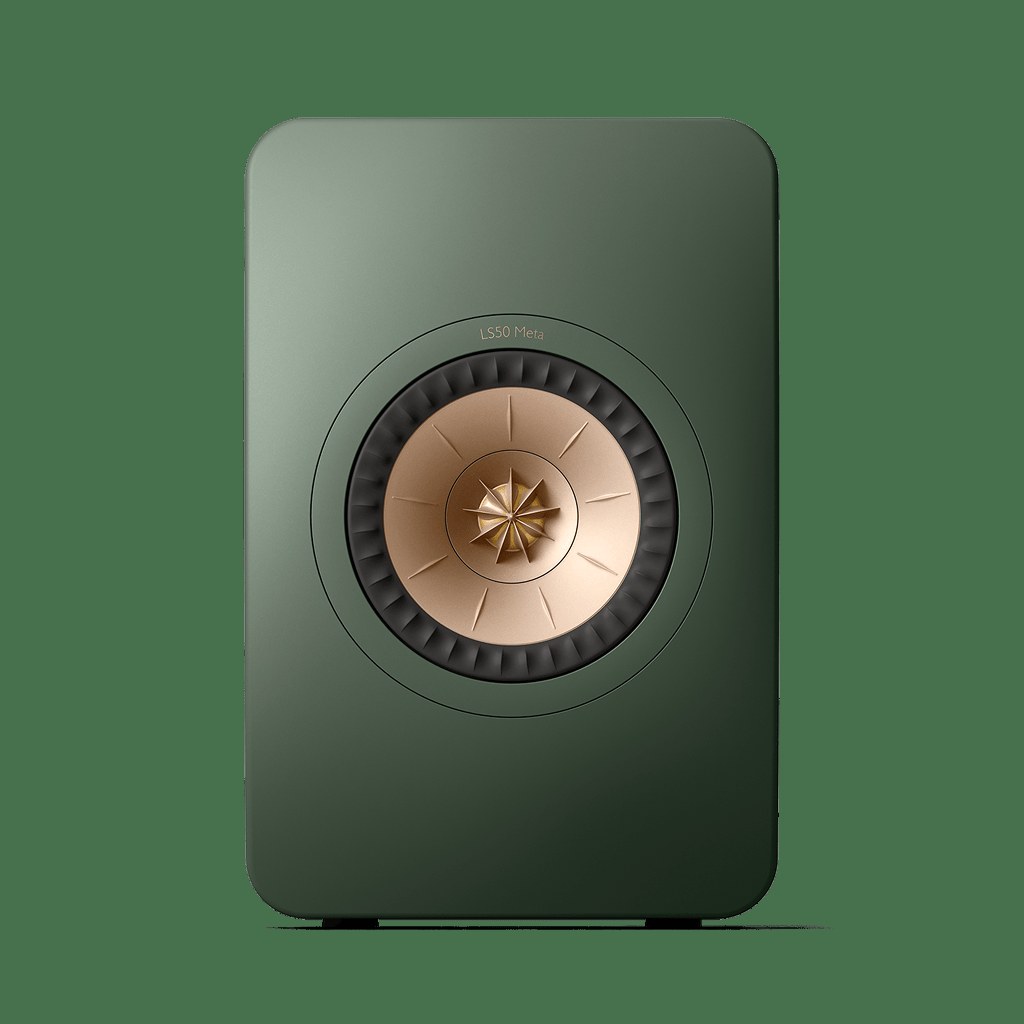
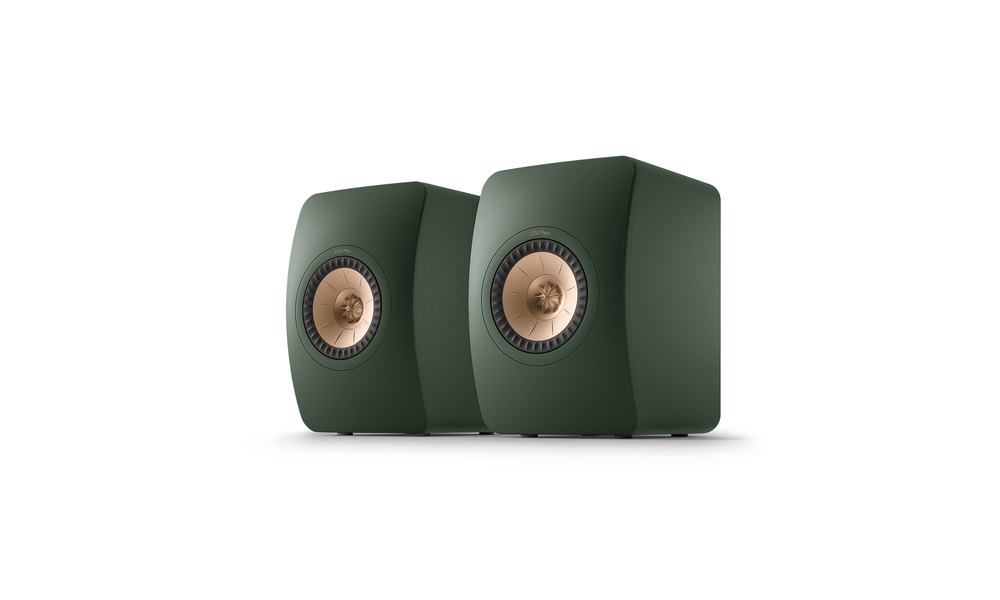
In November 2026 the EU page shows the finishes Carbon Black, Mineral White, Moss Green and Sand Shell [1]. We have not checked which finishes are still available from retailers.
What the labs measured
Three sets of measurements are available. They agree on the essentials but differ in detail:
Sensitivity: KEF specifies 85 dB [1]. Stereophile measures 84.5 dB, within experimental error of the specification by its own account [3]. Hi-Fi News measures 84.6 dB at 1 kHz and on average, and 82.4 dB to IEC [5]. So the speaker is relatively insensitive, which matters for amplifier choice.
Impedance: KEF specifies 8 ohms nominal and a 3.5-ohm minimum [1]. Hi-Fi News measures a minimum of 3.65 ohms at 220 Hz and a maximum of 31 ohms at 93 Hz; phase ranges from −62° at 110 Hz to +48° at 860 Hz [5]. Stereophile calculates the EPDR, the figure that matters for amplifiers. It drops to 1.66 ohms at 135–140 Hz and 1.7 ohms at 660–725 Hz, both regions where music can have high energy. Atkinson's conclusion: the amplifier needs to be comfortable driving 4 ohms [3].
Frequency response: Hi-Fi News measures ±2.1 dB and ±2.2 dB for the Meta, with 0.5 dB pair matching. In the same lab, the old LS50 managed ±2.9 dB and ±4.0 dB and 1.3 dB [5]. This is the clearest measurable improvement. audioXpress found a dip of about 2 dB between 1 kHz and 3.5 kHz on axis, but an overall smoother response in the listening window [6].
Bass: Hi-Fi News measures −6 dB at 40 Hz (relative to 200 Hz), slightly deeper than the LS50's 42 Hz; the port is tuned to 50 Hz [5]. Stereophile gives 51 Hz as the port tuning [3].
Distortion and treble: Hi-Fi News measures 1.2% at 100 Hz, 0.2% at 1 kHz and 0.7% at 10 kHz (90 dB/1 m). The aluminium dome's breakup mode is at 40.2 kHz, well above the audible range [5].
Dispersion: Stereophile describes very even horizontal dispersion [3]. audioXpress confirms the coaxial driver's good dispersion out to around 40 degrees [6].
The direct lab comparison with the old LS50
Hi-Fi News measured new samples of both models back-to-back under identical conditions [5]. This reveals differences that go beyond the spec sheets:
- The Meta's mid/bass driver works over a wider band: 72 Hz to 900 Hz (−6 dB) instead of 80 Hz to 650 Hz for the LS50 [5].
- The old LS50 had a boosted 2–6 kHz band. It gave it a slight edge in sensitivity: 85.0 dB versus 84.5 dB on average [5]. The Meta lacks this boost; its response is flatter.
- The new crossover makes the load slightly tougher above 200 Hz [5]. Stereophile describes it similarly: below 200 Hz the impedance is almost identical to the LS50's, while above that the Meta stays closer to 4 ohms for longer in the midrange and rises considerably in the crossover region [3].
- Both ports are cleanly tuned to 50 Hz. According to Hi-Fi News, the Meta's bass output is more uniform overall [5].
For LS50 owners this means: the Meta is measurably more even, but no easier to drive.
Amplification: what the data suggest
Two points follow from the measurements: low sensitivity of around 84.5 dB and a load that drops well below the nominal impedance in parts of the bass and midrange [3][5]. Stereophile therefore explicitly recommends an amplifier that drives 4 ohms securely [3]. What Hi-Fi? advises an amplifier with a bit of grunt [7]. The manufacturer's range of 40 to 100 W should be seen in this light [1].
For context, not as a recommendation: What Hi-Fi? names the Cambridge Audio CXA81 and Arcam A15 as suitable partners and considers a pricier Naim Supernait 3 worthwhile too [7]. By its own account, the magazine now uses the LS50 Meta as a staple of its listening-room reference system [7].
Stereophile (December 2020): "Highly recommended"
John Atkinson published his review on 16 December 2020 at a price of $1499.99 per pair [2]. He compared the LS50 Meta directly with the 2012 LS50.
His key points [2]:
- The bass matches that of the old LS50 and is shelved down a little below 100 Hz. With deep sub-bass, such as James Blake's "Limit to Your Love", the small speaker has to work hard.
- With bass guitar in the upper bass it conveys presence and good separation.
- Atkinson describes soundstage and imaging as a transparent window into the recording; voices were especially palpable.
- Compared with the LS50, the Meta reveals more low-level detail and has a little more treble energy.
His verdict: the LS50 Meta equals its predecessor in communicating the music, surpasses it in low-level detail and so offers an even more transparent window into the recording. He rates it "Highly recommended" [2]. According to Stereophile, the speaker is made in China [2].
Hi-Fi News (July 2021)
Ken Kessler compared the LS50 and LS50 Meta for Hi-Fi News; Paul Miller provided the measurements. The review was published online on 9 July 2021 [4]. Kessler likens the Meta to "The Godfather Part II": a sequel that really is that good [4]. To prepare, Kessler lived with the standard LS50 for a week in a system of comparable value before the Meta review samples arrived. He did not notice the small sensitivity difference measured by Paul Miller when switching, so he could treat both models equally in that respect [4]. He placed the speakers on 24-inch stands, firing straight ahead as KEF recommends, and noted that toe-in had its own virtues [4].
We could not retrieve the second page of the review, which contains the detailed listening section. We therefore cite Hi-Fi News only for the first part and the lab report [4][5].
What Hi-Fi? (September 2020, updated November 2024)
What Hi-Fi? first reviewed the LS50 Meta in September 2020 and updated the review in November 2024. It lists £1000, $1499 or AU$2495; sound, compatibility and build each received five stars [7].
The key points [7]:
- much clearer and more refined than the old LS50, with more transparency and better low-level detail;
- surprisingly full-bodied with authority for the size, but without deep bass;
- smooth and balanced while retaining enough treble bite; poor recordings are revealed but not made nasty;
- an expansive, tightly focused soundstage with convincing layering, stable even with demanding music;
- good bass punch and surefooted rhythm. The magazine has heard more enthusiastic rivals, but none matching its range of strengths.
The comparison with other KEF models is interesting: the older R3 (without Meta) sounds "congested" next to the LS50 Meta. The larger R3 Meta, by contrast, offers notably more low-frequency reach and openness, but perhaps not the same sense of integration [7].
Placement
What Hi-Fi? advises against putting the LS50 Meta in a bookshelf or right up against a wall. It sounds much better about 50 cm into the room and well away from the side walls, on dedicated stands [7]. Kessler at Hi-Fi News used 24-inch stands [4]. The port is at the rear, which makes some distance from the wall sensible [1][7].
Awards
On its product page KEF lists several awards, including What Hi-Fi? Awards 2022 (Product of the Year) and 2024 (best standmount between £800 and £1000) [1]. These are manufacturer statements about third-party awards; they say nothing about the sound in a given room.
Where the sources agree
- Imaging: Stereophile and What Hi-Fi? both praise soundstage and imaging [2][7]. This supports the strength "very precise imaging" in the list above.
- Progress over the LS50: all reviews hear more transparency and detail [2][4][7]; Hi-Fi News measures a flatter response and tighter pair matching [5].
- Bass limits: Stereophile and What Hi-Fi? note limited deep bass [2][7]; measurements show −6 dB at about 40 Hz [5].
- Amplification: all measurements show low sensitivity and a demanding load [3][5]; the shared advice is a capable amplifier that is stable into 4 ohms [3][7].
Who the LS50 Meta suits
According to the sources, the LS50 Meta suits listeners who
- want a small standmount with very good imaging and transparency [2][7];
- have an amplifier that drives 4 ohms securely [3][7];
- can place it freely [7].
According to the sources it is less suited to large rooms where deep bass is wanted without a subwoofer [2][7], and to weak amplifiers [3]. For vinyl listeners: it is passive, so a separate phono stage and amplifier are needed.
Prices and dates
All prices in the reviews ($1499.99 in 2020, £999 or £1000 in 2021) are historical [2][4][5][7]. KEF's EU product page showed €1,499 per pair on 8 November 2026 [1]. The price in the tables on this page remains unchanged and is dated separately.
Open points and limits of this analysis
- Weight: 7.8 kg (KEF, Hi-Fi News) versus 7.2 kg (What Hi-Fi?) [1][5][7].
- Minimum impedance: 3.5 ohms (KEF) versus 3.65 ohms measured (Hi-Fi News); Stereophile's EPDR is much lower [1][3][5].
- Port tuning: 50 Hz (Hi-Fi News) versus 51 Hz (Stereophile), practically the same [3][5].
- Hi-Fi News page 2 (listening section) not retrieved.
- Effect of MAT: the 99 per cent figure comes only from the manufacturer.
- A detailed human fact-check of this analysis is still pending.
Sources for this analysis
- KEF: LS50 Meta (Produktseite EU/product page EU). https://eu.kef.com/products/ls50-meta
- Stereophile (16.12.2020, John Atkinson): KEF LS50 Meta loudspeaker. https://www.stereophile.com/content/kef-ls50-meta-loudspeaker
- Stereophile (John Atkinson): KEF LS50 Meta loudspeaker, Measurements. https://www.stereophile.com/content/kef-ls50-meta-loudspeaker-measurements
- Hi-Fi News (09.07.2021, Ken Kessler/Paul Miller): KEF LS50 Meta Loudspeaker. https://www.hifinews.com/content/kef-ls50-meta-loudspeaker
- Hi-Fi News (Paul Miller): KEF LS50 Meta Lab Report. https://www.hifinews.com/content/kef-ls50-meta-loudspeaker-lab-report
- audioXpress (30.06.2021): Fresh From the Bench: KEF LS50 Meta, The Measurements. https://audioxpress.com/article/fresh-from-the-bench-kef-ls50-meta-the-measurements
- What Hi-Fi? (09/2020, aktualisiert/updated 05.11.2024): KEF LS50 Meta review. https://www.whathifi.com/reviews/kef-ls50-meta
Created by AI (Vinyl BotPro) from the sources listed; no listening tests or measurements of our own. Detailed human fact-check pending.
Created by Vinyl BotPro (AI) · As of Sept 2026 · Corrections: info@vinylcination.de
Read more: best bookshelf speakers 2026 · Improve your hi-fi system · What is hi-fi?