
Bookshelf speaker · AI analysis · Expert, rank 13
KEF R3 Meta: Analysis
AI analysis (research): the only compact speaker in KEF's current R Series, with Uni-Q driver and MAT; based on manufacturer data, the international specialist press and Hi-Fi News.
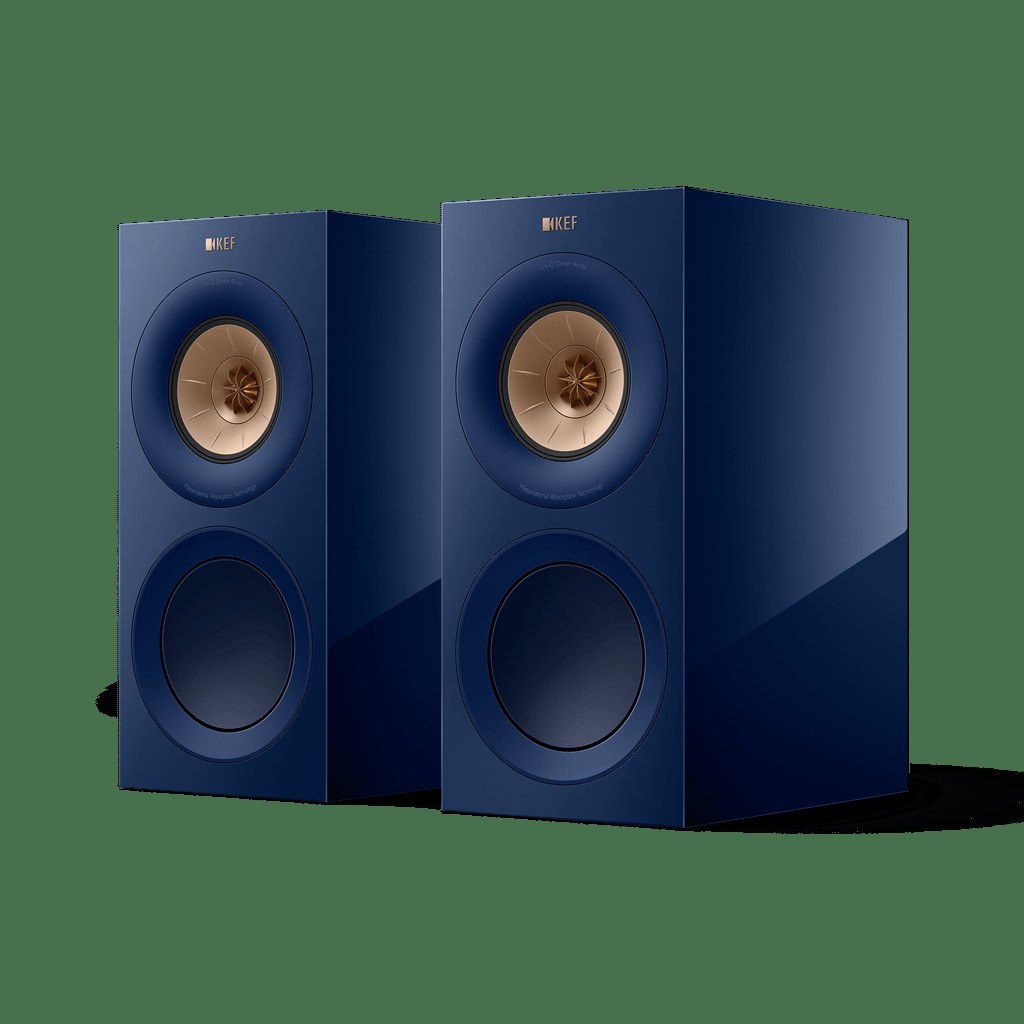
Summary
The R3 Meta (approx. €2,400/pair) is the only compact model in the R Series: a 12th-generation Uni-Q coaxial driver with MAT plus a 165 mm woofer, 3-way bass reflex. KEF quotes 87 dB and 4 Ω (min. 3.2 Ω). What Hi-Fi? awarded five stars in May 2023 and an Award in October 2023; Hi-Fi News (09/2023) and WIRED (08/2023) are similarly positive. Details in the analysis below.
Specs (public / manufacturer)
| Type | 3-way compact speaker · bass reflex |
|---|---|
| Sensitivity | 87 dB (2.83 V/1 m) |
| Impedance | 4 Ω nominal (min. 3.2 Ω) |
| Rec. amplifier power | 15–180 W |
| Frequency range | 58 Hz–28 kHz (±3 dB) |
| Chassis | Uni-Q 12th gen.: 25 mm aluminium dome with MAT · 125 mm aluminium midrange · 165 mm hybrid aluminium woofer |
| Dimensions / weight | 422 × 200 × 336 mm · 12.4 kg per speaker |
| Price guide | approx. €2,400/pair · Sept 2026 |
Manufacturer specifications (KEF)
| Type | 3-way compact speaker · bass reflex |
|---|---|
| Drivers | Uni-Q: 25 mm vented aluminium dome with MAT · 125 mm aluminium midrange · 165 mm hybrid aluminium bass |
| Frequency response | 58 Hz–28 kHz (±3 dB) · 38 Hz–50 kHz (−6 dB) · typical in-room bass 30 Hz (−6 dB) |
| Sensitivity | 87 dB (2.83 V/1 m) |
| Impedance | 4 Ω (min. 3.2 Ω) |
| Max. SPL | not specified by manufacturer |
| Crossover frequency | 420 Hz, 2.3 kHz |
| Recommended amplifier power | 15–180 W |
| Dimensions | 422 × 200 × 336 mm (H × W × D, with terminal) |
| Weight | 12.4 kg |
Source: KEF – official specifications · As of 16 October 2026 · subject to change by the manufacturer
Matching tips
- Suits: Load-stable expert amplifiers
- Suits: Stands with space from the wall
- Good fit: Small to medium-sized rooms
- Less suited: Weak amplifiers
- Less suited: Placement right against the wall or inside a bookshelf
Analysis: the KEF R3 Meta in depth
What this is: an AI analysis, not a listening test
This page summarises what can be documented about the KEF R3 Meta from manufacturer material, an independent lab report and international reviews. Vinyl BotPro has neither listened to nor measured the speaker. Where we describe sound, we paraphrase the named publications as they phrased it under their own conditions, each with a date. Our own assessments are marked as such. This section changes nothing about the rating, rank or index.
To keep models apart: the R3 Meta arrived in 2023 as part of the revised R Series. Its predecessor was simply called the R3 and, according to Hi-Fi News, appeared in 2018 [3]. The two look very similar but differ in the Uni-Q driver and, above all, in MAT [2][3]. The R3 Meta should also not be confused with the smaller two-way LS50 Meta or the much more expensive Reference 1 Meta, with which it shares technology [2][3]. All reviews evaluated here concern the R3 Meta.
Where it sits in the R Series
According to Hi-Fi News, the R Series is KEF's mid-tier range, above the Q Series and well below the Reference range [3]. It has seven models: three floorstanders, two centre speakers, a Dolby Atmos up-firing module and, as the only standmount, the R3 Meta [3]. The previous generation likewise had only one standmount, the R3 [3]. What Hi-Fi? confirms that the R3 Meta is the only standmounter in the 2023 R Series [2].
Hi-Fi News sees the R3 Meta as a close relation of the Reference 1 Meta in looks and technology and describes it as a more affordable alternative to it [3]. That is the magazine's positioning, not a sound comparison under identical conditions.
Three ways in a compact cabinet
The three-way layout is unusual for a standmount [1][2]:
- Tweeter: 25 mm vented aluminium dome with MAT behind it [1].
- Midrange: 125 mm aluminium cone, with the tweeter at its centre. KEF calls this coaxial arrangement Uni-Q [1][2].
- Bass driver: 165 mm with a "hybrid" aluminium cone [1]. Hi-Fi News describes the cone as an aluminium/paper combination, with a 50 mm voice coil and a vented magnet system [3].
Thanks to this division, the midrange driver does not have to produce deep bass. That explains why a standmount of this size uses three ways: tweeter and midrange can be optimised for their range while a dedicated driver handles the bass [2][3]. What Hi-Fi? describes exactly this combination as the reason for the extra spaciousness and deeper bass [2].
12th-generation Uni-Q
The Uni-Q arrangement is meant to make the tweeter and midrange radiate as if from a single point [2]. What Hi-Fi? names this as one of its advantages: because both drivers share the same acoustic centre, the sound seems to come from one source [2]. According to What Hi-Fi? and Hi-Fi News, the driver in the R3 Meta is the 12th generation [2][3].
According to Hi-Fi News and What Hi-Fi?, KEF changed several details for the R3 Meta to get the most out of MAT [2][3]:
- a "Shadow Flare" surround, originally designed for the Reference models [3];
- a new system decoupling the midrange motor from the Uni-Q chassis [2][3];
- a copper ring in the midrange motor to reduce inductance and distortion [3];
- a revised tweeter gap damper and a revised conical waveguide behind the dome [2][3];
- a revised crossover [2][3].
These changes are manufacturer statements relayed by both magazines. The sources do not allow us to separate how much each is audible.
MAT: what KEF promises and what measurements show
MAT stands for "Metamaterial Absorption Technology". Hi-Fi News describes it as a thin 100 mm disc behind the Uni-Q driver, a joint development with the Acoustic Metamaterials Group [3]. A series of tiny, computer-modelled channels acts as resonators. What Hi-Fi? mentions 30 tubes, each designed to absorb a particular high frequency [2]. KEF claims MAT absorbs 99 per cent of the rear-radiated sound [2][3]. That is a manufacturer figure; we have no independent verification of it.
MAT first appeared in the LS50 Meta and then in other KEF models such as the Blade One Meta, LS60 Wireless and Reference 5 Meta [3].
At the same time, the Hi-Fi News lab report shows where MAT does not help [4]:
- The aluminium dome's breakup at 39.5 kHz, at around +10 dB, remains. It lies far above the audible range.
- Cancellation notches at 7.3 kHz and 15.6 kHz on axis occur with the grille fitted. MAT has no influence on them.
- According to the lab, the graph of cabinet and driver resonances shows that MAT does eliminate treble modes [4].
For readers this means: on these measurements, listening without the grille is the more neutral choice. That is our conclusion from the lab data, not an explicit recommendation by Hi-Fi News.
Cabinet, bass reflex and terminals
According to Hi-Fi News, the cabinet is braced MDF with constrained-layer damping [3]. The bass reflex port is at the rear and has flexible rubber walls meant to reduce turbulence [3]. KEF supplies foam bungs with a removable inner section, so the port can be partly or fully closed, for example when the speaker is placed close to a wall [1][3].
The R3 Meta has two pairs of terminals, so bi-wiring and bi-amping are possible [2][3][5]. Instead of jumper bars, two rotary controls link the terminals internally [3][5]. WIRED asked KEF about the benefit of bi-amping. According to the magazine, KEF has no fixed position on it but implied the sonic benefit is minimal [6].
Crossover: 420 or 450 Hz?
KEF's product page gives crossover points of 420 Hz and 2.3 kHz [1]. Hi-Fi News and WIRED, by contrast, write that the bass driver operates below 450 Hz [3][6]. The upper crossover at 2.3 kHz is consistent across all sources. We cannot resolve the difference at the lower crossover; the specification tables on this page keep KEF's figure of 420 Hz.
Specifications according to the manufacturer
In November 2026 KEF's product page lists [1]:
- Three-way bass reflex
- Frequency response 58 Hz to 28 kHz (±3 dB), frequency range 38 Hz to 50 kHz (−6 dB)
- Typical in-room bass response 30 Hz (−6 dB)
- Sensitivity 87 dB (2.83 V/1 m)
- Nominal impedance 4 ohms, minimum 3.2 ohms
- Recommended amplifier power 15 to 180 W
- Dimensions 422 × 200 × 336 mm (H × W × D, with terminal)
- Weight 12.4 kg per speaker
- Finishes Black Gloss, White Gloss, Walnut and Indigo Gloss Special Edition
In the box, KEF lists a pair of speakers, microfibre grilles, rubber feet and port bungs [1].
What the Hi-Fi News lab measured
Paul Miller sums up that the R3 Meta delivers what KEF promises; there are no "fantasy specifications" here [4]. The key values:
- Sensitivity: 87.0 dB at 1 kHz, 86.8 dB averaged from 500 Hz to 8 kHz; 84.9 dB to IEC [4].
- Impedance: minimum 3.17 ohms at 142 Hz, maximum 14.0 ohms at 2.75 kHz. Between 112 Hz and 835 Hz the impedance is below 4 ohms [4][5].
- EPDR: the figure that matters for amplifiers (equivalent peak dissipation resistance) is, according to the reprint, a moderate 1.65 ohms at 875 Hz and 1.78 ohms at 39 Hz [5].
- Phase: −33° at 38 Hz, +45° at 1.46 kHz [4].
- Bass: −6 dB at 40 Hz (relative to 200 Hz); good for the cabinet volume [4].
- Distortion: 0.15% at 100 Hz, 0.05% at 1 kHz, 0.3% at 10 kHz (90 dB/1 m). Miller calls the midrange's ~0.05% "state-of-the-art" low [4].
- Pair matching: 0.3 dB; response error ±1.6 dB and ±1.5 dB (200 Hz to 20 kHz) [4].
The magazine gives a UK price of £1899 and £649 for matching stands [4]. These are historical prices.
Amplification: what the data mean
The figures show a 4-ohm load with regions below 4 ohms but no extreme dips [4][5]. KEF specifies 15 to 180 W [1]. WIRED points to the 4-ohm rating and, despite KEF's 15 W minimum, suggests a relatively brawny amplifier [6]. Hi-Fi News found the drive less demanding than the figures suggest: the R3 Meta worked well with the Audiolab 9000A and very well with the beefier Primare A35.2 Class D power amplifier [5]. What Hi-Fi? listened with its Burmester reference and also tried the Naim Nait XS 3 and Audiolab 9000A [2]. As a rule of thumb from these sources, not a purchase recommendation: an amplifier that drives 4 ohms securely.
What Hi-Fi? (May 2023): five stars
What Hi-Fi? published its review on 10 May 2023, at a price of £1900, $2200 or AU$3900 [2]. Sound, build and compatibility each received five out of five stars [2].
The key points [2]:
- transparent, refined and expressive, with an even tonal balance;
- a wide, open soundstage and instruments that feel three-dimensional;
- a cohesive, integrated sound thanks to Uni-Q and the dedicated bass driver;
- precise timing and plenty of fun, including with pop and hip-hop;
- enjoyable at both low and high volume.
In a direct comparison with the older R3, the magazine heard a clear difference: cleaner, more transparent and more precise [2]. The only drawback What Hi-Fi? lists is that the R3 Meta sounds best positioned away from a wall and with equally capable partner equipment [2]. In October 2023 the magazine named it the best standmount speaker between £1500 and £2500; KEF quotes this on the product page [1].
Hi-Fi News (September 2023): "Outstanding Product"
Mark Craven reviewed the R3 Meta for Hi-Fi News; the print issue appeared in September 2023 and the online version on 12 October 2023 [3][5]. He describes a very clean sound with superb clarity and resolution, open but not bright, and a surprisingly opulent, detailed bass [3]. With a range of recordings he heard a natural, uncoloured presentation, accomplished instrumental tones, quick leading edges, a very wide soundstage and bass without flab [5]. The cabinet, he writes, gets out of the way [5].
His verdict: the R3 Meta will shake up the sub-£2000 standmount market. Trickledown technology from the Reference range and build quality far above its price make it a speaker that sounds as smart as it looks. The sound quality score was 88 per cent [5]. Craven recommends some breathing room around the cabinet, about 15 degrees of toe-in and unrestricted ports [3].
WIRED (August 2023): 9 out of 10
Ryan Waniata gave the R3 Meta 9 out of 10 at WIRED on 20 August 2023 [6]. He praises its transparency, effortless detail, very expressive dynamics, instrumental separation, immersive imaging and tight, powerful bass [6]. He repeatedly calls the sound "luminous" and describes a clear step up from the KEF LS50 Wireless he knew; he had not heard the original R3 [6]. The only drawback he names is the price, then $2200 per pair [6]. He listened with, among others, a Naim Uniti Atom [6].
Placement according to the sources
The placement advice in the reviews is complementary:
- What Hi-Fi? recommends dedicated stands and ample space from a wall. Thanks to the Uni-Q's wide dispersion there is no need to fuss over toe-in; angling them slightly towards the listening position gives a solid soundstage [2].
- Hi-Fi News recommends some breathing room around the cabinet, about 15 degrees of toe-in and unrestricted ports [3]. According to a caption in the reprint, cables can be routed through the inside of the matching stand [5].
- WIRED advises angling the speakers towards the listening position despite the wide dispersion and keeping your ears roughly level with the tweeters [6].
- According to KEF and Hi-Fi News, the supplied port bungs are intended for placements near a wall or in confined spaces [1][3].
According to WIRED, a subwoofer is not necessary. Anyone adding one should match it carefully so that the R3 Meta's well-integrated bass does not suffer [6].
Where the sources agree
All three reviews describe the R3 Meta as very transparent and highly resolving, with coherent tweeter/midrange integration and clean, powerful bass for its size [2][3][6]. All praise build and finish [2][3][6]. The lab confirms the manufacturer's figures for impedance and sensitivity [4]. None of the sources evaluated contains serious sonic criticism. The caveats concern placement (distance from walls), amplification (4 ohms) and price [2][3][6].
Who the R3 Meta suits
Based on the sources evaluated, the R3 Meta suits listeners who
- want a standmount but expect more bass and level than from a small two-way speaker [2][3][6];
- value transparency and detail without giving up enjoyment [2][6];
- have room to place the speakers away from the walls [2][3];
- own an amplifier that securely drives 4-ohm loads [4][6].
It is less suited to a bookshelf or placement directly against a wall. The port bungs can help where space is tight, but Hi-Fi News heard the best results with breathing room and open ports [3]. For vinyl listeners: it is passive, so a separate phono stage and amplifier are needed. According to Hi-Fi News and WIRED, its high resolution also exposes the weaknesses of recordings [5][6].
Prices and dates
The prices in the reviews (£1900, $2200, AU$3900, 2023) are historical [2][4][6]. On KEF's US website the R3 Meta was listed at $2,499.99 per pair on 8 November 2026 [1]. The euro price in the tables on this page remains unchanged and is dated separately.
Open points and limits of this analysis
- Crossover: 420 Hz (KEF) versus 450 Hz (Hi-Fi News, WIRED), not resolved [1][3][6].
- Effect of MAT: the 99 per cent figure comes from KEF. The lab shows that MAT suppresses treble modes but not the dome's breakup [4].
- No comparative measurement with the original R3: only What Hi-Fi? compares the sound, by ear [2].
- Hi-Fi News: we could not retrieve page 2 of the online review directly; the text on sound and the verdict is taken from the reprint provided by KEF [5]. A reprint hosted by the manufacturer is a derived source.
- A detailed human fact-check of this analysis is still pending.
Sources for this analysis
- KEF: R3 Meta (Produktseite US/product page US). https://us.kef.com/products/r3-meta
- What Hi-Fi? (10.05.2023): KEF R3 Meta review. https://www.whathifi.com/reviews/kef-r3-meta
- Hi-Fi News (12.10.2023, Mark Craven): KEF R3 Meta Loudspeaker. https://www.hifinews.com/content/kef-r3-meta-loudspeaker
- Hi-Fi News (Paul Miller): KEF R3 Meta Lab Report. https://www.hifinews.com/content/kef-r3-meta-loudspeaker-lab-report
- Hi-Fi News, Ausgabe/issue September 2023: Nachdruck/reprint (PDF, bei KEF gehostet/hosted by KEF). https://assets.kef.com/pdf_doc/R_series/review_HFN_Sept2023_Review.pdf
- WIRED (20.08.2023, Ryan Waniata): Review: KEF R3 Meta Speakers. https://www.wired.com/review/kef-r3-meta/
Created by AI (Vinyl BotPro) from the sources listed; no listening tests or measurements of our own. Detailed human fact-check pending.
Technology in detail
The technical details on the 12th-generation Uni-Q, MAT, the bass driver, the cabinet and the terminals (two pairs for bi-wiring/bi-amping) are now collected in the analysis above, with sources and lab data.
What the specialist press says
We evaluate What Hi-Fi? (10 May 2023), Hi-Fi News with its lab report (09/2023) and WIRED (20 August 2023) in detail and separately above.
Who is it for?
For listeners who want plenty of resolution, a wide soundstage and powerful bass from a compact speaker on stands, and who own an amplifier that is stable into 4 Ω. Placement advice and limits are set out in the analysis above.
What makes this AI analysis special
This AI analysis combines KEF's technical data with international reviews and an independent lab report. Sources and open points are set out in the analysis above; a detailed human check is still pending.
How the score comes about
The index reflects the 3-way design with Uni-Q and MAT, the clean build quality and the very good reviews in international magazines; on value for money it leads its tier. The Vinyl BotPro Index on this page remains 72 (Expert, rank 13) — guidance from manufacturer data and the specialist press, no in-house listening session. The four criteria engineering/build, features, expected performance and value for money are weighted 25/20/25/30 and scaled across all tiers. Methodology
Sources
- KEF, R3 Meta product page with specifications
- What Hi-Fi?, KEF R3 Meta review
- Hi-Fi News, KEF R3 Meta review
- Hi-Fi News, KEF R3 Meta lab report
Vinyl BotPro Index: 72 (Expert 70–84) · Label: AI research · Sept 2026
Read more: best bookshelf speakers 2026 · Improve your hi-fi system · What is hi-fi?