
Active bookshelf speaker · AI analysis · Master, Rank 2
Kii Audio SEVEN: Analysis
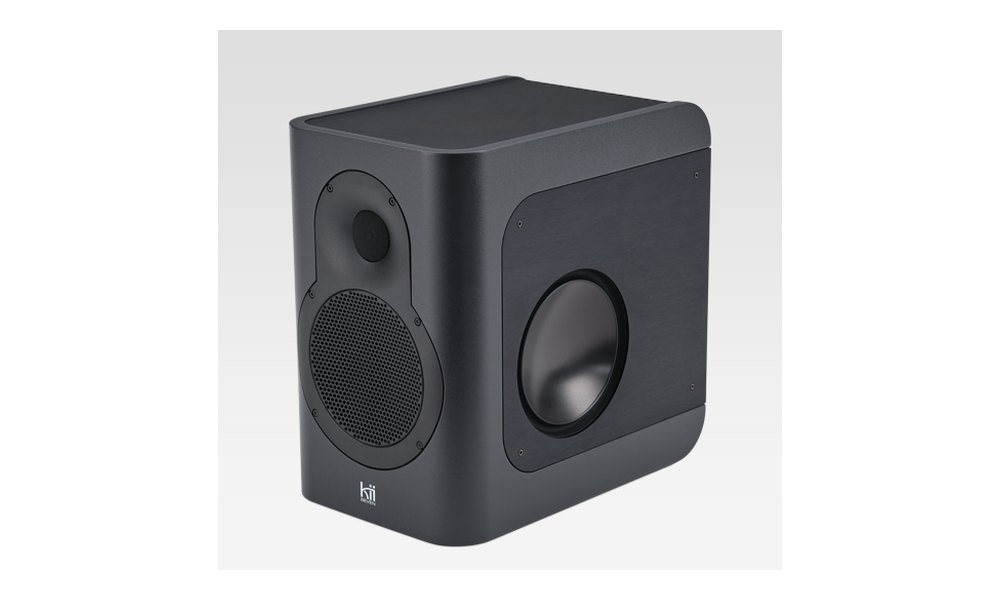
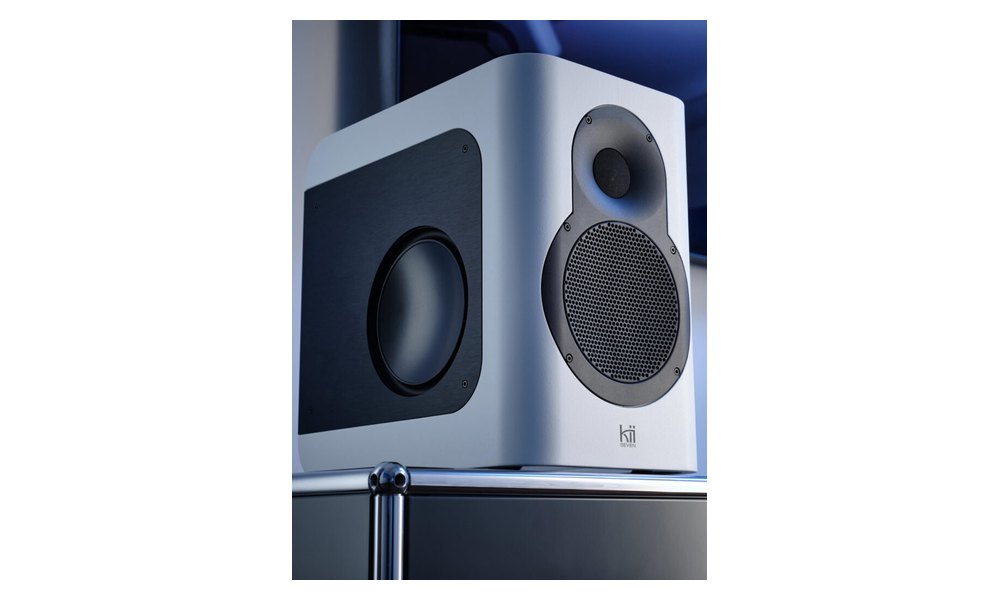
AI analysis (Research): Active 3-way compact monitor with two side-mounted 6.5-inch woofers, a 5-inch midrange driver and a 1-inch tweeter in a waveguide, 600 W per box, cardioid radiation and XLR, AES/EBU and network inputs. Based on manufacturer data and press reviews, no listening test.
Summary
Value-for-money Vinyl BotPro Champion Best value-for-money estimate of the tier on the data basis (no listening test).
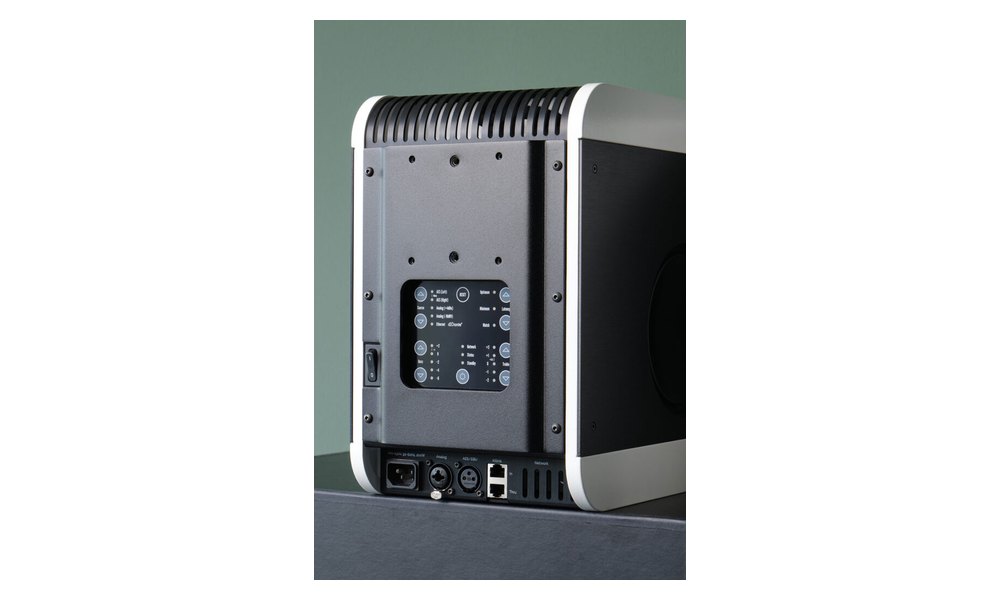
The Kii Audio SEVEN is the smaller sibling of the Kii THREE from Hamminkeln on the Lower Rhine. Two 6.5-inch woofers on the sides, a 5-inch midrange driver and a 1-inch tweeter with waveguide and acoustic lens work at 600 W total output per box. According to Kii designer Bruno Putzeys, the DSP control called Active Wave Focusing creates cardioid radiation from the crossover at around 125 Hz upwards, while below that the SEVEN radiates omnidirectionally: less sound goes to the rear and sides, and the room is excited less. Kii states 40 Hz (−3 dB) and ±0.5 dB between 100 Hz and 10 kHz. Inputs are XLR/TRS analog, AES/EBU, KiiLink for the Kii CONTROL, WLAN streaming, Bluetooth and Dante. Stereophile (01/2026) was greatly impressed by the SEVEN and attributes this mainly to its controlled dispersion; Sound On Sound (12/2024) and Hifi Pig (09/2025) are also very positive. Price guide: approximately 8,700 € per pair, with Kii CONTROL around 9,500 € (as of Oct. 2026, without guarantee).
Assumptions
- Price per pair or set according to manufacturer or trade, Stand Oct. 2026, no guarantee
- Vinyl via an external phono stage at the XLR/TRS analogue input (the SEVEN has no phono input)
- Placement on stands or free with some distance to the rear wall
- No in-house measurements or listening tests
Specifications (manufacturer)
| Type | Active 3-way compact monitor · Cardioid radiation (Active Wave Focusing) |
|---|---|
| Chassis | 2 × 6.5-inch woofers (side) · 5-inch midrange driver · 1-inch tweeter with waveguide |
| Amplifier | 600 W per speaker (Eigentakt modules for midrange and treble) |
| Frequency response | −3 dB at 40 Hz · 100 Hz – 10 kHz ±0.5 dB · 10 – 20 kHz ±1 dB |
| Inputs | XLR/TRS analog · AES/EBU · KiiLink/Kii CONTROL · Wi-Fi streaming · Bluetooth · Dante |
| Phono | No phono input — external phono stage on XLR/TRS |
| Sound control | Bass/treble, phase mode minimum phase or minimum latency |
| Dimensions / weight | 20 × 31 × 31 cm (W × H × D) · 14 kg per speaker |
| Price guide | approx. €8,700/pair · with Kii CONTROL approx. 9,500 € · as of Oct. 2026 · without guarantee |
Manufacturer specifications (Kii Audio)
| Type | Active loudspeaker with cardioid dispersion |
|---|---|
| Amplifier power | 600 W (per speaker) · load impedance not specified by manufacturer (built-in amplifier) |
| Drivers | 2 × 6.5 in woofers · 1 × 5 in midrange · 1 × 1 in custom wave-guided tweeter |
| Frequency response | −3 dB at 40 Hz · 100 Hz–10 kHz ±0.5 dB · 10–20 kHz ±1 dB |
| Size / weight | 20 × 31 × 31 cm (W × H × D) · 14 kg |
| Inputs | XLR and TRS, AES/EBU, KiiLink/KiiCONTROL, Wi-Fi, Bluetooth, Dante |
Source: Kii Audio – official specifications · As of 16 October 2026 · subject to change by the manufacturer
Rating criteria in detail
The four criteria feed into the Vinyl BotPro Index with weights of 25/20/25/30. The index is scaled across all tiers (see Methodology); that is why we do not show individual sub-scores.
Strengths
- Cardioid radiation: less room influence, even near the wall
- 600 W per speaker from a compact cabinet
- Studio connections plus streaming and Dante
- According to Stereophile, a finely detailed, precise soundstage
Weaknesses
- Bass extension limited by the limiter at very high levels (Stereophile)
- Analog sources are digitized internally
- No phono input
- High price for a compact system
Comparison models
| Dutch & Dutch 8c | Index 96, Rank 1, Sound champion — Bookshelf · 3-way · cardioid · approx. €15,200 |
|---|---|
| Kii Audio THREE | Index 86, Rank 3 — Bookshelf · 3-way · cardioid · approx. €15,400–17,100 |
System matching
Works well with
- Rooms with difficult acoustics or close-to-wall placement
- Listeners with a balanced phono stage
- Near to medium listening distance
Less suited
- Very large rooms with desire for deep bass without subwoofer
- Turntable without additional phono stage
- If you want a purely analog signal chain
Specs & Features
The drivers, amplifiers, dispersion, connections and manufacturer data are now collected, with sources, in the analysis below, including the differing figures from Stereophile and Sound On Sound.
Research Consensus
We evaluate the reviews by Stereophile (Kalman Rubinson, 01/2026, with measurements by John Atkinson), Sound On Sound (Phil Ward, 12/2024) and Hifi Pig (Stuart Smith, 09/2025) separately and with dates below.
For whom / Matching
Amplifier & Phono stage
There's no need for an amplifier. The phono stage comes to the XLR/TRS analog input; balanced phono stages from the Top list Phono preamps use the path without an adapter. The Kii CONTROL serves as a digital preamp for further sources.
Turntable & phono
Decks and cartridges of Master Level match the resolution. According to Putzeys, the concept puts less unnecessary bass energy into the room; the sources do not show whether this reduces acoustic feedback to the turntable.
Room & placement
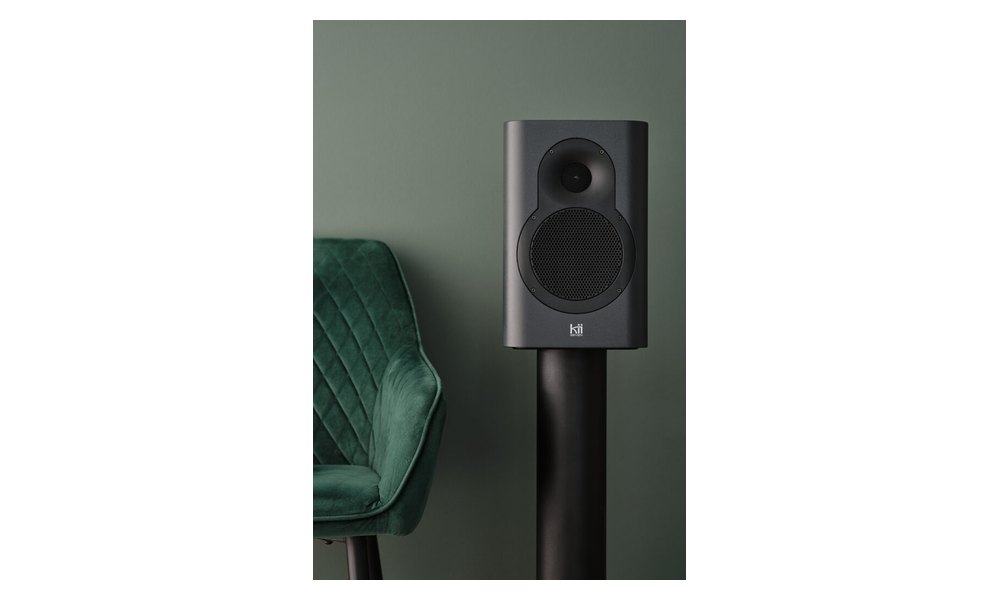
Stand or sideboard placement, also close to the rear wall. According to Kii designer Putzeys, placement with the back right against the wall is preferred.
Budget & upgrade
Around 8,700 € per pair, value for money champion of the master level. More bass extension and level offer the Kii THREE or a subwoofer from the Top list Active Subwoofer.
Analysis: the Kii Audio SEVEN in depth
What this page is: an AI analysis, not a listening test
This page summarises what can be documented about the Kii Audio SEVEN from manufacturer information, international reviews and published measurements. Vinyl BotPro has neither listened to nor measured these speakers. Sound descriptions are paraphrased as the named authors wrote them under their own conditions, each with a date. Measurements come from the cited sources; our own assessments are labelled. This section does not change the score, rank or index.
Keeping the models apart
- Kii THREE: the larger model with six drivers per speaker, including two rear-facing woofers [3]. Sound On Sound reviewed it in January 2017 [5].
- Kii THREE BXT: the extension of the THREE into a floorstanding system [1][3].
- Kii SEVEN: the smaller model with four drivers per speaker and no rear woofers [3]. It has no connection for a subwoofer or the BXT module [3].
- Kii CONTROL: a wired controller with additional inputs, sold separately or as a set [3][5].
Everything below refers to the SEVEN, combined with the Kii CONTROL where stated.
Concept: less room, more speaker
Kii Audio was founded in 2015 by Bruno Putzeys and is based in Hamminkeln, Germany [1]. At its core is a technique called Active Wave Focusing: the DSP controls the drivers so that less sound is radiated to the rear and sides [1]. This is meant to reduce the influence of the room [1].
It matters in which frequency range this applies. According to Putzeys in the Stereophile sidebar, the SEVEN is omnidirectional in the low bass and becomes cardioid only in the midband; at the 125 Hz crossover point the directivity lies in between [3]. Sound On Sound likewise describes cardioid radiation only from about 125 Hz upwards and compares: on the THREE it reaches down to about 50 Hz [5]. Sound On Sound's measurements show the cardioid effect from just above 100 Hz [5].
Placement right against the wall
The SEVEN is designed to be placed with its back directly against the wall [3][5]. Putzeys explains: the energy radiated towards the wall comes back in phase and boosts the frontal bass by 6 dB, so the boundary EQ cuts the low-frequency band by 6 dB [3]. According to Sound On Sound, this setting is active by default, so in free space the SEVEN will initially sound bass-light [5]. Putzeys explicitly does not recommend the free-space setting [3].
The SEVEN needs room at the sides for its side woofers. Putzeys' rule of thumb, quoted by Sound On Sound: an obstacle should be further away than the size of the SEVEN or of the obstacle, whichever is greater [5].
Drivers
- Tweeter: 1 inch, with its own waveguide and a lens in front [1]. According to Sound On Sound, the waveguide narrows dispersion at the lower end and the lens widens it at the top, giving constant dispersion up to 15 kHz [5]. The dome is aluminium/magnesium with ferrofluid in the magnet gap, according to Sound On Sound [5].
- Midrange: Kii states 5 inches [1]. Sound On Sound describes it as a 150 mm paper-cone driver covering 125 Hz to 2 kHz [5].
- Woofers: Kii states two 6.5-inch drivers on the sides [1]. Sound On Sound gives a nominal 140 mm with aluminium diaphragms [5].
- Cabinet: sealed, made of foamed polyurethane [3][5].
The driver sizes differ between the manufacturer and Sound On Sound. We give both.
Amplification and conversion
Kii states 600 W of amplifier power per speaker [1]. Sound On Sound describes this as total power shared among the drivers [5]. The Stereophile specifications, by contrast, break it down [3]:
- 200 W Purifi Eigentakt for the tweeter
- 200 W Purifi Eigentakt with current feedback for the midrange
- 600 W Pascal with current feedback for the woofers
According to Kii, as quoted by Stereophile, the woofers limit maximum output: they reach maximum linear excursion at 600 W and are protected by a limiter [3]. The analogue input uses a 1-bit sigma-delta converter with 120 dB dynamic range and switchable sensitivity for consumer and pro levels [3].
Connections and streaming
- XLR/TRS analogue
- AES3 (AES/EBU) up to 24/192
- two KiiLink sockets (RJ45) for the Kii CONTROL and the second speaker
- Dante/AES67 via two RJ45 sockets
- Wi-Fi and Bluetooth
The Kii CONTROL adds USB, optical and coaxial inputs [3]. According to Stereophile, USB supports PCM up to 24/384 and DSD128 [3]. Streaming: Spotify Connect, Tidal Connect and Qobuz Connect up to 24/192 [3]. According to Kii, the Kii CONTROL is Roon Tested [1]. The Kii Home app manages up to twelve zones [1].
There is a timeline for the software: in December 2024, Sound On Sound reported that some streaming features were not yet implemented [5]. Kii then announced Spotify and Tidal, followed by AirPlay, Qobuz and Roon Ready [5]. Stereophile streamed via Qobuz Connect in early 2026 [3]. In November 2026, one passage on Kii's page still describes Spotify Connect as a feature of a future software release [1]. We do not find AirPlay or Roon Ready in Kii's specifications.
Specifications according to Kii
Kii states in November 2026 [1]:
- −3 dB at 40 Hz
- 100 Hz to 10 kHz ±0.5 dB, 10 to 20 kHz ±1 dB
- tone controls for bass and treble
- phase mode minimum phase or minimum latency
- finishes Fine Touch White, Fine Touch Dark Grey, Soft Touch Titanium
- 20 × 31 × 31 cm (W × H × D), 14 kg
The Stereophile specifications, by contrast, give −3 dB at 30 Hz and −6 dB at 20 Hz, plus LR4 crossovers at 125 Hz and 2 kHz [3]. The sources do not resolve the difference from Kii's 40 Hz.
Stereophile: listening report (January 2026)
Kalman Rubinson reviewed the SEVEN for Stereophile; the article was published online on 30 January 2026, priced at $8,990 per pair, or $9,885 with the Kii CONTROL [3]. He had already reviewed the THREE in 2017 [3]. His impressions [3]:
- Under ten minutes from power-on to streaming via Qobuz Connect.
- He heard no difference between analogue XLR, AES3, USB and Wi-Fi.
- Free-standing, the SEVEN sounded clean and transparent, but the bass on one track seemed damped and dulled.
- After moving the speakers against the wall with −6 dB boundary EQ, the same bass sounded solid and full; the soundstage grew wider and taller.
- At moderate levels, the bass reached down to 20 Hz on organ tones. At very high levels the limiter reduces bass extension.
- The SEVEN could not play the finale of Saint-Saëns' Organ Symphony loud enough to load the room; for that he recommends bigger speakers such as the THREE BXT.
Compared with the KEF LS60 Wireless, the SEVEN, placed near the wall, imaged more precisely and emphasised close-in details [3]. The KEF produced a wider soundstage and separated the music better from the speakers [3]. His conclusion: the SEVEN reveals every detail of a recording with precision and balance; it suits studio monitoring as well as home listening [3].
Stereophile: measurements (January 2026)
John Atkinson measured the SEVEN for Stereophile [4]. For the measurements the setting was free space (0 dB), because Putzeys recommends it for standard measurements [4]. Key results [4]:
- Bass −6 dB at 20 Hz at moderate levels; at high levels the limiter acts.
- On-axis response within ±1 dB, with a slight lack of energy in the upper midrange and a small peak at 10 kHz.
- Very even horizontal dispersion.
- In Exact Phase mode a time-coincident step response, but a delay of almost 60 ms. In Minimum mode latency drops to 1.6 ms.
- Virtually no delayed energy in the waterfall plot; the enclosure seemed inert.
In the free-space setting, the measured crossover to the midrange was at 200 Hz, not the 125 Hz Putzeys mentioned [4]. Atkinson explains this with the boundary EQ: with −6 dB for wall placement, the crossover lies exactly at 125 Hz [4]. His verdict: extraordinarily good measured performance in both frequency and time domains [4].
Sound On Sound (December 2024)
Phil Ward reviewed the SEVEN for Sound On Sound in December 2024, with a focus on studio monitoring [5]. The price was £7,785 per pair including the Kii CONTROL [5]. He also measured it himself:
- At 80 dB at 1 m, third-harmonic distortion around −65 dB (about 0.05 %) from a few hundred hertz upwards; slightly higher at 90 dB but still very low.
- Clearly cardioid behaviour from about 100 Hz.
His listening impressions [5]:
- Less room, more monitor: noticeably fewer side- and rear-wall reflections reach the listening position.
- Neutral, clear midrange, very detailed and natural treble, more bass than the cabinet suggests.
- Stereo imaging perhaps the best he has heard in his room.
- Further back in the room, the lowest bass seemed slightly overcooked.
- He found the default balance a little bright; he added a slight boost around 200 Hz and cut the treble by about 1 dB.
As alternatives he names, among others, the Dutch & Dutch 8c, Genelec 8361 and PMC 6-2 [5].
Hifi Pig (September 2025)
Stuart Smith reviewed the SEVEN for Hifi Pig on 24 September 2025 [6]. A Kii staff member set up the speakers; they stood about 50 cm from the wall instead of the recommended 10 cm [6]. The room measured 5 × 10 m [6]. His observations [6]:
- Tight, fast bass with plenty of punch, which grows with higher volume.
- Clear mids, extended treble; best sound in the sweet spot, with the image changing somewhat outside it.
- In Wi-Fi mode he found it no worse than wired. Roon then only works via the Kii Link input.
- He would have liked an infrared remote rather than the app.
- Turntable: via a phono stage into the XLR inputs, selected in the app.
Hifi Pig gave the magazine's highest award [6].
For vinyl: what the sources show
The SEVEN has no phono input [1]. In our assessment, this means:
- A turntable needs a phono stage, ideally with balanced output for the XLR input [1][6].
- The analogue signal is digitised [3]; a purely analogue chain is not possible.
- Because the limiter restricts bass at high levels [3], a subsonic filter in the phono stage makes sense to keep rumble away from the woofers. This is our assessment, not that of the sources.
Where the sources agree
- Imaging: very precise and detailed [3][5][6].
- Room: much less room influence thanks to cardioid radiation [3][5][6].
- Bass: a lot for the size, but with physical limits at high levels [3][5][6].
- Measurements: very good [4][5].
Open points and limits of this analysis
- Bass extension: −3 dB at 40 Hz (Kii) versus 30 Hz (Stereophile specifications) [1][3].
- Driver sizes: 6.5 and 5 inches (Kii) versus 140 and 150 mm (Sound On Sound) [1][5].
- Power: 600 W total (Kii, Sound On Sound) versus 600 W for the woofers plus 200 W each (Stereophile) [1][3][5].
- Streaming: software-dependent and, according to the sources, rolled out in stages [1][3][5].
- A detailed human fact-check of this analysis is still pending.
Sources for this analysis
- Kii Audio – Kii SEVEN (Lifestyle-Seite, Spezifikationen). https://www.kiiaudio.com/kii-seven-lifestyle-listening/
- Kii Audio – Kii SEVEN (Pro-Audio-Seite). https://www.kiiaudio.com/kii-seven-professional-audio/
- Stereophile – Kalman Rubinson, Kii Audio SEVEN active loudspeaker system (30.01.2026), mit Spezifikationen und Sidebar „Bruno Putzeys Explains“. https://www.stereophile.com/content/kii-audio-seven-active-loudspeaker-system
- Stereophile – John Atkinson, Kii Audio SEVEN: Measurements (30.01.2026). https://www.stereophile.com/content/kii-audio-seven-active-loudspeaker-system-measurements
- Sound On Sound – Phil Ward, Kii Seven (Dezember 2024). https://www.soundonsound.com/reviews/kii-seven
- Hifi Pig – Stuart Smith, Kii SEVEN Loudspeakers (24.09.2025). https://www.hifipig.com/kii-seven-loudspeakers/
Created by AI (Vinyl BotPro) from the sources listed; no listening tests or measurements of our own. Detailed human fact-check pending.
What makes this AI analysis special
This section is an AI summary from Manufacturer data and reports from international specialist media. Vinyl BotPro had no physical access, no measurement of our own chain and no listening test. The basis are the manufacturer specifications of Kii Audio and Stereophile (with measurements), Sound On Sound and Hifi Pig. The expected performance is derived from construction, datasheet and the judgements of the Specialist press. Prices and availability change (as of Oct. 2026, no guarantee); please check technical values against the current data sheet.
Vinyl BotPro Score Logic
The Vinyl BotPro Index runs from 0–100 across all tiers and weights build/technology, features, expected performance and value for money at 25/20/25/30. Master typically sits at ~85–97. Kii Audio SEVEN receives 95 (Rank 2 Master). Very high technology and performance at the lowest price per pair of the master level. In the stage, the model bears the title Value for money Vinyl BotPro Champion. Rank is not Laboratory Evaluation — no Listening test. Details on weighting · Methodology.
Sources
- Kii Audio — Kii SEVEN (Manufacturer's website, technical data)
- Stereophile — Kii Audio SEVEN active loudspeaker system
Created by Vinyl BotPro (AI) · AI analysis · As of 08.10.2026 · Corrections: info@vinylcination.de · Prices without guarantee.
Read more: best active bookshelf speakers 2026 · What is hi-fi?