
In-ear analysis · Premium · as listed
Kiwi Ears Quintet Analysis
The Kiwi Ears Quintet sits on the in-ear shortlist of 12 November 2026 in the Premium tier, now expanded to thirty-four models, in rank 29 with a Vinyl BotPro index of 59 and no tier badge. It shares index 59 with the Softears Pro X10. This analysis takes the list record as published and does not run a second calculation.
In brief
The Kiwi Ears Quintet is a wired universal-fit in-ear with a dynamic driver, two balanced-armature drivers, a micro-planar driver and a piezoelectric driver. On kiwiears.com the figures are a DLC dynamic driver, two balanced-armature drivers, a micro-planar driver and a piezoelectric (PZT) driver, a 0.78 mm 2-pin connector and a 1.2 metre SPC OFC cable. Impedance and sensitivity are missing from the manufacturer page; this analysis takes 32 Ω and 108 dB at 1 kHz (also referred to 1 Vrms) from the Headfonics review and discloses the omission on the manufacturer page. On the in-ear shortlist of 12 November 2026 it sits in the Premium tier, now expanded to thirty-four models, in rank 29 with a Vinyl BotPro index of 59 and no tier badge. It shares index 59 in this tier with the Softears Pro X10; rank stays unique because its documented euro price sits below that of the Pro X10. The subscores and the linear mapping onto the 55–69 band are documented in the list package; this page repeats the list record and does not run a second calculation.
The listening report comes from Headfonics (Meldrick, 4 October 2023), reader score 8.0: a dated listening review of the exact model in an independent international online specialist outlet of the same class already used for other in-ears on this list. Under the single badge rule of 12 November 2026 — including addendum t647s3962 — the Kiwi Ears Quintet is eligible; its pillar here is the written review. The documented euro price is €204.84 at linsoul.de (JSON-LD InStock, retrieved 12 November 2026, Europe/Berlin). The Sound badge in the tier remains with the Sony IER-M500, and the value badge with the DUNU Titan S2.
Technical data (published)
| Type | Wired universal-fit in-ear, 1 DLC dynamic driver + 2 BA + 1 micro-planar + 1 PZT (kiwiears.com) |
|---|---|
| Impedance | 32 Ω (Headfonics, because missing on kiwiears.com; disclosed in the body) |
| Sensitivity | 108 dB at 1 kHz, also referred to 1 Vrms (Headfonics, because missing on kiwiears.com; disclosed in the body) |
| Frequency range | not highlighted as a separate figure on the manufacturer page in this research; nothing is invented |
| Connector | 0.78 mm 2-pin, 1.2 m SPC OFC cable (kiwiears.com) |
| Weight / shell | Headfonics describes large shells, average comfort, double venting and decent isolation |
| Accessories | see the kit section |
Amplifier compatibility
At the figures taken from Headfonics, 32 Ω and 108 dB at 1 kHz, the Quintet remains usable on a mobile source in principle. The drive subscore is 8.4, level with the Aether and below the KE4 and the Timeless (both 8.6).
Impedance and sensitivity are missing from the manufacturer page. This page does not invent a substitute figure from other shops and discloses that 32 Ω and 108 dB (also referred to 1 Vrms) come from the pillar. A second, conflicting official figure is not on file in this research.
A 0.78 mm 2-pin cable change alters the plug, not necessarily the electrical load of the five paths. A low-noise source remains wise, especially with a signature described as sensitive in the treble.
Scoring criteria in detail
The Vinyl BotPro index on this page is not a second calculation, but the list record of 12 November 2026. The Premium tier now holds thirty-four models; the mapping uses the 55–69 band linearly across the unrounded raw score. With a raw score of 7.635 the Kiwi Ears Quintet sits at index 59 and rank 13. It shares index 59 in this tier with the Softears Pro X10; rank stays unique because its documented euro price sits below that of the Pro X10. Shared indices are allowed; rank remains unique. The mapping follows the decision of 12 November 2026: the unrounded raw score is placed linearly on the tier band, strongest model at the ceiling, weakest at the floor, with no required gap between places. Shared indices within a tier are allowed; rank remains unique (higher index first, then higher sound-evidence score, then lower documented euro price, then alphabetical name).
The subscores 7.3 / 7.4 / 8.4 / 7.8 yield the raw score 7.635. Sound evidence rests on the dated Headfonics listening review: a novel configuration, a pleasing tuning, satisfactory detail, possible sibilance; bass that is deep, warm and textured but not bass-head; decent mids with bodied lower mids; average imaging and staging. Build 7.4 takes in the elaborate configuration, but also large shells and average comfort. Value 7.8 follows from €204.84 in stock.
The manufacturer and the concept
Kiwi Ears appears in this expansion with several models. This analysis covers only the Quintet, not the Cadenza II, Orchestra Lite, Aether or KE4.
The concept is five different driver paths: a DLC dynamic driver, two balanced armatures, a micro-planar and a PZT driver. The manufacturer page names the connector and the cable, but omits impedance and sensitivity. This page does not fill that gap with an invented manufacturer figure.
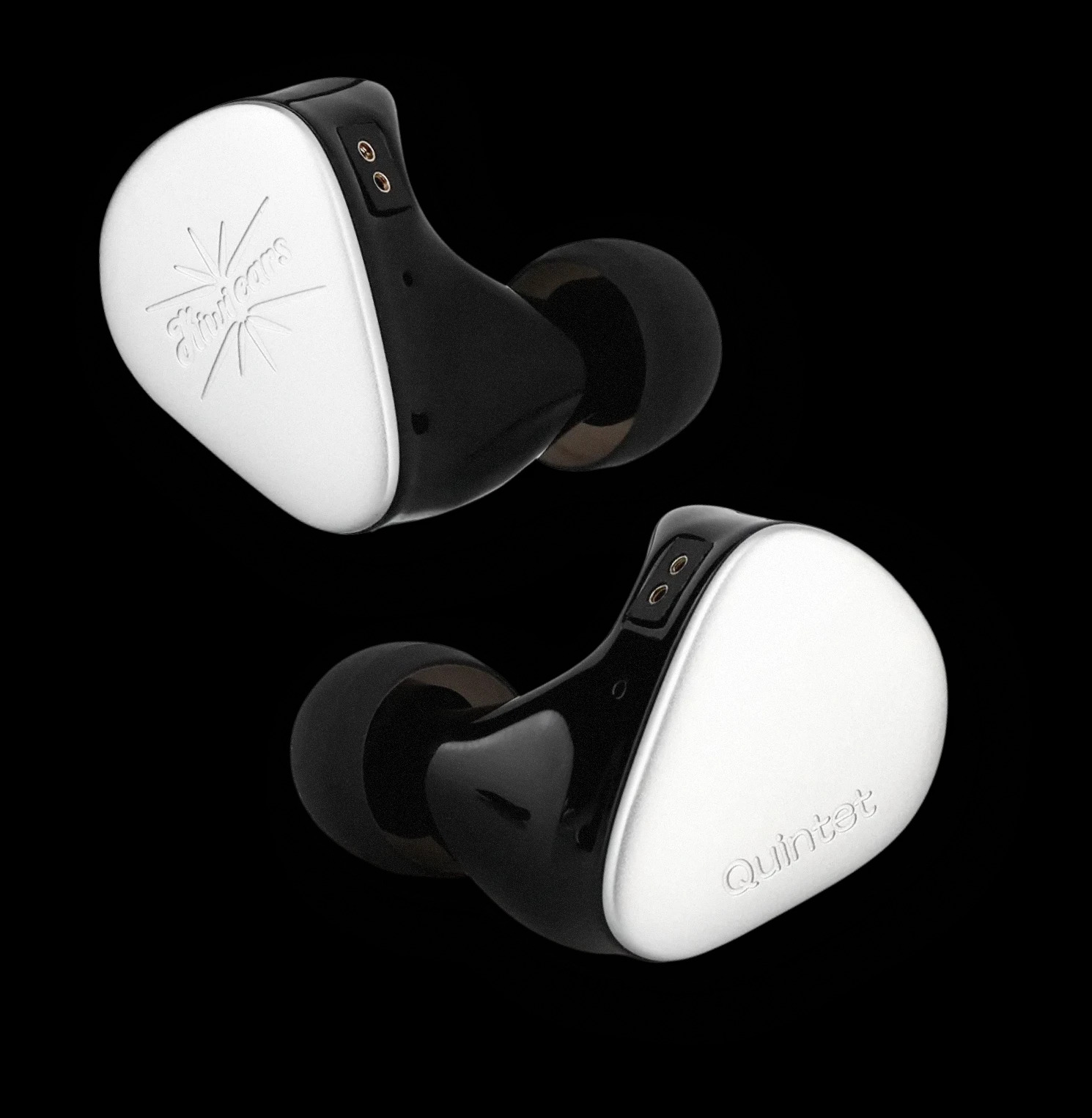
The packshot comes from kiwiears.com, unbadged, 1490 by 1525 pixels, not square, without upscaling. Upload is not pending; the product package remains isolated.
The technology, explained
Five driver paths need a crossover that splits or blends dynamic bass, BA mids, micro-planar and PZT. The manufacturer page describes the configuration, not the crossover frequencies. This page does not claim a frequency or phase response of its own.
A PZT driver works piezoelectrically and in such concepts is often used for the uppermost treble. The pillar mentions possible sibilance; that is a listening finding from the review, not a measurement of the PZT connection of our own.
Because impedance and sensitivity are missing from the manufacturer page, 32 Ω and 108 dB at 1 kHz (also 1 Vrms) appear in the data strip as figures from the pillar, with disclosure. A conversion between dB/mW and dB/Vrms is not derived from that as a second official number.
What the international specialist press hears
Headfonics — Kiwi Ears Quintet Review (Meldrick, 4 October 2023)
Meldrick describes a novel configuration, a pleasing tuning and satisfactory detail that can be sibilant. The bass is deep, warm and textured, but not bass-head; the mids are decent, the lower mids bodied; imaging and staging are average. The reader score is 8.0. This page takes that as a published listening review of the exact Quintet model.
On use, the review names average comfort, large shells, no fatigue in long sessions, double venting and decent isolation. That feeds the build subscore, without this page judging the fit itself.
The review states 32 Ω and 108 dB at 1 kHz, also referred to 1 Vrms. Because the manufacturer page omits those figures, this page takes them from the pillar and discloses the omission. The review meets the single rule of 12 November 2026.
The sound-evidence score of 7.3 sits just above the KE4 (7.2) and below the Timeless and the Aether (both 7.4). Index 59 is shared with the Softears Pro X10; the lower documented euro price decides rank ahead of the Pro X10.
Against the KE4 from the same manufacturer the pillar emphasises the five-way configuration and the pleasing tuning, while also noting possible sibilance and average imaging. Both models stay separate and are not treated as variants of each other.
Research consensus
The research consensus rests on the dated Headfonics listening review and the manufacturer page. The documented euro price comes from the EU shop. Impedance and sensitivity come from the pillar, because the manufacturer page omits them; that is disclosed.
Tonally the consensus remains a pleasing tuning, warm textured bass, decent mids and the reservation about possible sibilance plus average imaging. Large shells and average comfort are the practical notes. The Sound badge in the tier stays with the IER-M500, the value badge with the Titan S2.
Accessories and use
The kit, according to the manufacturer, includes a 1.2 metre SPC OFC cable with a 0.78 mm 2-pin connector. Exact tip counts are taken only as far as the sources name them; this page does not recount the set itself.
Headfonics describes large shells, average comfort, no fatigue in long sessions, double venting and decent isolation. That remains a note from the pillar. A cable change is possible through the 2-pin connector.
In daily use, fit matters at least as much as the five paths. The general in-ear explainer on the list describes why the seal, the venting and the tip also decide bass and isolation.
The build subscore of 7.4 sits above the KE4 and the Aether (both 7.2) and reflects the elaborate configuration as well as the shell reservation.
The double venting named in the pillar can also affect isolation and the sense of bass. That is a note from the published listening review, not a measurement of pressure equalisation of our own. A firm fit remains, even so, the condition for the warm textured bass described in the pillar.
Price and availability
The documented euro price is €204.84 at linsoul.de, JSON-LD InStock, retrieved on 12 November 2026 in the Europe/Berlin zone. A struck-through compare-at price is not on file as a separate figure for this model in this research. This page does not convert other currencies.
kiwiears.com remains the source for the configuration, the connector and the cable, not for impedance and sensitivity. The EU shop documents the euro amount and the stock status. Stock changes. The amount is without guarantee for the stated day.
In the Premium tier, €204.84 sits just below the Timeless and above the Aether and the KE4. The value subscore of 7.8 does not reach the Titan S2, which keeps the badge. Against the Softears Pro X10 at the same index, the lower amount decides rank.
On an amplifier and on a vinyl system
On a vinyl chain with a typical headphone output the Quintet is, on the sensitivity figures taken from the pillar, usually already loud. A low-noise source that is not overly bright remains the closer recommendation, because the pillar notes possible sibilance.
The warm textured bass can draw transients on a cut disc with body without sounding bass-head; possible sibilance can show up more clearly on already bright chains. That is an account of the sources, not a listening session of our own at a turntable.
An additional amplifier is usually unnecessary for level. A 2-pin cable change can adapt the plug, but it does not change the electrical figures taken from the pillar.
Long sessions are described in the review as not fatiguing. That is not a substitute for a try-on or for trying the chain itself, but it supports the practical assessment.
Possible sibilance in the pillar is the closer reservation on an already bright phono chain than on a warm chain. A different tip can change the impression, without this page comparing tips itself. The five paths do not replace the seal.
Who is the Kiwi Ears Quintet for?
The Quintet suits listeners who, in the Premium tier, want a documented five-way configuration and a pleasing, not bass-head signature, and who will accept the reservation about possible sibilance.
It is a poorer fit if large shells get in the way, if an expressly sibilance-free signature is the priority, or if impedance and sensitivity are accepted only as manufacturer figures. The Sound badge in the tier sits with the IER-M500, the value badge with the Titan S2.
The analysis is not a substitute for a personal try-on. Fit, venting and tip also decide bass and isolation, as the general in-ear explainer on the list describes.
Anyone looking for the same manufacturer will find the Orchestra Lite, the Aether and the KE4 further up the same tier, each with its own analysis and without mixing the models.
Anyone who buys the elaborate configuration mainly as a technical argument should take the pillar’s notes on imaging and possible sibilance as seriously as the driver list. Index 59 describes the place in the tier, not the number of paths.
How it compares
Against the Kiwi Ears KE4 (index 60, rank 12) the Quintet sits one index point behind, despite a slightly higher sound-evidence score. The KE4 is cheaper and a hybrid with isobaric bass; the Quintet remains the five-way, more expensive set.
The Softears Pro X10 shares index 59 and sits in rank 14, because its documented euro price is higher. The analyses remain the justification, not the index alone.
The 7Hz Timeless sits at index 60 and rank 11 as a planar model at a similar euro price. The pillars describe different signatures; a swap does not follow from the price band.
The Cadenza II, Orchestra Lite and Aether from the same manufacturer sit elsewhere on the list and are not treated as variants of the Quintet.
The Quintet is, in this expansion, the most expensive Kiwi Ears model in the Premium tier after the Timeless price band, but not the highest ranked. The Orchestra Lite and the Aether sit further ahead; the justification remains in the analyses.
Place on the expanded list
The in-ear shortlist of 12 November 2026 carries, after this expansion, 80 wired models: eight in Starter, thirty-four in Premium, seventeen in Expert and twenty-one in Master. The Kiwi Ears Quintet belongs in the Premium tier and does not move the badges of that tier.
The Premium mapping still uses the 55–69 band. There is no required gap between places. The Kiwi Ears Quintet, at a raw score of 7.635, sits at index 59 and rank 13. It shares index 59 in this tier with the Softears Pro X10; rank stays unique because its documented euro price sits below that of the Pro X10.
This analysis is reachable from the shortlist. The package remains an isolated product package without list, sitemap or kb.js files. Upload is not approved; automatic submission of new URLs is not provided for.
FAQ
Is the Quintet the same as the KE4?
No. The Quintet has five driver paths including micro-planar and PZT. The KE4 is an isobaric hybrid and stands separately.
Which impedance and sensitivity apply?
Both figures are missing on kiwiears.com. This page takes 32 Ω and 108 dB at 1 kHz (also 1 Vrms) from the Headfonics review and discloses the omission.
Can the Quintet be sibilant?
The pillar notes possible sibilance. That is a published listening finding, not a measurement of our own.
Why does it sit ahead of the Pro X10 when the index is also 59?
Shared indices are allowed. After index and sound-evidence score, the lower documented euro price decides; the Quintet is cheaper than the Pro X10.
Does VinylCination carry out listening tests of its own?
No. Subscores and text rest on the published listening review, the shop and the documented technical figures.
Conclusion
The Kiwi Ears Quintet sits, on the list record of 12 November 2026, in the Premium tier now expanded to thirty-four models, in rank 29 with index 59, with no badge, at a documented price of €204.84.
The pillar is the dated Headfonics listening review; the configuration comes from kiwiears.com, impedance and sensitivity from the pillar, because the manufacturer page omits them. A pleasing tuning and warm textured bass set the picture; possible sibilance and average imaging remain the reservations.
The Sound badge in the tier stays with the Sony IER-M500, the value badge with the DUNU Titan S2. This page does not run a second calculation and does not carry out listening tests of its own.
About this AI analysis
This section is an AI summary of published international listening reviews and the manufacturer’s published figures. Vinyl BotPro places those findings against the data sheet, a documented euro price and the list record; VinylCination does not conduct in-house listening tests or measurements, and every source is linked at the end of the page. Prices and availability change (as of 12 November 2026, without guarantee). Subscores and the index come from the list package of the same day. The Vinyl BotPro index maps the unrounded raw score linearly onto the tier band; equal or closely spaced raw scores may share an index.