
Integrated amplifier · AI analysis · Master, rank 1
Luxman L-507Z: Analysis
AI analysis (research): Luxman L-507Z with LIFES, 110 W/8 Ω and integrated MM/MC phono stage — specifications and retailer prices, no listening test.
Summary
The L-507Z delivers 110 W/8 Ω (210 W/4 Ω), LIFES, LECUA and a newly developed MM/MC phono stage, according to Luxman. MSRP often about €9,490 (price as of check). The Absolute Sound (Tom Martin, 28 November 2022) describes an uncommonly pure, low-grain and even-handed presentation — therefore sound champion of this Master-tier round (research, no listening test of our own).
Assumptions
- MM/MC on integrated phono
- No DAC — Digital external
- Check the German price as of Sept 2026
Specs (public / manufacturer)
| Type | Stereo integrated amplifier · Class AB · LIFES |
|---|---|
| Power | 110 W + 110 W (8 Ω) · 210 W + 210 W (4 Ω) |
| Phono | MM/MC · Yes · Permanently integrated |
| Digital | No DAC onboard |
| Features | LECUA · VU · Tone/Loudness · XLR · Pre/Main · 2 Speaker |
| Price guide | MSRP approx. €9,490 · Sept 2026 · Check the price date |
Manufacturer specifications (Luxman)
| Rated output | 110 W + 110 W into 8 Ω · 210 W + 210 W into 4 Ω |
|---|
Source: Luxman – official specifications · As of 16 October 2026 · subject to change by the manufacturer
Scores in detail
Vinyl BotPro Index: 95 · Index band Master 85–97 · Guidance only, not a lab value.
Strengths
- MM/MC firmly integrated
- LIFES Sound consensus in the Press
- Full Analog Feature Set
Weaknesses
- No DAC
- Still ~9.5k €
- No streaming
Analysis: Luxman L-507Z in detail
How the cited material is used
This analysis adds manufacturer data and a dated independent listening report on the Luxman L-507Z to the short overview above. Vinyl BotPro compiled it from the sources named below; VinylCination has not carried out its own listening session or measurement of this unit. The basis is the official English product page (luxman.com, id 40, retrieved 12 November 2026) and the Japanese product page [1], together with Tom Martin’s listening notes published by The Absolute Sound (28 November 2022; a later dateModified of 2 January 2026 is a page update, not a second listening test) [2].
The Absolute Sound meets the requirement of an international independent listening report: Martin publishes the show notes of his YouTube listening review with substantive sonic conclusions, power and feature figures, and a list of associated equipment. That is dated specialist press, not a manufacturer film and not a forum post. Forums are left aside. The SKU is the L-507Z, not the L-509Z and not the older L-507uXII.
Background and place in the range
The L-507Z is the first model of the Z series and carries Luxman’s new feedback architecture, LIFES Version 1.0, the successor to the ODNF circuit used since 1999. The English product page describes a circuit simulated from first principles and chosen through listening trials, intended to run with less distortion and to cut distortion in the amplification stage to less than half that of the previous architecture. The output stage is a three-stage Darlington triple-paralleled push-pull in Class AB and, according to the English page, delivers 110 watts + 110 watts into 8 ohms and 210 watts + 210 watts into 4 ohms [1]. Those same 210-watt figures appear in the table on this page and in Martin’s notes. The Japanese product page states 220 watts + 220 watts into 4 ohms. We record that contradiction; the live table is left unchanged.
In our list the unit is the Master-tier Sound champion (Index 95, rank 1). The existing short overview previously used an unnamed “press consensus” about a musical Z voicing; in the visible short text we replace that with a named attribution to The Absolute Sound / Tom Martin. The champion placing is an AI assessment based on the available data, not a listening seat of our own.
Casework, connections and operation
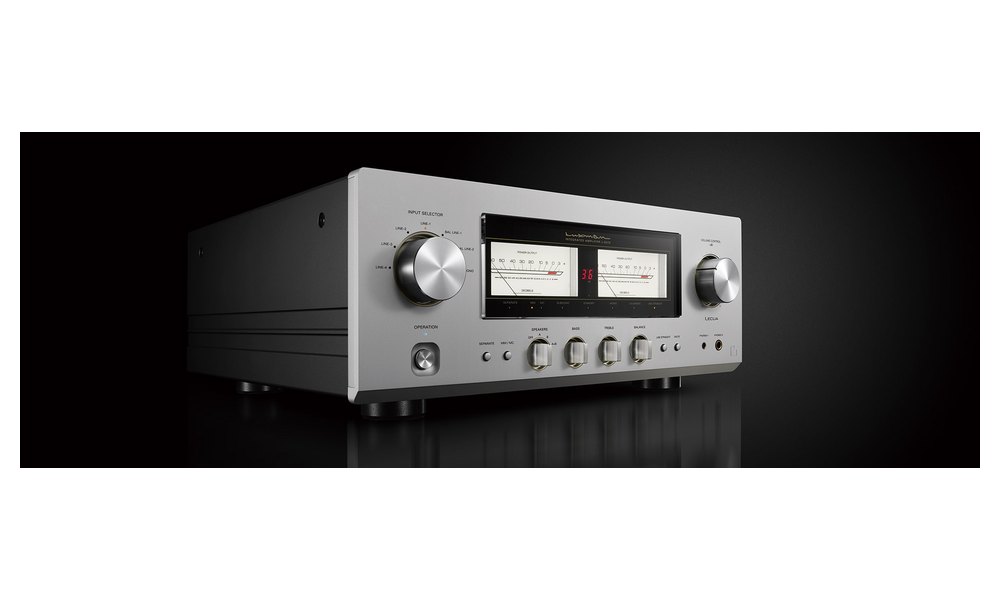
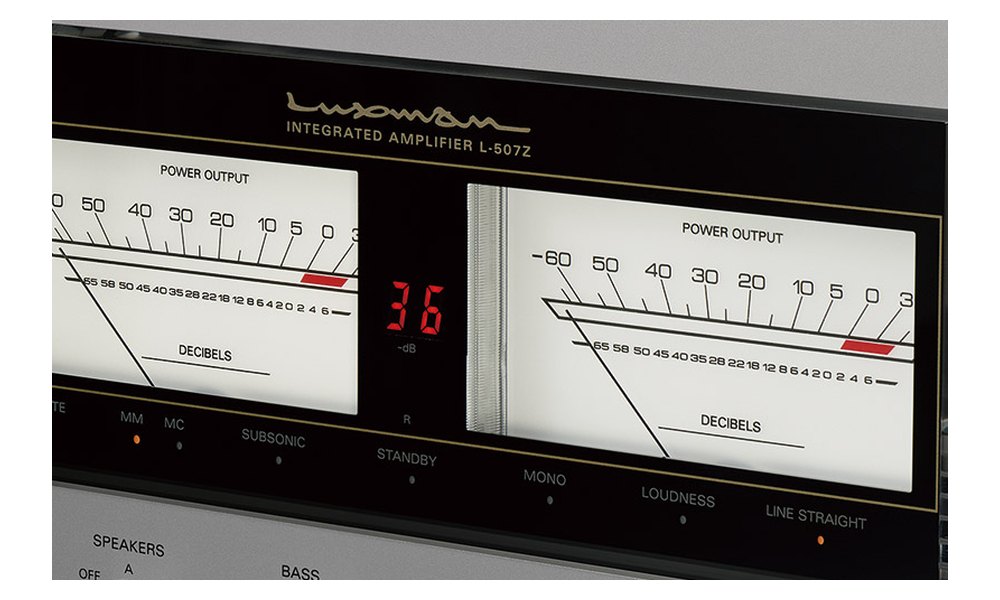
Large needle meters are typical of Luxman’s solid-state integrated amplifiers. According to the manufacturer, the L-507Z receives large, brightly lit VU meters with a fast response and, between them, a seven-segment LED readout of the attenuation level that can be read from the listening seat; meter lighting and the LED can be switched separately from the remote. The fascia is blasted white, the top plate is aluminium with a hairline finish; large vents above support cooling. Volume is handled by the 88-step electronic attenuator LECUA1000, integrated into the preamplifier [1].
Martin lists tone controls for bass, treble and loudness, a built-in moving-magnet and moving-coil phono stage, two balanced line inputs, a headphone output in single-ended and Pentaconn form, and an infrared remote [2]. The existing table also names pre/main separation and two speaker pairs, and notes that there is no DAC and no streaming on board. The table is left unchanged. Martin gives dimensions of 17.3 × 7.0 × 17.9 inches and a weight of 56 lb — the usual, just-under-440 mm integrated format of this class.
Beyond LIFES and the meters, the English product page describes a set of everyday details that distinguish the L-507Z from a purely laboratory design. The power supply is laid out for stable regulation; the input sockets and speaker terminals follow Luxman’s usual high-quality practice, and transmission inside the unit is meant to remain low-impedance. Newly designed parallel headphone outputs — named by Martin as single-ended and Pentaconn — make the fascia usable for headphone listening without rebuilding the speaker path. Cast-iron feet and the bundled aluminium remote belong to the typical accessory picture of this class [1]. Those are manufacturer feature statements, not listening findings; they do, however, explain why the existing page speaks of a “full analogue feature set” and why the absence of streaming and of a DAC remains a deliberate gap.
LIFES, power and manufacturer data
LIFES stands for Luxman Integrated Feedback Engine System. The English page explains the technical idea: as with ODNF (“Only Distortion Negative Feedback”), the original input signal is not fed back to the main amplification; the aim is a natural presentation reminiscent of a non-feedback circuit, together with strong static data. LIFES 1.0 simplifies the overall layout, reduces the number of paralleled elements and is said to cut distortion in the amplification stage by more than half [1]. Martin does not himself tie the sound to that acronym: he thinks it absurd for reviewers to bind sonic findings to features, even if Luxman makes much of LIFES and of extensive simulations, component trials and prototype listening. That, Martin writes, is part of what one pays for at 8,995 dollars: intellectual property, not only parts [2].
The 110-watt figure into 8 ohms is consistent across the manufacturer, the table and Martin. Into 4 ohms we stay with the 210 watts of the English page, the table and Martin’s notes, and record the 220 watts of the Japanese page as an open point. There is no DAC; anyone listening digitally needs an external source. The built-in phono stage is fixed and separates moving-magnet and moving-coil — a central difference from, for example, the Accuphase E-4000, which offers phono only as a board.
What the specialist press heard
Martin sums up the listening report in a few clear sentences. The “superpower” of the L-507Z is an uncommonly pure, low-grain tonality that is not bought with frequency-response or dynamic trickery. The frequency balance is very even-handed, the dynamics outstandingly realistic — exactly the two “cheats” with which some units first make instruments sound natural, but not over a longer listen. That combination of purity, balance and dynamics is hard to find at any price and makes the L-507Z an especially good value. Nine thousand dollars may not seem like value if one measures value by the pound; those who have ears should listen and judge. He expects agreement especially with medium- or high-efficiency loudspeakers (about 88 to 93 dB) in a small to medium room under about 2,000 cubic feet [2].
He names the associated chain expressly: a dCS Lina DAC and Master Clock, Tidal and Qobuz, Magnepan LRS+ and Golden Ear BRX, Sanus stands, AudioQuest cables, Shunyata power, an Audio Research Ref 6, a Legacy Wavelet, a Bryston 3B Cubed, an Orchard Audio Starkrimson, an Oppo BDP-105, and Vicoustic and RPG room treatment. That is the frame of his listening, not a guarantee for every loudspeaker. The notes are shorter than a classic magazine long review; they do contain dated, concrete sonic conclusions and therefore remain the international listening source for this analysis. A later dateModified in January 2026 does not change that.
Martin’s chain deserves a second look because it limits the scope of his verdict. With the dCS Lina, Magnepan LRS+ and Golden Ear BRX he is working in a circle that fits the recommended efficiency window: the LRS+ and the BRX are not especially insensitive large floorstanders, and the room stays, in his stipulation, under 2,000 cubic feet. A Bryston 3B Cubed and an Orchard Starkrimson in the equipment list show that he could also hold the L-507Z against separate-component thinking, without the notes becoming a formal comparison test. Anyone planning the L-507Z on markedly less sensitive or more bass-hungry loudspeakers in a large room will not find a reliable statement for that in this text. That is why Martin’s own caveat remains in the body [2].
Placement, loudspeakers and vinyl
Martin’s note of 88 to 93 dB sensitivity and rooms under 2,000 cubic feet is guidance, not a ban on smaller loudspeakers. The 110/210 watts and the built-in moving-magnet and moving-coil stage point towards analogue-first chains that need neither an extra phono box nor an internal DAC. Anyone who listens only digitally pays for the phono section and finds no converter on board — exactly the weaknesses the existing page already names. Two speaker pairs, pre/main and XLR allow typical high-end everyday chains; the tone and loudness controls remain on board, unlike some rival purist concepts.
Martin lists those tone controls expressly, without hanging the listening finding on them. In this class that is not a given: some designs drop bass, treble and loudness in favour of a shorter path. Luxman keeps them. For listeners working with different loudspeakers or levels, they remain a practical tool. Martin holds that the purity and balance of the L-507Z do not rest on such controls. That is how we read it: the controls are present; the listening finding does not depend on them [2]. Together with the parallel headphone outputs and the built-in phono stage, the picture is of a deliberately fully equipped analogue integrated amplifier that leaves digital tasks outside.
The existing system-matching note (analogue-first, 4–8 ohm loudspeakers, an external high-end DAC) follows this source picture. We have not ourselves heard the L-507Z on LRS+ or BRX loudspeakers. Comparison lines on the page are overviews, not extra listening sources.
Price and availability
Martin in 2022 named a US price of 8,995 dollars. The existing page note gives an MSRP of about €9,490 (as of September 2026, without guarantee) [2]. Those are different markets and years, not a converted spot rate. Loudspeakers, sources and cables are not typically in the box. A later street price does not change the listening notes, but it does change the Master-class field. Before a purchase, the specification and the current price should be checked; the L-507Z is easily confused with the larger L-509Z or the older L-507uXII.
The 4-ohm difference between the English page (210 watts) and the Japanese page (220 watts) remains an open point for human fact-checking. Until then the body text follows the English manufacturer page, the table and Martin, without changing the table.
A practical point concerns mix-ups in the Z family. The L-509Z sits above the 507, the L-505Z below it; the older L-507uXII carries a similar number but belongs to the previous ODNF generation. Packshots and lettering look alike. For pictures, prices and listening sources only the L-507Z may apply. The live photos on this page are checked against official Luxman L-507Z packshots and are not replaced by shots of a 509 or a 507uXII. Likewise a listening report of the 509 may not be read as a listening test of this 507.
As to placing in our Master-tier round: the Accuphase E-4000 stands in the same list as the value champion, the L-507Z as the sound champion. That follows the list logic and the respective sources, not a group listening session. VuMetre heard the E-4000 in Paris, Martin heard the L-507Z in his chain — two separate reports, not a head-to-head. We have not heard the two units against each other and draw no sonic conclusion from the different price bands (about €9,300 against about €9,490).
What we do not rely on
Listening reports of the L-509Z, L-505Z or L-507uXII are not a substitute for a report on the L-507Z. YouTube comments and forums are left aside. The later dateModified of the TAS page is not a second listening source. There is no track list of our own and no measurement.
Conclusion of the analysis
The sources portray the Luxman L-507Z as a Class AB integrated amplifier of the Z series with LIFES 1.0, LECUA1000, 110 watts into 8 ohms, a built-in moving-magnet and moving-coil stage, VU meters and no internal DAC — according to the manufacturer pages and the existing table [1]. The Absolute Sound (Tom Martin, 28 November 2022) describes an uncommonly pure, low-grain, evenly balanced and dynamically realistic presentation on medium- to high-efficiency loudspeakers in rooms that are not too large, and sees in that a strong value at about 9,000 dollars [2]. In our list the unit is the Master-tier Sound champion — an AI assessment based on the available data, not a listening test of our own.
Sources for this analysis
- Luxman: L-507Z product pages EN/JP (retrieved 12.11.2026). https://www.luxman.com/product/detail.php?id=40 · https://www.luxman.co.jp/product/l-507z
- The Absolute Sound: Tom Martin – Luxman L-507z Review (28 November 2022 / 28.11.2022; dateModified 02.01.2026 is not a second listening source). https://www.theabsolutesound.com/articles/49344/
Created by AI (Vinyl BotPro) from the sources named; no listening tests or measurements of our own. Detailed human fact-checking is still outstanding.
Comparison models
| Luxman L-509Z | More power/LECUA-EX, more expensive |
|---|---|
| Accuphase E-4000 | Phono only optional |
| Pass Labs INT-25 | Class A, without phono |
System matching
Works well with
- Analog-first vinyl systems
- Boxes 4–8 Ω with fine tuning
- External high-end DAC
Less suited
- Digital-only users without phono requirements
- Budget well below 7k €
Created by Vinyl BotPro (AI) · As of Sept 2026 · Corrections: info@vinylcination.de
Read more: best amplifiers 2026 · Improve your hi-fi system · What is hi-fi?