
Amplifiers · AI analysis · Premium, rank 4
Marantz Model 50: Analysis
AI analysis (research): analogue integrated amplifier with 70 W into 8 Ω, MM phono stage and HDAM circuitry — listed by Marantz as its current integrated amplifier in this class. Manufacturer data and international trade press, no listening test.
Summary
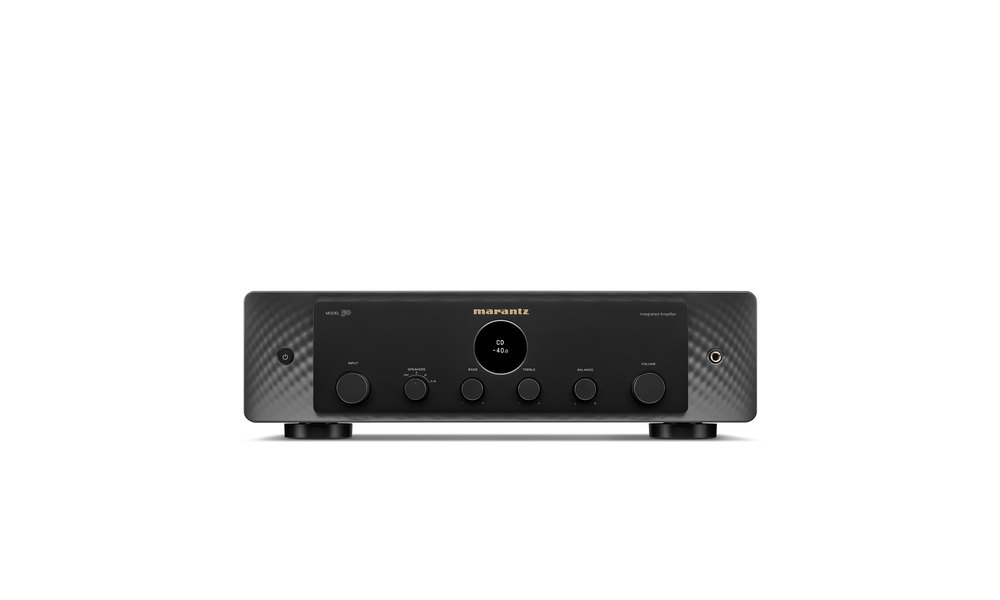
The Model 50 is Marantz's current analogue integrated amplifier in the class of the discontinued PM8006. It keeps the concept without a DAC: MM phono input, line inputs, power amp direct input, tone controls and subwoofer outputs. According to the data sheet it delivers 70 W into 8 Ω and 100 W into 4 Ω (20 Hz–20 kHz); the circuit uses HDAM-SA2/SA3 modules and current feedback. Marantz states an RRP of €2,000 (as of Oct. 2026, without guarantee).
Successor
Replaces the Marantz PM8006, which Marantz no longer lists. The Model 50 is the current analogue integrated amplifier in this class.
Assumptions
- RRP €2,000 according to Marantz (as of Oct. 2026)
- Assessed as a pure analogue amplifier without DAC
- MM phono; MC needs an external stage
Specifications (manufacturer)
| Power | 70 W into 8 Ω · 100 W into 4 Ω (20 Hz–20 kHz) |
|---|---|
| Phono | MM · 1.4 mV / 47 kΩ |
| Dimensions / weight | 442 × 431 × 130 mm · 14.2 kg |
| Price guide | MSRP €2,000 · as of Oct. 2026 · without guarantee |
Manufacturer specifications (Marantz)
| Type | Analogue stereo integrated amplifier, class AB, current feedback |
|---|---|
| Output power | 70 W (8 Ω) · 100 W (4 Ω), 20 Hz–20 kHz |
| Circuitry | HDAM-SA2 / HDAM-SA3 · toroidal transformer |
| Phono | MM · 1.4 mV / 47 kΩ |
| Line input | 185 mV / 16 kΩ |
| Power amp direct | 1.5 V / 15 kΩ |
| Tone controls | Bass ±10 dB (50 Hz) · treble ±10 dB (15 kHz) |
| Power consumption | 220 W · standby 0.3 W |
| Dimensions (W × D × H) | 442 × 431 × 130 mm |
| Weight | 14.2 kg |
| Price | RRP €2,000 |
Source: Marantz – official specifications · As of 16 October 2026 · subject to change by the manufacturer
Scores in detail
Vinyl BotPro Index: 62 · Index band Premium 55–69 · Guidance only, not a lab value.
Strengths
- Analogue signal path with HDAM modules
- MM phono stage on board
- Power amp direct input for AV integration
- Current model with a complete manufacturer data sheet
Weaknesses
- No DAC, no streaming
- No MC-Phono
- Above the Premium price focus
- According to the trade press, warm rather than analytical
Analysis: Marantz Model 50 in detail
Scope and sources
On the existing VinylCination page the Marantz Model 50 holds the Sound Vinyl BotPro Champion title in the Premium tier, with a Vinyl BotPro Index of 62 and rank 4 in that tier (analysis 09/2026). That ranking stays the live page’s; this long analysis adds named, re-checked listening reports and manufacturer data. VinylCination has neither listened to the Model 50 nor measured it in-house.
Two international independent listening reports of the exact model are the pillars. SoundStage! Access (Dennis Burger, 1 May 2024) heard the Model 50 as an analogue integrated amplifier with no digital section, driving Paradigm Studio 100 v.5 loudspeakers, with a Marantz CD 50n transport and an iFi Zen Signature One DAC; one of the recorded examples is Alice Phoebe Lou, “She”, Live at Funkhaus. hifi.nl (Harro Tillema, 6 February 2024) heard the Model 50 together with the CD 50n as a pair. Remarks that clearly concern the combination are labelled as such and kept apart from statements that attach to the amplifier itself.
The official Marantz product page (URL in the sources, retrieved 12 November 2026) supplies the technical frame: 70 W into 8 ohms and 100 W into 4 ohms, frequency response 5 Hz–100 kHz, THD 0.02 percent, damping factor 100, cabinet 442 × 431 × 130 mm, weight 14.2 kg, a moving-magnet phono stage and Marantz HDAM circuits. The live short overview also mentions AVForums, Residential Systems and HiFiReport; those texts were not re-fetched as full-text pillars in this pass, so they do not carry the core claims below.
The Model 50 is therefore read through two listening reports with a named setup and through official ratings, not through an in-house laboratory sheet. Where a finding is limited by the setup, we leave that limit visible.
Origin and place in the range
The existing page places the Model 50 as Marantz’s current analogue integrated amplifier in the class of the discontinued PM8006. The concept stays free of a DAC: analogue sources, including a turntable on the MM phono input, and a Power Amp In that SoundStage! Access explicitly records. The manufacturer page describes the unit as modern yet intended to last, and uses the marketing phrase “Warm, rich, and spacious sound”; that wording is not treated as a listening result.
The 50 series is Marantz’s mid-level analogue line in a 70-watt frame with 2.2 channels (the manufacturer’s channel count includes a subwoofer path). For vinyl systems that matters, because there is no built-in digital board: amplification, the phono stage and the loudspeaker match do the work.
Burger used the Model 50 in a deliberately analogue chain: CD was converted externally, not inside the amplifier. That matches the product idea already stated on the live page. Anyone who needs a DAC, network audio or HDMI has to add those functions separately; that is the manufacturer’s boundary, not a fault found by the listening reports.
Construction and manufacturer data
The official specification, retrieved on 12 November 2026, states 70 W per channel into 8 ohms and 100 W into 4 ohms, frequency response 5 Hz–100 kHz, THD 0.02 percent and a damping factor of 100. The chassis measures 442 × 431 × 130 mm and weighs 14.2 kg. SoundStage! Access restates the 70 W and 100 W figures and mentions the MM phono input and the Power Amp In. These are manufacturer ratings or figures repeated in the listening report, not VinylCination measurements.
Marantz promotes its HDAM modules (“Custom HDAM” on the product page) and an MM phono stage that is said to “amplify the nuances” of a turntable — manufacturer wording, not a lab result. In practice the Model 50 is an analogue integrated amplifier with a built-in MM stage, not an MC phonostage and not a digital hub.
Size and the 14.2 kg weight place the unit in the familiar mid-class of integrated amplifiers: substantial, not unusually deep, with a typical Marantz front panel. Whether tone controls and Source Direct change the character is answered not by the datasheet but by the hifi.nl listening report, which we separate from purely combined impressions in the next section.
What the specialist press heard and measured
SoundStage! Access heard the Model 50 in a defined room on Paradigm Studio 100 v.5 loudspeakers. The source was a Marantz CD 50n transport, the converter an iFi Zen Signature One. On Alice Phoebe Lou’s “She” (Live at Funkhaus) Burger describes dynamic punch, bang-on tonal balance, detail and energy — even when peaks sat at only about 72 dB. That is a listening note at a moderate level, not a claim about maximum output. Elsewhere in the same report he notes that the bass can become body-slamming when the volume is raised. We take that as his observation, not as a general law for every loudspeaker.
The report uses a pair of floorstanders that are known to ask for current and control. That the Model 50 stayed dynamic and tonally orderly in that setting is the central point. How the same amplifier behaves with small standmounts or in a heavily damped room is not in this text; we do not fill that gap with guesses.
hifi.nl heard the Model 50 not in isolation but together with the CD 50n. Tillema describes the impression as dynamic and lively, the bass as held in an iron grip, and the image as wide and precise. The tone controls struck him as a little forward; he preferred Source Direct. Because amplifier and disc player were used as a pair, we treat liveliness, bass control and imaging as findings of the combination, not as an isolated test of the Model 50. The remarks on the tone controls and on Source Direct, by contrast, concern the amplifier’s own controls and can be attached to the Model 50.
VinylCination has no measurement series of its own. Laboratory figures in the reports that merely repeat manufacturer ratings are labelled as such. Where Burger quotes a sound-pressure level in decibels, that is his listening note, not a standardised protocol from our laboratory.
Burger frames his text expressly as a listening report on the Model 50, not as a continuation of an earlier Marantz review. The setup therefore stays the one described: Paradigm Studio 100 v.5 floorstanders, digital material from the CD 50n through the iFi Zen Signature One, analogue amplification by the Model 50. In that frame the claim holds that the amplifier can keep dynamic attack and tonal order at the same time, without turning that into a rule for every loudspeaker. The figure of about 72 dB at the peaks also shows that he was not exploring the limit of output power, but a typical domestic level.
The same care applies to the phono stage: SoundStage! Access confirms the MM input as part of the feature set. A comparison of different cartridges through that stage is not laid out as a separate tableau in the passages we have. We do not infer that the stage is weak or strong, only that the amplifier was heard and described as an analogue unit with an MM input. hifi.nl supplies the practical control note that Source Direct is preferable to the slightly forward character of the tone controls — an observation about the amplifier itself, even though the disc player and the amplifier ran together.
The manufacturer page speaks of an evolution meant to reveal the musicality of source components, and of 70 watts plus Custom HDAM. Those sentences remain sales language. What can be pinned down are the ratings (70/100 W, 5 Hz–100 kHz, 0.02 percent THD, damping factor 100, 14.2 kg) and the two listening texts. We keep that line between marketing and listening reports.
Setup and system
For vinyl systems the built-in MM phono stage is the obvious entry. SoundStage! Access confirms the MM input; neither the manufacturer page nor the listening reports used here mention an MC stage. A low-output moving-coil system needs an external phonostage or a step-up transformer — that follows from the sockets, not from a listening comparison.
The Power Amp In recorded by Burger lets the Model 50 work as a power amplifier behind an external preamp or volume control. Pre-out and the manufacturer’s 2.2-channel wording point to the usual integrated-amplifier path toward an active subwoofer; we do not present an in-house calibration.
Seventy watts into 8 ohms and 100 watts into 4 ohms set a clear scale for loudspeaker choice: the Model 50 is not a high-current heavyweight, yet in Burger’s chain with the Studio 100 v.5 it showed enough reserve to keep dynamic attacks convincing even at a restrained average level. hifi.nl’s practical advice is to leave the tone controls alone in favour of Source Direct if the forward character gets in the way.
Because the amplifier has no DAC, the digital source remains the user’s responsibility. Burger worked exactly that way: transport and converter external. That suits a turntable-centred system in which the Model 50 handles amplification and MM phono and the rest of the chain stays separate.
An analogue integrated amplifier in this power class typically sits between compact domestic standmounts and floorstanders that are not extremely insensitive. Burger’s choice of the Studio 100 v.5 lies toward the more demanding side of that field; that the Model 50 is not described there as thin or underpowered therefore carries weight. How the same unit behaves with very insensitive or current-hungry loudspeakers at party levels is not in the present texts and is not added here.
Tone controls and Source Direct matter in daily use because they can shift the amplifier’s character. Tillema’s preference for Source Direct is a clear operational note. Anyone who still uses the controls should know that at least one international listening report heard them as tending a little forward. That is not a measurement curve, but it is a named observation.
Prices and availability
The existing VinylCination page gives a list-price orientation of €2,000 according to Marantz, as of October 2026, without a guarantee of day-to-day street prices. We take that figure as the live page’s orientation, not as a fresh price survey in this pass. Whether street prices sit lower does not change the listening results from SoundStage! Access and hifi.nl.
In the Premium tier on the existing page the Model 50 stands at index 62, rank 4. This long analysis does not re-score that index; it only sets out which international listening reports support the sonic picture. It is not a buying appeal.
What we do not rely on
VinylCination has not listened to the Model 50 and has not measured it. Manufacturer promises such as “warm, rich, and spacious” remain marketing. AVForums, Residential Systems and HiFiReport, where they appear in short form on the live page, were not re-fetched as full-text listening pillars in this pass and therefore do not carry the core claims of this analysis.
We read the hifi.nl report with the limit already stated: it is a Model 50 plus CD 50n combination, not an isolated amplifier comparison. Awards, retailer copy and forum posts do not replace an independent listening report. Under the internal t646u rule, German-language specialist press alone would not be enough; in this case SoundStage! Access and hifi.nl supply international listening texts of the exact model.
Conclusion of the analysis
The Marantz Model 50 is an analogue integrated amplifier without a DAC, officially rated at 70 W into 8 ohms and 100 W into 4 ohms, with an MM phono stage, HDAM circuits and a weight of 14.2 kg. SoundStage! Access, on Paradigm Studio 100 v.5, hears dynamic punch, bang-on tonal balance and detail — including at moderate peaks around 72 dB — and describes very physical bass when the level is raised. hifi.nl, in combination with the CD 50n, confirms a lively picture with a firm grip on the bass and a wide, precise image, and prefers Source Direct if the tone controls sound forward.
For vinyl chains the built-in MM stage remains the practical anchor; MC needs outside help. The long analysis supports the existing champion placement on the live page with two named international listening reports, without in-house measurement and without a buying appeal. The limits remain the press titles not re-fetched here and the combined character of the Dutch report.
Sources
- SoundStage! Access, Dennis Burger, 1 May 2024: https://www.soundstageaccess.com/index.php/equipment-reviews/1290-marantz-model-50-integrated-amplifier
- hifi.nl, Harro Tillema, 6 February 2024: https://hifi.nl/artikel/review-marantz-model-50-en-cd-50n-een-performant-duo
- Marantz official Model 50 page, retrieved 12 November 2026: https://www.marantz.com/en/product/amplifiers/model50/MODEL50.html
- VinylCination, existing Marantz Model 50 product page (list-price orientation €2,000, as of October 2026; Premium Sound champion placement, index 62, rank 4).
Created by AI (Vinyl BotPro) from the cited sources; no in-house listening tests or measurements. Detailed human fact-checking is pending.
Comparison models
| Yamaha A-S801 | Price/Performance champion, with USB DAC |
|---|---|
| NAD C 368 | HybridDigital, modular with MDC slots |
| Denon PMA-1600NE | With DAC and MM/MC phono |
System matching
Works well with
- Turntables with MM cartridges
- Speakers with normal to good sensitivity
- Systems with an external streamer or DAC
Less suited
- Anyone who needs an integrated DAC or streaming
- MC systems without external phono stage
Vinyl in practice
The MM phono stage (1.4 mV / 47 kΩ) suits most MM cartridges; MC needs an external phono stage. Matching cartridges: Best cartridges.
Technology in detail
The Model 50 is a purely analogue class AB integrated amplifier. Marantz quotes 70 W into 8 Ω and 100 W into 4 Ω, current feedback, HDAM-SA2 and HDAM-SA3 modules, a toroidal transformer and symmetrically laid-out boards. According to the data sheet, distortion is 0.02 % and the damping factor 100.
On board are six analogue inputs including MM phono (1.4 mV / 47 kΩ, 87 dB signal-to-noise ratio), power amp direct, pre-out and subwoofer output, two pairs of speaker terminals, headphone output and tone controls. Digital inputs are deliberately omitted; Marantz cites simple operation and less interference.
What the specialist press says
AVForums sees the Model 50 as the star of the 50 package and as a possible benchmark under £2,000, provided no digital inputs are needed. Residential Systems reports remarkably noise-free operation and highlights the flexibility of the pre-out and power amp input. HiFiReport describes the character as distinctly warm and designed for long, relaxed listening.
Pattern: low noise, strong bass control, warm basic tone — less suited to listeners who want maximum analytical detail. Magazine verdicts, summarised by Vinyl BotPro — no listening experience of our own.
Who is it for?
Phono
The MM stage suits most MM cartridges; MC needs an external phono stage.
Speakers
70/100 W is enough for speakers of normal to good sensitivity; very insensitive 4-ohm speakers demand more.
Digital sources
Streamer or DAC are added externally. The power amp direct input allows integration into an AV system.
The special features of this analysis
This AI analysis brings together manufacturer specifications, technical data and the verdicts of the specialist press in a compact assessment. It shows where the sources agree, which strengths come up again and again, and which system the product suits best.
How the score comes about
Vinyl BotPro Index 0–100; technology/build, features, expected performance and price/performance are weighted 25/20/25/30. Premium is typically ~55–69. It gets 62: technology and features match the PM8006, and the higher price of €2,000 costs one point. In Premium it ranks level with the Rotel A14MKII. With the highest expected performance (8.4) among the Premium amplifiers with a full analysis, it is the Sound Vinyl BotPro Champion of the tier — an AI assessment based on the available data. No listening test. Details on weighting · Methodology.
Sources
- Marantz — Model 50 (manufacturer page DE, price and features)
- Marantz — Model 50 (manufacturer page US, specifications)
- AVForums — Marantz 50 Series Amplifier and CD Player Review
- Residential Systems — Marantz Model 50 and CD 50n Review
- HiFiReport — Marantz Model 50 Review
Created by Vinyl BotPro (AI) · AI analysis · As of 16.10.2026 · Corrections: info@vinylcination.de · Prices without guarantee.
Read more: best amplifiers 2026 · Improve your hi-fi system · What is hi-fi?