
In-ear analysis · Premium · as listed
Meze Alba Analysis
The Meze Alba sits on the in-ear shortlist of 12 November 2026 in the newly opened Premium tier in rank 2 with a Vinyl BotPro index of 68 and no champion badge. This analysis takes the list record as published and does not run a second calculation.
In short
The Meze Alba is a wired universal-fit in-ear from Baia Mare. On the in-ear shortlist of 12 November 2026 it sits in the newly opened Premium tier in rank 2 with a Vinyl BotPro index of 68 and carries no champion badge; the tier’s Sound badge sits with the Sony IER-M500. The subscores and the mapping onto the 55–69 band are documented in the list package; this page repeats the list record and does not run a second calculation.
A 10.8 mm dynamic driver sits in a zinc-and-aluminium-alloy shell. Meze quotes 32 ohms, 109 dB/mW at 1 kHz and 14 g; the cable uses 2-pin sockets and is 1.2 m long. In the standard Alba carton there is a small case with an eco-leather look, silicone tips in four sizes and — in a box of its own — a USB-C-to-3.5 mm dongle. Geoffrey Morrison described the model on 15 March 2025 for SoundStage! Solo in a magazine listening review: build and feel sit clearly above the price, and most impressive is the sound — fun and “extremely well balanced”, with controlled bass and treble that never turns harsh.
In European specialist trade (allsound.at) the Alba cost €159.00 on 12 November 2026. The review quoted $159 at publication; this analysis does not convert the dollar price. VinylCination has not listened to the Alba and has not measured it. All listening judgements come from that magazine review, plus manufacturer and dealer data.
On a vinyl system the Alba is a light, easy-to-drive wired in-ear. The included dongle helps at digital USB-C sources but does not replace a phono stage. On typical headphone outputs the data-sheet figures are enough; Morrison got “pretty loud” even from a Sony NW-A306.
Technical data (public)
| Form | Wired universal-fit in-ear, ear-canal |
|---|---|
| Driver | Single 10.8 mm dynamic driver (Meze) |
| Impedance | 32 Ω (Meze) |
| Sensitivity | 109 dB/mW at 1 kHz (Meze) |
| Weight | 14 g (Meze / SoundStage! Solo) |
| Cable | 1.2 m, braided, detachable, 2-pin, 3.5 mm (Meze / SoundStage! Solo) |
| Standard Alba kit | Eco-leather case, silicone tips in four sizes (incl. XL), USB-C dongle in a separate box (SoundStage! Solo) |
| Price as of 12 November 2026 | €159.00 at allsound.at (EU specialist trade) |
| List record 12 November 2026 | Premium rank 2 · index 68 · no badge |
| Origin | Designed in Baia Mare, Romania (Meze; lettering on the manufacturer packshot) |
Amplifier compatibility
32 ohms and 109 dB/mW at 1 kHz are figures a typical headphone output will handle easily. SoundStage! Solo confirms that in use: with the included USB-C dongle levels reached a range Morrison calls dangerously loud, and even a low-powered Sony NW-A306 went “pretty loud” — a rarity on that player. A dedicated headphone amplifier is not a requirement for using the Alba well.
For a vinyl system that is a clear, limited hint. An integrated amplifier with a decent jack, or a small converter after the phono stage, is enough according to the sources. The dongle is a practical extra for a notebook or phone, not the core of the analogue chain. As a single driver without a crossover, the Alba is less sensitive to output impedance than a low-impedance multi-way in-ear.
More power does not, according to the review, turn the Alba into a different model; it only makes it louder. The described, extremely well-balanced character with a slight treble lift and a touch of upper bass remains a tuning, not a level effect.
Rating criteria in detail
The four subscores and the index of 68 stand in the list package of 12 November 2026 and are taken here as the list record. The method is the same as on the other headphone lists: sound-data, build and comfort, drive, value, then mapping onto the Premium band 55–69. The tier’s Sound badge sits with the Sony IER-M500, which shares the Alba’s sound-data score but has the higher raw figure; the Aria 2 scores higher on value and, under the single eligibility rule, receives the value badge (SoundGuys is an independent editorial outlet, as with the existing Starter champions). This page does not award the badge itself.
Manufacturer and concept
Meze Audio is based in Baia Mare, Romania, and already appears on the list with the dearer Advar in the Master tier. The Alba is meant to bring the same design brief into a price frame that sat at €159.00 in specialist trade on 12 November 2026. Morrison opens his review with exactly that point: inexpensive products usually look inexpensive, expensive ones occasionally look cheap — the Alba looks and sounds clearly above its price.
The concept stays wired and plain: one driver, a replaceable braided cable, four tip sizes, a small case, plus the dongle in a second box. No app, no wireless path, no remote on the cable. For a vinyl system that simplifies the signal path. The Alba S variant is a different offer and is not mixed into this page.
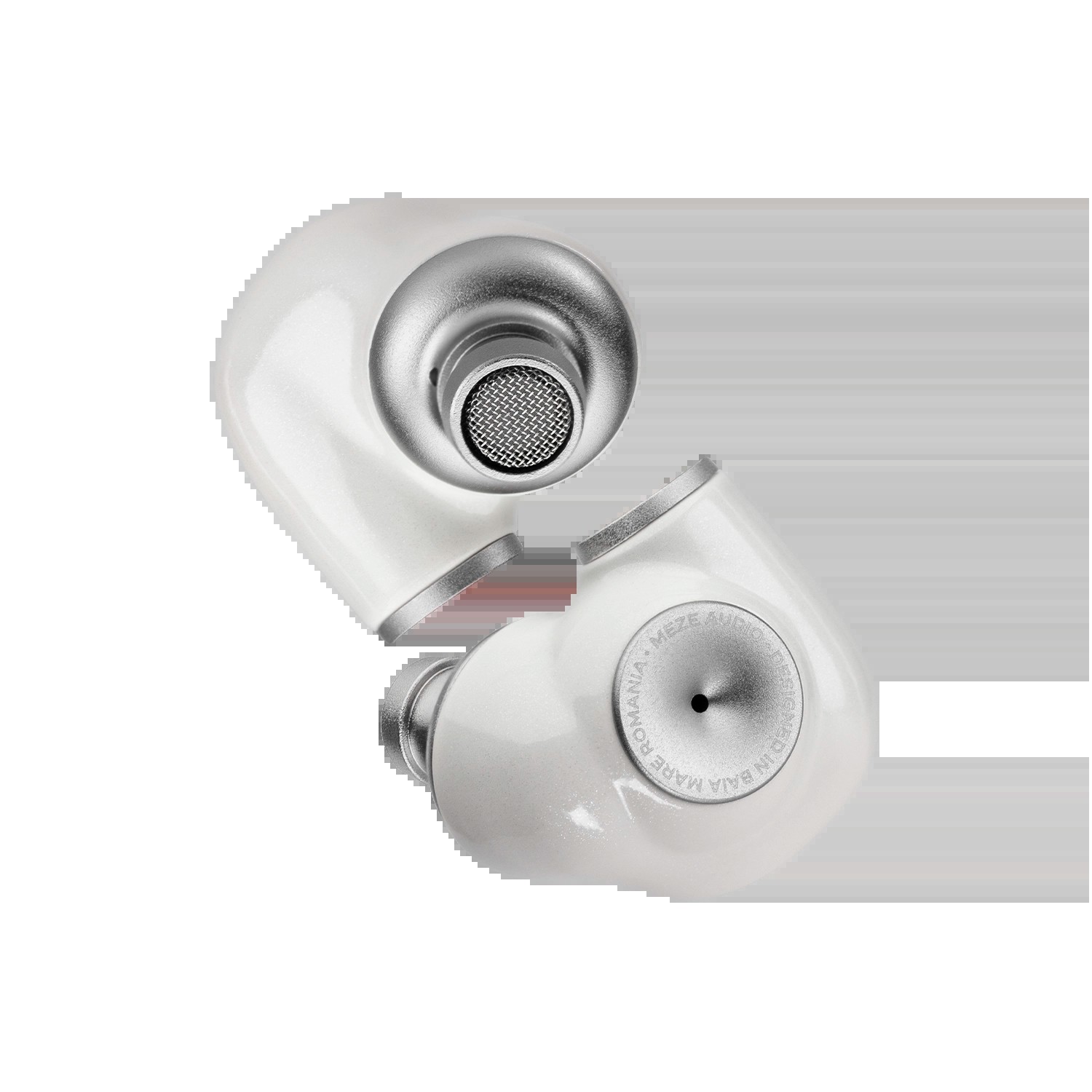
The official packshot shows the pearlescent faceplate with the lettering “MEZE AUDIO · DESIGNED IN BAIA MARE ROMANIA”. The picture is for orientation and comes from the manufacturer.
How the technology works
A 10.8 mm wide-band driver works in the shell. Meze quotes 32 ohms and 109 dB/mW at 1 kHz; the 14 g weight stays low despite the zinc-and-aluminium shell, which Morrison notes expressly. The cable is braided, 1.2 m long and detachable at 2-pin sockets. According to the review the shells themselves carry no “L” and “R” lettering; the right connection plate has a slight red tinge that matches the red accent on the right plug. A slip of paper in the box explains this.
The case holds silicone tips in four sizes, including XL. Morrison sits comfortably with the pre-fitted medium and stresses that smaller ear canals should also find a step that fits. In his description the case looks more luxurious than the price suggests; the cable was coiled in a way he is sure he could not repeat.
The USB-C dongle does not sit in the main carton but in a box of its own. A small LED in the connector shows the link. Morrison listened with it as well as with a separate amplifier and the analogue output of a portable player. That is a hint about flexible digital sources, not a substitute for a phono stage.
What the international specialist press hears
Character
Morrison holds the sound, given the price, to be the most impressive thing about the Alba. The tuning is fun and at the same time “extremely well balanced”. A slight lift in the treble and a small one in the upper bass or lower midrange stay, in his account, inside an overall balanced picture, not as a skew.
Tonal balance
On Lauren O’Connell’s largely acoustic “Power Out” he describes bright, smooth guitar plucks, a voice sitting dead-center and well balanced, and a foundation with heft but not too much. If anything, the Alba leaned a little toward the treble. On America’s “Ventura Highway” jingles and the occasional jangle were reproduced with aplomb, the treble staying smooth and never harsh. On Chappell Roan’s bass-heavy “Hot to Go!” there was plenty of bass, well controlled and never boomy; the voice soared above the mix even if a synth snare and cymbals competed for attention — not unbalanced, more a touch of extra excitement.
Dynamics, bass and stage
The review calls the bass controlled, with enough substance for pop tracks and without the overemphasis Morrison later criticises on an older Bowers & Wilkins comparison model. The stage is not particularly wide; that, he writes, is not surprising with well-sealed in-ears. The opening guitars of “Ventura Highway” did not seem to reach far beyond the ears. Dynamically the text does not describe constriction, but a tuning that carries quiet and driving tracks without pushing the low end into the foreground.
Strengths and limits
Strengths in the review: feel and build above the price, a very well-balanced, fun sound, controlled bass, smooth treble, easy drive, four tip sizes and the included dongle. Limits: no L/R lettering on the shells, only a 1.2 m cable, a stage that is not wide. The 15 March 2025 text is a classic magazine listening review and therefore, in the Premium tier, a t646u-eligible pillar; any badge is awarded by the list package, not by this page.
Research consensus
Manufacturer data and the listening review form a stable picture. The Alba is a light wired in-ear with a replaceable cable, a documented euro price and a magazine review that highlights balance, control and a feel above the price. Typical outputs and the included dongle are enough for level. The stage remains typical of a well-sealed in-ear. Those sentences are a consensus of the sources in hand, not an in-house listening judgement.
Features and daily use
According to the review and the manufacturer, the standard Alba carton holds the in-ear, the braided 2-pin cable, four tip sizes, the eco-leather case and the USB-C dongle in a second box. The official packshot on this page shows the pearlescent face with the origin lettering. The pictures are for orientation and come from the manufacturer.
In daily use, fit and seal matter. Morrison was fine with the medium size and values the fourth, large step. Anyone who wants to skip tracks on the move uses the source; there is no remote on the cable. At the system that barely matters. The 1.2 m cable typically reaches from the ear to an amplifier on a sideboard, not into a distant rack.
Price and availability
On 12 November 2026 the Alba stood at €159.00 at allsound.at. That is the documented European specialist-trade price the list uses. Meze’s own euro URL may show other currency schemes; this analysis does not take a converted dollar price or a US shop figure as a euro price. Street prices may differ, without guarantee. The Alba S is a different model and does not enter this price.
At the amplifier and on a vinyl system
On a phono chain the Alba hangs from the jack after the phono stage. 32 ohms and 109 dB/mW make it an easy partner for integrated amplifiers and small converters. The review suggests that already modest sources get loud enough; an expensive headphone amplifier is not a requirement. The USB-C dongle belongs on digital devices, not between cartridge and phono stage.
The described, extremely well-balanced character with slightly emphasised treble and controlled upper bass suits, according to the review, acoustic as well as pop records. Anyone expecting a very wide recorded stage will not find it in Morrison’s text: the image stays close to the ear, typical of a sealed in-ear. In a living room without a closed listening space the passive seal helps keep the level moderate. There is no active isolation.
Against the dearer Meze Advar in the same brand line the Alba remains the less expensive model, listed in Premium. A direct index comparison between the tiers is not made here; both figures stand only as the list record of their own tier.
Who is the Alba for?
The Alba suits listeners who want a wired in-ear at a documented euro price, with easy drive and a tuning described as extremely well balanced. It fits a vinyl system that already has a jack and mobile USB-C sources thanks to the included dongle. It fits less well if you need a very wide stage, a long cable or buttons on the cable, or if you want to stay in the Starter tier. The list package places it in Premium in rank 2 with index 68 and no champion badge.
How it compares
In the opened Premium tier the neighbours include the Moondrop Aria 2, the Sennheiser IE 200, the Westone Pro X10, the Final E5000 and the Sennheiser IE 300. Morrison himself compares the Alba with the Westone Pro X10 (then slightly dearer in US dollars) and an older Bowers & Wilkins C5 S2, whose bass he describes as unbalanced in its enthusiasm; the Alba stays more controlled. The Aria 2 is cheaper in euros, has the higher value subscore on the list and, under the single eligibility rule, carries the value badge. The IE 200 sits close to the Alba in price and has a What Hi-Fi? review scored 4 out of 5; the Alba sits above it in the list record. The Pro X10 carries no badge in the same tier. Those relations are the list record, not in-house listening comparisons.
How it sits on the opened list
The in-ear shortlist of 12 November 2026 opens Premium and Expert and expands Master. The Meze Alba sits there in the Premium tier in rank 2 with a Vinyl BotPro index of 68 and carries no champion badge; the Sound badge sits with the Sony IER-M500. That figure is the list record: it comes from the four documented subscores and from mapping onto the 55–69 band, not from a measurement and not from an in-house listening test. The reasons for the subscores appear in the list package’s overview of the models.
As neighbours in the tier the list names, among others, the Moondrop Aria 2, the Sennheiser IE 200 and the Westone Pro X10. A gap of a few index points describes order within the tier, not the size of a sonic difference. Anyone weighing two models should read the linked listening reviews and the documented euro prices, not only the index number. The Aria 2 remains higher on the value subscore and carries the value badge; the Alba carries no badge; the Sound badge sits with the Sony IER-M500.
For listening to records the review describes a balanced, controlled character that carries acoustic and pop recordings without promising a very wide stage. On a typical phono chain the practical point remains the headphone output after the phono stage: fit, seal and a quiet cable run matter more than an expensive extra box. The included USB-C dongle belongs on digital sources, not between cartridge and phono stage. The 1.2 m cable typically reaches an amplifier on a sideboard, not a distant rack.
FAQ
What exactly is the Meze Alba?
A wired universal-fit in-ear from Baia Mare (Romania) with a 10.8 mm dynamic driver, 32 ohms, 109 dB/mW at 1 kHz, 14 g, a detachable 2-pin cable of 1.2 m, and a USB-C headphone dongle in the standard Alba carton (not the Alba S).
Does the Alba need a headphone amplifier?
Meze quotes 32 ohms and 109 dB/mW at 1 kHz. SoundStage! Solo describes it as easy to drive: with the included USB-C dongle levels reached a dangerously loud range, and even a low-powered Sony NW-A306 went “pretty loud”. A dedicated amplifier is not a requirement.
Is it suitable for listening to records?
Yes. As a wired in-ear with a 3.5 mm plug it hangs from typical phono chains with a headphone output. The review describes a fun, extremely well-balanced tuning with controlled bass and treble that is never harsh; the stage is not particularly wide, which the author treats as typical of well-sealed in-ears. The included dongle is for digital sources, not a substitute for a phono stage.
What does the Alba cost?
In European specialist trade (allsound.at, Audio Tuning) the price on 12 November 2026 was €159.00. SoundStage! Solo quoted $159 at publication. This analysis does not convert the dollar price into euros. Prices change, without guarantee.
Is the USB-C dongle always included?
On the standard Alba described by SoundStage! Solo a USB-C-to-3.5 mm dongle arrives in a separate box; a small LED in the connector confirms the link. The Alba S variant is not the subject of this page.
Does this page rest on a listening test by the VinylCination team?
No. There was no in-house listening test and no measurement of our own. The assessment draws on Meze’s manufacturer data and the international SoundStage! Solo magazine listening review (Geoffrey Morrison, 15 March 2025). The list figures (Premium, rank 2, index 68, no badge) come from the list package of 12 November 2026.
Conclusion
The Meze Alba is a clearly documented wired in-ear for the opened Premium tier: light, easy to drive, with a replaceable cable, a documented euro price and a magazine review that records balance, control and a feel above the price. The list record of 12 November 2026 is Premium rank 2, index 68, with no champion badge. Anyone planning €159.00 and looking for a calm, fun tuning at a vinyl system will find a solid source base here. Anyone expecting a very wide stage or buttons on the cable should read the review at exactly those points.
About this AI analysis
This section is an AI summary of a published international magazine listening review and of Meze’s own data. Vinyl BotPro places the findings and links them to the data sheet, the specialist-trade price and the list record; VinylCination does not carry out its own listening tests or measurements, and all sources are linked at the end of the page. Prices and availability change (as of 12 November 2026, without guarantee). Subscores and index come from the list package of the same day.