
In-ear analysis · Expert · as listed
Moondrop Blessing 3 Analysis
The Moondrop Blessing 3 sits on the in-ear shortlist of 12 November 2026 in the Expert tier, now expanded to seventeen models, in rank 8 with a Vinyl BotPro index of 79 and the tier’s value badge. It shares index 79 with the DUNU SA6 MK2. This analysis takes the list record as published and does not run a second calculation.
In brief
The Moondrop Blessing 3 is a wired hybrid universal-fit in-ear with two dynamic drivers and four balanced-armature drivers, a 14.8 Ω impedance and 117 dB sensitivity. On the in-ear shortlist of 12 November 2026 it sits in the Expert tier, now expanded to seventeen models, in rank 8 with a Vinyl BotPro index of 79 and the tier’s value badge. It shares index 79 with the DUNU SA6 MK2 (rank 7): the raw scores of 7.72 and 7.715 sit close together, and the mapping does not stretch them apart artificially. The subscores and the linear mapping onto the 70–84 band are documented in the list package; this page repeats the list record and does not run a second calculation.
The listening report comes from Headfonics (Meldrick, 5 June 2023): a dated listening review of the exact model in an independent international online specialist outlet of the same class already used for other in-ears on this list. Under the single badge rule of 12 November 2026 — including addendum t647s3962 — Blessing 3 is eligible; its pillar is the written review, not a video. The documented euro price is €271.99 at linsoul.de (12 November 2026, JSON-LD InStock; no lasting stock guarantee). The US$319.99 figure in the review is not converted into euros.
Technical data (published)
| Construction | Wired universal-fit in-ear, hybrid 2 dynamic drivers + 4 balanced armatures, H.O.D.D.D.U.S. isobaric dual-dynamic array, 3D-printed crossover (Moondrop / Headfonics) |
|---|---|
| Impedance | 14.8 Ω (Moondrop / Headfonics) |
| Sensitivity | 117 dB (Moondrop / Headfonics) |
| Connector | 0.78 mm 2-pin (Moondrop / Headfonics) |
| Price as of | €271.99 at linsoul.de, 12 November 2026 (JSON-LD InStock; no lasting stock guarantee) |
Amplifier compatibility
At 14.8 Ω and 117 dB, Headfonics describes Blessing 3 as easy to drive, with a gain in resolution from a stronger amplifier. A phone will reach volume, but the detail retrieval sits below what a better output supplies. The drive score of 8.4 sits above the Edge and the SA6 MK2 (8.2 and 8.0) and just below the most sensitive Premium neighbours.
As a wired in-ear with a 0.78 mm 2-pin connector, the typical 3.5 mm plug hangs from phono chains with a headphone output. A dedicated headphone amplifier is not, on this report, a requirement for level, but it can add headroom for detail. This analysis does not run a measurement series of its own.
Scoring criteria in detail
The Vinyl BotPro index on this page is not a second calculation; it is the list record of 12 November 2026. The Expert tier holds seventeen models; the mapping uses the 70–84 band linearly across the unrounded raw score. Shared indices within a tier are allowed; rank remains unique (higher index first, then higher sound-evidence score, then lower documented euro price, then alphabetical name).
The sound-evidence score of 7.3 rests on Headfonics: a Reader Score of 8.0, tight, clean, linear bass without basshead rumble, textured midrange with a slight lower-mid dip and a slight upper-mid lift, excellent imaging and very good detail. Below Iris, the Edge and the SA6 MK2 (7.5–7.6), just above Aspire 1 (7.2). Build/comfort of 7.4 follows from the documented limits: large, heavy shells and easily damaged faceplates, with an otherwise clean hybrid construction. Drive of 8.4 follows from 14.8 Ω, 117 dB and easy drive, with the documented gain in resolution from stronger outputs. Value of 8.2 follows from €271.99, the lowest documented euro price in the Expert tier, and carries the value badge (Aspire 1 gives up the badge it had held). The raw score of 7.715 maps to index 79, which it shares with the SA6 MK2; rank 5 follows from the lower sound-evidence score of 7.3.
The manufacturer and the concept
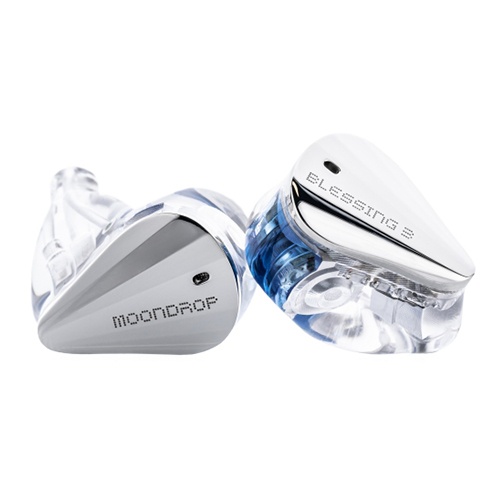
Moondrop presents Blessing 3 as the successor in the Blessing line: two dynamic drivers in the H.O.D.D.D.U.S. isobaric array plus four balanced-armature drivers, with a 3D-printed crossover. Headfonics describes large, heavy shells and faceplates that are easily damaged — that remains the central caveat on build. The official packshot on this page is a manufacturer photograph from the Moondrop product page (photo: manufacturer).
Headfonics describes a DLP 3D-printed, transparent housing, developed with HeyGears, that makes the drivers and the physical crossover visible. The faceplates are CNC-machined, hand-polished stainless steel with faceted edges and a small vent; under the vent a stylised Moondrop mark sits on the right shell and a Blessing 3 mark on the left. The same report warns that these mirror plates are easily damaged.
The concept is a rather linear, detailed tuning rather than a bass-forward signature. The review puts tight, clean bass, textured midrange and excellent imaging ahead of the missing basshead rumble and the comfort caveat of the large shells. In the Expert tier this is the lowest documented euro price in this list record.
The technology, explained
Two dynamic drivers in an isobaric array (H.O.D.D.D.U.S.) are, according to Moondrop, meant to keep the bass controlled; four balanced-armature drivers and a 3D-printed crossover lead the midrange and treble. Headfonics quotes 14.8 Ω and 117 dB and describes the set as easy to drive, with a gain in resolution from stronger outputs. This analysis has no measurements of its own; the figures come from the manufacturer and the review, read on 12 November 2026.
The abbreviation H.O.D.D.D.U.S. stands, in the review, for Horizontally Opposed Dual Dynamic Drivers Unit System: two opposed dynamic drivers in an isobaric array, meant to reduce even-order distortion and to produce the same bass level at half the stroke. In addition to the electrical crossover, Meldrick names 3D-printed physical filters. That remains a manufacturer and review claim, not a measurement of this analysis.
The shells are, in the review, large and heavy, the faceplates easily damaged. The fit still depends on the ear; this analysis does not attempt a sitting of its own. The connector is a 0.78 mm 2-pin.
What the international specialist press hears
Tonal character
Meldrick describes tight, clean, linear bass without basshead rumble, textured midrange with a slight lower-mid dip and a slight upper-mid lift, excellent imaging and very good detail. The Reader Score of 8.0 sits below the SA6 MK2’s 8.5 and the Headfonics scores for the Edge, but it carries a clearly documented, rather linear line.
The missing basshead rumble is, in the review, not a deficit of control but a limit of quantity: anyone wanting physical sub-bass will, in this tier, find it more readily in the Edge. Anyone wanting control, imaging and detail will find them here as the report’s central argument.
Tonal balance
The slight lower-mid dip and the slight upper-mid lift give the set a rather slim, well-drawn midrange, not a warm fullness. The bass stays tight and linear; the report puts that control ahead of quantity. That carries the sound-evidence score of 7.3: clearly documented, but below the 7.5–7.6 of Iris, the Edge and the SA6 MK2, because the comfort caveat and the missing rumble stand against a higher mark.
This balance supports the value subscore of 8.2: €271.99 is the lowest documented euro price in the tier, with a review that reads the set favourably overall and as a detailed all-rounder. The value badge therefore moves from Aspire 1 to Blessing 3.
Dynamics, staging and drive
Headfonics highlights excellent imaging and very good detail. Drive is easy; a phone will reach volume, but resolution benefits from a better output. A dedicated amplifier is not a requirement for level, but it can add headroom for detail. The large shells remain a comfort theme, not a drive theme.
Strengths and limits
Strengths in the review: tight, clean, linear bass, textured midrange, excellent imaging, very good detail, easy drive, a Reader Score of 8.0, and the lowest euro price in the tier. Limits: no basshead rumble, large and heavy shells, and easily damaged faceplates. On the list of 12 November 2026 Blessing 3 carries the Expert tier’s value badge, not the Sound badge: €271.99 and P 8.2 sit ahead of Aspire 1 (€348.00, P 8.0), while the sound-evidence score of 7.3 stays behind Iris (7.6).
Research consensus
This analysis has the full Headfonics listening review; it does not have a second international magazine report of the same depth. The consensus is Meldrick’s finding, read against the data sheet and the euro price: an easy-to-drive hybrid in-ear with tight, linear bass, textured midrange, excellent imaging, large and heavy shells and easily damaged faceplates, at €271.99 in the EU — the lowest documented euro price in the Expert tier. Eligibility follows from the single rule of 12 November 2026, including t647s3962. Forums, retailer copy or manufacturer pages do not serve as a listening pillar. Blessing 3 carries the tier’s value badge; the Sound badge sits with Iris.
Accessories and use
Headfonics describes large, heavy shells and faceplates that are easily damaged. That remains the central caveat on the kit and the fit. The fit still depends on the ear; this analysis does not attempt a sitting of its own.
The official packshot is a manufacturer photograph of the exact shells. The connector is a 0.78 mm 2-pin; typical chains hang from the 3.5 mm plug of the supplied cable.
The transparent shells printed with HeyGears make the drivers and the crossover visible; that is, in the review, a design and technical argument, but it does not remove the caveat of size and weight. The hand-polished stainless-steel faceplates look, on Meldrick’s first inspection, almost like etched glass — and remain the part of the kit that the report describes as easily damaged.
Price and availability
The documented euro price is €271.99 at linsoul.de on 12 November 2026, marked InStock in the JSON-LD. The InStock mark is not a lasting stock guarantee. The US$319.99 figure in the review is not converted. Prices and availability change, without guarantee.
In the Expert tier, €271.99 is the lowest documented euro price, below Aspire 1 (€348.00, P 8.0), the Edge (€395.00, P 7.6) and the SA6 MK2 (€492.15, P 7.2). The value subscore of 8.2 is the highest in the tier; the value badge therefore moves from Aspire 1 to Blessing 3.
On an amplifier and on a vinyl system
As a wired in-ear with a typical 3.5 mm plug Blessing 3 hangs from typical phono chains with a headphone output. Drive is, on Headfonics, easy, with a gain in resolution from stronger outputs. A dedicated headphone amplifier is not a requirement for level, but it can add headroom for detail.
Anyone listening to records will find a rather linear, detailed tuning with tight bass and excellent imaging, without basshead rumble. The large, heavy shells should be previewed before longer listening. This analysis does not set up a system of its own.
In the treble Meldrick describes a natural, well-extended range with sparkle, smooth from the lower to the upper treble, without noticeable peaks or dips, neither bright nor harsh and not fatiguing, with cymbals and hi-hats that remain easy to tell apart, without the set being particularly sibilant. That supports the rather linear line when listening to records: detail and extension without a sharp upper edge, so long as the large shells stay seated in the ear.
Who is the Moondrop Blessing 3 for?
Blessing 3 suits listeners who want the value argument in the Expert tier, who like a rather linear, detailed hybrid tuning and who are planning €271.99. Anyone wanting the tier’s higher sound evidence stays with Iris (rank 1, index 84, Sound badge) or the SA6 MK2 (rank 8, index 79, no badge). In this list record Blessing 3 sits in rank 8 at index 79 with the value badge — in an honest raw-score group with the SA6 MK2, ahead on price, not on sound evidence.
Anyone wanting bass quantity, small shells or more robust faceplates should read the same review against the Edge and the SA6 MK2.
How it compares
Inside the Expert tier the SA6 MK2 and Blessing 3 share index 79. The SA6 MK2 takes rank 4 because of the higher sound-evidence score of 7.6; Blessing 3 follows in rank 8 and carries the value badge, because €271.99 carries the highest value subscore of 8.2. Aspire 1 (rank 8, index 81, P 8.0) gives up the badge it had held, but stays just ahead on the index. Iris keeps the Sound badge.
For the list work, the comparison that counts is with the documented Expert neighbours: cheaper and more linear than the Edge and the SA6 MK2, with documented caveats on shell size, faceplates and bass quantity.
The visible 3D-printed crossover and the isobaric dual-dynamic array are the technical distinction from the all-BA sets in the tier, without turning that into a higher sound-evidence score. Anyone wanting control, imaging and the lowest euro price will find them here; anyone wanting bass quantity or a smaller fit stays closer to the Edge or the SA6 MK2. The easily damaged stainless-steel faceplates remain the documented caveat on the kit.
Place on the expanded list
With the Edge, the SA6 MK2 and Blessing 3 the Expert tier expands from six models to nine. The Vinyl BotPro index of Blessing 3 is 79, rank 5, with the value badge. It shares index 79 with the SA6 MK2; rank remains unique in favour of the SA6 MK2’s higher sound-evidence score. All nine models in the tier are eligible under the single rule. The Sound badge stays with Iris. The value badge moves from Aspire 1 to Blessing 3. The unrounded raw score is mapped linearly onto the tier band; shared indices are allowed, and rank remains unique.
FAQ
What exactly is the Moondrop Blessing 3?
A wired hybrid universal-fit in-ear with two dynamic drivers in an isobaric array and four balanced-armature drivers, 14.8 Ω and 117 dB.
Does Blessing 3 need a headphone amplifier?
Not as a requirement for level, on Headfonics. It is easy to drive; detail benefits from a stronger output. A phone will reach volume, but resolution is lower.
Is it suitable for listening to records?
Yes. As a wired in-ear with a typical 3.5 mm plug it hangs from typical phono chains with a headphone output. The review describes a rather linear, detailed tuning with tight bass. The cable is not a substitute for a phono stage.
What does Blessing 3 cost?
At linsoul.de the price on 12 November 2026 was €271.99 (JSON-LD InStock, with no lasting stock guarantee). The US$319.99 figure in the review is not converted. Prices change, without guarantee.
Why does it carry the value badge?
Because €271.99 is the lowest documented euro price in the Expert tier and the value subscore of 8.2 is the highest in the tier. Aspire 1 (P 8.0) gives up the badge it had held. The Sound badge stays with Iris.
Why does it share index 79 with the SA6 MK2?
Since 12 November 2026 the mapping follows the unrounded raw score linearly, with no required gap. The raw scores of 7.72 and 7.715 sit close together and may share an index. Rank remains unique: SA6 MK2 ahead of Blessing 3, because the sound-evidence score of 7.6 sits above 7.3.
Does this page rest on a listening test by the VinylCination team?
No. There was no in-house listening test and no measurement of our own. The assessment draws on Moondrop and the Headfonics listening review (Meldrick, 5 June 2023). The list figures (Expert, rank 8, index 79, value badge) come from the list package of 12 November 2026.
Conclusion
The Moondrop Blessing 3 is a clearly documented hybrid in-ear for the expanded Expert tier: tight and rather linear in tuning, with excellent imaging, easy drive, large and heavy shells and the lowest documented euro price in the tier. The list record of 12 November 2026 is Expert rank 8, index 79, with the value badge — in an honest raw-score group with the SA6 MK2, ahead on price, not on sound evidence. Anyone planning €271.99 and wanting a detailed, controlled line will find a solid body of sources here. Anyone wanting bass quantity, a small fit or the highest sound evidence should read the same report against the Edge, the SA6 MK2 and Iris.
About this AI analysis
This section is an AI summary of published international listening reviews and the manufacturer’s published figures. Vinyl BotPro places those findings against the data sheet, a documented euro price and the list record; VinylCination does not conduct in-house listening tests or measurements, and every source is linked at the end of the page. Prices and availability change (as of 12 November 2026, without guarantee). Subscores and the index come from the list package of the same day. The Vinyl BotPro index maps the unrounded raw score linearly onto the tier band; equal or closely spaced raw scores may share an index.