
Phono preamp · AI analysis · Master, rank 15
Musical Fidelity M6x Vinyl: Analysis
AI analysis (research): discrete full-width phono stage with three separately configurable MM/MC inputs and a balanced output; based on manufacturer data, the international specialist press and StereoNET.
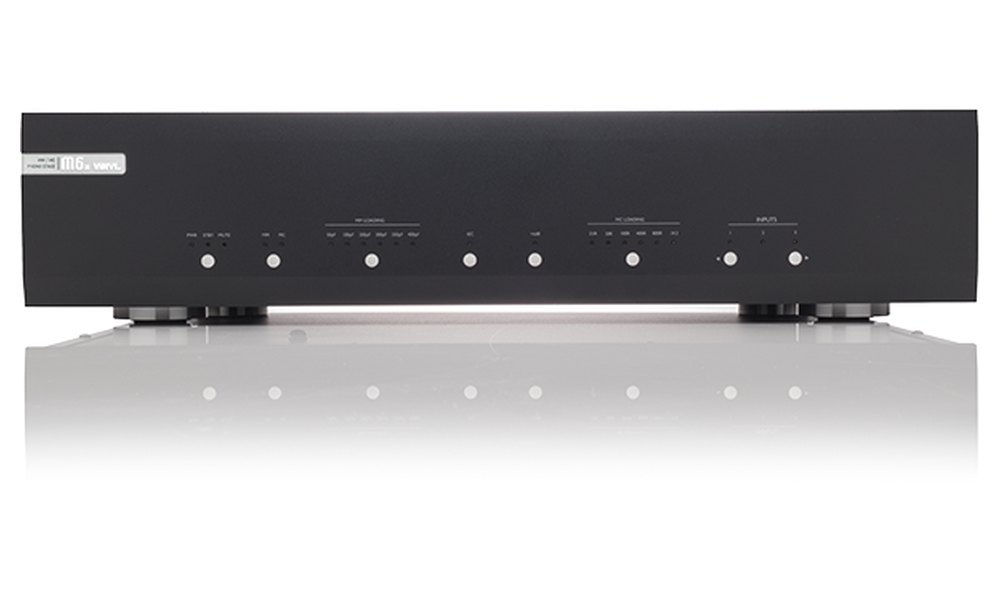
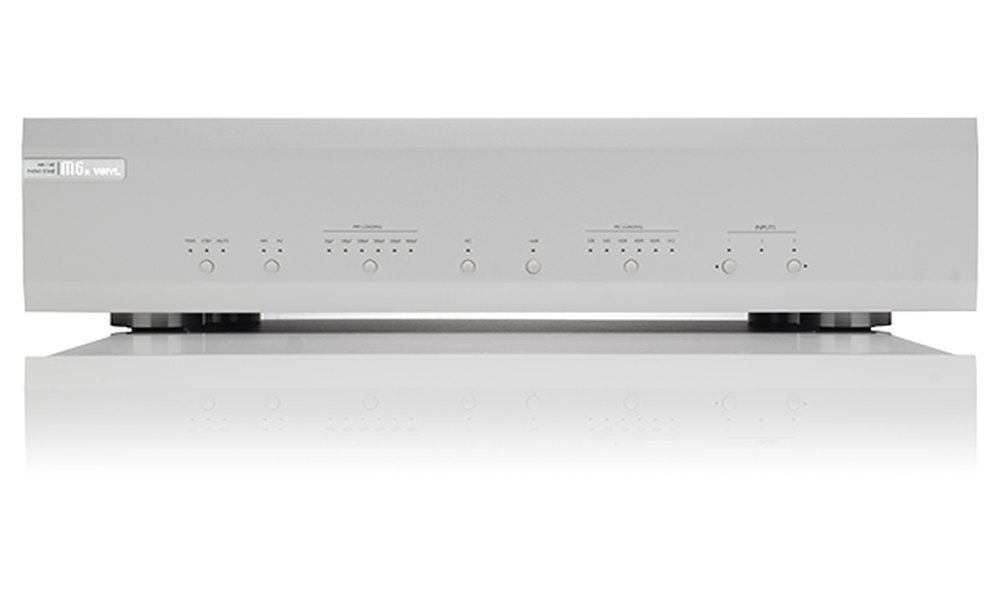
Summary
The M6x Vinyl (approx. 1,799–2,299 €) is a discrete phono stage with three separately configurable MM/MC inputs (two RCA, one XLR), an MC load from 25 Ω to 1.2 kΩ and RCA and XLR outputs. StereoNET (David Price, 9 June 2021) calls it detailed and strong value; the same author, in Hi-Fi Choice (Issue 475, April 2021), describes it as clear, spacious and slightly dry.
Specs (public / manufacturer)
| Type | MM/MC phono preamp · discrete · 3 inputs |
|---|---|
| MM | 5 mV for 500 mV output · 47 kΩ · 50–400 pF · RIAA ±0.2 dB |
| MC | 500 µV for 500 mV output · 25 Ω–1.2 kΩ · 470 pF fixed · RIAA ±0.25 dB |
| Signal-to-noise ratio | > 101 dB (MM) · > 90 dB (MC) |
| Overload margin | 26 dB |
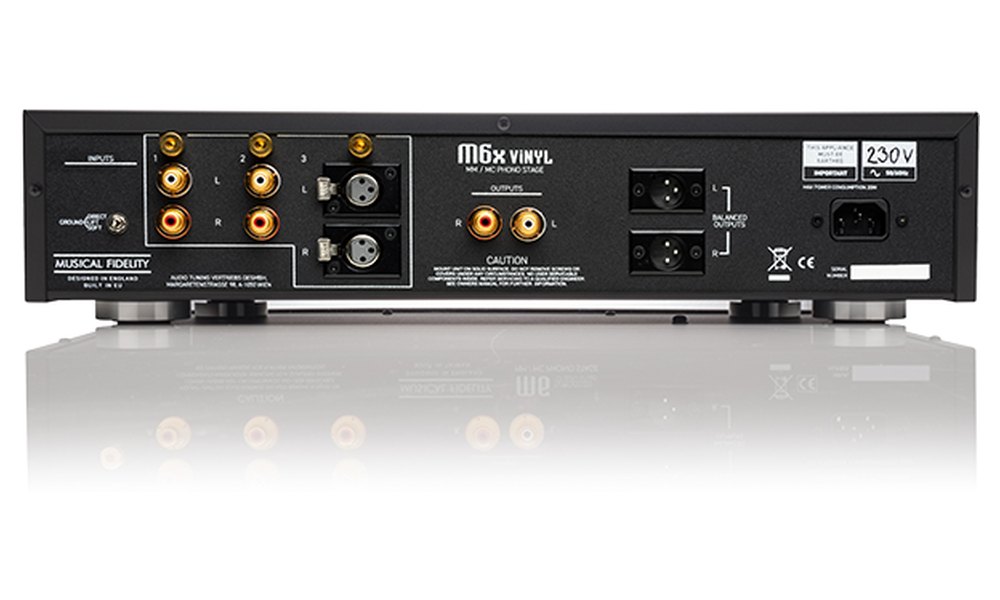
| I/O | 2 × RCA + 1 × XLR phono in · RCA 500 mV (max. 10 V) + XLR 1 V (max. 20 V) out |
| Dimensions / weight | 440 × 100 × 385 mm (B × H × T) · 5.5 kg |
| Price guide | approx. €1,799–2,299 · Sept 2026 |
Manufacturer specifications (Musical Fidelity)
| Type | MM/MC phono preamp, discrete, balanced input and output |
|---|---|
| Input sensitivity | MM 5 mV · MC 500 µV (for 500 mV out, 1 kHz) |
| Input impedance/capacitance | MM 47 kΩ, 50–400 pF · MC 25 Ω–1.2 kΩ, 470 pF fixed |
| Signal-to-noise ratio | > 101 dB MM · > 90 dB MC |
| RIAA accuracy | RIAA or RIAA/IEC ±0.2 dB (MM) · ±0.25 dB (MC) |
| Overload margin | 26 dB |
| Outputs | RCA 500 mV nom. (max. 10 V) · XLR 1 V nom. (max. 20 V) |
| Power consumption | max. 20 W |
| Dimensions | 440 × 100 × 385 mm (W × H × D) |
| Weight | 5.5 kg |
Source: Musical Fidelity – official specifications · As of 16 October 2026 · subject to change by the manufacturer
Matching tips
- Fits: Two or three turntables or tonearms
- Fits: MC cartridges with variable loading
- Good fit: Amplifiers with XLR input
- Less suited: Listeners looking for a warm, soft sound
- Less suited: Small racks (440 mm full width)
Technology in detail
Musical Fidelity builds the M6x Vinyl with discrete transistors in a 440 mm wide full-size case. It has three phono inputs, two RCA and one balanced XLR; each can be set separately for MM or MC.
For MM, Musical Fidelity quotes 47 kΩ and 50 to 400 pF; for MC, a load of 25 Ω to 1.2 kΩ with a fixed 470 pF. For 500 mV output, the MM section needs 5 mV and the MC section 500 µV; RIAA or RIAA/IEC equalisation can be selected.
According to the manufacturer, the signal-to-noise ratio is above 101 dB (MM) and 90 dB (MC), and the overload margin is 26 dB. The outputs deliver a nominal 500 mV on RCA (max. 10 V) and 1 V on XLR (max. 20 V). The unit weighs 5.5 kg and draws no more than 20 W.
What the specialist press says
Hi-Fi Choice (David Price, Issue 475, April 2021) describes the sound as neutral, clean, detailed and spacious, with taut bass and good dynamics, but matter-of-fact rather than warm. The reviewers explicitly praise the three inputs and the ease of use; for the price, they call the M6x Vinyl excellent value.
David Price (June 2021, 8/10) calls the sound light-footed, detailed and spacious, with natural timbre and plenty of rhythmic swing; the bass is a little leaner than with more expensive rivals. It does not quite reach the very top tier, but offers a great deal for its price.
Analysis: Musical Fidelity M6x Vinyl in detail
Scope and sources
This analysis adds manufacturer data and one dated, independent listening report to the short overview above for the Musical Fidelity M6x Vinyl. Vinyl BotPro compiled it from the sources named here; VinylCination has not listened to this unit and has not measured it. The basis is Musical Fidelity’s official product page (retrieved 12 November 2026) [1] and David Price’s listening report on StereoNET, dated 9 June 2021 [2]. The same author wrote a magazine piece on the same stage in Hi-Fi Choice Issue 475; the manufacturer page cites “David Price – Hi-Fi Choice 04/21”. The CMS datePublished of 29 February 2024 on the Hi-Fi Choice page is a republish, not the listening date [3].
StereoNET meets the test of an international, independent listening report: Price names the playback chain, describes the character and compares the box with a dearer stage. The Hi-Fi Choice text is a magazine piece by the same author, not a second, independent listening seat. We use it as a complement from the same pen, not as a second pillar. A What Hi-Fi? “Phono Stage of the Year 2023” award, if it is named on the manufacturer page, is an award, not a full listening write-up we have fetched. Forums are left aside.
Place in the range
The M6x Vinyl is Musical Fidelity’s discrete, full-width phono stage in the M6 line, a revision of the M6 Vinyl, with three separately memorable inputs (two RCA, one XLR) and RCA and XLR outputs. In our list it is the Value-for-Money champion in the Master band (index 85, rank 15). That champion label is an AI assessment from the sources in front of us, not a listening session of our own.
Price, in 2021, places the box in the succession of the M6 Vinyl and listens to it on a Michell GyroDec with a TecnoArm and a Lyra Dorian. The comparison partner is a ModWright PH 9.0, at almost twice the price. In Hi-Fi Choice he also holds it against a Rega Aria Mk3 and finds the M6x clearly ahead. Those are his comparison chains, not group rankings we have heard ourselves. The existing page note quotes around €1,799–€2,299 (as of September 2026).
Case, connections and use
The product page lists dimensions of 440 × 100 × 385 mm, a weight of 5.5 kg and a power consumption of 20 W [1]. Three inputs can each be remembered as MM or MC with their own loading: two unbalanced RCA inputs and one balanced XLR input, with RCA and XLR outputs as well. Those three memorable paths are the practical core of the box: two turntables plus a balanced path, without having to reset the switches every time. The existing strength and weakness lines on this page are left untouched as score graphics.
Unlike the small Pro-Ject S boxes in the same list family, the M6x is a full-width case with an internal supply, not an S-sized box with a wall-wart. That is a format difference, not a listening comparison we have made ourselves. In both texts Price expressly praises the ease of use and the three inputs as a practical advantage.
Inputs, loading and manufacturer data
Musical Fidelity describes a discrete circuit. In MM use the figures are 47 kΩ, 50 to 400 pF, 5 mV in for 500 mV out, THD below 0.005 %, 26 dB of overload margin and a signal-to-noise ratio above 101 dB. In MC use the load runs from 25 Ω to 1.2 kΩ at a fixed 470 pF, 500 µV in for 500 mV out, THD below 0.02 % and signal-to-noise above 90 dB. RIAA or RIAA/IEC can be selected. The RCA output is specified at 500 mV nominal and 10 V maximum, the XLR output at 1 V nominal and 20 V maximum [1]. These are manufacturer figures. The existing table is left unchanged.
Typical MM cartridges stay at 47 kΩ and a capacitance step between 50 and 400 pF. Low-output MCs — Price heard a Lyra Dorian — sit in the low-to-mid part of the 25 Ω-to-1.2 kΩ grid. The choice between RIAA and RIAA/IEC is an equalisation option, not a separately written A/B trial in the listening reports. He notes the balanced input and the higher-headroom XLR output as features; his fully described listening seat is a Michell with a conventional RCA path and the Lyra, not a fully balanced chain of the kind Hughes used with the DS3 B.
What the specialist press heard
On StereoNET, Price describes the M6x Vinyl as spry, light on its feet, detailed and spacious, not syrupy. On “Wichita Lineman” — the StereoNET text prints “Witchita”, the standard title is meant — he hears air and vastness against the CD; Kate Bush’s “Moving” sounds ethereal. Against the almost twice-as-expensive ModWright PH 9.0 the M6x is slightly well-lit in the upper midrange, with drier, leaner bass; that very trait helps Rose Royce’s “Wishing on a Star”. Rhythmically the stage has swing. For the money it is excellent; it does not quite reach the top tier [2].
In Hi-Fi Choice, Issue 475, the same author, signed “DP”, draws a matching picture: crisp, clean, spacious, slightly dry and neutral, clearly ahead of the Rega Aria Mk3. Among the records heard are Kate Bush’s “Wow”, the Beatmasters’ “Who’s In The House?” — with a slight edge on the percussion — and Donald Byrd’s “Street Lady”. The three inputs and the ease of use are expressly praised; at the price the stage is a strong offering [3].
Because both texts are by David Price, we do not add them up as two independent magazines. The StereoNET report of 9 June 2021 remains the dated international primary source; Hi-Fi Choice of April 2021 (Issue 475) is the same ear in a magazine format, with extra titles and the Aria Mk3 comparison. The shared line is a neutral, detailed, spacious, dry-rather-than-warm stage with rhythmic swing, strong at the price, and not a substitute for the dearest top-tier units. Price himself sets it below the very top and behind the almost-double ModWright, with a clear lead over the Aria Mk3.
Setup, cartridges and system
Price’s chain is a Michell GyroDec with a TecnoArm and a Lyra Dorian MC — a fully grown, not inexpensive turntable side. The light, detailed, unsyrupy presentation and the slightly drier bass were heard with this MC, not with a bundled MM. Anyone who connects a warm, full MM should not automatically expect the same slightly well-lit upper midrange he noted against the ModWright; he did not hear that combination. The three memorable inputs are most useful to anyone who switches between two or three turntables or cartridges without resetting the load each time.
The balanced input presupposes a turntable or cable with XLR. The RCA path remains fully usable and carries Price’s detailed listening seat. There is no USB recorder and no headphone socket; the M6x is a full-width phono stage, not a digital hub. The internal supply should still be kept away from sensitive arm cables, even though there is no wall-wart beside the box.
Price and availability
The existing page note quotes around €1,799–€2,299 (as of September 2026, without guarantee). Price’s judgement, “excellent for the money, not quite top tier”, refers to the 2021 price and to the gap to the ModWright PH 9.0 and, in the magazine, to the Aria Mk3. A present-day euro price in the Master band has to be read afresh against current alternatives; we have not heard those alternatives ourselves. In our list the M6x Vinyl is the Master Value-for-Money champion. That follows from the sources and from the secured StereoNET listening text, complemented by the same author in Hi-Fi Choice, not from a group comparison in this analysis.
The M6 Vinyl without the “x” is the predecessor and does not automatically inherit this report. A smaller Musical Fidelity stage from another series does not inherit it either.
Price’s comparison with the ModWright PH 9.0 is a listening gap upwards, not a price crash in the Master band. To him the M6x sounds slightly more well-lit in the upper midrange and drier in the bass, and that drier bass is what helps a record such as “Wishing on a Star”. That is not a fault sheet, but a character against an almost twice-as-expensive stage. The lead over the Aria Mk3 in the magazine is the downward gap: crisp, clean, spacious, slightly dry — and, for him, the stronger box in that pair. Both gaps remain tied to his chains and titles.
The three memorable inputs deserve one more practical sentence. Anyone who owns only one turntable is paying for memory slots they do not need, but still gets the discrete circuit, the load choice and the XLR output. Anyone who runs MM and MC decks, or two arms, is using exactly the function Price highlights in both texts. The choice of RIAA or RIAA/IEC remains an option for cutting and playback habits; without a heard A/B trial we do not treat it as a sound decision.
The gap between the April 2021 issue, the StereoNET text of 9 June 2021 and the CMS republish in 2024 explains why online dates alone can mislead. We date the listening seat to 2021 and treat 2024 as a republication of the same magazine text, not as a new listening session. A later revision of the M6x under the same name is something we would have acknowledged only if the product page or the listening text had marked it; that is not the case here.
What we are not using
A What Hi-Fi? annual award on the manufacturer page does not count as a written-out international listening report for as long as we do not have a fetched, full What Hi-Fi? listening text. German texts on their own would not meet the rule; they are not used here as a second pillar. Forums and shop comparisons are left aside. We correct the StereoNET typo “Witchita” to “Wichita Lineman” in the write-up. There is no in-house track list and no measurement.
Above all, we do not count StereoNET and Hi-Fi Choice as two independent listening magazines. Anyone who, in older short overviews, reads two unnamed press mentions is reading two publications by the same author. This analysis names both with dates and makes the shared authorship plain.
Conclusion of this analysis
The sources portray the Musical Fidelity M6x Vinyl as a discrete full-width phono stage with three memorable MM/MC inputs, an MC load from 25 Ω to 1.2 kΩ, MM capacitance from 50 to 400 pF, a choice of RIAA or RIAA/IEC, and RCA and XLR outputs — according to the product page and the existing table [1]. StereoNET (David Price, 9 June 2021) describes, on a Michell GyroDec with a TecnoArm and a Lyra Dorian, a spry, detailed, spacious, unsyrupy stage with slightly drier bass than a dearer ModWright PH 9.0, rhythmic swing and strong value, without quite reaching the top tier; among the records heard were “Wichita Lineman”, Kate Bush and Rose Royce [2]. Hi-Fi Choice (David Price, Issue 475, April 2021) confirms the same ear: crisp, clean, spacious, slightly dry, ahead of the Aria Mk3, with titles by Kate Bush, the Beatmasters and Donald Byrd [3]. In our list the unit is the Master Value-for-Money champion — an AI assessment from the sources in front of us, not a listening report of our own.
Sources for this analysis
- Musical Fidelity: M6x Vinyl, product page (retrieved 12 November 2026). https://www.musicalfidelity.com/products/m6series/m6x-vinyl
- StereoNET: David Price – Musical Fidelity M6x ViNYL Phono Stage Review (9 June 2021). https://www.stereonet.com/reviews/musical-fidelity-m6x-vinyl-phono-stage-review
- Hi-Fi Choice: David Price (DP) – Musical Fidelity M6x Vinyl (Issue 475, April 2021; CMS republish 29 February 2024). https://www.hifichoice.com/content/musical-fidelity-m6x-vinyl
Created by AI (Vinyl BotPro) from the sources named; no in-house listening tests or measurements. Detailed human fact-checking pending.
Who is it for?
For vinyl listeners with several turntables or tonearms who want a flexible, neutrally voiced MM/MC phono stage with a balanced output.
What makes this AI analysis special
This AI analysis combines Musical Fidelity's technical data with international reviews. All technical values are manufacturer figures. As of October 2026.
How the score comes about
The Index reflects the discrete design, the three separately configurable inputs, the balanced output and the very good reviews; on value it leads its tier. The Vinyl BotPro Index on this page remains 85 (Master, rank 15) — guidance from manufacturer data and the specialist press, no in-house listening session. The four criteria engineering/build, features, expected performance and value for money are weighted 25/20/25/30 and scaled across all tiers. Methodology
Sources
- Musical Fidelity, M6x Vinyl product page with specifications
- Hi-Fi Choice, Musical Fidelity M6x Vinyl review
- StereoNET, Musical Fidelity M6x ViNYL review
Vinyl BotPro Index: 85 (Master 85–97) · Label: AI research · Sept 2026
Read more: best phono preamps 2026 · What is hi-fi?