
Speaker cable · Short analysis · Starter, rank 11
Oehlbach Speaker Wire SP-7 Review
Short analysis (research): 2 × 0.75 mm² · OFC, sold by the metre, without plugs · up to 75 W (manufacturer) — manufacturer specifications and retailer prices, no listening test.
Summary
Oehlbach Speaker Wire SP-7 (bulk cable sold by the metre, 2-core, round): 2 × 0.75 mm² · OFC; sold by the metre, without plugs · to 75 W (manufacturer). Price: approx. €0.75/m · price as of Sept 2026. The small cross-section of 0.75 mm² makes sense for short distances (few meters) on loudspeakers with 8 Ω; with longer distances the cable resistance increases noticeably.
At usual lengths (up to approx. 5–10 m), what matters most is an adequate cross-section and a clean, firm connection; audible sound differences between speaker cables are scientifically disputed.
Assumptions
- Prices: consumer prices incl. VAT, as of Sept 2026 (manufacturer or retailer page); they may change
- Details from the manufacturer’s shop or datasheet, or the retailer’s page; availability may differ and was not checked for every variant.
- Living-room system with cable runs of up to approx. 5–10 m
- No measurements or listening tests of our own
Specs (public / manufacturer)
| Type | Sold by the metre · 2-core, round |
|---|---|
| Cross-section / conductor | 2 × 0.75 mm² · OFC |
| Conductor material | OFC (oxygen-free copper) |
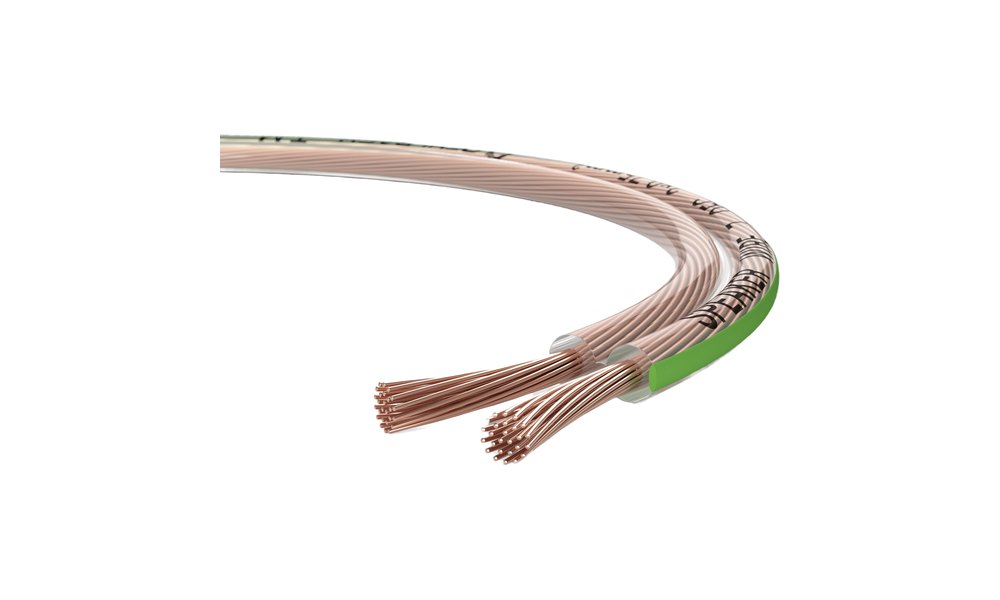
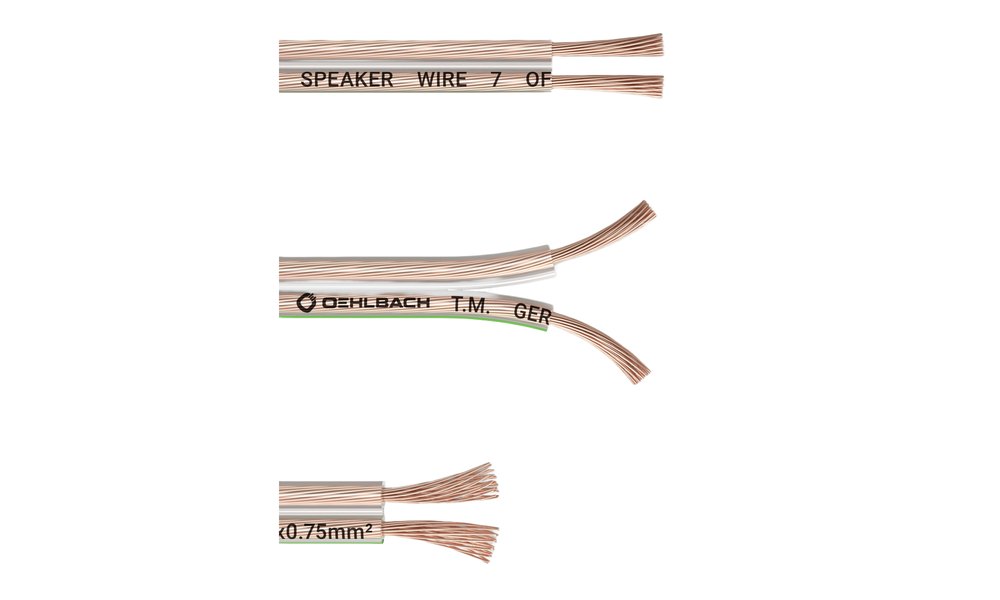
| Construction | Round, transparent plastic sheath |
| Termination / connection | Sold by the metre, no plugs · Up to 75 W (manufacturer) |
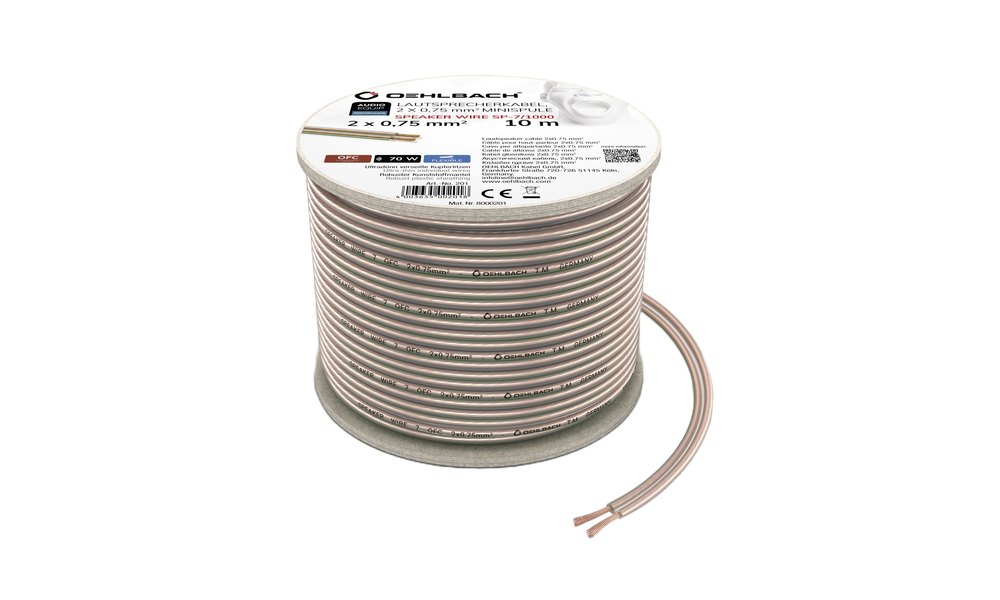
| Length | coil 10 m or 20 m |
| Manufacturer / origin | Oehlbach, manufacturer warranty 30 years according to shop |
| Price guide | 20 m coil €14.99 (€0.75/m) · Price as of Sept 2026 |
Manufacturer specifications (Oehlbach)
| Type | stereo speaker cable |
|---|---|
| Cross-section | 2 × 0.75 mm² (Einzeldraht ca. 0.20 mm) |
| Conductor | OFC (oxygen-free copper) |
| Construction | round |
| Insulation | plastic, transparent |
| Amplifier power (recommendation) | up to 75 W |
| Lengths | coil 10 m or 20 m |
| Resistance | not specified by manufacturer |
| Warranty | 30 years (per Oehlbach) |
Source: Oehlbach – official specifications · As of 16 October 2026 · subject to change by the manufacturer
Suits / less suited
- Suits: Short runs up to approx. 3 m
- Suits: Small speaker at 8 Ω
- Suits: Who is terminated
- Less suited: way over 5 m
- Less suited: 4-Ω-speaker with high performance
Vinyl BotPro Index: 40 (Starter 40–54) · Label: AI research · Sept 2026 · All information is provided without guarantee; prices change and manufacturer specifications may differ.
Manufacturer and concept
Oehlbach is a German accessories maker offering cables from simple speaker wire up to high-end models. The Speaker Wire series is its entry line, available in cross-sections of 0.75, 1.5, 2.5 and 4 mm². With 2 × 0.75 mm², the SP-7 is the thinnest model in the range. It uses oxygen-free copper (OFC), has a round, transparent plastic jacket and is sold on 10 m or 20 m reels. At around €0.75 per metre (no guarantee), it sits in our starter tier.
There are no international reviews for such a basic cable. This page relies on the manufacturer's data, calculations from the cross-section and practical advice. There are no own listening or measurement tests.
The technology explained
OFC copper
OFC stands for oxygen-free copper. It contains less oxygen than standard electrolytic copper and is therefore slightly less prone to corrosion inside the conductor. Conductivity is practically the same. For the electrical job of a speaker cable the difference is very small. Cross-section matters more.
Fine strands
Each conductor consists of many thin strands of about 0.20 mm diameter according to Oehlbach. Fine stranding makes the cable very flexible. It is easy to route around corners, lay under carpets or push into narrow cable ducts. The drawback is that fine strands break more easily if nicked during stripping.
Transparent jacket
The clear jacket shows the copper. One of the two conductors is usually marked so polarity can be identified. The jacket is thin and flexible but less robust than a thick outer sheath. It is not ideal where furniture rolls over the cable or squeezes it.
The "up to 75 W" rating
Oehlbach recommends the SP-7 for amplifiers up to 75 W. That is a rough guide. The load on a cable depends on current, not directly on amplifier power. At normal room volume, usually only a few watts flow. Heating is not an issue at 0.75 mm² in home use. The real limit is resistance over longer runs.
Resistance in numbers
Copper has a resistivity of about 0.0172 Ω·mm²/m. At 0.75 mm² that gives roughly 0.023 Ω per metre and conductor. Because the current flows out and back, twice the length counts. Oehlbach itself gives no resistance figure, so the numbers below are calculated from the cross-section.
- 3 m of cable: about 0.14 Ω. Around 0.15 dB loss into 8 Ω, about 0.3 dB into 4 Ω.
- 5 m of cable: about 0.23 Ω. Around 0.25 dB into 8 Ω, about 0.5 dB into 4 Ω.
- 10 m of cable: about 0.46 Ω. Around 0.5 dB into 8 Ω, almost 1 dB into 4 Ω.
A level loss alone is no drama, as you simply turn the volume up a little. More critical is that a speaker's impedance changes with frequency. Higher cable resistance amplifies these swings and can bend the frequency response by fractions of a decibel. Damping factor also falls, so the amplifier controls the woofer's movement less well. With short runs and 8 Ω speakers this stays uncritical. With long runs and 4 Ω speakers, a thicker cable is the better choice.
Example: damping factor
Damping factor describes how well an amplifier controls the movement of the speaker cone. It is the speaker impedance divided by the amplifier's output resistance plus the cable resistance. An example: an amplifier with 0.08 Ω output resistance achieves a damping factor of 100 into 8 Ω. With 3 m of SP-7, about 0.14 Ω is added and the value drops to around 36. With 10 m it is only around 15. At what point this becomes audible is disputed; values above 20 are often considered sufficient. Short runs therefore keep the SP-7 in the safe zone.
Use in home cinema
In home cinema, runs to the rear speakers are often long because the cable goes around the room. Here the SP-7 quickly reaches its limits. For front speakers and the centre right next to the AV receiver, it can be enough if the speakers are small and rated at 8 Ω. For ceiling speakers with long runs, a thicker cable is the better choice.
Where the SP-7 makes sense
The SP-7 suits short runs of up to about 3 to 5 m and speakers rated at 8 Ω. Typical uses are:
- small bookshelf speakers on a micro system or mini amplifier,
- surround speakers with short runs,
- second systems in a kitchen, study or workshop,
- passive speakers on a computer or TV amplifier,
- wiring that should disappear discreetly under a skirting board.
For long runs, 4 Ω floorstanders or powerful amplifiers, 2.5 or 4 mm² makes more sense. Within the series that would be the SP-25 or the SP-40. The price difference is small at short lengths.
Sound differences: what is proven
Audible differences between speaker cables of adequate cross-section are scientifically disputed. With very thin cables over long runs, however, measurable effects caused by resistance can be shown. With the SP-7 the outcome therefore depends mainly on length and speaker. We make no claims about a sound of its own.
Connecting step by step
With round two-conductor cables, the two conductors can often be separated by carefully slitting the jacket. Then remove about 10 mm of insulation. Because of the fine strands, a wire stripper set to 0.75 mm² works best. Twist the strands tightly afterwards. With spring clips, common on small amplifiers and speakers, simply insert the twisted end. With binding posts, wrap the end clockwise around the shaft so it does not twist out when tightened.
Wire ferrules for 0.75 mm² make the connection tidier and prevent stray strands. Banana plugs are possible, but many are designed for larger cross-sections, in which case the thin cable does not sit firmly. A single stray strand can cause a short circuit and damage the amplifier, so check every terminal before switching on.
Polarity and routing
Positive and negative must match at amplifier and speaker. Always connect the marked conductor to positive, on both ends. A speaker wired out of phase sounds thin in the bass and the stereo centre blurs. The thin cable is easy to run under skirting boards or in cable ducts. Under carpets it should not lie where people walk a lot, because the thin jacket can wear through over time. Avoid long parallel runs close to mains cables.
Warranty and durability
According to its shop, Oehlbach offers a 30-year warranty. For a simple cable this mainly signals durable materials. Bare copper at the ends tarnishes over time. Stripping the ends afresh every few years gives clean contact surfaces again. Ferrules protect the ends further.
A 10 m or 20 m reel is usually enough for both channels of a stereo system. Before buying, measure the runs with a tape measure and add about half a metre per side as reserve. That leaves room to strip the ends again later or move a component slightly without buying new cable.
When is a thicker cable worth it?
A thicker cable pays off when the run is longer than about 5 m, when the speakers are 4 Ω or when large woofers draw a lot of current. The extra cost for 2.5 mm² is usually small. For a small second system with short runs, a dearer cable brings no measurable benefit. Here the SP-7 is a sensible, low-cost solution. Money saved is better spent on the speakers or their placement.
Strengths and limits at a glance
- Strength: very inexpensive.
- Strength: thin, flexible and discreet.
- Strength: OFC copper, 30-year warranty according to the manufacturer.
- Strength: fits the spring clips of small devices.
- Limit: 0.75 mm² only makes sense for short runs.
- Limit: too thin for 4 Ω speakers and long runs.
- Limit: thin jacket, not very robust.
- Limit: no manufacturer figure for resistance.
Who it suits
The SP-7 suits anyone wanting to connect small speakers over short runs cheaply, for example on a micro system or a mini amplifier. If you are wiring a main system with floorstanding speakers, choose a thicker cable such as the Supra Classic 2x2.5 or the Oehlbach SP-25.
Compared with alternatives
The Oehlbach SP-15 has twice the cross-section and costs hardly more. The Supra Ply 2x2.0 is an alternative with a larger cross-section. The QED Performance Speaker Cable is a higher-grade option. More in our best speaker cables.
Oehlbach Speaker Wire SP-7 FAQ
How long can the SP-7 be?
For 8 Ω speakers, about 3 to 5 m is uncritical. For longer runs, use a thicker cable.
Is it enough for 4 Ω speakers?
Only for very short runs. Otherwise 2.5 mm² is better.
What does "up to 75 W" mean?
A rough recommendation from the manufacturer on amplifier power.
Is OFC better than standard copper?
Conductivity is practically the same. Cross-section matters more.
Do I need connectors?
No. Ferrules are a clean solution at 0.75 mm².
Verdict
The Oehlbach Speaker Wire SP-7 is an inexpensive, flexible speaker cable with 2 × 0.75 mm² of OFC copper. It is enough for short runs and 8 Ω speakers on small systems. For longer runs, 4 Ω speakers or larger systems, a thicker cable is the better choice.
Read more: best speaker cables 2026 · Improve your hi-fi system · What is hi-fi?