
Turntable · AI analysis · Starter, rank 2
Pro-Ject Essential III (Essential 3): Analysis
AI analysis (research): an audiophile starter with an Ortofon OM10, a 8.6″ aluminium arm and an MDF platter. Guidance from specifications and magazine consensus; no listening test.
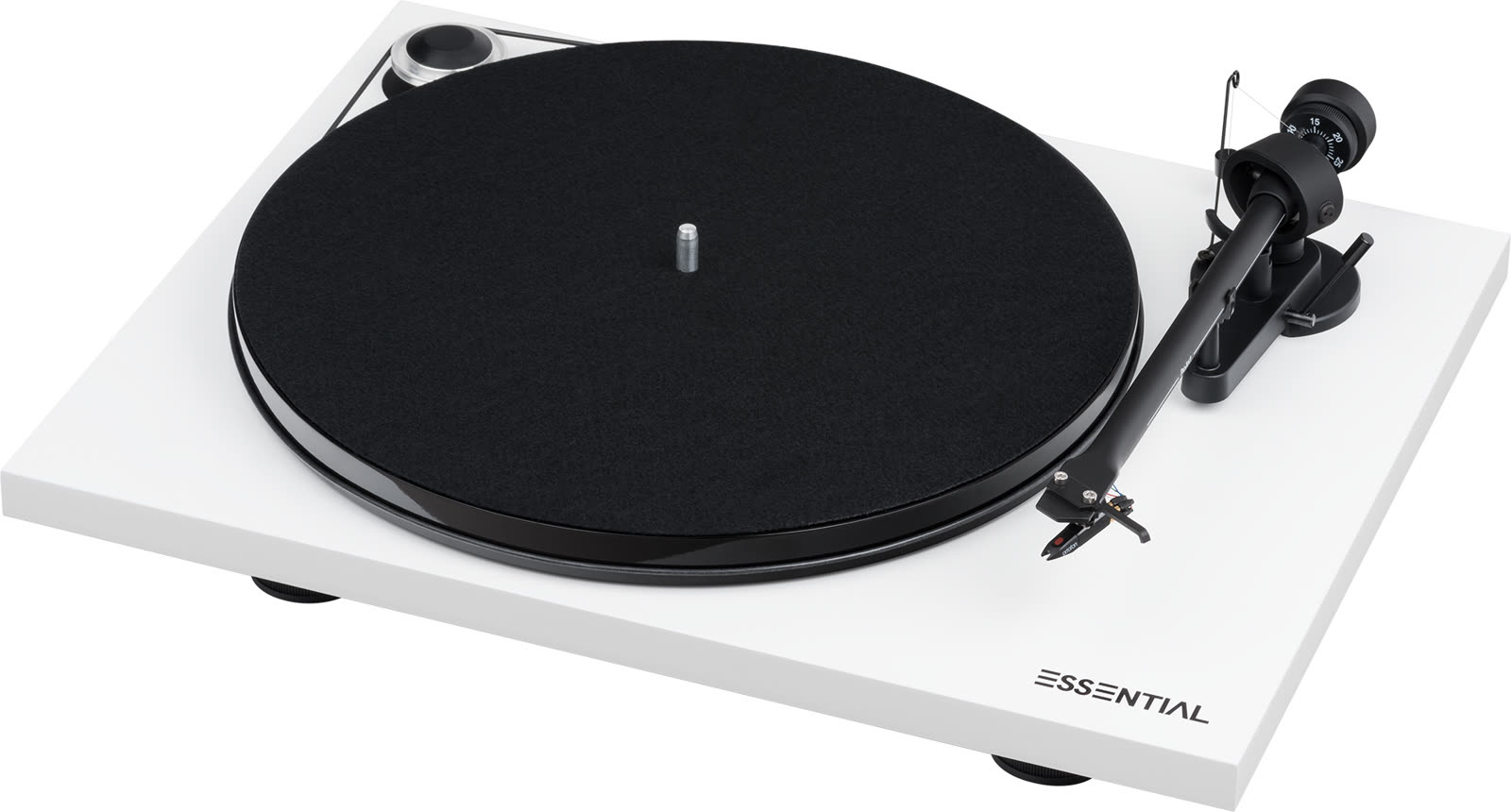
Summary
According to the specifications and the manufacturer's approach, the Essential III is the audiophile entry point to the Pro-Ject Flexi range: belt drive, a diamond-turned aluminium pulley, a resonance-optimised MDF platter and chassis, a pre-mounted Ortofon OM10, and the Connect it E tonearm cable included according to the manufacturer. Makes sense as a clear starter without a feature overload — less if you need USB/BT/integrated phono or electronic speed (to check variants SB/Phone/BT).
Assumptions
- Basic model without integrated phono (external MM stage)
- Series-OM10 as start; stylus/OM upgrade conceivable
- No listening log of our own
Technical data (public)
| Drive | Belt · Manual 33/45 switching |
|---|---|
| Speed | 33⅓ / 45 |
| Tonearm | 8.6″ Aluminium · eff. length 218.5 mm · eff. mass 8.0 g |
| Cartridges | Ortofon OM10 pre-assembled |
| Platter / chassis | 300 mm MDF platter (manufacturer) |
| Dimensions / weight | 415×112×335 mm (lid closed) · 5.0 kg |
| Phono / auto | No / No (basic model; variants exist) |
| Price guide | approx. €250–400 market price · MSRP often ~€359 · Sept 2026 |
Manufacturer specifications (Pro-Ject)
| Type | belt drive, manual speed change 33/45 (no longer listed by manufacturer) |
|---|---|
| Speeds | 33, 45 rpm |
| Wow & flutter | 33: 0.21% · 45: 0.19% |
| Speed variance | 33: 0.70% · 45: 0.60% |
| Platter | 300 mm MDF |
| Tonearm | 8.6″ aluminium, eff. length 218.5 mm, eff. mass 8.0 g, overhang 22 mm |
| Cartridge (fitted) | Ortofon OM10 |
| Power consumption | max. 4.5 W |
| Dimensions | 415 × 112 × 335 mm (lid closed) |
| Weight | 5.0 kg |
Source: Pro-Ject – official specifications · As of 16 October 2026 · subject to change by the manufacturer
Rating criteria in detail
The four criteria feed into the Vinyl BotPro Index with weights of 25/20/25/30. The index is scaled across all tiers (see Methodology); that is why we do not show individual sub-scores.
Strengths
- OM10 pre-assembled — known upgrade path
- Simple setup; Connect it E included (manufacturer)
- Clear audiophile entry role
- Flexi range variants if required (SB/Phono/BT)
Weaknesses
- No electronic speed on the basic model
- No integrated phono — external stage needed
- Placement & decoupling remain critical (assumption)
Comparison models
| Audio-Technica AT-LP120XUSB | Direct drive + Phono/USB — Feature contrast |
|---|---|
| Pro-Ject Debut Carbon EVO / Debut PRO | Next tier with more alignment/feature set |
| Teac TN-3B | Often more comfort (Phono/USB) in the entry+ |
System matching
Works well with
- Simple MM-Phono or integrated amplifier with Phono
- Compact active/bookshelf speakers
- Beginners who want to learn belts & manual speed
Less suited
- USB/BT/Auto-Stop Expectation on the Basic Model
- If you want Expert-level alignment reserve straight away → Debut PRO / Planar 3
Technology in detail
On the manufacturer's side, the Pro-Ject Essential III positions itself as the audiophile entry to the Flexi range: belt drive, manual 33/45 rpm selection by moving the belt (base model), a diamond-turned aluminium pulley, a resonance-optimised MDF chassis and platter, and a 8.6″ aluminium tonearm with an effective mass of around 8 g. An Ortofon OM10 comes pre-mounted as standard, a clear step up from the OM5e of earlier Essential generations. The Pro-Ject data sheet states wow & flutter of 0.21 %/0.19 % (33/45), speed variance 0.70 %/0.60 %, platter diameter 300 mm MDF, dimensions 415 × 112 × 335 mm (lid closed) and weight 5.0 kg. MSRP figures are often ~€359 incl. VAT; market prices are often approx. €250–400 (price as of Sept 2026, check regionally). Typically supplied with dust cover, felt mat and a Connect it E phono cable.
The basic model has no integrated phono stage and no electronic speed. The Flexi range, however, includes variants with phono stage, speed box (SB), Bluetooth, digital/optical output and RecordMaster/USB — the same basic mechanical idea, with other layers of comfort. Compared to lifestyle machines, the Essential III deliberately remains "HiFi-first: Setup requires Platter, belts, Counterweight and Anti-skating according to instructions. Reviews describe set-up as feasible in about half an hour, but not as strictly plug-and-play as the Rega Planar 1. High-gloss colours (black, white, red and others) dominate the look; foot decoupling is available, but the lightweight construction remains critical.
Setup & pairing: Pro-Ject Essential III
Placement
The Essential III has no suspended subchassis. So place it on a stable, level surface and not right next to or on top of a speaker, otherwise footfall and bass can reach the stylus.
Amplifier and speakers
The base model and the SB need a phono input or an external phono stage. The Phono, Bluetooth, Digital and RecordMaster versions connect directly to a line input or to active speakers. Matching pairs are listed in the best bookshelf speakers by budget.
Cartridge upgrade
Pro-Ject specifies around 8 g effective mass for the 8.6-inch arm and cartridges from 3 to 5.5 g. Before a swap, it is therefore worth checking the cartridge weight. Budget candidates are listed in the best cartridges under €100.
What the specialist press says
What Hi-Fi? gave the Essential III five stars in 2017 and describes good dynamics, lively treble on the bright side but never edgy, and an open soundstage; the deck feels light. In a direct comparison with the Rega Planar 1, the editors often see slight advantages in timing and organisation for the Rega, but expressly recommend listening to both; the acrylic-platter variant Essential III A is described as a worthwhile, audible upgrade. This is magazine consensus in an editorial reference system, not a VinylCination listening log and not a lab test.
The international specialist press sees the Essential III as a worthy continuation of the Essential line: carefully matched components and an energetic presentation with substance in bass and treble; the main criticism is that onboard phono only comes in more expensive variants. The manufacturer's spec PDFs and the FlexiRange coverage from international reviews underline the OM10, aluminium pulley, improved bearing and the DC-powered control of the synchronous motor as the core upgrades over the Essential II. The news situation around the Flexi range helps to tell the base model from the SB/phono/BT/digital variants — important so that buyers do not expect features that only sibling models provide.
The context draws on manufacturer documents (project-audio.com PDFs, setup guides) and the international reviews listed. The verdict of the specialist press is clear: lively, balanced, beginner-friendly; weaknesses are the missing features of the base model and the placement sensitivity of light MDF constructions.
Next to feature-rich decks like the Audio-Technica AT-LP5X, the Essential III looks purist: no USB, no direct drive, no 78 rpm, no switchable line stage. If you want the OM10 stylus route and the Pro-Ject ecosystem, stay with the Essential III sweet spot; if you are after comfort features, read the variant matrix before buying rather than being disappointed later.
Who is it for?
Arm
The 8.6″ aluminium arm with sapphire bearings (manufacturer’s specification) and the OM10 are tailored to an MM entry. Tracking force (VTF) and anti-skating must be set correctly — here starters learn basics that do not apply to planar 1. For an ambitious system change later, the Debut Carbon EVO or Debut PRO are suitable as a Premium step within the same brand family. Azimuth and VTA adjustment are limited within the Starter range; if you want maximum adjustment, plan the step up to the next tier.
Phono
External MM-Phono is mandatory on the basic model. Useful partners on a budget (guidance without listening claim): Pro-Ject Phono Box E or S2, Cambridge Alva Solo, iFi Zen Phono — always with an eye on MM loading and sensible connecting cables. The Essential III Phono variant or the T1 Phono SB are alternatives if a line-level output is desired. Avoid double phono stages (internal and external at the same time); check switch positions in the manuals.
Budget
As the Value-for-money Vinyl BotPro Champion in Starter (Index 53), the Essential III aims at maximum music per euro without feature inflation. Keep funds in reserve for phono stage and speakers; the acrylic platter (Acryl-it E / “A” variant) is an upgrade documented in reviews. Placement as decoupled as possible from loudspeakers and pedal sound. Those who often change 45s can offset SB variant or T1 Phono SB.
Upgrade
Stylus/OM path, Connect-it-Cable, Matte/Platter, later debut series. The Flexi range siblings cover SB, phono and Bluetooth versions without leaving the basic concept. If you want USB digitisation, choose the RecordMaster or AT-LP5X rather than the base model. The index gap to the Premium Pro-Jects is deliberate: the Essential remains in the Starter band.
The special features of this analysis
This AI analysis brings together manufacturer specifications, technical data and the verdicts of the specialist press in a compact assessment. It shows where the sources agree, which strengths come up again and again, and which system the product suits best. Prices as of Sept 2026.
Analysis: the Pro-Ject Essential III in depth
What this is: an AI analysis, not a listening test
This page brings together what can be established about the Pro-Ject Essential III from manufacturer documents and international reviews. Vinyl BotPro has neither listened to nor measured the turntable. Where sound is discussed, we paraphrase what named reviewers described under their own conditions. We explain technical relationships with general turntable knowledge and mark where a statement comes from the manufacturer and where it is our own interpretation. This analysis does not change the rating, rank or index: the Essential III remains at index 53, rank 2 in the Starter tier, and holds the Price/Performance Champion award.
A note on availability first: when we checked on 8 November 2026, the product pages for the Essential III and its variants on project-audio.com returned the status "410 Gone", meaning they have been removed [12]. The PDF spec sheets can still be downloaded [1][2]. Anyone looking for an Essential III today is therefore more likely to find remaining stock or a used unit. All prices in this section are historical manufacturer figures or dated press prices, not current market prices.
Background: successor to the Essential II
What Hi-Fi? reported the unveiling of the Essential III as the successor to the Essential II in October 2016 [11]. Its review of August 2017 lists the changes: an MDF chassis instead of chipboard, the Ortofon OM10 cartridge, a new pulley, revised bearings, improved motor electronics and a new grounding link [8]. In its spec sheet Pro-Ject lists an MDF chassis and a 300 mm MDF platter, a diamond-cut aluminium pulley, a low-tolerance bearing and a stainless-steel spindle [1].
The concept is deliberately simple: a manual belt drive with two speeds, a fixed tonearm, a pre-mounted cartridge and a dust cover. There is no automatic arm return, and the base model has no built-in phono stage. This reduction is exactly why the model is listed as Price/Performance Champion in our Starter tier: the budget goes into the parts that matter most for tracking the groove, not into features.
The variants, clearly separated
Several models were sold under the Essential III name. They share the mechanics but connect differently. In October 2017 What Hi-Fi? described the "FlexiRange" as variants that all share the MDF plinth and platter, decoupling feet, the aluminium tonearm and the OM 10 [10]. The differences according to the manufacturer's spec sheets, with the recommended retail prices in euros listed there (spec sheets are undated):
- Essential III: base model, speed change by hand at the pulley, no phono stage; RRP €359 [1].
- Essential III SB: with a built-in Speed Box for electronic switching between 33 and 45, also without a phono stage; RRP €379 [2].
- Essential III Phono: with a built-in MM phono stage and a switchable line or phono output; RRP €399 [4].
- Essential III Digital: with an optical digital output in addition to the switchable line/phono output; RRP €449 [5]. What Hi-Fi? gives 24-bit/96 kHz via an A/D converter for the optical output [10].
- Essential III BT: with a Bluetooth transmitter (aptX according to the spec sheet) and a range of about 10 m, plus line and phono outputs; RRP €449 [6].
- Essential III RecordMaster: with Speed Box, phono stage and a USB output for recording on a computer; RRP €499, weight 6.0 kg instead of 5.0 kg [7]. The setup guide gives up to 24-bit/192 kHz for USB recording and refers to recording software [3].
The setup guide also mentions a Headphone version with a headphone output [3]; we have not found a separate spec sheet for it. The Essential III A is a separate case: What Hi-Fi? describes it as the version with the Acryl-IT E acrylic platter, £40 more than the base model in the UK [8]. This analysis and the rating refer to the base model with an MDF platter and no phono stage.
Drive and speed
The Essential III uses belt drive with a synchronous motor and a silicone belt [1]. The motor sits beside the platter and drives a belt via the pulley that runs directly around the outer edge of the platter. The belt damps motor vibration before it reaches the platter. Pro-Ject also lists an integrated, DC-powered motor control, intended to improve speed stability and reduce motor vibration [1]. A note on terminology: our previous page said "DC motor control". The spec sheet describes a synchronous motor with DC-powered control electronics, not a DC motor. Louder writes of a DC motor [9]; we follow the manufacturer here.
On the base model the speed is changed by hand: according to the setup guide the belt sits on the small step of the pulley for 33 rpm and on the large step for 45 rpm [3]. This usually means lifting the platter off or carefully moving the belt across. 78 rpm is not supported. The SB and RecordMaster variants switch electronically [2][7].
The manufacturer's figures for wow and flutter are 0.21% (33) and 0.19% (45), with speed variance of 0.70% and 0.60% respectively [1]. The spec sheet does not state the weighting method used, so these values can only be compared with other manufacturers' figures to a limited extent. We have not measured them ourselves.
Platter and bearing
The platter is made of MDF and measures 300 mm [1]. It carries a felt mat, which the spec sheet lists as an accessory [1]. The sources disagree here: in 2017 What Hi-Fi? wrote that a mat is optional and none is included [8], while Louder mentions a felt mat in 2021 [9]. The spec sheet explicitly lists the felt mat as an accessory; the contents may have differed by market or batch. This cannot be confirmed.
Pro-Ject describes the main bearing as a precise, low-tolerance bearing with a stainless-steel spindle [1]. In its 2016 launch news, What Hi-Fi? mentioned a stainless-steel spindle in a bronze bushing with a Teflon bottom [11]. The same news item also mentioned an acrylic platter; that does not match the later spec sheet with its MDF platter and probably relates to the Essential III A. For the standard specification we rely on the spec sheet.
Tonearm and Ortofon OM10
The tonearm is an 8.6-inch aluminium arm with sapphire bearings [1]. Pro-Ject's key figures: effective length 218.5 mm, overhang 22 mm, effective mass 8.0 g, suitable cartridge weight 3 to 5.5 g, tracking force adjustable from 0 to 25 mN [1].
An effective mass of 8 g puts the arm in the light to lower-medium class. That matters for cartridge choice: the tonearm and the stylus compliance form a spring-mass system with a resonant frequency. A common rule of thumb is a range of about 8 to 12 Hz – low enough to stay out of the audible bass, high enough to keep clear of record warps and footfall. Light arms tend to suit cartridges with medium to higher compliance. This is general turntable engineering; apart from the OM10, the manufacturer does not name specific pairings for the Essential III. The 5.5 g weight limit rules out heavy cartridges anyway.
The Ortofon OM10 comes fitted from the factory [1]. Louder describes it as an upgrade over the OM5e with a finer stylus [9]. For a starter model the cartridge is a key point: Ortofon's OM system uses replaceable styli, so the stylus can be changed later without realigning the cartridge. We have not checked which replacement or upgrade styli are currently available, or at what price.
What comes in the box
According to the spec sheet, the Essential III comes with a power supply, the dust cover and the felt mat; the Connect it E tonearm cable is pre-mounted [1]. The setup guide lists an adapter for 7-inch singles, the anti-skating weight, the belt and the Connect it E in the accessory bag [3]. This corrects a wording on our previous page: on the base model, the cable is not "often" included but is part of the equipment according to the manufacturer [1][3].
A phono stage is not included. Anyone buying the base model or the SB needs an amplifier with an MM phono input or a separate phono preamp.
Setup step by step
The manufacturer's setup guide shows the process in pictures [3]. In summary:
- Remove the transport locks and protective inserts, put the platter on.
- Fit the belt: first around the pulley, then around the platter; small step for 33, large step for 45 rpm [3].
- Balance the tonearm until it floats level, set the counterweight scale to zero, then turn it to the required tracking force [3].
- Hang the anti-skating weight by its loop in the second groove [3].
- Connect the cable, fit the dust cover.
There is a discrepancy between the manufacturer's documents on tracking force: the setup guide gives a setting of 15 on the counterweight [3], while the spec sheet recommends 18 mN for the OM10 [1]. Ortofon publishes its own range for the OM10, which we have not verified here. If in doubt, measure with a stylus force gauge and follow the cartridge maker's figures.
What Hi-Fi? needed less than half an hour for setup, found the counterweight a little fiddly and the anti-skating thread fussy [8]. Louder gives 15 to 20 minutes and criticises the manual as poor [9]. According to Louder, the power switch sits underneath the unit [9].
Placement and decoupling
The Essential III stands on special decoupling feet [1]; Louder mentions three feet [9]. Fixed feet offer no levelling beyond the usual, so a level surface is important. A spirit level on the platter shows whether the furniture is giving way.
As a general rule for light belt-drive designs weighing 5 kg [1]: they react to footfall and to vibration from the speakers. A sturdy piece of furniture, ideally against a wall, is better than a springy shelf. Speakers are best not placed on the same furniture as the turntable. Otherwise, at high volume, acoustic feedback can occur and show up as boom in the bass. The dimensions are 415 × 112 × 335 mm, and 415 × 365 × 390 mm with the lid open [1] – the height with the lid open is worth allowing for in a shelf.
Phono stage and connections
A cartridge like the OM10 produces a very small signal, whose frequency response has to be equalised to the RIAA curve on playback. That is the job of the phono stage. On the base model and the SB it is not built in; the signal goes via the Connect it E to an MM phono input [1][2][3]. The Phono, Digital, BT and RecordMaster variants have a built-in stage and a switch between line and phono output [3][4][5][6][7]. In line mode they connect to any line-level input or to active speakers; in phono mode the internal stage is bypassed, so a better external stage remains an option later.
The Pro-Ject setup guide suggests pairings from its own Box Design range, including the MaiA S2 or Stereo Box S2 with Speaker Box 5 [3]. That is a manufacturer suggestion, not a requirement; any amplifier with an MM input will do. Louder regrets that the built-in phono stage costs extra [9].
What the reviewers describe
What Hi-Fi? gave five stars in its review of 16 August 2017; the UK price at the time was £240 [8]. It describes good dynamics, lively treble and a balance on the bright side that never becomes edgy. It highlights instrument placement, decent scale and an open soundstage [8]. Compared with the Rega Planar 1, the reviewers find the Rega slightly ahead on timing and a little fuller, and advise hearing both [8].
Louder reviewed the base model on 13 April 2021 [9]. Playing Dire Straits' "Brothers in Arms", the review describes energy, deep bass and detailed treble. Louder gives series entry prices from £249, $340 or €287, and £359 for the Phono version [9]. Louder also mentions a walnut finish; the spec sheet lists only high-gloss black, red and white [1][9].
These verdicts come from two publications at two different times, each with its own system. Our previous page said "the international specialist press" awards five stars; the five stars are documented only for What Hi-Fi? [8].
Upgrade path: acrylic platter and stylus
What Hi-Fi? also listened to the Essential III A with the Acryl-IT E platter and describes the sound as bigger and more open, with firmer bass [8]. In 2016 the platter was announced separately at £85 [11]. Whether retrofitting makes sense today depends on availability and price, which we have not checked. The second upgrade route is the OM system stylus; the third, a better external phono stage for the base model.
Care and maintenance
The Essential III needs little attention, but it needs it regularly. These tips are general practice, not manufacturer requirements:
- Stylus: clean with a soft brush from back to front before playing. A worn stylus damages records; its lifespan depends heavily on record care and tracking force.
- Belt: silicone belts age. If the platter takes longer to reach speed or the pitch wavers, it is time for a replacement. Avoid touching the belt with greasy fingers.
- Records: keep them clean; dust in the grooves is a main source of crackle.
- Dust cover: keep it closed or remove it while playing, but do not use it as a shelf for heavy objects.
Limits of the concept
The Essential III has clear limits that match its price: no 78 rpm, no automatic arm return, manual speed change and no phono stage on the base model, no height-adjustable tonearm for fine VTA work, and a light chassis that reacts to placement. Only the RecordMaster has a USB output for digitising [7]. Anyone looking for convenience will be better served by a fully automatic turntable; anyone who wants to digitise, by a variant with a USB output or a different model.
Place in the index
With index 53, the Essential III ranks second in the Starter tier. The Price/Performance Champion award reflects that its features are focused on tracking the groove: a decent tonearm, a well-known cartridge with a replaceable stylus and a stable basic construction. Whether it suits a particular household depends mainly on two questions: is there already a phono stage in the amplifier? And is the furniture stable enough? Both can be checked before buying. We do not give a buying recommendation without these conditions.
Sources for this analysis
- Pro-Ject: Essential III – Datenblatt / spec sheet (PDF). https://www.project-audio.com/wp-content/uploads/2018/03/EssentialIII-EN.pdf
- Pro-Ject: Essential III SB – Datenblatt / spec sheet (PDF). https://www.project-audio.com/wp-content/uploads/2018/03/EssentialIIISB-EN.pdf
- Pro-Ject: Setup Guide Essential III (PDF). https://www.project-audio.com/wp-content/uploads/2018/07/Setup-Guide-EIII-EN.pdf
- Pro-Ject: Essential III Phono – Datenblatt / spec sheet (PDF). https://www.project-audio.com/wp-content/uploads/2018/03/EssentialIIIPhono-EN.pdf
- Pro-Ject: Essential III Digital – Datenblatt / spec sheet (PDF). https://www.project-audio.com/wp-content/uploads/2018/03/EssentialIIIDigital-EN.pdf
- Pro-Ject: Essential III BT – Datenblatt / spec sheet (PDF). https://www.project-audio.com/wp-content/uploads/2018/07/EssentialIIIBT-EN.pdf
- Pro-Ject: Essential III RecordMaster – Datenblatt / spec sheet (PDF). https://www.project-audio.com/wp-content/uploads/2018/03/EssentialIIIRecordMaster-EN.pdf
- What Hi-Fi? (16.08.2017): Pro-Ject Essential III review. https://www.whathifi.com/pro-ject/essential-iii/review
- Louder (13.04.2021): Pro-Ject Essential III turntable review. https://www.loudersound.com/reviews/pro-ject-essential-iii-turntable
- What Hi-Fi? (25.10.2017): Pro-Ject builds Essential III turntable into feature-packed FlexiRange. https://www.whathifi.com/news/pro-ject-builds-essential-iii-turntable-feature-packed-flexirange
- What Hi-Fi? (26.10.2016): Pro-Ject unveils Essential III turntable. https://www.whathifi.com/news/pro-ject-unveils-essential-iii-turntable
- Pro-Ject: Produktseite Essential III / product page – HTTP 410, geprüft / checked 08.11.2026. https://www.project-audio.com/en/product/essential-iii/
Created by AI (Vinyl BotPro) from the sources listed; no listening tests or measurements of our own. Detailed human fact-check pending.
Frequently asked questions about the Pro-Ject Essential III
Is the Essential III the same as the Essential 3?
Yes. “Essential 3” is just another spelling; Pro-Ject writes the name with a Roman three.
Which versions of the Essential III are there?
Pro-Ject builds the Essential III as a FlexiRange: the base model with manual speed change, Phono with built-in phono stage, SB with push-button electronic speed change, Bluetooth with a wireless transmitter, Digital with optical output and RecordMaster with USB output. There is also the Essential III A with an acrylic platter. All share the chassis, the 8.6-inch aluminium arm and the Ortofon OM10.
Do I need a phono stage?
With the base model and the SB, yes – neither has a built-in phono stage. Phono, Bluetooth, Digital and RecordMaster have their own stage. External models are in the phono preamp top list.
How much does the Essential III cost?
In its data sheet, Pro-Ject lists an RRP of 359 € for the base model and 379 € for the SB, each including VAT. Street prices are often around 250–400 € (as of Sept. 2026, no guarantee).
Which cartridge is fitted, and is an upgrade worth it?
The Ortofon OM10 comes pre-fitted, recommended at 1.8 g tracking force. According to Pro-Ject, the arm has 8 g effective mass and suits cartridges weighing 3 to 5.5 g. The OM 10 has since been discontinued; recommended successor, with the calculation: Ortofon 2M Red on the Essential III. More on this: the best cartridges under 200 € (check the cartridge weight).
Essential III or Rega Planar 1?
One review often sees a slight timing advantage for the Rega Planar 1, but recommends listening to both. In our Starter tier, the Essential III is the value-for-money champion. For comparison: AI analysis Rega Planar 1.
Can I connect the Essential 3 directly to active speakers?
Only the versions with a built-in phono stage (Phono, Bluetooth, Digital, RecordMaster), or via an external phono stage. The base model and the SB output the weak phono signal without preamplification.
How the score comes about
The Vinyl BotPro Index is scaled across all tiers, 0–100. Starter typically sits at ~40–54. The Essential III receives 53 (rank 2): solid engineering/build, deliberately low features on the base model, good expected performance according to the magazine consensus and maximum value-for-money weighting (Value-for-Money Vinyl BotPro Champion in the tier). Weights according to the methodology: technology/build ~25, features ~20, performance (expected) ~25, value for money ~30. Champion badges are sub-score awards from research — no listening test. Details: Details on weighting · Methodology.
Created by Vinyl BotPro (AI) · As of Sept 2026 · Corrections: info@vinylcination.de
Sources
Read more: best turntables 2026 · What is hi-fi?