
Phono preamp · AI analysis · Expert, rank 9
Pro-Ject Phono Box DS3 B: Analysis
AI analysis (research): true balanced, discrete dual-mono MM/MC phono stage with XLR and RCA connections; based on the Pro-Ject data sheet and StereoNET.
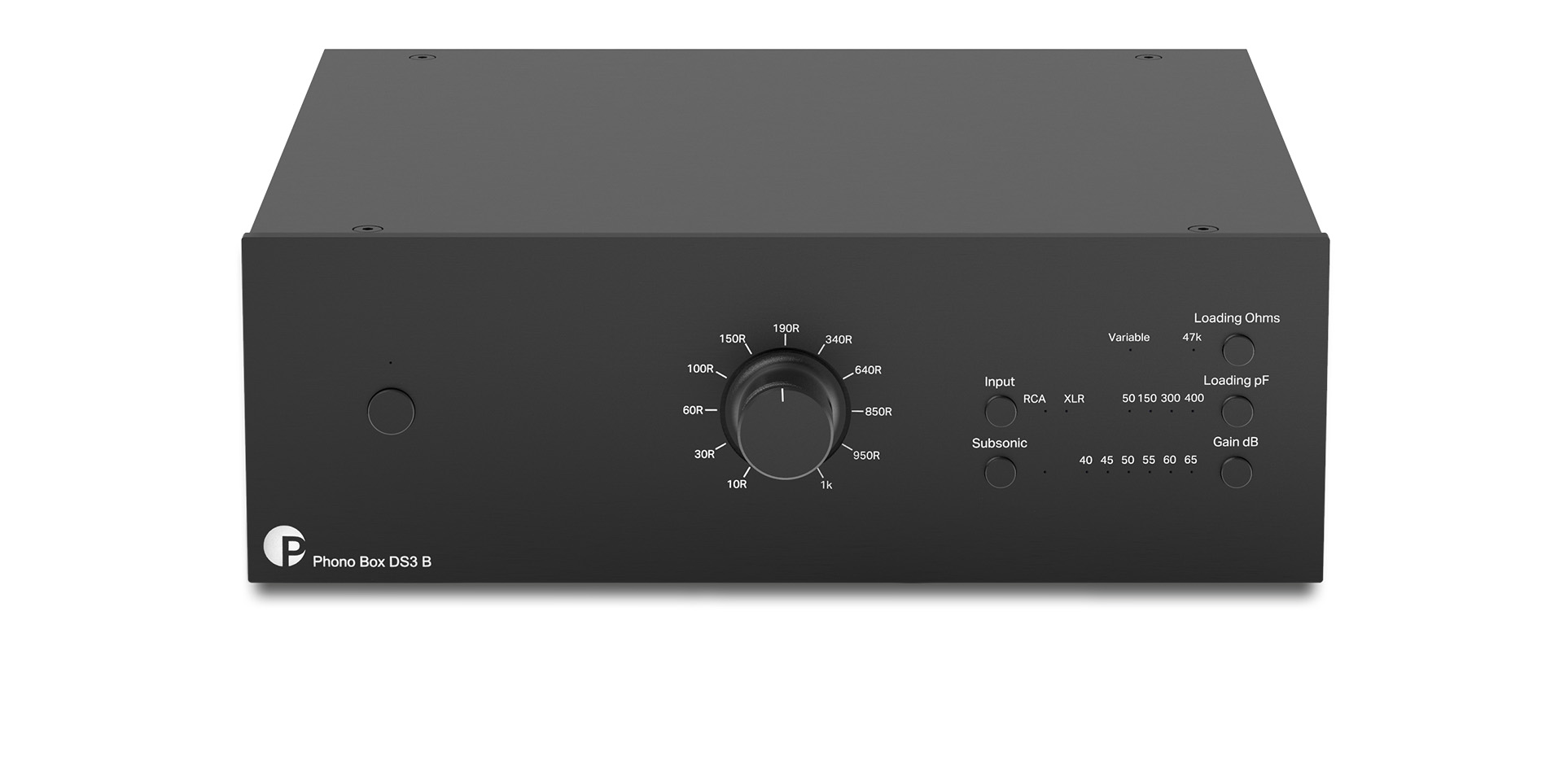
Summary
The Phono Box DS3 B (approx. 570–700 €, RRP 699 €) is a true balanced, discrete dual-mono MM/MC phono stage with 40 to 65 dB of gain and continuously adjustable MC loading. StereoNET (James Michael Hughes, 26 May 2022) praises the quietness and the gain in scale and detail via balanced connections.
Specs (public / manufacturer)
| Type | MM/MC · discrete · Symmetrical · Dual mono |
|---|---|
| Gain | 40 / 45 / 50 / 55 / 60 / 65 dB (+6 dB via XLR) |
| Load | continuously variable 10–1,000 Ω or fixed 47 kΩ |
| C | 50 / 150 / 300 / 400 pF |
| Signal-to-noise ratio | MM (40 dB): 104 dBV, 111 dBV A-weighted · MC (60 dB): 85 dBV, 91 dBV A-weighted |
| RIAA accuracy | < 0.25 dB (20 Hz–20 kHz) |
| I/O | Mini-XLR + XLR + RCA in · RCA + XLR out |
| Dimensions / weight | 206 × 72 × 194 (205) mm · 1,480 g without power supply |
| Price guide | approx. €570–700 · MSRP €699 · Sept 2026 |
Manufacturer specifications (Pro-Ject)
| Type | MM/MC phono preamp, balanced and discrete throughout, dual mono |
|---|---|
| Gain factor | 40 / 45 / 50 / 55 / 60 / 65 dB (+6 dB via XLR) |
| Input impedance/capacitance | continuously 10–1,000 Ω or fixed 47 kΩ · 50 / 150 / 300 / 400 pF |
| Signal-to-noise ratio | MM (40 dB): 104 dBV, 111 dBV A-weighted · MC (60 dB): 85 dBV, 91 dBV A-weighted |
| Distortion | 1 kHz: < 0.001% MM, < 0.004% MC · 20 Hz–20 kHz: < 0.005% MM, < 0.01% MC |
| RIAA accuracy | < 0.25 dB (20 Hz–20 kHz) |
| Power consumption | 18 V / max. 290 mA DC, < 0.5 W standby |
| Dimensions | 206 × 72 × 194 (205) mm |
| Weight | 1,480 g without PSU |
Source: Pro-Ject – official specifications · As of 16 October 2026 · subject to change by the manufacturer
Matching tips
- Fits: MM and MC cartridges with variable loading
- Fits: Turntables with a balanced tonearm cable
- Good fit: Amplifiers with XLR input
- Less suited: Very small racks
- Less suited: Listeners looking for a valve phono stage
Technology in detail
Pro-Ject builds the Phono Box DS3 B as a true balanced, discrete design without integrated amplifier chips in the signal path, in dual-mono form with separate circuits for each channel.
Inputs are RCA plus balanced XLR and mini-XLR; outputs are RCA and XLR. Gain ranges from 40 to 65 dB in six steps, with an extra 6 dB at the XLR output. The load can be set continuously between 10 and 1,000 Ω or fixed at 47 kΩ, and the capacitance to 50, 150, 300 or 400 pF.
According to the data sheet, the signal-to-noise ratio is 104 dBV (MM, 40 dB) and 85 dBV (MC, 60 dB), or 111 and 91 dBV A-weighted. Distortion at 1 kHz stays below 0.001 % (MM) and 0.004 % (MC), and RIAA accuracy is better than 0.25 dB. The unit weighs 1,480 g and runs from an external 18 V power supply.
What the specialist press says
James Michael Hughes (May 2022, 8.5/10 together with the X8 turntable) praises how quiet it is and how flexible the settings are. Over balanced connections the sound becomes bigger, more dynamic and more detailed, yet it is clear and open unbalanced too; his verdict: high-end vinyl sound at a surprisingly reasonable price.
Analysis: Pro-Ject Phono Box DS3 B in detail
Scope and sources
This analysis adds manufacturer data and one dated, independent listening report to the short overview above for the Pro-Ject Phono Box DS3 B. Vinyl BotPro compiled it from the sources named here; VinylCination has not listened to this unit and has not measured it. The basis is Pro-Ject’s official product page (retrieved 12 November 2026) [1] and James Michael Hughes’s listening report on StereoNET, dated 26 May 2022 [2].
StereoNET meets the test of an international, independent listening report. The article is a combined review of the Pro-Ject X8 turntable and the Phono Box DS3 B. For this analysis only the passages in which Hughes actually listens to the DS3 B count: first unbalanced, then via the XLR output, then with a balanced arm cable, each time into an Elipson PF1, with an Ortofon Quintet Blue. Remarks on the X8’s bearing, platter, arm play or plinth are findings about the turntable, not about the phono stage. The Tube Box DS3 B is a different product and does not inherit this report. Manufacturer copy that advertises an in-house listening trial does not count. Forums are left aside.
Place in the range
The Phono Box DS3 B is Pro-Ject’s true-balanced, discrete dual-mono MM/MC stage in the DS line, with RCA and XLR paths and the option to connect two turntables at once. It sits above the compact S boxes and alongside the valve-equipped Tube Box DS3 B, which shares only the name. In our list it is the Value-for-Money champion in the Expert band (index 74, rank 9). That champion label is an AI assessment from the sources in front of us, not a listening session of our own.
Hughes, in 2022, places the box in the context of Pro-Ject’s “True Balanced Connection”: the promise of lower noise, less interference and more detail and dynamics along a balanced path from the cartridge to the output. That is the framing of the report and of the product page, not a measurement protocol of this analysis. The UK price at the time was £529; the existing page note quotes around €570–€700 at an MSRP of €699 (as of September 2026). Those figures describe the same box in different years and currency areas.
Case, connections and use
The product page describes a steel and aluminium case, dimensions of 206 × 72 × 194 mm (205 mm deep with sockets) and a weight of 1,480 g. Magnetic wooden side panels are optional. Power is 18 V; a trigger is provided. Inputs are mini-XLR, XLR and RCA, outputs RCA and XLR [1]. Hughes notes that two turntables can be connected — one balanced on XLR, one unbalanced on RCA — and that the stage remembers the settings for each input [2].
That second input with memory is what separates the DS3 B from the Phono Box S2 Ultra in the same list family: the Ultra remains a single RCA socket in the S case. That is a feature difference, not a listening comparison we have made ourselves. Load and gain are set on the DS box itself, not under an S-line floor. The existing strength and weakness lines on this page are left untouched as score graphics.
Gain, loading and manufacturer data
Pro-Ject describes a discrete, fully balanced dual-mono gain stage with a split passive RIAA. MC loading is continuous from 10 Ω to 1,000 Ω, or fixed at 47 kΩ; capacitance is 50, 150, 300 or 400 pF; gain is 40 to 65 dB, plus 6 dB at the XLR output. Signal-to-noise is quoted as 104 dB or 111 dB (A, MM) and 85 dB or 91 dB (A, MC), the subsonic filter as 18 dB/octave at 20 Hz [1]. Hughes restates distortion typically below 0.005 % and 0.01 % at worst, RIAA accuracy of 0.25 dB from 20 Hz to 20 kHz, and noise of −104 dBV at 40 dB (MM) and −85 dBV at 60 dB (MC); there is no hum, and the stage is exceptionally quiet [2]. These are restated manufacturer and report figures, not measurements of our own. The existing table is left unchanged.
On the gain steps, Hughes’s list (40, 45, 50, 55, 60 dB) visibly differs from the product-page span of 40 to 65 dB plus 6 dB at XLR. We record the difference, do not change the table, and have not counted the switches ourselves. The continuous 10-to-1,000 Ω control is the practical difference from the fixed impedance grids of the smaller S boxes; typical MM cartridges stay at 47 kΩ and one of the capacitance settings, typical low-output MCs in the lower part of the pot and the higher gain steps. The extra 6 dB at the XLR output is something Hughes later heard as a level and character difference, not only as a data-sheet line.
What the specialist press heard
Hughes did not listen to the DS3 B on an isolated lab bench. He heard it after the X8, which in the UK arrived with an Ortofon Quintet Blue. The preamp was an Elipson PF1, whose own phono stage he used first as a reference — just as he had previously heard a much dearer Vertere turntable into that same PF1 phono stage. Remarks about the X8 versus the Vertere, about bearing noise, platter flatness or arm play belong to the turntable part of the article and are not repeated here as attributes of the DS3 B [2].
Only after he had a clear idea of the X8 into the Elipson phono stage did Hughes introduce the DS3 B. Unbalanced, the stage sounded clear, open and detailed, on a par with the Elipson’s own phono stage — the text says “Epsilon” at one point; the preamp in question is clearly the Elipson PF1. He then took the DS3 B’s balanced output into the PF1’s balanced line input on Chord cables with three-pin XLRs at both ends. That produced the expected 6 dB rise in output and a bigger, more dynamic sound with much greater breadth and depth. Using the Elipson’s 0.5 dB volume steps he matched levels; subjectively the balanced path still seemed a tad louder, but it was not — it simply sounded more assertive and dynamic [2].
Next he replaced the unbalanced arm cable (RCA plugs) with the balanced XLR option. That brought a further 3 dB of level and still more transparency and fine detail. The music projected strongly against an even quieter, more inky-black silent background. On “Jeep Blues” from “Jazz at the Pawn Shop” he heard an impressive contrast between the quieter, more introspective sections and the powerful projection of the saxophone solo, which seemed to come out of nowhere from that inky-black background. The gain in clarity, separation and overall refinement was not subtle. With the DS3 B in and the path fully balanced, the X8 went, for him, from sounding very good to outstanding; subjectively he was now listening to a much better vinyl spinner — one that might have cost three times as much. Balanced operation also, to his ear, improved bass quality in depth, clarity and dynamics [2].
As an example he names the double bass on Elles Springer’s “Reveal”: via unbalanced cables it had seemed a bit ill-focused and muddy. An acoustic double bass gives a warmer, looser bottom end than a bass guitar, possibly at the expense of firmness and control; going fully balanced brought focus there, and other material also sounded cleaner and crisper. That is a finding about the DS3 B in this chain — X8, Quintet Blue, Elipson PF1 — not a general promise that XLR will rescue every unbalanced setup. Hughes’s closing remarks apply to the X8 and DS3 B package, especially when the balanced paths are used; he does not issue a standalone award for the phono stage alone, and we do not invent one.
Setup, cartridges and system
Anyone who wants to hear the DS3 B as Hughes describes it needs more than the box: a balanced path, either at least the XLR output into a balanced line input, or a balanced arm cable as well. The second step in his report presupposed a turntable that actually offers XLR at the arm — the X8 did; many starter decks do not. An unbalanced connection remains available and already sounded clear and detailed to him; the gain he describes sits in the two balanced steps.
The Quintet Blue is a low-output MC at 0.5 mV in his account. The DS3 B’s grid also covers MM; he does not write out an MM listening session in this article. Two turntables can be connected at once, with independently stored settings — useful if, for example, one deck is MM and the other MC, without having to throw the switches each time. The optional wooden side panels change the mass and the look of the case; they are not a separate sonic variable in the report. The 18 V supply should be kept away from the signal path. A valve stage of this width is the Tube Box DS3 B, not this transistor box.
The existing short overview already mentions the quietness and the gain in scale and detail via balanced connections; Hughes is the named source for that claim. It is worth repeating that he level-matched the 6 dB XLR step and still heard more assertiveness, then heard a further, not-subtle jump once the arm cable was balanced as well. Anyone comparing a DS3 B in a shop on RCA leads only is not hearing the configuration that carries most of his enthusiasm. Conversely, anyone who already has a balanced arm and a balanced line input is closer to the chain he used, provided the cartridge and gain setting are in the same region as the Quintet Blue.
Price and availability
The existing page note quotes around €570–€700 at an MSRP of €699 (as of September 2026, without guarantee). Hughes quoted £529 in 2022. The gap is a matter of exchange rates, distribution and the years in between, not a silent successor. Whether the box is still the obvious choice in today’s DS family has to be checked against the current price and the exact model name: “DS3 B” is not “Tube Box DS3 B” and not “Phono Box S3 B”.
In our list it is the Expert Value-for-Money champion. That follows from the sources and from the one secured international listening text, not from a group comparison we have not heard ourselves. The existing comparison table on this page places other boxes alongside it; those are overview rows, not extra listening sources. An Applause award, if it is attached to the combined X8-plus-DS3 B report, is not treated here as a standalone award for this phono stage.
What we are not using
Remarks on the X8’s bearing, platter, arm and plinth are not a listening report on the DS3 B. The Tube Box DS3 B, the S3 B, the S2 Ultra and older DS2 stages are different products. Manufacturer pages that advertise an in-house listening trial do not count as an independent international listening report. German texts on their own would not meet the rule; they are not used here as a second pillar. Forums are left aside. There is no in-house track list and no measurement. We read the “Epsilon” name in the StereoNET text as the Elipson PF1.
Nor do we carry Hughes’s general explanation of balanced lines — an extra 3 dB of gain in a power amplifier, rejected common-mode interference, a subjectively more powerful sound — over as a measured property of this box. In his article those sentences are preparation; what he heard on the DS3 B is the concrete path from RCA output to XLR output and on to a balanced arm cable, on a named chain. Only that path carries the sound claims in this analysis.
Conclusion of this analysis
The sources portray the Pro-Ject Phono Box DS3 B as a discrete, balanced dual-mono MM/MC stage with 40 to 65 dB of gain plus 6 dB at XLR, continuous MC loading from 10 Ω to 1,000 Ω, capacitance from 50 to 400 pF, RCA and XLR paths for two turntables, and an 18 V supply — according to the product page and the existing table [1]. StereoNET (James Michael Hughes, 26 May 2022) describes, on a Pro-Ject X8 with an Ortofon Quintet Blue and an Elipson PF1, a stage that is already clear and open unbalanced, grows bigger and more dynamic via the XLR output, and gains transparency, a blacker background and tighter bass focus with a balanced arm cable; among the records heard were “Jazz at the Pawn Shop” and Elles Springer’s “Reveal”. The conclusion applies to the pairing with the X8, not to an isolated lab stage [2]. In our list the unit is the Expert Value-for-Money champion — an AI assessment from the sources in front of us, not a listening report of our own.
Sources for this analysis
- Pro-Ject: Phono Box DS3 B, product page (retrieved 12 November 2026). https://www.project-audio.com/en/product/phono-box-ds3-b/
- StereoNET: James Michael Hughes – Pro-Ject X8 Turntable and DS3 B Phono Box Review (26 May 2022). https://www.stereonet.com/reviews/pro-ject-x8-turntable-and-ds3-b-phono-box-review
Created by AI (Vinyl BotPro) from the sources named; no in-house listening tests or measurements. Detailed human fact-checking pending.
Who is it for?
For vinyl listeners looking for a flexible MM/MC phono stage who want to connect their turntable or amplifier over balanced lines.
What makes this AI analysis special
This AI analysis combines Pro-Ject’s technical data sheet with a review from the international specialist press. All technical values are manufacturer figures. As of October 2026.
How the score comes about
The Index reflects the true balanced, discrete dual-mono design, the flexible settings, the very good data-sheet figures and the very good review; on value it leads its tier. The Vinyl BotPro Index on this page remains 74 (Expert, rank 9) — guidance from manufacturer data and the specialist press, no in-house listening session. The four criteria engineering/build, features, expected performance and value for money are weighted 25/20/25/30 and scaled across all tiers. Methodology
Sources
- Pro-Ject, Phono Box DS3 B data sheet (PDF)
- Pro-Ject, Phono Box DS3 B product page
- StereoNET, Pro-Ject X8 and DS3 B review
Vinyl BotPro Index: 74 (Expert 70–84) · Label: AI research · Sept 2026
Read more: best phono preamps 2026 · What is hi-fi?