
Phono preamp · AI analysis · Premium, rank 8
Pro-Ject Phono Box S2 Ultra: Analysis
AI analysis (research): compact MM/MC phono stage with four gain settings, adjustable loading and a subsonic filter; based on the Pro-Ject data sheet and Hi-Fi Choice.
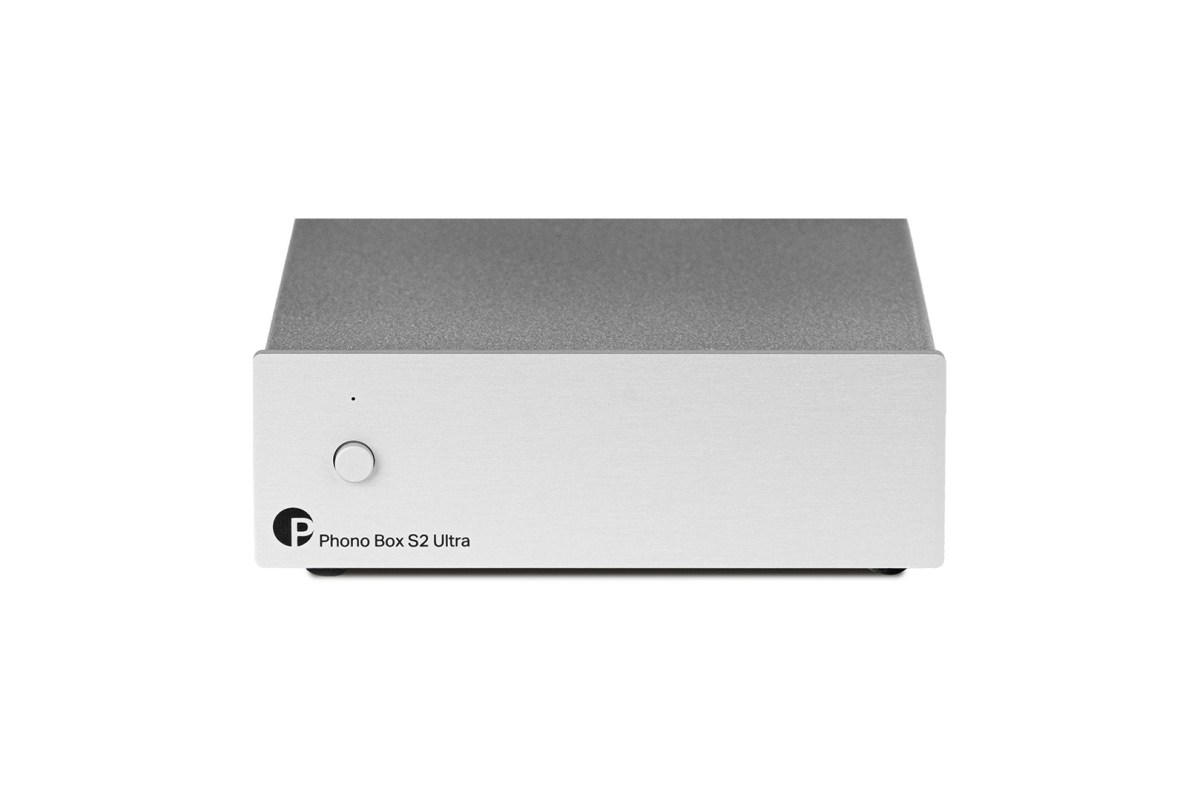
Summary
The Phono Box S2 Ultra (approx. 230–260 €) is a compact MM/MC phono stage with 40, 43, 60 or 63 dB of gain, a load from 10 Ω to 47 kΩ, 100 or 220 pF and a switchable subsonic filter. Hi-Fi Choice (Ed Selley, June 2019, Issue 450) praises the calm, natural sound with MM cartridges; with low-output MC cartridges it is audibly noisier.
Specs (public / manufacturer)
| Type | MM/MC phono preamp |
|---|---|
| Gain | 40 / 43 / 60 / 63 dB |
| Load/C | 10 / 100 / 1k / 47k Ω · 100 / 220 pF |
| Signal-to-noise ratio | −89 dBV (MM) |
| Total harmonic distortion | 0.00052 % |
| RIAA accuracy | < 0.4 dB (20 Hz–20 kHz) |
| Subsonic | −18 dB at 20 Hz (switchable) |
| Dimensions / weight | 103 × 37 × 119 mm (B × H × T) · 570 g without power supply |
| Price guide | approx. €230–260 · Sept 2026 |
Manufacturer specifications (Pro-Ject)
| Type | MM/MC phono preamp |
|---|---|
| Gain factor | 40 / 43 / 60 / 63 dB |
| Input impedance/capacitance | 10 / 100 / 1k / 47k Ω · 100 / 220 pF |
| Signal-to-noise ratio | −89 dBV (MM) |
| Distortion | 0.00052% |
| RIAA accuracy | < 0.4 dB (20 Hz–20 kHz) |
| Subsonic | −18 dB at 20 Hz (switchable) |
| Power consumption | 18 V / 80 mA (18 V DC / 500 mA PSU) |
| Dimensions | 103 × 37 × 119 mm (W × H × D) |
| Weight | 570 g without PSU |
Source: Pro-Ject – official specifications · As of 16 October 2026 · subject to change by the manufacturer
Matching tips
- Fits: MM cartridges
- Fits: Higher-output MC cartridges
- Fits: Small racks and sideboards
- Less suited: Very low-output MC cartridges
- Less suited: Frequent changes of settings (DIP switches underneath)
Technology in detail
Pro-Ject builds the Phono Box S2 Ultra into a small metal case measuring 103 × 37 × 119 mm. It handles MM and MC cartridges; settings are made with DIP switches on the underside.
Gain can be set to 40, 43, 60 or 63 dB, the load to 10 Ω, 100 Ω, 1 kΩ or 47 kΩ and the capacitance to 100 or 220 pF. A subsonic filter with −18 dB at 20 Hz can be switched in.
According to the data sheet, the signal-to-noise ratio is −89 dBV (MM), distortion is 0.00052 % and RIAA accuracy is better than 0.4 dB between 20 Hz and 20 kHz. An external 18 V power supply provides the power; the unit weighs 570 g.
What the specialist press says
Hi-Fi Choice (Ed Selley, June 2019, Issue 450) finds the S2 Ultra highly competitive with MM cartridges and praises its quiet, warm and natural sound with good dynamics as well as the solid metal case. With low-output MC cartridges at 60 dB of gain, noise becomes audible, and the DIP switches are a little fiddly.
Analysis: Pro-Ject Phono Box S2 Ultra in detail
Scope and sources
This analysis adds manufacturer data and one dated, independent listening report to the short overview above for the Pro-Ject Phono Box S2 Ultra. Vinyl BotPro compiled it from the sources named here; VinylCination has not listened to this unit and has not measured it. The basis is Pro-Ject’s official product page (retrieved 12 November 2026) [1] and Ed Selley’s listening report in Hi-Fi Choice, Issue 450 (June 2019), published online with datePublished 18 November 2019, signed “ES” and named on Pro-Ject’s review index [2].
Hi-Fi Choice meets the test of an international, independent listening report: Selley names the playback chain, describes MM and MC use with specific records, and ends with a clearly graded conclusion. The text is about the Phono Box S2 Ultra, not the Phono Box S2, the S3 or the S3 B. Reports on those sister models do not count as a listening report on this box. A What Hi-Fi? announcement without a full listening write-up does not count either. Forums are left aside.
Place in the range
The Phono Box S2 Ultra is Pro-Ject’s compact MM/MC stage in the S line, in a discrete circuit without op-amps, with a split RIAA equalisation and an external wall-wart supply. It shares the small S case with the Phono Box S2, but it is a different product: the Ultra puts the discrete layout and polystyrene capacitors forward, while the S2 remains a separate model with its own source trail. A listening report on the S2 is not a listening report on the Ultra, and vice versa. In our list the S2 Ultra is the Value-for-Money champion in the Premium band (index 61, rank 8). That champion label is an AI assessment from the sources in front of us, not a listening session of our own.
In 2019 Selley placed the box as the successor to larger DS and DS+ units, which Pro-Ject had replaced with a smaller, simpler device with switchable loading and gain. That is the reviewer’s framing, not a claim about later S3 or DS3 models. The existing page note quotes around €230–€260; Selley quoted a UK price of £200 in 2019. Those figures describe the same box in different years and currency areas, not two products.
Case, connections and use
The product page lists dimensions of 103 × 37 × 119 mm and a weight of 570 g without the power supply, in silver or black [1]. Hi-Fi Choice’s details table repeats this as “570 kg”, an obvious typesetting error in the magazine, not a second measurement. We follow the manufacturer figure of 570 g and leave the existing data table on this page unchanged. Selley describes all-metal casework that feels unusually solid at the price, a power button, and a grounding post large enough to take the spade terminations from his turntable. The supply is an external wall-wart; Selley expects that to keep noise down compared with housing the supply in the same case. Loading and gain adjustments sit on the underside of the chassis [2].
Connections are one RCA input and one RCA output, plus the 18 V inlet. The product page quotes 18 V / 80 mA at the unit and a supplied 18 V / 500 mA wall-wart [1]. There is no second input, no balanced output, no USB socket and no trigger. The existing weakness line on this page, that the DIP switches under the floor are a little fiddly, follows exactly this layout and is left untouched as a score graphic. Anyone who changes load or gain has to lift or turn the box; that is the format, not a handling error in Selley’s report.
Gain, loading and manufacturer data
Pro-Ject describes a fully discrete circuit without op-amps, polystyrene capacitors and a split passive RIAA equalisation. Impedance is offered at 10 Ω, 100 Ω, 1 kΩ and 47 kΩ, capacitance at 100 or 220 pF, and gain at 40, 43, 60 or 63 dB. A subsonic filter is specified at −18 dB at 20 Hz, signal-to-noise at 89 dB (A, MM, as a voltage figure in the table), THD at 0.00052 %, and RIAA deviation at less than 0.4 dB [1]. These are manufacturer figures. We have not re-measured them and we do not change the existing table.
Typical MM cartridges stay at 40 or 43 dB, 47 kΩ and one of the two capacitance settings. Low-output MCs move to the 60 or 63 dB steps and the low impedance grid. Selley took exactly that step with the Goldring Ethos and heard the cost of the higher gain: at 60 dB, noise crept in at idle and in quiet passages. That is a listening finding with this cartridge, not a rebuttal of the 89 dB MM figure. The four impedance values and two capacitance values remain a coarse but usable grid for the class; there is no continuous MC potentiometer of the kind fitted to the DS3 B.
What the specialist press heard
Selley listened to the S2 Ultra on a Michell GyroDec with an SME M2-9 arm. He started in MM mode with an Audio-Technica AT-VM95SH — Hi-Fi Choice prints “ATM-VM95SH” at this point, an obvious typo; the cartridge is the AT-VM95SH, cross-referred to issue 446. At idle the stage was commendably quiet; unwanted noise crept in only when he raised the level to a bombastic setting. That quiet floor, Selley writes, gives the dynamics the space they need, and the results were extremely impressive [2].
The heavyweight electronica of Chvrches’ “Every Open Eye” sounded big and confident. The S2 Ultra supplied the headroom for the punchy “Leave A Trace” to keep its impact and scale. Lauren Mayberry’s vocals were well defined, and the ideal of a warm, harmonious sound was reached without the performance feeling soft or sluggish. On the slower, more considered Fink album “Sunday Night Blues Club Vol. 1” the results remained extremely impressive: instruments showed a consistently believable tonal quality and a natural decay, the stage was commendably resistant to amplifying surface noise, and those factors together meant he listened to the music recorded on the record rather than to the record itself [2].
Switching to a Nagaoka MP-200 priced around £350 — HFC issue 434 in their numbering — suggested to Selley that the stage can work with moving-magnet designs that comfortably cost more than it does; the cartridge’s sweetness was convincingly reproduced. Moving up to Goldring’s £895 Ethos moving coil is where the limits show. The 60 dB gain setting allows some noise to creep in during idle and quiet passages, enough to become a faint distraction with some music. The news is not all bad: the way the Ethos captures the emotional content of the vinyl is beautifully realised. Nick Drake’s “Pink Moon” sounded wonderfully intimate and lifelike, again helped by the Pro-Ject’s ability to make voices and instruments sound highly natural and convincing [2].
In conclusion the S2 Ultra, for Selley, puts in a respectable performance with MC cartridges, but judged predominantly as a moving-magnet option it is very competitive indeed. A consistently impressive performance and the ability to handle upmarket cartridges made it, in 2019, a flexible and attractive stage that deserved to be high on any audition shortlist at the price. That is a dated finding on a GyroDec, an SME M2-9 and three specific cartridges in Britain in 2019, not a guarantee for every turntable and not a listening session of our own.
Setup, cartridges and system
Selley’s chain was not a starter turntable, but a Michell GyroDec with an SME arm. The quiet MM behaviour and the headroom for Chvrches were therefore heard on a fully grown deck, not on a packaged player with a bundled cartridge. Conversely, the MP-200 shows that the stage does not immediately limit dearer MM designs; the Ethos shows that a quiet, expensive low-output MC at 60 dB costs some of that quiet background. Anyone planning to use such an MC should take that passage seriously and not read the MM quietness as an MC promise.
The DIP switches under the floor need clearance underneath, or the box has to be lifted. The external 18 V supply should be kept away from the RCA path. Two turntables at once, a balanced output or a headphone socket are not provided; the DS3 B is the other, dearer design in the same list for that job. We have not listened to the S2 Ultra and the DS3 B against each other. Shop comparisons do not replace that. There is no USB recorder; anyone who wants to digitise needs a different unit.
Price and availability
The existing page note quotes around €230–€260 (as of September 2026, without guarantee). Selley quoted £200 in 2019. The shift is a matter of exchange rates, distribution and the years in between, not a silent successor model. Whether the box is still the obvious choice in today’s S and DS family has to be checked against the current price and the exact model name on the carton and the case. The Ultra remains the discrete-circuit unit in the small S case; an S3 or S3 B does not inherit this listening report.
In our list it is the Premium Value-for-Money champion. That follows from the sources and from the one secured international listening text, not from a group comparison we have not heard ourselves. The existing comparison table on this page places other boxes alongside it; those are overview rows, not extra listening sources.
The existing short overview on this page already lists the four gain steps, the load from 10 Ω to 47 kΩ, 100 or 220 pF and the switchable subsonic filter. That is the grid Selley used, without logging every switch position for every title. The subsonic figure of −18 dB at 20 Hz is a manufacturer rating; Selley emphasises the quiet MM idle and the low amplification of surface noise, not a filter curve of his own. Switching the filter in changes the deep bass on purpose — that follows from the specification, but it is not a separately heard A/B trial in the report.
A word on the boundary with the Phono Box S2, which appears in the same list family as a separate product. Both share the S form factor and the idea of a compact MM/MC stage with an external supply. The Ultra, on the product page, rests its name on a discrete circuit, polystyrene capacitors and a split RIAA; the S2 has its own source trail, heard by StereoNET in 2019. This analysis does not lean on that S2 text and does not carry sound attributes from one box to the other. Anyone who finds both names in the shops should compare the carton and the front badge: the “Ultra” suffix is the SKU boundary here, not a feature pack on the same board.
Selley’s closing remark, that in 2019 the stage deserved a high place on an audition shortlist at £200, is a time-bound editorial judgement, not a market guarantee today. The issue’s UK distribution line names Henley Audio; that is a 2019 contact, not an extra listening source and not a dealer comparison. What remains is the core of the report: on a GyroDec with an SME M2-9, the S2 Ultra was quiet, warm and natural in MM use, with headroom and believable instruments, and it supported a dearer MM, while a quiet MC at 60 dB gave up some of that quiet floor. That grading — strong as an MM stage, respectable as an MC stage — is what to take from the text, not a blanket fitness for every low-output cartridge.
What we are not using
Listening reports on the Phono Box S2, the S3, the S3 B, the DS2 or the Mini are not a substitute for a report on the Phono Box S2 Ultra. A What Hi-Fi? announcement without a full listening write-up does not count as an international listening report. German texts on their own would not meet the rule; they are not used here as a second pillar. Forums are left aside. Hi-Fi World (Martin Pipe, April 2019) appears on Pro-Ject’s index as a further pointer, but was not used as a primary, page-fetched listening source for this analysis. There is no in-house track list and no measurement. We silently correct the “570 kg” typesetting error in the HFC table and the “ATM-VM95SH” typo in the write-up, without touching the live data table.
Conclusion of this analysis
The sources portray the Pro-Ject Phono Box S2 Ultra as a compact, discrete MM/MC stage without op-amps, with 40 to 63 dB of gain, a load from 10 Ω to 47 kΩ, 100 or 220 pF, a subsonic filter at −18 dB at 20 Hz, and an external 18 V supply — according to the product page and the existing table [1]. Hi-Fi Choice (Ed Selley, June 2019, Issue 450) describes, on a Michell GyroDec with an SME M2-9, a stage that is quiet, warm and natural in MM use, with headroom for Chvrches and Fink, a convincing account of a Nagaoka MP-200, and a respectable, slightly noisier MC performance at 60 dB with a Goldring Ethos; as a moving-magnet stage he calls it very competitive [2]. In our list the unit is the Premium Value-for-Money champion — an AI assessment from the sources in front of us, not a listening report of our own.
Sources for this analysis
- Pro-Ject: Phono Box S2 Ultra, product page (retrieved 12 November 2026). https://www.project-audio.com/en/product/phono-box-s2-ultra/
- Hi-Fi Choice: Ed Selley – Pro-Ject Phono Box S2 Ultra (June 2019, Issue 450; online 18 November 2019). https://www.hifichoice.com/content/pro-ject-phono-box-s2-ultra
Created by AI (Vinyl BotPro) from the sources named; no in-house listening tests or measurements. Detailed human fact-checking pending.
Who is it for?
For newcomers looking for a compact, flexible phono stage mainly for MM cartridges or higher-output MC cartridges.
What makes this AI analysis special
This AI analysis combines Pro-Ject’s technical data sheet with a review from the international specialist press. All technical values are manufacturer figures. As of October 2026.
How the score comes about
The Index reflects the flexible MM/MC settings, the good data-sheet figures and the good review; on value it leads its tier. The Vinyl BotPro Index on this page remains 61 (Premium, rank 8) — guidance from manufacturer data and the specialist press, no in-house listening session. The four criteria engineering/build, features, expected performance and value for money are weighted 25/20/25/30 and scaled across all tiers. Methodology
Sources
- Pro-Ject, Phono Box S2 Ultra data sheet (PDF)
- Pro-Ject, Phono Box S2 Ultra product page
- Hi-Fi Choice, Pro-Ject Phono Box S2 Ultra review
Vinyl BotPro Index: 61 (Premium 55–69) · Label: AI research · Sept 2026
Read more: best phono preamps 2026 · What is hi-fi?