
Phono preamp · AI analysis · Starter, rank 1
Pro-Ject Phono Box S2: Analysis
AI analysis (research): Compact MM/MC stage with Dual mono, four gain levels and load/capacitance per DIP — guidance from manufacturer specs, no listening test.
Summary
The Phono Box S2 is, according to Pro-Ject, the S2-successor of the popular S-series: Dual-mono, WIMA-PP, Gain 40–63 dB, impedance/capacitance switchable, Subsonic. Market price often approx. €159–179 (price as of check). Makes sense as a flexible bridge between Starter and Premium — not as a substitute for a weak turntable.
Assumptions
- Line input at the amplifier (no phono required)
- MM: 47 kΩ + capacitance matching the system; MC: impedance according to manufacturer
- No noise voltage/RIAA measurements
Specs (public / manufacturer)
| Type | MM/MC phono preamp · Dual mono |
|---|---|
| Gain | 40 / 43 / 60 / 63 dB |
| Input impedance | 10 Ω / 100 Ω / 1 kΩ / 47 kΩ |
| Input capacitance | 100 / 200 / 320 / 420 pF |
| Subsonic | −12 dB @ 20 Hz switchable |
| SNR / THD+N | 85 dB · 0.01 % MM / 0.05 % MC (manufacturer) |
| RIAA | < 0,4 dB / 20 Hz–20 kHz |
| Connections | 1× RCA in · 1× RCA Out · external 18 V-power supply |
| Price guide | market price approx. €159–179 (without guarantee) · Sept 2026 · Check the price date |
Manufacturer specifications (Pro-Ject)
| Type | MM/MC phono preamp, dual mono |
|---|---|
| Gain factor | 40 / 43 / 60 / 63 dB |
| Input impedance/capacitance | 10 / 100 / 1k / 47k Ω · 100 / 200 / 320 / 420 pF |
| Signal-to-noise ratio | 85 dB |
| Distortion | 0.01% MM / 0.05% MC (THD+N) |
| RIAA accuracy | < 0.4 dB (20 Hz–20 kHz) |
| Subsonic | −12 dB at 20 Hz (switchable) |
| Power consumption | 18 V / 85 mA (18 V DC / 500 mA PSU) |
| Dimensions | 103 × 36 × 104 (115) mm (W × H × D) |
| Weight | 570 g net |
Source: Pro-Ject – official specifications · As of 16 October 2026 · subject to change by the manufacturer
Scores in detail
Vinyl BotPro Index: 54 · Index band Starter 40–54 · Guidance only, not a lab value.
Strengths
- MM and Low-MC in one box
- DIP matching without premium price
- Compact, external power supply
Weaknesses
- No USB/ADC
- DIP under the device — adjustment cumbersome
- No balanced output
Analysis: Pro-Ject Phono Box S2 in detail
How the cited material is used
This analysis adds manufacturer data and a dated independent listening report on the Pro-Ject Phono Box S2 to the short overview above. Vinyl BotPro compiled it from the sources named below; VinylCination has not carried out its own listening session or measurement of this unit. The basis is Pro-Ject’s official product page (retrieved 12 November 2026) [1] and Peter Familari’s StereoNET listening report (7 May 2019) [2].
StereoNET meets the requirement of an international independent listening report: Familari describes the casework and the underside, names the playback chain and ends with a clear recommendation. The title and body cover the Phono Box S2, not the S2 Ultra, not the S3 and not the S3 B. Reports of those sister models do not count as a listening test of this box. Forums are left aside.
Background and place in the range
The Phono Box S2 is Pro-Ject’s compact moving-magnet and moving-coil stage in the S line, with an external supply. The existing page note calls it the S2 successor of the popular S series, with a dual-mono layout and WIMA polypropylene capacitors. Familari places it in the same “value for money” context in which Pro-Ject builds turntables and small extras, and sees typical buyers with a first turntable below about 599 Australian dollars, often with a preinstalled moving-magnet cartridge, running into an amplifier without a phono input of its own [2]. In our list the unit is the Starter-tier Sound champion (Index 54, rank 1). The champion placing is an AI assessment based on the available data, not a listening seat of our own.
The SKU boundary remains important. The S2 Ultra, later S3 models and the DS2 line share parts of the name but are different boxes with different features. A listening report of the Ultra is not a listening report of this S2. Likewise the S2 is not a substitute for a weak turntable — that already stands in the short overview and also follows Familari, who deliberately ran an entry-level OM5 to its limits.
Casework, connections and operation
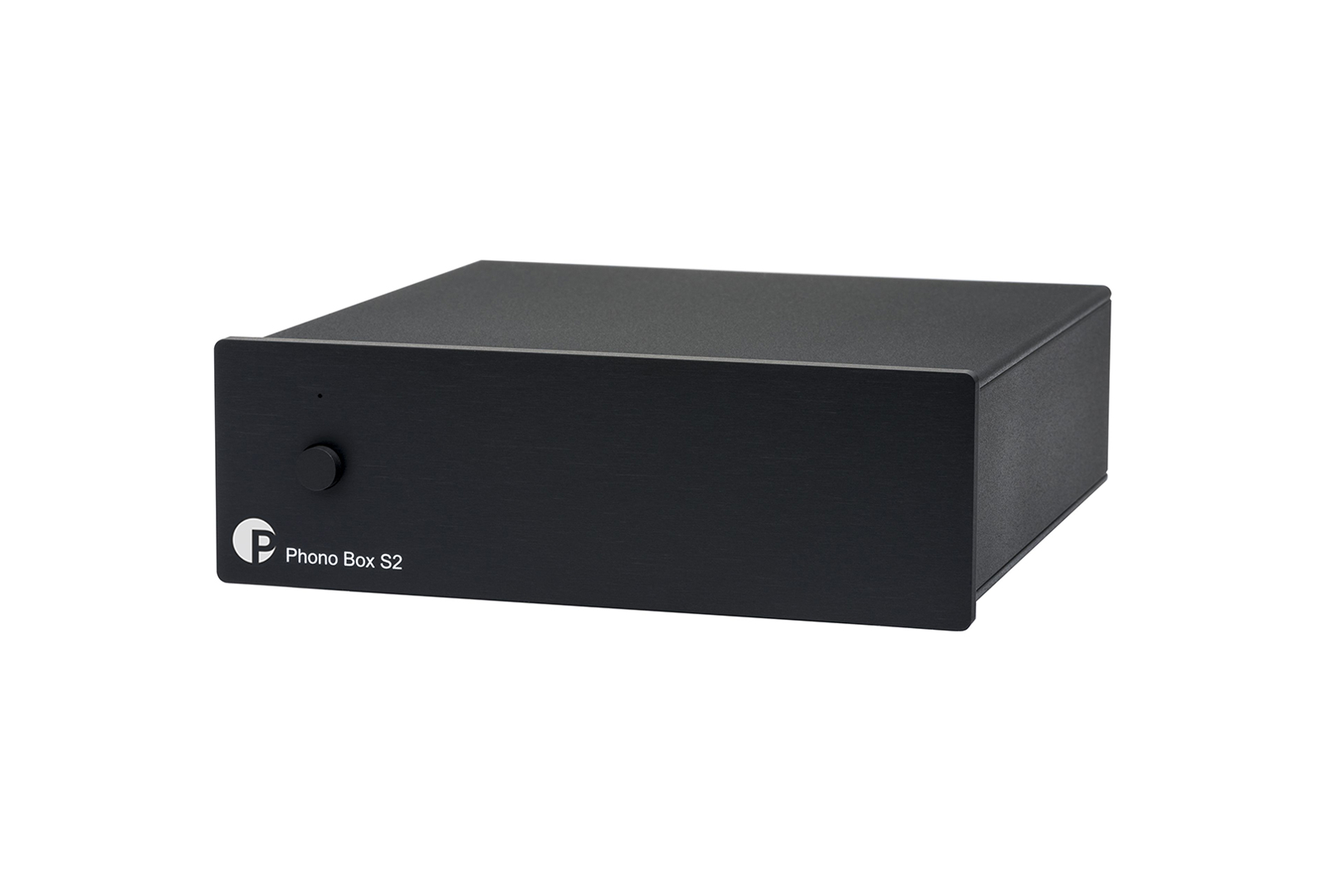
Familari describes a case so compact that it fits on the palm of a hand, including the plug-in supply. The fascia carries a logo, a model name and a power switch, and nothing else. At the rear sit an RCA input, an RCA output and the socket for the bundled supply. Adjustment is on the underside: Familari counts eight small switches, plus an earth screw and a separate switch for the subsonic filter (−12 dB at 20 Hz). In his account five switches set impedance and three set gain [2].
The data table already on this page (as of 16 October 2026) instead lists an impedance grid of 10 Ω, 100 Ω, 1 kΩ and 47 kΩ, a capacitance grid of 100, 200, 320 and 420 pF, gain settings of 40, 43, 60 and 63 dB, and an external 18 V supply [1]. Familari describes the underside from listening use; the table states the manufacturer’s figures. Where the two accounts of the switch count do not appear to line up, we leave the table unchanged and note that we have not counted the DIP switches ourselves. The weakness line on the page, that adjustment under the unit is awkward, fits exactly this layout and stays as part of the score graphic. There is no USB output, no balanced output and no second input.
Gain, load and manufacturer data
The table and the product page, besides the gain and load figures already named, quote a signal-to-noise ratio of 85 dB, distortion of 0.01% (MM) and 0.05% (MC), and RIAA accuracy of better than 0.4 dB from 20 Hz to 20 kHz [1]. Familari finds those numbers impressive and calls the stage remarkably quiet in use for 280 Australian dollars; inside he notes audiophile-grade polypropylene capacitors and a tidy layout [2]. The existing page note on dual-mono and WIMA PP follows the manufacturer; we have not opened the case. Subsonic is defeatable. A low-output moving-coil cartridge will typically sit in the 60 or 63 dB settings and in the low-impedance grid; typical moving-magnet cartridges stay at 40 or 43 dB and 47 kΩ. That is a reading of the table, not a load protocol of this analysis.
The four capacitance values allow a moving-magnet fine-tuning that, for example, the Mani 2 does not offer at this density. Conversely the S2 remains a single RCA input without a second input or a balanced output — deliberately a small box, not a laboratory stage. There is no ADC for digitising; anyone who wants to record vinyl needs another unit.
What the specialist press heard
Familari had the S2 connected, in about five minutes, to a 399-dollar Pro-Ject Essential II with an Ortofon OM5, later to an Ortofon MC10 and an Audio-Technica AT160ML. The amplifier was a long-owned NAD 3020, the loudspeakers a pair of 949-dollar B&W 607. He deliberately chose a chain that a quality-conscious first-time buyer might assemble, not the doctrine of a dear source and a skimping rest of the system [2].
On Ry Cooder’s “Prodigal Son” he first heard a highly communicative midrange, a treble with a little coarseness, and warmish but taut bass. On “Harbour of Love” the OM5 showed its limit: tracking was not an issue, but treble refinement and fine detail were, the midrange was warm, and the track’s richness and emotional impact were thinned; bass arrived shyly. The MC10 changed the picture: the treble regained most of its refinement — not to the level of his Koetsu Red Signature — the midrange surprised, and the bass became deep, with palpable presence and scale [2].
With the AT160ML and James Taylor’s “Fire and Rain”, sweetness, refinement and detail in the treble rose several notches; the midrange became fuller and more transparent, the bass more extended and quicker to start. Between the MC10 and the 160ML, bass and treble sat close together; in the midrange the 160ML seemed more linear and transparent, while bass was tighter and fuller with the MC10. That, for Familari, is the point: the small 280-dollar stage made the differences among the three cartridges audible. After another dozen albums he concludes that the S2 handles moving-magnet and moving-coil cartridges with an even hand; against dearer stages it lacks the last transparency and subliminal detail; in the midrange it has presence and an ability to convey musical emotion above its price; in the bass, compared with more expensive rivals, it lacks scale and depth. At 280 Australian dollars it is an authentic bargain, deserves more than an entry-level cartridge, and is highly recommended [2].
That is a dated listening finding on a specific chain in Australia in 2019, not a guarantee for every system and not a listening seat of our own. The advice to give the S2 more than an OM5 belongs to that finding and explains why the existing short overview treats the box as a bridge between Starter and Premium, not as a substitute for a weak turntable.
Placement, cartridges and system
The official grid covers typical moving-magnet cartridges and many low-output moving-coil cartridges. Familari heard exactly that span: a cheap OM5, an older low-output moving-coil and a higher moving-magnet. In his report the OM5 was the limit of the chain, not necessarily the limit of the S2. Anyone who connects only the starter cartridge supplied with a turntable should not expect the same treble he describes with the 160ML. The DIP switches under the floor mean the unit has to be turned or lifted; the external 18 V supply should be kept away from the RCA path. Two turntables at once, a headphone output or a balanced output are not provided.
In relation to the Mani 2, which is the Starter-tier value champion in the same list, the S2 is the finer-grained, somewhat dearer sister with a subsonic filter according to the table. Those are feature differences, not a listening ranking. We have not heard the two boxes against each other. Shop comparisons do not replace that.
Price and availability
The existing page note gives about €159–179 (as of September 2026, without guarantee). Familari in 2019 named an Australian guide price of 280 dollars [2]. Those are different markets and years, not a converted spot rate. A power supply typically comes in the box; a turntable, a cartridge and cables do not. A later street price does not change the listening notes, but it does change the set of today’s rivals. Before a purchase it should be checked that the unit supplied really is the Phono Box S2 and not an Ultra, an S3 or an S3 B.
The long life of the S line explains why namesakes are so easily confused. Pro-Ject has renewed the family more than once; in the sources for this analysis the S2 remains the model Familari heard in 2019 and the current product page describes. A newer sister in a similar case does not automatically inherit this listening report.
Familari also frames the S2 in a short history of the phono socket that remains useful for newcomers even though it is not a sonic point. After the arrival of the compact disc, many manufacturers, he writes, dropped the phono stage from the integrated amplifier, sometimes leaving a line input labelled “phono”. A generous reading is that this merely marked the input to which an external stage should be connected. It is into that gap that Pro-Ject places affordable valve and solid-state stages — and the S2 is the small, plain expression of that idea. That explains the bare fascia as well as the absence of USB: the box is meant to replace a missing phono input, not to become a digital laboratory [2].
He mentions the manual specifically because, at this price, handbooks are often the opposite of clear. The packaging is fine, the instructions are short on presentation, but they are written in English that can be read without stumbling translations. Anyone who has recently had to decode a poorly transferred handbook will notice the difference. That is not a sonic argument, but it is a practical one for exactly the first-time buyers he sees as the main audience. Together with the quiet baseline in use — 85 dB signal-to-noise on the table, “remarkably quiet” in the listening report — the picture is of a stage that makes little fuss and leaves the work to the switches on the underside [2].
A further pass over the cartridge changes is worthwhile, because they carry the core of Familari’s verdict. The OM5 was not “bad”; it was a cheap starter cartridge that supplied timing and warmth but owed fine detail and treble refinement. The MC10, an older low-output moving-coil that Familari describes as more sophisticated than its reputation sometimes suggests, lifted bass and treble and showed that the S2 can handle a lower output without immediately becoming loud or restless. The AT160ML, a higher-resolving moving-magnet, then made clear that the S2 has reserves once the cartridge supplies more than a typical bundled pickup. That is why the short overview on this page warns against reading the S2 as compensation for a weak turntable: the stage makes differences audible; it does not create them [2].
The existing comparison table on the page sets other boxes alongside it; those are overview lines, not extra listening sources. The Starter-tier Sound champion placing follows the available data and the one secured international listening text, not a group comparison we have heard ourselves. Anyone buying the S2 today should also not simply convert the 280 Australian dollars of 2019 into the current euro band: taxes, distribution and the larger family of siblings all change the set of alternatives. What should be checked, above all, is the exact model name on the carton and the case.
What we do not rely on
Listening reports of the Phono Box S2 Ultra, the S3, the S3 B, the DS2 or the Mini are not a substitute for a report on the Phono Box S2. Forums are left aside. There is no track list of our own and no measurement.
Conclusion of the analysis
The sources portray the Pro-Ject Phono Box S2 as a compact moving-magnet and moving-coil stage with a stated dual-mono layout, 40 to 63 dB of gain, switchable load and capacitance, a defeatable subsonic filter and an external 18 V supply — according to the product page and the existing table [1]. StereoNET (Peter Familari, 7 May 2019) describes, on an Essential II with an OM5, an MC10 and an AT160ML, a quiet, midrange-communicative stage that makes differences between cartridges audible, that dearer units still beat for last transparency and bass scale, and calls it an authentic bargain at the then Australian price [2]. In our list the unit is the Starter-tier Sound champion — an AI assessment based on the available data, not a listening test of our own.
Sources for this analysis
- Pro-Ject: Phono Box S2 product page (retrieved 12.11.2026). https://www.project-audio.com/en/product/phono-box-s2/
- StereoNET: Peter Familari – Pro-Ject Phono Box S2 MM/MC Phono Preamplifier Review (7 May 2019 / 07.05.2019). https://www.stereonet.com/reviews/review-pro-ject-phono-box-s2-phono-preamplifier
Created by AI (Vinyl BotPro) from the sources named; no listening tests or measurements of our own. Detailed human fact-checking is still outstanding.
Comparison models
| iFi Zen Phono 3 | More gain range/balance, more expensive |
|---|---|
| Schiit Mani 2 | Cheap MM/MC, less fine tuning C |
| Phono Box E | Only MM, significantly cheaper |
System matching
Works well with
- MM/HO-MC and low-MC at line input
- Starter/premium decks without phono
- Users who want to fine-tune load/gain
Less suited
- Only USB-Digitalize (no ADC)
- Master-MC with exotic load-force
- Who already has strong Amp-Phono
Created by Vinyl BotPro (AI) · As of Sept 2026 · Corrections: info@vinylcination.de
Read more: best phono preamps 2026 · What is hi-fi?