
Active bookshelf speaker · AI analysis · Premium, Rank 1
PSB iQ2: Analysis
AI analysis (research): active streaming bookshelf pair from PSB with a 19 mm aluminium dome, 100 mm polypropylene mid/bass driver, 270 W Burr-Brown Class D, BluOS up to 24/192, MM phono, HDMI eARC and a wireless link between the speakers. Based on manufacturer data and press reviews, no listening test.
Summary
Value-for-money Vinyl BotPro Champion Best value-for-money estimate of the tier on the data basis (no listening test).
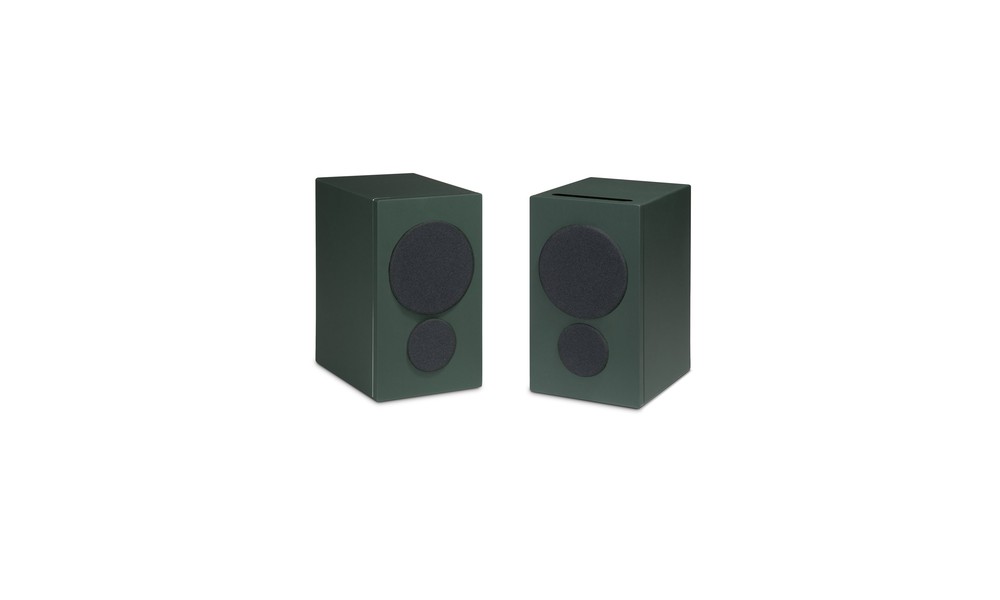
The PSB iQ2 is the wireless model in the new iQ series (launch June 2026): amplifier, DAC and BluOS streaming sit in the cabinets, and the left and right speakers pair over a low-latency wireless link. PSB quotes 270 W of system power (90 W per woofer, 45 W per tweeter), 64 Hz to 20 kHz (±3 dB) and a low-frequency cutoff of 35 Hz (−10 dB). Sources connect via BluOS, AirPlay 2, Spotify/TIDAL/Qobuz Connect, Bluetooth aptX Adaptive, HDMI eARC, optical, USB-C/USB-A and a switchable RCA input with MM phono. The international specialist press places the series against the KEF LSX II / LSX II LT and quotes euro prices. Two reviews, TechRadar (07/2026) and SoundStage! Access (10/2026), praise the sound and BluOS; they disagree on the built-in phono stage. Price guide: USA MSRP 1,399 $ (walnut 1,499 $), UK about 1,199 £, EUR in the trade press about 1,299–1,399 € per pair (as of Oct. 2026, without guarantee).
Assumptions
- Price per pair or set according to manufacturer or trade, as of Oct. 2026, no guarantee
- Vinyl via the phono input of the box or via an external phono stage at the analog input
- Placement on stands or free with some distance to the rear wall
- No in-house measurements or listening tests
Specifications (manufacturer)
| Type | Active streaming bookshelf speaker · Bass-reflex · wireless stereo link |
|---|---|
| Chassis | 19 mm aluminium dome · 100 mm polypropylene mid/bass driver (woofer over tweeter) |
| Amplifier | 270 W system · Burr Brown Class D · 90 W/woofer · 45 W/tweeter per speaker |
| Frequency range | 64 Hz – 20 kHz (±3 dB) · LF cutoff 35 Hz (−10 dB, manufacturer) |
| Streaming / DAC | BluOS · AirPlay 2 · Spotify/TIDAL/Qobuz Connect · Bluetooth aptX Adaptive · up to 24-bit/192 kHz |
| Inputs | HDMI eARC · Optical · USB-C · USB-A · RCA phono/line (app-switchable) · Ethernet/Wi-Fi |
| Outputs | Subwoofer output with DSP high-/low-pass |
| Phono | Built-in MM phono stage (enabled in the BluOS app) |
| Dimensions / weight | 246 × 145 × 192 mm (H × W × D) · 7.36 kg/pair (manufacturer) |
| Finishes | Black, white, Ember Red, Boreal Green, Granite Grey, Sandstone Beige · Walnut surcharge |
| Price guide | MSRP 1,399 $/pair (USA) · EUR approx. 1,299–1,399 € according to the trade press · as of Oct. 2026 · without guarantee |
Manufacturer specifications (PSB)
| Type | Active streaming bookshelf speaker (BluOS) |
|---|---|
| Amplifier power | tweeter 45 W · woofer 90 W (per speaker) · total system power 270 W (dual PSU) · load impedance not specified by manufacturer (built-in amplifier) |
| Drivers | tweeter 19 mm aluminium dome · woofer 100 mm cone |
| Frequency response | 64 Hz–20 kHz (±3 dB, 0°) |
| Weight | 7.36 kg (pair, net) |
Source: PSB – official specifications · As of 16 October 2026 · subject to change by the manufacturer
Rating criteria in detail
The four criteria feed into the Vinyl BotPro Index with weights of 25/20/25/30. The index is scaled across all tiers (see Methodology); that is why we do not show individual sub-scores.
Strengths
- BluOS multi-room with a strong control app
- Built-in MM phono input for a direct turntable connection
- HDMI eARC, optical, USB-C and subwoofer output
- Wireless stereo link and seven finishes
- Detailed, dated reviews from TechRadar and SoundStage! Access
Weaknesses
- Built-in phono stage clearly behind the other inputs according to TechRadar (SoundStage! Access: adequate for most)
- Compact 4-inch drivers limit level and stage in large rooms
- HDMI eARC with occasional dropouts at SoundStage! Access (cause unclear)
- No dedicated line input alongside phono (switching in the app)
Comparison models
| Klipsch The Nines | Index 64, Rank 2, Sound champion — bookshelf · 2-way · Horn tweeter · approx. €1,350–1,900 |
|---|---|
| Nubert nuZeo 3 | Index 60, Rank 3 — bookshelf · 2-way · bass reflex · approx. € 1,900 (pair) |
System matching
Works well with
- Living rooms and sideboards where a cable between the speakers gets in the way
- Vinyl starters with MM cartridges who want streaming and TV in the same system
- BluOS / NAD / Bluesound multi-room households
Less suited
- Vinyl as the main source with high demands on the phono stage — then use an external stage on the line input or check another active pair
- Large rooms and high levels without a subwoofer
- Anyone who prefers a wired master/slave link (then iQ1)
Specs & Features
The drivers, amplifiers, connections, app settings and manufacturer data are now collected, with sources, in the analysis below.
Research Consensus
We evaluate the reviews by SoundStage! Access (Dennis Burger, 10/2026) and TechRadar (Simon Lucas, 07/2026), and What Hi-Fi?'s launch news (06/2026), separately and with dates below.
For whom / Matching
Amplifier & Phono stage
There's no need for an amplifier. Streaming, TV and digital inputs run directly; for vinyl you enable the phono stage in the BluOS app or use an external phono stage on the line input.
Turntable & phono
MM cartridges can be connected directly (mind the ground). SoundStage! Access (10/2026) found the RIAA equalisation good, TechRadar (07/2026) found the stage sonically weak — anyone who listens to vinyl intensively should plan an external phono stage from the top list of phono preamps and set the input to line. Matching decks: top list of turntables.
Room & placement
Compact dimensions for sideboard and shelf; the rear bass reflex needs clearance from the wall. For more deep bass and higher levels, add an active subwoofer on the sub out (top list of active subwoofers).
Budget & upgrade
At about 1,299–1,399 € the iQ2 sits in the Premium band next to the Nubert nuPro XS-3000 RC and the KEF LSX II. The cheaper wired iQ1 (about 999 $) and the LSX II LT (999 €, no analogue) are the typical alternatives.
Analysis: the PSB iQ2 in depth
What this page is: an AI analysis, not a listening session
This page summarises what can be documented about the PSB iQ2 from manufacturer information and international reviews. Vinyl BotPro has neither listened to nor measured these speakers. We paraphrase sound descriptions as the named authors wrote them under their own conditions, each with a date, and we flag our own assessments. The iQ2 has only been on sale since June 2026, so the number of sources is small. This section does not change the rating, rank or index.
Keeping the models apart
- Alpha iQ: PSB's earlier active model, whose acoustic platform the new series builds on [2][3].
- iQ1: the sibling with a cable between the speakers, in black or white, from $999 according to PSB [2]. Its two tweeters share a two-channel amplifier [2].
- iQ2: the model analysed here, with a wireless link between the speakers and independent tweeter amplifiers [2].
According to SoundStage! Access, the "2" is not a generation number; it marks one of two successors to the Alpha iQ [3]. Everything below refers to the iQ2.
The concept
PSB describes the iQ2 as a complete system of streamer, DAC, amplifiers and speakers [1][2]. The two speakers pair over a low-latency wireless link; there is no cable between them [2]. All connections are on the primary speaker [3][4]. SoundStage! Access notes there is only one Ethernet port, so the link between the speakers stays wireless even on a wired network [3].
PSB says each channel has its own amplification and its own DAC [1]. SoundStage! Access suspects that the iQ2 works essentially like two paired streamers, while the iQ1 is more like a stereo streamer with a cable to the second box; the author explicitly marks this as a guess [3].
Drivers and cabinet
- Mid/bass driver: 4 inch (100 mm), polypropylene, with rubber surround and steel basket [1][2].
- Tweeter: 0.75 inch (19 mm) aluminium dome with neodymium magnet and ferrofluid [1][2].
- Layout: the mid/bass driver sits above the tweeter [3][4]. SoundStage! Access highlights the resulting very good vertical dispersion [3].
- Cabinet: bass reflex with a rear port; MDF sleeve, front baffle of MDF on aluminium, aluminium rear panel [1][4].
- Crossover frequency: TechRadar gives about 3 kHz [4]. We found no manufacturer figure.
Amplification
PSB quotes 270 W system power with two power supplies: 90 W per mid/bass driver and 45 W per tweeter [1][2]. The amplifiers are Class D based on Burr-Brown technology [2][4]. The crossover is done in DSP [2][5].
One detail conflicts between sources: TechRadar writes that analogue signals are passed straight through while digital ones go via the DAC [4]. With a DSP crossover, in our assessment, an analogue signal would also have to be digitised. The sources do not settle this.
Connections and streaming
On the primary speaker [2][3][4]:
- HDMI eARC
- optical (Toslink)
- USB-C as an audio input for computers and mobile devices
- USB-A for memory sticks (FAT32 or NTFS) [3]
- one RCA pair, switchable in the app between MM phono and line
- Ethernet and Wi-Fi
- subwoofer output with DSP high- and low-pass, 40 to 200 Hz in 10 Hz steps [3]
Streaming: BluOS with more than 20 services, AirPlay 2, Spotify Connect, TIDAL Connect, Qobuz Connect, Bluetooth with aptX Adaptive [2]. What Hi-Fi?'s news item says aptX HD [5]; PSB itself says aptX Adaptive [1][2]. Resolution goes up to 24-bit/192 kHz [2]. Through BluOS the iQ2 can be integrated into Control4, Crestron, Nice, RTI and URC control systems [2].
Controls: touch panels on the primary speaker for volume, playback and two presets [2][4]. According to SoundStage! Access no remote is included, and the Bluesound RC1 remote is not supported [3]. Without a TV connected via eARC, the app is the remote [3].
Specifications according to PSB
PSB lists in November 2026 [1]:
- Frequency response 64 Hz to 20 kHz (±3 dB), low-frequency cutoff 35 Hz (−10 dB)
- Dimensions 145 × 246 × 192 mm (W × H × D)
- Weight 7.36 kg per pair
- Finishes: black, white, Granite Grey, Sandstone Beige, Ember Red, Boreal Green, walnut veneer
According to the press release, the walnut version was due in November 2026 [2].
Setup and settings
SoundStage! Access describes setup in detail [3]:
- The app uses a test tone to identify which speaker is left and which is right.
- According to the manual, the RCA input automatically detects whether a turntable or a line source is connected. In the review this was not the case: the phono preamp had to be switched on in the app.
- Automatic switching to TV sound is enabled in the HDMI menu (Auto Sense).
- Subwoofer crossover settings only become available once a subwoofer is connected.
An important point is A/V mode. According to the app, it improves sync with the picture and matters when players are grouped; switched off, it prefers quality over speed and is meant for audio-only sources such as turntables [3]. With A/V mode on, the centre image sounded more diffuse to SoundStage! Access; with it off, the image was more precise, and latency stayed below 50 ms according to the reviewer's sync-test videos [3].
SoundStage! Access (October 2026)
Dennis Burger reviewed the iQ2 for SoundStage! Access on 1 October 2026, then priced at $1,399, £1,199 or €1,299 (walnut $1,499, £1,299, €1,499) [3]. He listened mostly in stereo and briefly with an SVS subwoofer [3]. His impressions [3]:
- Good tonal neutrality, good horizontal and very good vertical dispersion.
- Far more bass than you would expect from a 4-inch driver; by ear he found the manufacturer's figures accurate.
- At full volume the bass modulated the vocals, the cabinet resonated a little, and there was some distortion. With a subwoofer the system played louder and cleaner.
- During a film the left speaker briefly clipped at around 95% volume; with the subwoofer this did not happen.
- Wide, deep soundstage; he does not consider image specificity the last word.
His conclusion: tonality, dynamics and soundstage are excellent; a subwoofer is a worthwhile upgrade that can wait [3].
TechRadar (July 2026)
Simon Lucas reviewed the iQ2 for TechRadar on 10 July 2026, then priced at $1,399 or £1,199 [4]. He gave 4 out of 5 for sound, 5 out of 5 each for features, design and usability, and 4.5 for value [4]. His observations [4]:
- Lively, engaging sound with even-handed tonality and plenty of detail.
- The bass reaches deeper than PSB claims and is well controlled.
- Good dynamics without audible compression; a well-organised but not especially large soundstage.
- Somewhat squashed over Bluetooth.
- The BluOS app is one of the best interfaces around.
For large rooms he recommends bigger speakers [4].
The phono input: two verdicts
The sources differ clearly here:
- TechRadar (07/2026): the phono stage is a real disappointment. It strips away the liveliness the system shows on every other input. Anyone using vinyl as the main source is not well served by the iQ2 [4].
- SoundStage! Access (10/2026): RIAA equalisation is good, and so is the rumble filter. He preferred his turntable's built-in phono stage because it gave more gain and a little less noise, but for most people the MM input will do [3].
A firmware update came between the two reviews. According to SoundStage! Access, PSB explicitly asked for this update before listening began; among other things, it affected phono-stage gain [3]. Whether this explains the different verdicts cannot be derived from the sources.
HDMI eARC
With a TCL TV, SoundStage! Access occasionally saw short dropouts of the left speaker and twice a complete loss of sound that could only be fixed by disconnecting power [3]. It did not recur over the following two weeks [3]. The author cannot say whether the TV or the iQ2 was the cause [3].
For vinyl: what the sources show
- An MM cartridge can be connected directly; the phono preamp is enabled in the app [3][4].
- For audio-only sources such as a turntable, the app recommends switching A/V mode off [3].
- Heavy vinyl listeners can use an external phono stage on the line input. Since there is only one RCA input, it occupies that input [3][4].
- The verdicts on the internal phono stage differ (see above).
Placement
TechRadar recommends leaving the rear bass ports a little space from the wall; then the iQ2 is very flexible to position [4]. SoundStage! Access tried various amounts of toe-in and still remained somewhat reserved about image precision [3]. Because the mid/bass driver sits above the tweeter, vertical dispersion is especially good according to SoundStage! Access [3]. In our assessment, this makes ear height relative to the speaker less critical; the sources contain no measurement on this.
Because the speakers pair wirelessly, each box needs only a power cable; there is no link cable to the secondary speaker [2][3]. The connections for turntable, TV and network are on the primary speaker [3][4].
Running with a subwoofer
The subwoofer output uses DSP high- and low-pass filters [2]. SoundStage! Access found that the main benefit of a subwoofer was less the extra deep bass than the relief for the small mid/bass driver [3]:
- Vocals stayed cleaner at high volume.
- The system played louder overall without compromise.
- With films there was much more impact, and the brief clipping of the left speaker disappeared.
Instead of a wired subwoofer, SoundStage! Access says a wireless Bluesound subwoofer can also be paired [3].
Comparison models in the sources
The sources name models the iQ2 competes with:
- PSB iQ1: cheaper, with a cable between the boxes, black or white only. SoundStage! Access suspects the iQ1 might suit films better because of the wired link, but has not heard it [3].
- KEF Coda W: wired link, HDMI eARC, subwoofer output and separate MM and line inputs [3].
- KEF LSX II and LSX II LT: named by What Hi-Fi? as direct rivals [5]. TechRadar finds the LSX II slightly larger and audibly bigger-sounding [4].
These comparisons are the authors' assessments. We do not derive a ranking from them.
Who the iQ2 suits according to the sources
The two reviews give a fairly clear profile [3][4]:
- Suits: small to medium rooms, streaming as the main source, a TV via eARC, BluOS multiroom, a wish for coloured cabinets.
- Suits less: large rooms, very high levels without a subwoofer, vinyl as the main source with high demands on the internal phono stage.
- Worth checking: eARC stability with your own TV and the current firmware version.
Where the sources agree
- Features and app: very extensive, BluOS very good [3][4].
- Bass: surprisingly much for the size, with limits at high levels [3][4].
- Room size: rather small for large rooms; a subwoofer helps [3][4].
Open points and limits of this analysis
- Bluetooth: aptX Adaptive (PSB) versus aptX HD (What Hi-Fi? news item) [1][5].
- Prices: What Hi-Fi?'s news item gives £1,299, €1,399 and $1,499 for the iQ2 [5]; PSB gives $1,399 (walnut $1,499), SoundStage! Access £1,199 and €1,299 for standard finishes [2][3]. The page's price information stays unchanged.
- Analogue signal: whether analogue signals are digitised is not clearly documented [4].
- Phono detection: automatic according to the manual, not present in the review [3].
- Firmware: phono gain and eARC were changed by update; later versions have not been evaluated [3].
- A detailed human fact-check of this analysis is still pending.
Sources for this analysis
- PSB – iQ2 BluOS Streaming Powered Speakers (Produktseite, Spezifikationen). https://www.psbspeakers.com/products/iq2-bluos-streaming-powered-speakers
- PSB – PSB Debuts the iQ Series (Pressemitteilung, 23.06.2026). https://www.psbspeakers.com/blogs/news/psb-debuts-the-iq-series-true-all-in-one-streaming-speakers
- SoundStage! Access – Dennis Burger, PSB iQ2 Streaming Active Speaker System (01.10.2026). https://www.soundstageaccess.com/index.php/equipment-reviews/1401-psb-iq2-streaming-active-speaker-system
- TechRadar – Simon Lucas, PSB iQ2 review (10.07.2026). https://www.techradar.com/audio/wireless-bluetooth-speakers/psb-iq2-review
- What Hi-Fi? – Ioan Hazell, PSB's BluOS-powered all-in-one wireless speaker systems (News, 29.06.2026). https://www.whathifi.com/speakers/wireless-speakers/psbs-bluos-powered-all-in-one-wireless-speaker-systems-aim-to-take-on-five-star-kef-rivals
Created by AI (Vinyl BotPro) from the sources listed; no listening tests or measurements of our own. Detailed human fact-check pending.
What makes this AI analysis special
This section is an AI summary from Manufacturer data and reports from international specialist media. Vinyl BotPro had no physical access, no measurement of our own chain and no listening test. The basis is PSB’s manufacturer data plus the reports in international reviews. The weaker phono stage feeds into features and expected performance. The expected performance is derived from construction, datasheet and the judgements of the Specialist press. Prices and availability change (as of Oct. 2026, no guarantee); please check technical values against the current data sheet.
Vinyl BotPro Score Logic
The Vinyl BotPro Index runs from 0–100 across all tiers and weights build/technology, features, expected performance and value for money at 25/20/25/30. Premium typically sits at ~55–69. The PSB iQ2 scores 68 (Premium rank 1). High feature score (BluOS, phono, HDMI, wireless link) and a solid value weighting around 1,300 €; the phono stage and compact drivers limit the performance share versus larger Premium models. In the stage, the model bears the title Value for money Vinyl BotPro Champion. Rank is not Laboratory Evaluation — no Listening test. Details on weighting · Methodology.
Sources
- PSB Speakers — iQ Series launch / iQ2 (manufacturer, specs and price)
- PSB — iQ2 BluOS Streaming Powered Speakers (product page)
- What Hi-Fi? — PSB BluOS-powered all-in-one wireless speaker systems (29.06.2026)
- SoundStage! Access — PSB iQ2 Streaming Active Speaker System (01.10.2026)
- TechRadar — PSB iQ2 review (10.07.2026)
Created by Vinyl BotPro (AI) · AI analysis · As of 08.10.2026 · Corrections: info@vinylcination.de · Prices without guarantee.
Read more: best active bookshelf speakers 2026 · What is hi-fi?