
Phono preamp · AI analysis · Expert, rank 2
Rega Aria MK3: Analysis
AI analysis (research): discrete MM/MC phono stage with separate inputs — specifications and retailer price, no listening test.
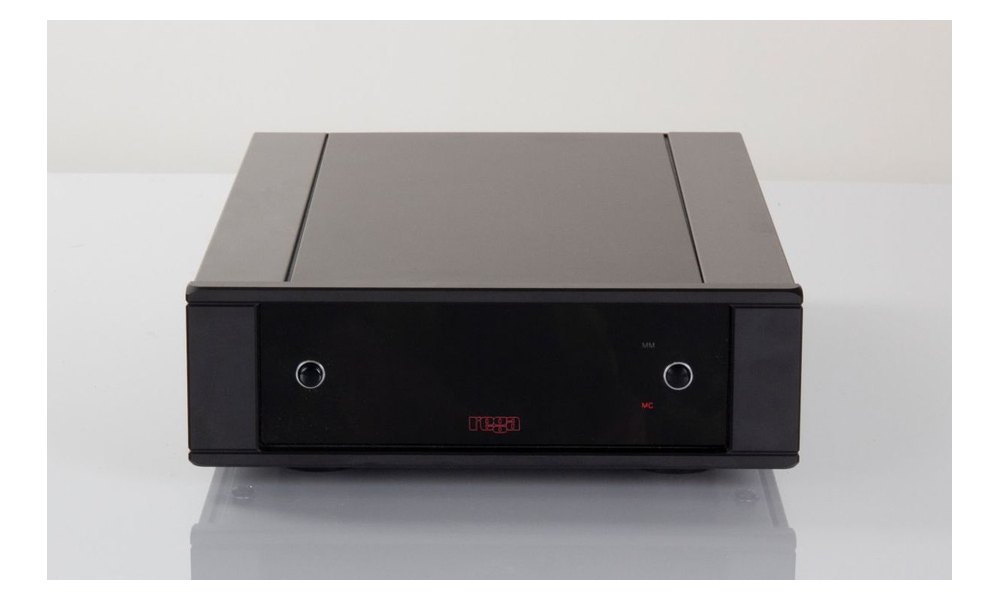
Summary
The Aria MK3 separates the MM and MC paths (own inputs), uses a discrete circuit, offers MC loading via DIP switches (including 70/100/150/400 Ω) and switchable capacitance, and is made in the UK. Market price approx. €1,449–1,499. StereoNET (David Price, 20 August 2020) describes it as musical and coherent — less of a feature show than, for example, the Chord Huei.
Assumptions
- Separate line input
- A system MM or MC active
- No measurements of our own
Specs (public / manufacturer)
| Type | MM/MC Phono · Separate inputs · discrete |
|---|---|
| MM | 47 kΩ / 100 pF · Gain 41.4 dB |
| MC | Load 70 / 100 / 150 / 400 Ω · 1,000–4,200 pF · Gain 63.5 / 69.3 dB |
| I/O | 2× RCA Phono In · RCA Line Out |
| Enclosure | Aluminium · UK |
| Price guide | approx. 1,450–1,500 € DE/EU · Sept 2026 · Check the price date |
Manufacturer specifications (Rega)
| Type | MM/MC phono preamp |
|---|---|
| Gain factor | MM 41.4 dB · MC 69.3 dB (high) / 63.5 dB (low), at 1 kHz |
| Input impedance/capacitance | MM 47 kΩ / 100 pF · MC 70 / 100 / 150 / 400 Ω, 1,000 / 2,000 / 3,200 / 4,200 pF |
| Distortion | MM typ. 0.005% at 1 V · MC typ. 0.035% at 1 V (low gain) |
| RIAA accuracy | MM better than ±0.2 dB (100 Hz–100 kHz) · MC better than ±0.2 dB (70 Hz–70 kHz) |
| Max. input level | MM 93 mV · MC 5.1 mV (high) / 10 mV (low), 1 kHz |
| Outputs | 200 mV rated, max. 11 V RMS, output resistance 100 Ω |
| Power consumption | 10 W |
Source: Rega – official specifications · As of 16 October 2026 · subject to change by the manufacturer
Scores in detail
Vinyl BotPro Index: 83 · Index band Expert 70–84 · Guidance only, not a lab value.
Strengths
- Separate MM/MC inputs
- Discrete Rega design
- Clear matching focus
Weaknesses
- No Balanced
- Less gain levels than RS2
- Price without feature abundance
Analysis: Rega Aria MK3 in detail
How the cited material is used
This analysis adds manufacturer data and a dated independent listening report on the Rega Aria MK3 to the short overview above. Vinyl BotPro compiled it from the sources named below; VinylCination has not carried out its own listening session or measurement of this unit. The basis is Rega’s launch news item (4 May 2020) and the official Aria MK3 user manual (Revision 1, retrieved 12 November 2026) [1][2], and David Price’s listening report for StereoNET (20 August 2020) [3].
The product page at www.rega.co.uk/products/aria-mk3, which the news item links to, returned HTTP 404 on 12 November 2026; the core figures in the existing page table (as of 16 October 2026) and the manual therefore remain the manufacturer reference, together with the public announcement. StereoNET meets the requirement of an international independent listening report: Price writes extended session notes, compares the unit with the Chord Huei and awards eight out of ten. A Hi-Fi Choice group test by David Vivian (December 2020) is mentioned in secondary summaries; a freely reachable article URL was not secured in this pass, so it is not used as a second listening source. Some retailer texts mistakenly attribute Price’s StereoNET report to Stereophile — a Stereophile report of the Aria MK3 is not used here. Forums are left aside.
Background and place in the range
The Aria MK3 is Rega’s half-width MM/MC phono stage in an aluminium case, which went on sale in May 2020 after being shown at the Bristol Show in February [1]. Price describes it as a visual refresh of the Mk2, styled to match the Planar 10 power supply and the Aethos integrated amplifier; electronically, he says, it is essentially the same circuit as the Mk2, still without digital control, with mechanical switches and separate MM and MC paths [3]. That is the listening report’s account, not a board photograph of our own. Below it in the range sit the smaller Fono MM and Fono MC boxes, and above it typically the Aura; this analysis covers only the Aria MK3, not the Mk2 as a separate product and not the Fono models.
In our list the Aria MK3 is the Expert-tier Sound champion (Index 83, rank 2). The existing short summary already speaks of a musical, coherent impression and less of a feature show than, for example, a Phono Box RS2 or a Chord Huei — the Huei comparison is Price’s, named and heard in the room; the RS2 line in the comparison table remains a page overview, not an extra listening report. The champion placing is an AI assessment based on the available data, not a listening seat of our own.
Casework, inputs and operation
Rega describes a half-width, custom aluminium case intended to screen the circuit from stray radio-frequency interference and to match the rest of the current range; the stage is presented as an all-analogue product with no digital control circuitry [1][2]. Manual and trade figures typically quote 218 × 78 × 315 mm (325 mm deep including the earth terminal). The fascia shows the red Rega lettering, a power control and separate MM and MC indicators; switching between the paths is done at the front, and the sockets at the back are separate RCA pairs, so two turntables — one with an MM cartridge, one with an MC — can stay connected at the same time [3]. Price underlines the old-school operation with mechanical switches rather than digital menus.
There is no balanced (XLR) output; the signal path remains RCA to RCA. Anyone who wants a balanced-only path finds the unit under “rather not” in the existing system-matching note — that follows the connection list, not a listening verdict of our own. The existing page note says manufacture is in the United Kingdom; we leave that as it stands and do not invent factory details.
MM and MC paths and manufacturer data
The manual and the existing detail table describe two separately designed phono stages with their own input sockets and their own preamplification: switching is done by relays at high level and low impedance so that the signal path is not unnecessarily compromised [2]. The MM stage, according to the page, works at 47 kΩ and 100 pF with 41.4 dB of gain (1 kHz). The MC stage offers, via DIP switches on the back, resistive loads of 70, 100, 150 and 400 Ω, capacitive loads in the range 1,000–4,200 pF and a 6 dB sensitivity step; gain is given as 63.5 dB (low) and 69.3 dB (high) at 1 kHz. Price restates the same load windows and the 6 dB step, and describes a discrete-transistor signal path, with bipolar input transistors as a compound pair on MM and parallel-connected field-effect transistors on MC with no bias current in the cartridge coil; two power supplies per channel, Nichicon FG electrolytics in critical positions and polypropylene capacitors in the signal path and equalisation [3]. Those are figures and descriptions from the manual, the table and the listening report, not measurements of our own.
The manual quotes typical output figures: a rated output of 200 mV, a maximum output of 11 V RMS, an output resistance of 100 Ω, a power consumption of 10 W, and operation from 230 V or 115 V [2]. The existing table is left unchanged; where the manual and the table agree, we only note that fact, without doubling or smoothing the numbers.
What the specialist press heard
David Price heard the Aria MK3 for StereoNET (20 August 2020, then £899) and set it expressly beside the Chord Huei, which many regarded as the class reference [3]. He describes the Huei as extremely detailed, with a solid, almost architectural soundstage; the Aria sounded looser, not as tight, with a slight opacity in the midband that the Huei did not show. In other respects the Aria pulled ahead: fuller and sweeter in tone, with a better sense of musical flow, more romantic and emotionally involving, whereas the Huei sounded clean, precise and more focused on the technical quality of the recording [3].
On Change’s “A Lover’s Holiday”, a funk- and soul-tinged disco track with no audiophile pretensions, the Aria unlocked the syncopated playing and the subtle dynamic accents and carried the music’s natural groove; the Huei sounded more mechanical and more recording-focused [3]. Tonally, for Price, it was what one would expect from Terry Bateman, Rega’s tube-minded electronics designer: a little warm, with a slight, not unpleasant bass bloom that helped push Scritti Politti’s “The Word Girl” along, without chopping off the treble; hi-hats remained surprisingly sparkly. On REM’s “Welcome to the Occupation” the presentation was more organic and less processed than on the Huei; midband detail was good rather than exceptional, but the layered Rickenbacker guitars and the tangible, not over-etched vocals used the appeal of vinyl well [3].
In his conclusion Price calls the Aria MK3, in absolute terms, a little dynamically constrained and not a window to every last detail in the groove — comprehensively surpassing it in those respects would cost two to three times as much. As a configurable, flexible mid-price phono stage it is excellent: not every dot and comma of the groove, but the large musical picture, engaging, warm and smooth. Score: eight out of ten, plus the Applause mark that Price issues personally on the site — the award itself does not count for us as a second listening test; the underlying text does [3].
Placement, cartridges and loading
The separate sockets allow an MM and an MC turntable to stay connected at once, with switching at the front. The MM load is fixed; typical moving-magnet cartridges looking for 47 kΩ / 100 pF find the intended termination. On the MC side the load should be set to the chosen cartridge with the DIP switches — 70 to 400 Ω and 1,000 to 4,200 pF are the official window, plus the 6 dB sensitivity step [2][3]. The existing system-matching note names Rega turntables in the Planar 6 and Planar 8 class and RCA integrated amplifiers as typical partners, and advises against the unit where a balanced-only path or a budget below €1,000 is required. That remains guidance. Price heard the stage as a mid-price, flexible box, not as a laboratory piece; we have not repeated a combination of arm, cartridge and cable of our own.
The DIP switches sit at the back; anyone who changes cartridges often should place the unit or the shelf so that the row of switches stays reachable. The MM side does not offer that freedom, which need not be a drawback in a fixed MM system and, in a changing park of cartridges, rather puts the MC sockets in the foreground. Price describes the stage as highly configurable and flexible — that refers mainly to the MC path, not to a universal load menu for both inputs.
Because the case is deliberately half-width and all-analogue, it suits a typical hi-fi shelf beside an integrated amplifier without phono or with a weaker built-in stage. Cooling and footprint follow the usual manual dimensions; the launch announcement does not set special rack rules. There is no second power supply or external clock — the Aria remains a classic phono stage with a fixed mains inlet according to the manual [2].
Price and availability
StereoNET quoted £899 in August 2020. The existing page note points to about €1,449–1,499 (as of September 2026, without guarantee) [3]. Those are price anchors, not a current shop comparison; the gap between the earlier British price and the later euro band is large and should be checked before a purchase. The 2020-to-2026 shift also moves the comparison frame: £899 sat closer to some mid-class rivals of the time; about €1,450–1,500 today places the unit in a different neighbourhood, without changing Price’s listening report. The Expert-tier champion placing follows the page’s data and the international listening text we have, not an updated price survey, which we have not carried out. The manual and the announcement describe a commercial phono stage without a cartridge in the box; a turntable, RCA cables and an amplifier are not part of the carton.
What we do not rely on
Listening reports of the Aria Mk2, the Fono MM, the Fono MC or the Aura are not a substitute for a report on the Aria MK3, even though Price places the Mk3 electronically close to the Mk2 — his text is about the Mk3 unit in the new case [3]. We do not use the December 2020 Hi-Fi Choice group test as a source while no secured article URL is to hand. Retailer texts that attribute the StereoNET report to Stereophile are not followed. Forums are left aside. There is no track list of our own. The Applause award does not count as an extra listening test.
Conclusion of the analysis
The sources portray the Rega Aria MK3 as a half-width, all-analogue MM/MC phono stage with separate inputs, discrete paths, MC loading by DIP switches and an aluminium case, launched in 2020 as a visual refresh of the Mk2 [1][2]. David Price (StereoNET, 20 August 2020) describes a fuller, sweeter, more musically flowing sound than on the Chord Huei, with a slight midband opacity, a somewhat looser bass and limits in the last dynamics and insight, but rates the large musical picture in this class clearly positively and awards eight out of ten [3]. In our list the unit is the Expert-tier Sound champion — an AI assessment based on the available data, not a listening test of our own.
Sources for this analysis
- Rega: New Aria MK3 MM / MC Phono Stage (news item, 4 May 2020 / 04.05.2020; retrieved 12.11.2026). https://www.rega.co.uk/news/item/new-aria-mk3-mm-mc-phono-stage
- Rega: Aria MK3 User Manual, Revision 1 (manufacturer PDF, retrieved 12.11.2026). https://www.rega.co.uk/download/aria-mk-3-manual-2020.pdf
- StereoNET: David Price – Rega Aria MK3 Phono Stage Review (20 August 2020 / 20.08.2020). https://www.stereonet.com/reviews/rega-aria-mk3-phono-stage-review
Created by AI (Vinyl BotPro) from the sources named; no listening tests or measurements of our own. Detailed human fact-checking is still outstanding.
Comparison models
| Phono Box RS2 | More I/O and loading options, balanced |
|---|---|
| Hegel V10 | XLR-Out, JFET, car standby |
| Fono MM/MC | Premium entry, separate speakers |
System matching
Works well with
- Rega-Decks Planar 6/8 class
- MM and Low-MC with DIP fine tuning
- RCA amps
Less suited
- Only balanced path desired
- Budget below €1,000
Created by Vinyl BotPro (AI) · As of Sept 2026 · Corrections: info@vinylcination.de
Read more: best phono preamps 2026 · What is hi-fi?