
In-ear analysis · Master · as listed
Sennheiser IE 600 Analysis
The Sennheiser IE 600 sits on the in-ear shortlist of 12 November 2026 in the expanded Master tier in rank 16 with a Vinyl BotPro index of 90 and no badge. This analysis takes the list record as published.
In short
The Sennheiser IE 600 is a wired in-ear in the audiophile IE range. On the in-ear shortlist of 12 November 2026 it sits in the expanded Master tier in rank 16 with a Vinyl BotPro index of 90. It carries no champion badge: under the single rule SoundGuys is an eligible independent editorial outlet; the value badge sits with the 64 Audio Aspire 3 and the Sound badge with the Sennheiser IE 900. The subscores and the mapping onto the 85–97 band are documented in the list package; this page repeats the list record.
A dynamic driver sits in 3D-printed, hand-finished AMLOY-ZR01 zirconium housings. Sennheiser quotes 18 ohms, 118 dB at 1 kHz and 1 Vrms, 6 g per side, a 125 cm MMCX cable, stated isolation of 25 dB and a frequency range of 4 to 46,500 Hz. The carton holds 3.5 mm and 4.4 mm cables as well as silicone and foam tips. Jasper Lastoria described the model for SoundGuys (datePublished 6 December 2024, a flagged update of an earlier text): sound quality as a strength, “sounds very good”, undistorted, strong isolation, build 8.0, design 9.0, comfort 6.9; the texture of the housings is polarizing, and the price is a criticism (Value 6.3).
In the official Sennheiser EU shop the IE 600 cost €799.90 including VAT on 12 November 2026 (SKU 508948, marked in stock). SoundGuys quoted an original price of $699 and showed an Amazon snippet of $899.95; this analysis does not convert the dollar prices. VinylCination has not listened to the IE 600 and has not measured it.
On a vinyl system the IE 600 is a light, easy-to-drive wired in-ear in the Master tier with both common plugs in the box. Anyone seeking the very good, undistorted character the review describes will find support in that text. Anyone expecting a magazine badge or the lowest euro price in the tier must also read the source class and the comparison with the Aspire 4 and the Advar.
Technical data (public)
| Form | Wired in-ear, 3D-printed AMLOY-ZR01 zirconium housing |
|---|---|
| Driver | Single dynamic driver (Sennheiser) |
| Impedance | 18 Ω (Sennheiser) |
| Sensitivity | 118 dB (1 kHz, 1 Vrms) (Sennheiser) |
| Frequency claim | 4–46,500 Hz (Sennheiser data sheet) |
| Isolation | −25 dB (Sennheiser, stated) |
| Weight | 6 g per side (Sennheiser / SoundGuys) |
| Cable | 125 cm, MMCX, 3.5 mm and 4.4 mm in the box (Sennheiser) |
| In the box | Silicone and foam tips in three sizes each, case, certificate of inspection (Sennheiser / SoundGuys) |
| Price as of 12 November 2026 | €799.90 in the Sennheiser EU shop (incl. VAT, InStock, SKU 508948) |
| List record 12 November 2026 | Master rank 10 · index 90 · no badge |
Amplifier compatibility
18 ohms and 118 dB for one volt are figures a typical headphone output will handle easily. SoundGuys describes undistorted playback and does not describe a heavy drive requirement. A dedicated headphone amplifier is not a requirement for using the IE 600 well. As a single driver without a crossover it is less sensitive to output impedance than a low-impedance multi-way in-ear.
For a vinyl system that is a clear, limited hint. An integrated amplifier with a decent jack, or a small converter after the phono stage, is enough for level according to the sources. The 4.4 mm plug is useful if the stage already has a 4.4 mm socket; it does not replace a phono stage.
Compared with the IE 900 in the same range, which What Hi-Fi? treats as very source-critical and to which the list therefore gives a drive subscore of 7.4, the list package sets the IE 600 at 8.6: more sensitive on the data sheet and, in the listening source in hand, not described as a fussy partner. More power does not turn the described character into a different model; it only makes the earphone louder.
Rating criteria in detail
The four subscores and the index of 90 stand in the list package of 12 November 2026 and are taken here as the list record. The raw score of 7.5 is tied with the IE 900; the tie-break follows the IE 900’s higher sound-data score (8.6 against 7.6), hence rank 10 behind rank 9. No badge sits here: under the single rule SoundGuys is eligible, but the value badge belongs to the 64 Audio Aspire 3 and the Sound badge to the Sennheiser IE 900.
Manufacturer and concept
Sennheiser uses the IE letters for a line of wired in-ears. The IE 600 sits in price between the IE 200, the IE 300 and the flagship IE 900. SoundGuys dates the release to 8 March 2022 and describes an unusually elaborate housing for this class: 3D-printed AMLOY-ZR01, zirconium-based, reportedly tougher than steel, hand-finished, with a pitted-and-smooth texture that can polarize. A signed certificate of inspection is included.
The concept stays wired: one driver, two MMCX cables, silicone and foam tips, a case, no app, no wireless path. For a vinyl system that simplifies the signal path and stays flexible on 3.5 mm and 4.4 mm sockets. People with nickel allergies should, according to SoundGuys and the alloy’s composition, be safe; that is a statement in the review, not a medical judgement from this page.
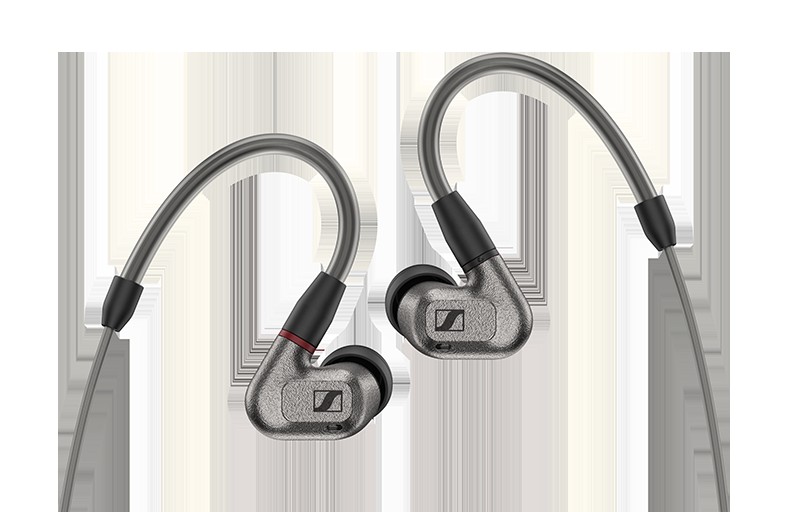
The official shop packshot on this page shows the housing in the manufacturer view. The resolution of the original in hand is more modest than some other packshots (785 × 512 pixels after conversion); it remains an official product photograph for orientation, not a lifestyle image.
How the technology works
A dynamic driver works in the shell. Sennheiser quotes 18 ohms, 118 dB at 1 kHz and 1 Vrms, 6 g per side, isolation of 25 dB and a very wide frequency range on the data sheet — laboratory or manufacturer figures that do not replace a listening judgement. The cable is 125 cm long and detachable at MMCX sockets; 3.5 mm and 4.4 mm plugs are included.
SoundGuys puts the housings at the centre: 3D-printed AMLOY-ZR01, cited in aerospace and medical uses, hand-finished, with an unusual, polarizing texture. The tips include silicone and foam in three sizes each. Fit should be tried before buying; the comfort score of 6.9 sits below build 8.0 and design 9.0.
A remote on the cable is not the focus of this review. At the system that barely matters. Over-ear routing and the choice of a wired connection are, SoundGuys writes, preferences the buyer should settle.
What the international specialist press hears
Character
SoundGuys sums the IE 600 up as a nice, upscale, lightweight metal in-ear that, if you have the funds, offers an unusual texture, a suite of extras and “performs well at virtually every task”. Sound quality, isolation, build and a removable cable are listed among the strengths. The sound is very good and undistorted, the isolation strong.
Tonal balance
This text does not supply a track-by-track tonal description of the density found in a magazine listening review. The sonic placing therefore rests on the stated strengths, the “sounds very good” conclusion and “undistorted audio”, not on invented album logs. MDAQS is marked on the same page as “Not measured for this product”. A lab line “Beats 14 % of in-ear monitors” sits without filled MDAQS values next to “Based on our lab testing”; the list package does not use that line as a measurement, because the page expressly marks the measurement as not carried out.
Dynamics, bass and stage
On dynamics and stage the review has no detailed, track-based account that can be quoted with confidence. SoundGuys stresses instead that, price aside, the IE 600 does what it says it will do: play undistorted, isolate well, feel tough and come with the accessories you need. This page does not fill the gap with spatial descriptions of its own.
Strengths and limits
Strengths in the review: sound quality, isolation, build, a removable cable. Weaknesses: a polarizing texture, the price (Value 6.3). Comfort 6.9, editorial isolation 6.7. The advice to try the fit before buying is stated expressly. The 6 December 2024 text is a dated listening source of the same class as other SoundGuys pillars on the list, and is eligible under the single rule; no badge sits here because the Advar holds the value badge and the IE 900 the Sound badge.
Research consensus
Manufacturer data and the listening review form a clear picture that is rather brief on tonal detail. The IE 600 is an elaborately housed wired in-ear with two plugs, easy drive, an official euro price in the Master tier and a review that records very good, undistorted sound and strong isolation, while criticising the price and treating the housing texture as a matter of taste. MDAQS was not measured; an isolated lab line without values is not used as a measurement. Those sentences are a consensus of the sources, not an in-house listening judgement.
Features and daily use
According to the manufacturer and the review the carton holds the in-ear, two MMCX cables (3.5 mm and 4.4 mm), silicone and foam tips in three sizes each, a case and a signed certificate of inspection. The official shop packshot on this page shows the zirconium housing in the manufacturer view. The pictures are for orientation and come from the manufacturer.
In daily use, fit and the feel of the texture at the finger and the ear matter. SoundGuys expressly advises trying the fit and presents the remaining choices — texture, over-ear cables, a wired connection — as preferences. There is no remote; at the system that barely matters. The 125 cm cable typically reaches an amplifier on a sideboard.
Price and availability
On 12 November 2026 the IE 600 stood at €799.90 including VAT in the Sennheiser EU shop, with article number 508948 and an in-stock mark. Street prices at dealers may differ; this analysis uses the official shop price. The original $699 price SoundGuys quoted and the $899.95 Amazon snippet are dollar figures and are not converted. In euros the IE 600 sits practically alongside the Aspire 4 (€799.00) and above the Advar (€699.00).
At the amplifier and on a vinyl system
On a phono chain the IE 600 hangs from the jack after the phono stage, either 3.5 or 4.4 mm if the stage offers it. 18 ohms and 118 dB for one volt make it an easy partner. An expensive headphone amplifier is not a requirement.
The very good, undistorted character SoundGuys describes suits, according to the review, a wide range of use; the text does not supply a detailed, genre-by-genre tonal account. The stated passive isolation of 25 dB and isolation named as a strength help, in a living room without a closed listening space, to keep the level moderate. There is no active isolation.
The IE 900 in the same range remains the dearer, already listed flagship and the Sound champion of the Master tier. The IE 200 and the IE 300 sit in Premium. An invented family gap in the index is not set here.
Who is it for?
The IE 600 suits listeners who want a wired Sennheiser in-ear in the Master tier at an official euro price, with easy drive, two plugs and a review that describes very good, undistorted sound and strong isolation. It fits less well if you expect a magazine badge, the lowest euro price in the tier, or a detailed track-by-track sound log, or if the described housing texture does not appeal. The list package places it in rank 16 with index 90.
How it compares
In the twenty-one-model Master tier the models above it are the Meze Advar, the 64 Audio Aspire 4, the Meze Astru, the Shure SE846 Gen 2, the THIEAUDIO Monarch MKIV and the Sennheiser IE 900; below it sit the Westone MACH 60, the Campfire Audio Grand Luna and the Westone MACH 80, which closes the tier. The Aspire 4 sits at almost the same euro price, has a magazine listening review and carries no badge. The Advar is cheaper in euros, leads the tier and holds the value badge; a leftover clause about its pillar is ecoustics. The IE 900 remains Sound champion. Those relations are the list record, not in-house listening comparisons.
How it sits on the opened list
The in-ear shortlist of 12 November 2026 opens Premium and Expert and expands Master. The Sennheiser IE 600 sits there in the Master tier in rank 16 with a Vinyl BotPro index of 90 and carries no badge. That figure is the list record from the four documented subscores and from mapping onto the 85–97 band. The reasons appear in the list package’s overview of the models.
As the neighbour immediately above it stands the Sennheiser IE 900 (rank 16, index 90, Sound badge) at the same raw score of 7.5; the tie-break is the IE 900’s higher sound-data score. A gap of a few index points describes order within the tier, not the size of a sonic difference. Anyone weighing the IE 600 against the Aspire 4 should read both reviews, the two euro prices and the badge rule, not only the index number.
For listening to records the practical point remains the headphone output after the phono stage: fit — here with the express advice to try the fit — seal, the polarizing texture and a quiet cable run matter more than an expensive extra box. The sources do not describe a heavy drive requirement.
Anyone who sees the “Beats 14 %” lab line on the SoundGuys page will find the placing for it in the list package and in this analysis: MDAQS is marked as not measured, and the line is not used as a measurement. That is a criticism of the source, not laboratory work of our own.
FAQ
What exactly is the Sennheiser IE 600?
A wired in-ear in the audiophile IE range with a dynamic driver in 3D-printed AMLOY-ZR01 zirconium housings, 18 ohms, 118 dB at 1 kHz and 1 Vrms, 6 g per side, a 125 cm MMCX cable, and both 3.5 mm and 4.4 mm plugs in the box. The EU shop article number is 508948.
Does the IE 600 need a headphone amplifier?
18 ohms and 118 dB at 1 kHz and 1 Vrms point to easy drive from typical outputs. SoundGuys describes undistorted playback and does not describe a heavy drive requirement. A dedicated amplifier is not a requirement. Compared with the IE 900 in the same range, which What Hi-Fi? treats as very source-critical, the IE 600 is, on the sources in hand, the less fussy partner.
Is it suitable for listening to records?
As a wired in-ear with 3.5 mm and 4.4 mm plugs it hangs from typical phono chains and from converters with a jack. SoundGuys describes the sound as very good and undistorted, the isolation as strong, and the texture of the housings as polarizing. Fit should be tried before buying. The price of €799.90 sits in the Master tier.
What does the IE 600 cost?
In the official Sennheiser EU shop the price on 12 November 2026 was €799.90 including VAT, SKU 508948, marked in stock. SoundGuys quoted an original price of $699 and showed an Amazon snippet of $899.95. This analysis does not convert the dollar prices into euros. Prices change, without guarantee.
Why does the IE 600 carry no champion badge?
The pillar is SoundGuys (Jasper Lastoria, datePublished 6 December 2024, an update of an earlier text). Under the single eligibility rule, SoundGuys is an independent editorial outlet. What Hi-Fi? coverage, on the research in hand, was news, not a full listening review. The tier’s value badge goes to the 64 Audio Aspire 3; the Sound badge stays with the Sennheiser IE 900. The IE 600 carries no badge because both titles are already taken.
Does this page rest on a listening test by the VinylCination team?
No. There was no in-house listening test and no measurement of our own. The assessment draws on Sennheiser’s manufacturer data and the SoundGuys listening review. The list record (Master, rank 16, index 89) comes from the list package of 12 November 2026.
Conclusion
The Sennheiser IE 600 is a clearly documented wired in-ear for the expanded Master tier: an elaborate zirconium housing, two plugs, easy drive, an official euro price and a review that records very good, undistorted sound and strong isolation, while criticising the price. The list record of 12 November 2026 is Master rank 16, index 90, with no badge. Anyone planning €799.90 and wanting to check fit and housing texture will find a solid source base here that is rather brief on tonal detail. Anyone expecting a magazine badge must also read the tier’s t646u rule.
About this AI analysis
This section is an AI summary of a published international listening review and of Sennheiser’s own data. Vinyl BotPro places the findings and links them to the data sheet, the shop price and the list record; VinylCination does not carry out its own listening tests or measurements, and all sources are linked at the end of the page. Prices and availability change (as of 12 November 2026, without guarantee). Subscores and index come from the list package of the same day.