
In-ear headphones · AI analysis · Master, rank 15
Sennheiser IE 900: Analysis
AI analysis (research): single-driver in-ear with 7 mm driver, three Helmholtz resonators, aluminium housing, 18 Ω – manufacturer data and an international listening review, no listening test of our own.
Summary
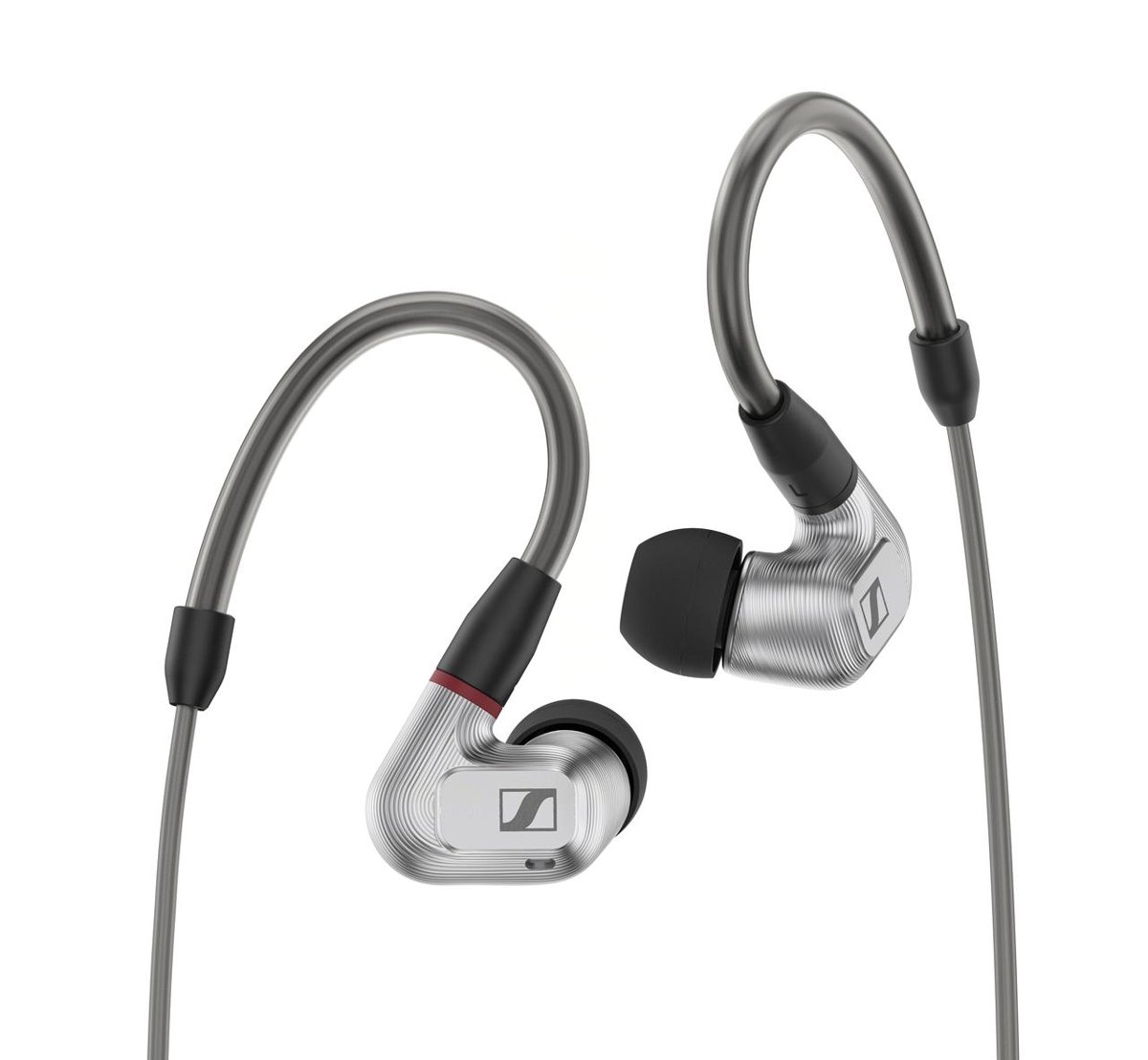
The Sennheiser IE 900 is Sennheiser's wired flagship in-ear. It launched in spring 2021 and is still offered unchanged today. Instead of many drivers, Sennheiser relies on a single 7 mm dynamic transducer whose resonances are tamed by three chambers machined into the aluminium housing. In Sennheiser's official European store it cost €1,399 on 7 November 2026, with a regular price of €1,499. Dearer models in the tier include the Campfire Audio Andromeda 10, the Westone MACH 80 and the Campfire Audio Grand Luna.
The listening review we evaluated awards top marks for sound and comfort and four out of five for build. It praises a detailed, articulate yet entertaining sound but criticises that the cable transmits handling noise and has no remote. In our in-ear ranking the IE 900 sits in the Master tier at rank 15 (index 90) and carries the title Sound Vinyl BotPro Champion because it has the strongest sound evidence in the tier. Its lower rank is mainly due to the high price. That is an AI assessment based on manufacturer data and a published listening review, not a listening impression of our own.
Specs (manufacturer)
| Design | in-ear, wired, single driver |
|---|---|
| Driver | 7 mm, dynamic (X3R), 3 Helmholtz resonators |
| Frequency response | 5 Hz – 48 kHz |
| Impedance | 18 Ω |
| Weight | approx. 4 g per earpiece |
| Housing | machined in one piece from aluminium, made in Ireland |
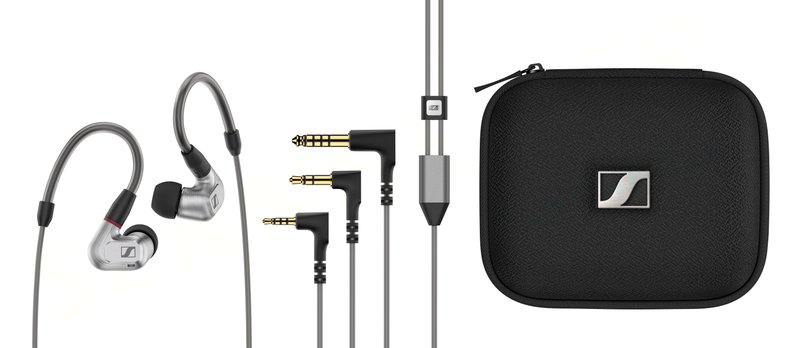
| Cables | 3 × 1.2 m: 3.5 mm, 2.5 mm bal., 4.4 mm bal. |
| Accessories | 3 pairs silicone, 3 pairs foam tips, case |
| Released | 2021 |
| Price | €1,399 in Sennheiser EU store, as of 7 Nov 2026 (regular €1,499) |
Scores in detail
Vinyl BotPro Index 90 (Master 85–97) · sub-scores 0–10, weights 35/20/15/30 · weighted raw score 7.5, mapped within the twelve-model tier onto the 85–97 band: the index shows the order within the tier, not measured differences in sound. Editorial synthesis, not a lab value · Sub-score rationale.
Manufacturer and concept
Sennheiser is one of the most storied headphone manufacturers of all. Since 2022 its consumer headphone business has belonged to the Swiss hearing-aid group Sonova, which continues the Sennheiser brand. The IE 900 was created under the old roof and remains the flagship of the IE series, above the IE 600 and IE 300.
The concept is deliberately purist. Instead of splitting the bandwidth across several drivers and a crossover, a single transducer is meant to cover the entire range from 5 Hz to 48 kHz. The review explains the advantages: without a crossover there are no transitions between drivers, no phase problems and no crossover distortion. The difficulty lies in making a single driver play so evenly that it needs no help from other transducers.
According to the manufacturer, the IE 900 is developed in Germany and made at Sennheiser's plant in Ireland. The housings are machined in one piece from a block of aluminium and assembled by hand by a specialist team.
The technology explained
A 7 mm driver
At 7 mm the driver is comparatively small. Sennheiser calls the driver concept X3R. According to the review, the diaphragm is made of a blend of polymers intended to combine rigidity with low resonance. Small drivers can react quickly but have to move a lot of air for deep bass; the fact that the IE 900 is specified down to 5 Hz shows how much Sennheiser relies on a good seal in the ear canal.
Three Helmholtz resonators
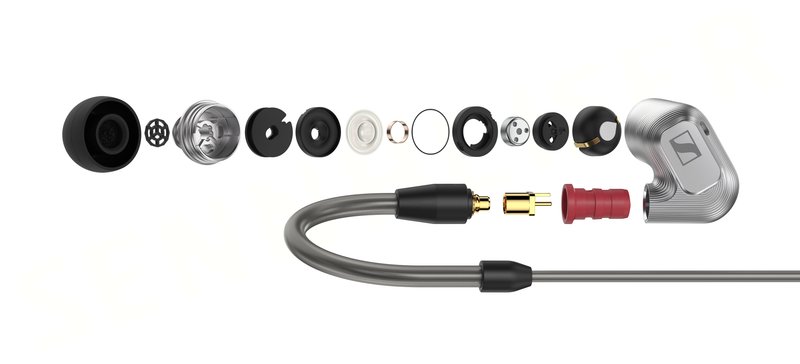
Not all resonances can be controlled through the diaphragm material. Sennheiser therefore machined three small chambers into the housing that act as Helmholtz resonators. They work in the 6.5 to 10 kHz range and absorb the driver's excess energy there. The result, according to the review: a much more even balance. Even the tiny channel that guides the sound from the driver into the ear is shaped to help control the frequency response.
Matched drivers
Left and right drivers are matched during production so that both channels sound as alike as possible. This is meant to produce a stable, focused stereo image. With in-ears sitting directly in the ear canal, differences between left and right are particularly easy to notice.
Manufacturer and review data
The IE 900 has an impedance of 18 ohms and a frequency range of 5 Hz to 48 kHz. Each earpiece weighs about 4 grams. Three 1.2-metre cables are included: one with a 3.5 mm plug and two balanced ones with 2.5 mm and 4.4 mm plugs. The cables are routed over the ear; according to the manufacturer, the ear hooks can be adjusted to the shape of the ear.
Single driver or multi-way: what it means for the sound
At the high end most in-ears use several drivers, often even three different transducer types, as with the Monarch MKIV in this ranking. Multi-way designs have a clear advantage: each driver only has to cover part of the frequency range and can be optimised for it. The price is a crossover that has to bring together the transitions, phase and level of the drivers.
A single driver like the one in the IE 900 sidesteps this task. All frequencies come from the same source and reach the ear at the same time. That favours a particularly coherent, natural sound, as the review describes. The challenge shifts instead to the driver itself and to the housing, which has to compensate for its weaknesses. That is exactly the job of the resonance chambers. Which concept sounds better cannot be said in general; the evidence shows, however, that Sennheiser's approach works very well in this case.
What international reviewers hear
Sound character
The review describes the IE 900 as impressively clear and open. It digs deep into a recording's production, reveals layers of low-level information and organises them into a structured, cohesive whole. Tonally it is well balanced. The overall verdict: the IE 900 combines listenability, insight and comfort and is one of the front runners at its price.
Bass
On bass, the review does not cast the IE 900 as a powerhouse. A similarly priced rival offers more authority and punch in the low end. The IE 900 counters with a more expressive midrange and more verve. With dynamic orchestral music and big swings in volume it captures the music's energy superbly.
Midrange and vocals
In this review the midrange is one of its great strengths; other sources are more critical (see the analysis below). Voices come through with texture and passion, according to the review, and rhythms charge along with enthusiasm. The IE 900 sounds confident and insightful without dissecting the music.
Treble
The work on the Helmholtz resonators pays off, according to the review: the treble is clean and crisp while remaining refined. Precisely in the region where small dynamic drivers often tend towards peaks, the IE 900 sounds controlled.
Source dependency
A central point in the review: the IE 900 is highly revealing. Problems in the source or amplification become audible. It can be used with any 3.5 mm output, but it deserves more than a phone or laptop. The review suggests a high-quality external DAC and advises spending at least as much on the player as on the earphones to hear their full potential.
Weaknesses according to the review
Two points are criticised. The cable transmits noise caused by movement, which is annoying on the move. And none of the three cables has a remote or microphone. There is also a general note: expensive in-ears often look and feel less valuable than they cost because they are so small. Sennheiser has visibly made an effort here, though.
Accessories and everyday use
The box contains six pairs of tips, half silicone and half memory foam, the three cables and a case. With three cables the IE 900 covers all common connections, from smartphone adapter to the balanced output of a portable player or headphone amplifier. Comfort receives top marks in the review: the earpieces are carefully shaped, very light at 4 grams and sit securely thanks to the over-ear cable routing.
In everyday use, cable noise is the main issue. Anyone wearing the IE 900 while walking will hear the cable rubbing and being touched. At a quiet listening position it does not matter.
Price and availability
At the time of the review in May 2021 the IE 900 cost £1,099 or $1,300. In Sennheiser's official European store it was listed at €1,399 on 7 November 2026, with the regular price given there as €1,499. In Germany it is therefore available directly from the manufacturer. For our assessment the high price counts: it is the main reason the IE 900 is in eighth place in the tier despite having the strongest sound evidence.
With an amplifier and a vinyl system
In a vinyl system, what the review says in general applies especially to the IE 900: it reveals the quality of the chain. Hiss, hum or a thin-sounding phono stage become audible. The good news: at 18 ohms and with a single driver and no crossover, it is less sensitive to the source's output impedance than multi-driver in-ears. The tuning is therefore more likely to be preserved with headphone sockets that have a higher output impedance, even if the bass can get a little softer.
In practice: a good low-noise headphone amplifier or a high-quality DAC with a headphone output gets more out of the IE 900 than the headphone socket of a basic integrated amplifier. The balanced cables can be used directly with matching outputs. Anyone listening quietly at the turntable in the evening benefits from the even, non-fatiguing treble and the strong midrange, which matters a lot for voices and acoustic music on vinyl.
Who is the IE 900 for?
The IE 900 suits listeners who are primarily after sound quality, own or plan to buy a high-quality source and value a very light, comfortable in-ear. It suits a quiet listening position, long sessions and all genres, as long as the recording is good.
It is less suitable for mobile use with a lot of movement, because the cable transmits noise, for people who want to make calls and for anyone who only wants to use it with a smartphone. Those who put powerful, punchy sub-bass first will find alternatives with more low-end authority, according to the review.
Comparison with alternatives
Our Master tier now includes eighteen models (list record 12 November 2026). The Meze Advar leads the tier without a badge; the value badge sits with the 64 Audio Aspire 3. The THIEAUDIO Monarch MKIV sits in rank 10 with index 92, with no badge; the Shure SE846 Gen 2 shares index 92 in rank 11, the THIEAUDIO Origin follows in rank 12, and the Campfire Audio Andromeda 10 in rank 14. The Monarch has ten drivers and a tuning switch but no longer holds a badge. The IE 900 is the counter-design: a single driver, no crossover, no switch, but the strongest sound evidence in the tier and still the Sound badge, despite rank 15. The Sennheiser IE 600, the Westone MACH 60, the Campfire Audio Grand Luna and the Westone MACH 80 close the tier.
Within Sennheiser's range the IE 600 and the IE 300 are more affordable models with related technology. In the 12 November 2026 list record the IE 300 sits in the Premium tier and the IE 600 in the Master tier, behind the IE 900.
Images
FAQ
How many drivers does the IE 900 have?
One 7 mm dynamic driver per side. Three Helmholtz resonators in the housing smooth the frequency response between 6.5 and 10 kHz.
Does the IE 900 need a headphone amplifier?
It plays from any 3.5 mm output, but according to the review it deserves a high-quality source, such as a good external DAC.
Which cables are included?
Three 1.2 m cables: 3.5 mm plus balanced 2.5 mm and 4.4 mm. None has a remote.
What does the review criticise about the IE 900?
The cable transmits movement noise, and there is no remote.
Where can I get the IE 900 in Germany?
Directly from Sennheiser's official European store, where it was €1,399 on 7 November 2026. Prices without guarantee.
Why is the Sound Champion in eighth place?
The index weights value at 30 per cent. The IE 900 leads on sound but trails on the value sub-score. The Sound title only rates sound evidence.
Conclusion
On the evidence, the Sennheiser IE 900 is one of the strongest-sounding wired in-ears in its class: clear, open, detailed and entertaining, very light and comfortable. It demands a good source, the cable transmits noise, and several dearer models in the tier sit above its shop price. In the Master tier it holds the Sound title. The basis is manufacturer data and international listening reviews, evaluated one by one in the analysis below, no listening tests or measurements of our own.
Analysis: the Sennheiser IE 900 in depth
What this analysis does and does not do
The section above mainly summarises one listening review. Here we place the Sennheiser IE 900 in a wider context: using Sennheiser's German and English product pages [1][2] and six dated reviews from the UK, Australia, Singapore and the US [3][4][5][6][7][8]. Vinyl BotPro has neither listened to nor measured the IE 900. Statements about sound belong to the named authors; frequency response and isolation figures come from their measurements, not ours. Where we calculate or draw conclusions ourselves, we say so explicitly. The page's rank, index and prices remain unchanged.
The sources differ in age. What Hi-Fi? (May 2021), StereoNET (July 2021) and HardwareZone (August 2021) describe the model shortly after launch [3][4][5]. Audiophilia followed in spring 2022 [6], SoundGuys in 2023 with an update in November 2024 [7], and Headphones.com in January 2024 [8]. Because Sennheiser has offered the IE 900 since 2021 without a new model version, all of them refer to the same product. Headphones.com is also a retailer that sells the IE 900; keep that in mind when reading it.
The technology according to the manufacturer
Sennheiser presents the IE 900 as the result of a deliberate decision: according to Sennheiser, multi-driver systems bring phase issues and distortion in the overlapping frequency bands, so there is only one dynamic transducer [2]. Sennheiser calls the package X3R. It consists of the 7 mm transducer from the TrueResponse family, three Helmholtz resonators milled into the aluminium housing and a structure in the nozzle called the "Vortex", which is meant to swirl acoustic energy in the critical frequency bands and so smooth out peaks [2].
The second element is less well known: an acoustic back volume. Sennheiser describes it as a small chamber within a chamber that controls the slope and amplitude of the bass lift and is meant to separate bass and midrange cleanly [2]. Behind the driver, a tuned volume of air therefore helps decide how much low end reaches the ear canal. That matters for the listening reports below, because with the IE 900 the amount of bass also depends heavily on fit.
Sennheiser told StereoNET that the resonator chamber technology was first used in the IE 800 in 2012, three years later in the HD 800 S and after that in the closed-back HD 820 [4]. HardwareZone learned that the 7 mm driver is closely related to the one in the cheaper IE 300; according to Sennheiser, the difference lies in the resonators, the more elaborate airflow management and the larger vents [5]. The IE 900 is therefore less a new driver than a new acoustic environment for a proven one.
Housing, cables and manufacturing
According to Sennheiser, each housing is cut individually from a block of aluminium on a five-axis CNC machine and then anodised, which is meant to make it resistant to wear and corrosion [2]. The drivers are matched in pairs in an automated process [2]. Headphones.com found almost identical channel matching on its sample, but itself stresses that this is a single unit [8].
According to Sennheiser, the MMCX sockets sit in a recessed 4.8 mm wide housing that provides strain relief; the cables are para-aramid reinforced and are meant to withstand many thousands of bend cycles [2]. That recess becomes a drawback in two reviews: HardwareZone and Headphones.com report that many aftermarket cables with flush MMCX plugs do not fit [5][8]. With the stock cables, Headphones.com also had occasional brief dropouts when moving its head [8]. HardwareZone describes the cables themselves as sturdy but stiff and rubbery [5]; What Hi-Fi? and StereoNET both criticise microphonics, meaning noise that travels up the cable into the ear when it is touched [3][4].
There is a contradiction about the place of manufacture between older and newer statements. HardwareZone (2021) and Audiophilia (2022) write that the IE 900 is made, or assembled by hand, in Germany [5][6]. The current product pages, by contrast, state development in Germany and manufacture at Sennheiser's plant in Ireland, which according to Sennheiser also builds the HD 800 S, HD 820, HD 650 and HD 600 [1][2]. We follow the current manufacturer statement; whether the location changed or the early reviews were inaccurate cannot be settled from the sources.
Spec sheet: what is documented and where it falls short
Sennheiser specifies a frequency range of 5 Hz to 48 kHz, total harmonic distortion of 0.05 % at 1 kHz and 94 dB, and a sound pressure level of 123 dB at 1 kHz and 1 volt [1][2]. On impedance, the German product page is not consistent: the feature list says 18 ohms, the data table 16 Ω [1]. StereoNET also gives 16 ohms [4]. In practice the difference is small; we keep the page's 18 Ω and point out the discrepancy. Sennheiser lists the cable length as 1.25 m [1]; above it is rounded to 1.2 m.
A calculation of our own from the manufacturer data: 123 dB at 1 volt means roughly 103 dB at 0.1 volt. The IE 900 therefore gets loud with very small voltages. That is convenient for phones but has a downside, which we return to in the section on vinyl systems. SoundGuys notes soberly about the frequency range that values below 20 Hz and above 20 kHz hardly matter for listening [7]. The span indicates the bandwidth of the driver; it is not an audible advantage in itself.
Where the sources agree on sound
Almost all reviews agree on resolution and treble. What Hi-Fi? describes a detailed, articulate sound [3], StereoNET an "incredibly detailed, airy" character [4], HardwareZone a well-extended, smooth treble without harshness or sibilance [5]. Audiophilia highlights detail and sparkle in the upper registers without harshness [6]. Headphones.com sees the treble elevated broadly between about 6 and 10 kHz and calls it "spicy", but by and large kept in check [8]. That fits Sennheiser's aim of taming resonance peaks in this range with the resonators.
Praise for build and comfort is just as unanimous. To HardwareZone the housing feels almost indestructible, and at around 4 grams it is so light that you barely notice it [5]. SoundGuys praises the passive isolation: in its measurement the IE 900 attenuates outside noise across the whole spectrum by at least around 10 dB and in the upper mids and treble by up to around 45 dB [7].
Where the sources disagree: bass and midrange
On bass, the verdicts diverge widely. Headphones.com considers it possibly the best bass an in-ear currently offers, with lots of texture and depth [8]. StereoNET, by contrast, describes the overall sound as rather lean and missed some impact on an electronic track [4]. What Hi-Fi? places it in between: not the powerhouse of the class, but engaging [3]. HardwareZone calls the bass tastefully elevated, tight and punchy [5].
The sources themselves suggest an obvious explanation. SoundGuys writes that the bass disappears as soon as the earpieces shift in the ear, and that you should insert them deeper than you first think [7]. Headphones.com reports that the supplied silicone tips only sealed in its ears when positioned exactly, and that the nozzle sits at a somewhat awkward angle [8]. If the seal succeeds so differently from ear to ear, it is plausible that the amount of bass also varies strongly between listeners. That is our conclusion, not a measurement.
The dispute over the midrange is even clearer. What Hi-Fi? praises an expressive midrange [3], and Audiophilia calls the mids forward and detailed [6]. Headphones.com, on the other hand, considers the midrange the biggest weakness: the lift the ear naturally produces is placed too early at about 1.5 kHz, presence is missing around 3 kHz, and voices therefore sound somewhat congested and nasal [8]. HardwareZone also hears unevenness in the mid to upper mids, with vocals sounding breathier and more hollow than they should [5]. In its measurement SoundGuys describes the same region as a largely missing lift in the presence range, but finds the result pleasant and not very fatiguing; only some female voices lost a little detail [7]. If you listen to a lot of vocals, you should therefore audition the IE 900 before buying.
Ear tips, fit and counterfeits
The supplied silicone and foam tips contain a small foam filter that, according to Headphones.com, slightly tames the treble [8]. If you switch to tips from other makers, you lose this filter and may hear a slightly brighter sound. Headphones.com still recommends trying different tips, because they matter more with the IE 900 than with many other in-ears [8]. SoundGuys likewise recommends third-party tips in case of fit problems, because a poor fit harms both isolation and sound [7].
Headphones.com also warns of counterfeits in circulation and advises buying from reputable dealers [8]. According to SoundGuys, every genuine unit comes with a signed certificate of authenticity carrying the serial number, which also appears on the case [7]. Both are simple plausibility checks when buying second-hand.
With a turntable: what matters
For vinyl listeners, the high sensitivity is the most important point. If 0.1 volt is already enough for around 103 dB, any noise floor of a headphone jack becomes very audible. Many integrated amplifiers deliver high voltages at their headphone jack for high-impedance over-ear headphones; for such a sensitive in-ear that is not a good match. A low-noise headphone output with fine volume control at the bottom of its range suits it better. That is our assessment based on the manufacturer data.
StereoNET recommends a high-quality source with low output impedance for the IE 900 [4]. With a single driver and no crossover, output impedance usually affects the tuning less than with multi-driver in-ears; noise remains an issue, though. The good isolation reported by SoundGuys has a pleasant side effect at the turntable: mechanical noise from the deck and room noise recede into the background [7]. At the same time, the resolution and bright treble praised by several sources make crackle and surface noise on a record clearly audible. On a streamed track, StereoNET even noticed vinyl crackle mixed into the recording that it had previously missed [4].
Our conclusion on the evidence
Eight sources give a clearer picture than a single listening review. Exceptional build quality, very low weight, strong passive isolation, high resolution and extended treble are well documented. The amount of bass and the midrange are disputed, and with the IE 900 fit apparently matters more than with many other in-ears. The points of criticism are cable noise, the recessed MMCX sockets and the high price. The broader evidence therefore confirms the Sound title in the Master tier, but makes it clearer that the IE 900 is not a headphone to buy unheard.
Sources for this analysis
- Sennheiser: IE 900 (Produktseite EU-Shop, deutsch, abgerufen/accessed 09.11.2026). https://eu.sennheiser-hearing.com/de-de/products/ie-900
- Sennheiser: IE 900 (product page, English, abgerufen/accessed 09.11.2026). https://www.sennheiser-hearing.com/en-US/p/ie-900/
- What Hi-Fi?: Sennheiser IE 900 review (17.05.2021). https://www.whathifi.com/reviews/sennheiser-ie-900
- StereoNET: Sennheiser IE 900 In-ear Headphones Review (Matthew Jens, 08.07.2021). https://www.stereonet.com/reviews/sennheiser-ie-900-in-ear-headphones-review
- HardwareZone Singapore: Sennheiser IE 900 review: Aiming for the summit (Kenny Yeo, 19.08.2021, republished 10.04.2024). https://www.hardwarezone.com.sg/lifestyle/audio/review-sennheiser-ie900-iem-headphones-review-singapore-price
- Audiophilia: Sennheiser IE 900 IEM (Charles Brown, 03/2022). https://www.audiophilia.com/reviews/2022/3/29/jbtrk8yh1d7yy735lywjpvli90kg8f
- SoundGuys: Sennheiser IE 900 review (Jasper Lastoria, 20.07.2023, updated 28.11.2024). https://www.soundguys.com/sennheiser-ie-900-review-58946/
- Headphones.com: Sennheiser IE 900 Review: This is the Bass I've Been Looking For! (Caleb Loo, 16.01.2024). https://headphones.com/blogs/reviews/sennheiser-ie-900-review-this-is-the-bass-ive-been-looking-for
Created by AI (Vinyl BotPro) from the sources listed; no listening tests or measurements of our own. Detailed human fact-check pending.
About this analysis
The review we evaluated dates from May 2021. Sennheiser has offered the IE 900 unchanged since then, so we still consider it meaningful. The euro price comes from Sennheiser's official European store on 7 November 2026. All images come from the manufacturer's product page and show the IE 900, its accessories and its construction. The sub-scores and their rationale are listed for every model in the ranking.
Sources
Created by Vinyl BotPro (AI) · As of 7 Nov 2026 · All information without guarantee.