
In-ear analysis · Expert · as listed
Softears Edge Analysis
The Softears Edge sits on the in-ear shortlist of 12 November 2026 in the Expert tier, now expanded to seventeen models, in rank 4 with a Vinyl BotPro index of 82 and no tier badge. This analysis takes the list record as published and does not run a second calculation.
In brief
The Softears Edge is a wired dynamic universal-fit in-ear with an 11 mm driver, a CNC-machined titanium housing, a 16 Ω impedance and 128 dB/Vrms sensitivity. On the in-ear shortlist of 12 November 2026 it sits in the Expert tier, now expanded to seventeen models, in rank 4 with a Vinyl BotPro index of 82 and no tier badge. The subscores and the linear mapping onto the 70–84 band are documented in the list package; this page repeats the list record and does not run a second calculation.
The listening reports come from Headfonics (Marcelo, 24 July 2026) and Headfonia (Kazi, 9 November 2026): two dated listening reviews of the exact model in independent international online specialist outlets of the same class already used for other in-ears on this list. Under the single badge rule of 12 November 2026 — including addendum t647s3962 — the Edge is eligible; its pillars are the written reviews, not a video. The documented euro price is €395.00 at linsoul.de (12 November 2026, JSON-LD InStock; no lasting stock guarantee). The €447 figure quoted by Headfonia is not used as the list price.
Technical data (published)
| Construction | Wired universal-fit in-ear, 11 mm dynamic driver in a CNC-machined titanium housing with a labyrinth acoustic structure (Softears / Headfonics) |
|---|---|
| Impedance | 16 Ω (Softears / Headfonics) |
| Sensitivity | 128 dB/Vrms (Softears / Headfonics) |
| Weight | 7.6 g per shell; 5.5 mm nozzle (Softears / Headfonics / Headfonia) |
| Connector | 0.78 mm 2-pin (plastic plug), supplied 7N OCC silver-plated cable with a 4.4 mm plug (Headfonics / Headfonia) |
| Price as of | €395.00 at linsoul.de, 12 November 2026 (JSON-LD InStock; no lasting stock guarantee) |
Amplifier compatibility
At 16 Ω and 128 dB/Vrms, both reviews describe the Edge as easy to drive. Headfonia adds that the same efficiency makes the set hiss-prone: very quiet outputs are advisable. The drive score of 8.2 sits below the 8.6–8.8 of the most sensitive Premium neighbours, but clearly above more drive-hungry sets. Level is not an issue on typical phono chains and portable sources; the issue is hiss rather than under-driving.
The supplied cable carries a 4.4 mm plug. On typical phono chains with an unbalanced headphone output an adaptor or a 3.5 mm cable is needed; neither is documented here as a shop item. Headfonics highlights synergy with suitable sources (Synergy 8.9) and describes the set as uncomplicated for level, so long as the source stays quiet.
Scoring criteria in detail
The Vinyl BotPro index on this page is not a second calculation; it is the list record of 12 November 2026. The Expert tier holds seventeen models; the mapping uses the 70–84 band linearly across the unrounded raw score. Shared indices within a tier are allowed; rank remains unique (higher index first, then higher sound-evidence score, then lower documented euro price, then alphabetical name).
The sound-evidence score of 7.5 rests on two specialist texts: Headfonics awards Sound Quality 8.5, Award 8.6, Design 8.6, Comfort 8.4 and Synergy 8.9, and describes subwoofer-like bass, a spacious stage, clean mids and treble, and imaging that is not among the most defined. Headfonia awards 4.2 out of 5, names a bassy presentation with treble sparkle and boosted upper mids, midrange compromises, isolation below average because of the vents, and a pronounced dependence on tips. Just below Iris (7.6), above Aspire 1 (7.2) and Blessing 3 (7.3). Build/comfort of 8.2 follows from the praised titanium housing, 7.6 g per shell and the Comfort score of 8.4, with documented tip sensitivity and isolation below average. Drive of 8.2 follows from easy drive and the documented hiss sensitivity. Value of 7.6 follows from €395.00, behind Blessing 3 (€271.99, P 8.2) and Aspire 1 (€348.00, P 8.0). The raw score of 7.835 maps to index 82; rank 2 follows behind Iris (index 84, Sound badge).
The manufacturer and the concept
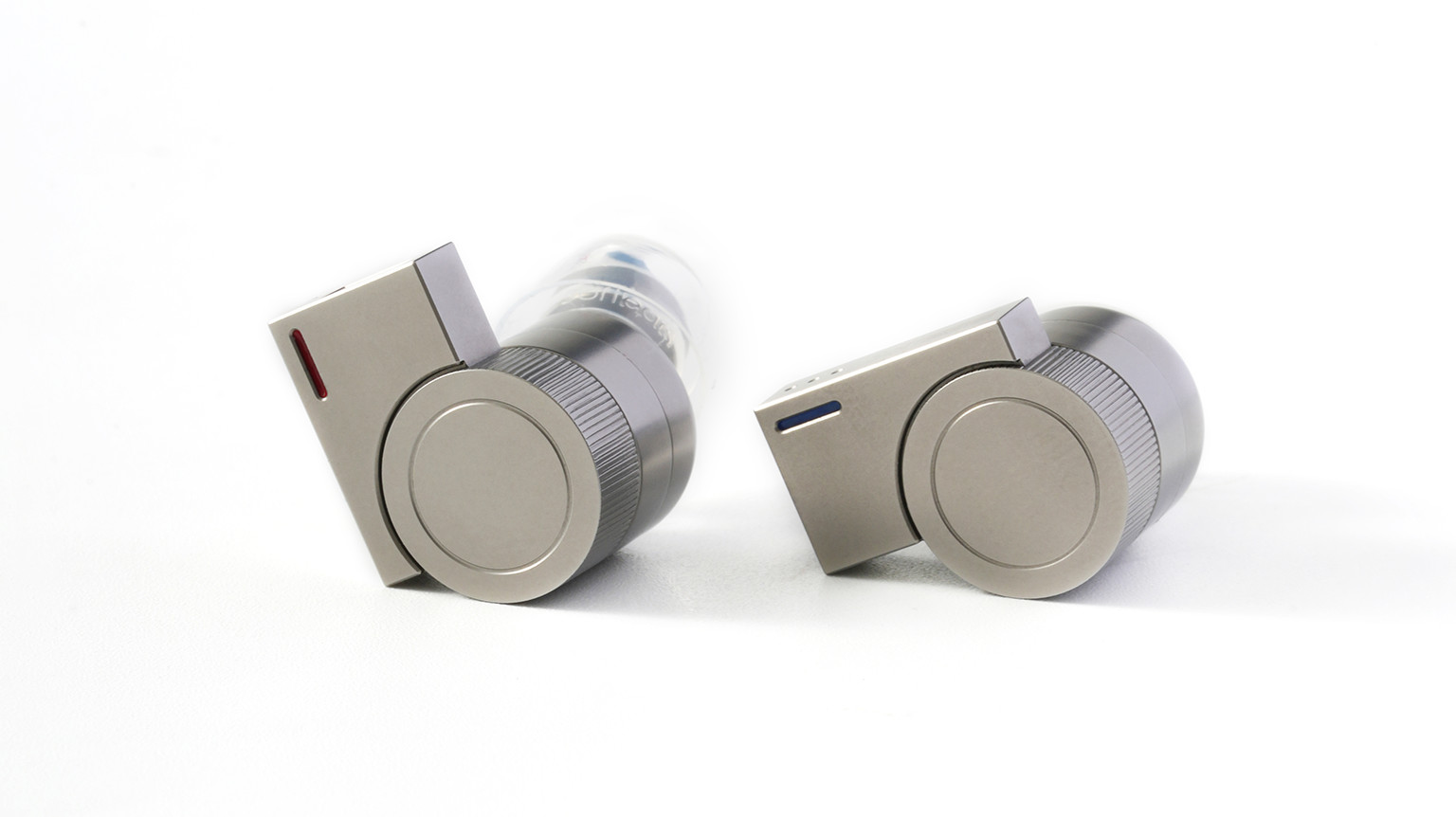
Softears presents the Edge as a dynamic in-ear in a CNC-machined titanium housing, with a labyrinth acoustic structure, 7.6 g per shell and a 5.5 mm nozzle. Headfonics and Headfonia expressly praise the build; Headfonics awards Design 8.6. The official packshot on this page is a studio photograph from the Softears product page (photo: manufacturer).
Headfonics describes the housing as three glued, CNC-machined titanium parts — nozzle and front chamber, rear chamber and the labyrinth structure — and sees in the rectangular body with a circular nozzle a resemblance to the Sigma BF camera. Headfonia places the Edge as the brand’s third single dynamic driver after the Turii and the Twilight, with the titanium housing of the dearer flagships, but a clearly lower price in the reviews (US$499; only the documented euro price of €395.00 is used).
The concept is a single 11 mm dynamic driver rather than a multi-way BA array. The reviews read the set as a bass-forward, spatially open dynamic in-ear with a clean upper half, not as a dissecting multi-way tool. The supplied cable is 7N OCC silver-plated with a 4.4 mm plug and a plastic 2-pin connector; Headfonics and Headfonia mention both factually, without making the cable the central argument.
The technology, explained
The 11 mm dynamic driver sits in a CNC-machined titanium housing with a labyrinth acoustic structure. Headfonics quotes 16 Ω and 128 dB/Vrms; Headfonia confirms the easy drive and adds the hiss sensitivity. The vents that Headfonia holds responsible for isolation below average are part of the housing design. This analysis has no measurements of its own; the figures come from the manufacturer and the reviews, read on 12 November 2026.
The labyrinth structure is, according to both reviews, meant to lead the driver’s rearward radiation along a winding path and to dissipate unwanted reflections in the lower midrange and bass; Headfonics compares the idea, factually, with the bass labyrinth of the B&W Nautilus loudspeakers, without treating that as a sonic equivalence. Headfonics also names a pressure-relief system that is meant to prevent a build-up of pressure in the ear. The same venting that relieves pressure is, on Headfonia, what makes isolation sit below average.
The nozzle measures 5.5 mm; Headfonia describes a pronounced dependence on tips. The fit still depends on the ear; this analysis does not attempt a sitting of its own. The titanium housing at 7.6 g per shell remains the central build argument in both reports.
What the international specialist press hears
Tonal character
Marcelo describes subwoofer-like bass, a spacious stage and clean mids and treble. Imaging is not among the most defined, but it sits inside an overall spatially open picture. Headfonia reads the same set as bass-forward, with treble sparkle and boosted upper mids, and names midrange compromises. Both reports meet on a physical foundation and a clean, not neutral, upper half.
The differences sit in the weighting: Headfonics highlights stage and cleanliness and awards Sound Quality 8.5; Headfonia stresses the midrange compromises and tip sensitivity more strongly and lands at 4.2 out of 5. The sound-evidence score of 7.5 records both findings without letting one text overrule the other.
Tonal balance
Bass quantity carries both reports; the midrange is, on Headfonics, rather clean, and on Headfonia the place of the compromises; the treble brings sparkle without standing at the centre as sharp. That yields a bass-forward, spatially open dynamic in-ear, not a linear studio tool. Anyone wanting neutrality in the Expert tier stays closer to Iris; anyone wanting body and stage will find the Edge immediately behind it.
This balance supports the value subscore of 7.6: €395.00 sits above Blessing 3 and Aspire 1, with a sound-evidence score that sits above both. The tier’s value badge therefore goes to Blessing 3 (P 8.2), not to the Edge.
Dynamics, staging and drive
Headfonics describes a spacious stage and a subwoofer-like foundation; imaging stays behind the most defined sets in the class. Drive is easy; the limit is hiss on restless outputs, not a lack of level. Headfonia adds that the vents push isolation below average — that can limit usable dynamics in a noisy room without changing the tonal character itself.
Strengths and limits
Strengths in the reviews: a titanium housing and low weight, subwoofer-like bass, a spacious stage, a clean upper half, easy drive, and Headfonics scores between 8.4 and 8.9. Limits: imaging that is not among the most defined, midrange compromises on Headfonia, hiss sensitivity, isolation below average, tip sensitivity, and a stock cable that is 4.4 mm only. On the list of 12 November 2026 the Edge carries no tier badge: the Sound badge sits with Iris (K 7.6), the value badge with Blessing 3 (P 8.2).
Research consensus
This analysis has two full specialist listening reviews: Headfonics (Marcelo, 24 July 2026) and Headfonia (Kazi, 9 November 2026). The consensus, read against the data sheet and the euro price, is an easy-to-drive, hiss-sensitive titanium dynamic in-ear with subwoofer-like bass, a spacious stage, a clean upper half, documented midrange compromises, isolation below average and tip sensitivity, at €395.00 in the EU. Eligibility follows from the single rule of 12 November 2026, including t647s3962. Forums, retailer copy or manufacturer pages do not serve as a listening pillar. The Edge carries no tier badge; the Sound badge sits with Iris, the value badge with Blessing 3.
Accessories and use
Both reviews praise the build of the titanium housing; Headfonics awards Comfort 8.4 and Design 8.6. Headfonia also stresses tip sensitivity and isolation below average because of the vents. The fit depends on the ear and the tip; this analysis does not attempt a sitting of its own.
In the box is a 7N OCC silver-plated cable with a 4.4 mm plug and a plastic 2-pin connector. A 3.5 mm cable is not documented as a stock item in the sources read. The official packshot shows the exact titanium shells.
The three glued titanium parts and the low weight of 7.6 g per shell remain the build argument in both reviews; the plastic 2-pin connector and the exclusively supplied 4.4 mm cable are the documented compromise in the kit. Anyone using typical phono chains with a 3.5 mm socket will need to plan for a suitable cable or an adaptor in addition.
Price and availability
The documented euro price is €395.00 at linsoul.de on 12 November 2026, marked InStock in the JSON-LD. The InStock mark is not a lasting stock guarantee. The €447 figure quoted by Headfonia is not used as the list price. Prices and availability change, without guarantee.
In the Expert tier, €395.00 sits above Blessing 3 (€271.99, P 8.2) and Aspire 1 (€348.00, P 8.0) and below the SA6 MK2 (€492.15, P 7.2). The value subscore of 7.6 is not enough for the value badge, which sits with Blessing 3. The Edge carries no tier badge on this list.
On an amplifier and on a vinyl system
As a wired in-ear the Edge hangs directly from a typical phono chain only if a 3.5 mm cable or an adaptor is available; the stock cable is 4.4 mm. Drive is treated as easy; the limit is hiss on restless outputs. A quiet phono stage or a quiet headphone output is, on Headfonia, advisable.
Anyone listening to records will find a bass-forward, spatially open tuning with a clean upper half and documented midrange compromises. Isolation below average can get in the way in a noisy room; tip sensitivity should be previewed before a purchase. This analysis does not set up a system of its own.
The pressure relief that Headfonics describes as comfortable, and the isolation below average that Headfonia records, belong firmly to the design: anyone listening to records in a quiet room will more readily benefit from the lack of pressure; anyone listening in a noisier room should preview the isolation. The labyrinth structure remains, in both reports, an argument for controlled bass, not for isolation.
Who is the Softears Edge for?
The Edge suits listeners who want a bass-forward, spatially open dynamic in-ear in titanium in the Expert tier, who are planning €395.00 and who will live with a 4.4 mm cable and a degree of hiss sensitivity. Anyone wanting the tier’s highest sound evidence stays with Iris (rank 1, index 84, Sound badge). Anyone wanting the tier’s value argument stays with Blessing 3 (rank 8, index 79, value badge). In this list record the Edge sits in rank 4 at index 82, with no badge.
Anyone wanting more defined imaging, strong isolation or a linear midrange should read both reviews against Iris, the SA6 MK2 and Blessing 3.
How it compares
Inside the Expert tier the Edge sits immediately behind Iris (rank 1, index 84, Sound badge) and ahead of Aspire 1 (rank 6, index 81). The SA6 MK2 and Blessing 3 share index 79 below; Blessing 3 carries the value badge. The raw score of 7.835 sits clearly below Iris (7.91) and clearly above Aspire 1 (7.8); the linear mapping places it at 82, with no artificial gap.
Two specialist texts carry this placement; that sets the Edge apart from neighbours with only one listening pillar. For the list work, the comparison that counts is with the documented Expert neighbours: more spacious and more bass-forward than many multi-way sets in the tier, dearer than Blessing 3 and Aspire 1, without their value argument and without Iris’s Sound badge.
Headfonics also sets the Edge against other single dynamic in-ears outside this list; those side glances explain bass and midrange, but they do not replace the list comparison. What counts is the place immediately behind Iris: more spacious and more bass-forward than many multi-way sets, with a titanium housing and a labyrinth structure, with documented hiss sensitivity and isolation below average.
Place on the expanded list
With the Edge, the SA6 MK2 and Blessing 3 the Expert tier expands from six models to nine. The Vinyl BotPro index of the Edge is 82, rank 2, with no tier badge. All nine models in the tier are eligible under the single rule. The Sound badge stays with Iris (K 7.6). The value badge moves from Aspire 1 to Blessing 3 (P 8.2). The unrounded raw score is mapped linearly onto the tier band; shared indices are allowed, and rank remains unique.
FAQ
What exactly is the Softears Edge?
A wired dynamic universal-fit in-ear with an 11 mm driver in a CNC-machined titanium housing, 16 Ω, 128 dB/Vrms and a supplied 4.4 mm cable.
Does the Edge need a headphone amplifier?
Not as a requirement for level, on either review. It is easy to drive, but hiss-sensitive; very quiet outputs are advisable. The stock cable is 4.4 mm.
Is it suitable for listening to records?
Yes, as a wired in-ear, provided a 3.5 mm cable or an adaptor is available on typical phono chains. The reviews describe a bass-forward, spatially open tuning; a quiet source is advisable. The cable is not a substitute for a phono stage.
What does the Edge cost?
At linsoul.de the price on 12 November 2026 was €395.00 (JSON-LD InStock, with no lasting stock guarantee). The €447 figure quoted by Headfonia is not used as the list price. Prices change, without guarantee.
Why does it carry no tier badge?
The Expert tier’s Sound badge sits with Iris (K 7.6), the value badge with Blessing 3 (P 8.2). The Edge, at K 7.5 and P 7.6, sits just behind on sound evidence and clearly behind on the value argument.
Why do two reviews count?
Headfonics (24 July 2026) and Headfonia (9 November 2026) are two dated listening reviews of the exact model in independent international specialist outlets. Both carry the placement; neither overrules the other.
Does this page rest on a listening test by the VinylCination team?
No. There was no in-house listening test and no measurement of our own. The assessment draws on Softears and the listening reviews by Headfonics (Marcelo, 24 July 2026) and Headfonia (Kazi, 9 November 2026). The list figures (Expert, rank 4, index 82, no badge) come from the list package of 12 November 2026.
Conclusion
The Softears Edge is a clearly documented dynamic titanium in-ear for the expanded Expert tier: bass-forward and spatially open, with a clean upper half, documented midrange compromises, easy drive, hiss sensitivity and isolation below average, at €395.00 in the EU. The list record of 12 November 2026 is Expert rank 4, index 82, with no tier badge — immediately behind Iris, ahead of Aspire 1, without Blessing 3’s value argument. Anyone wanting body, stage and a titanium housing will find two solid specialist texts here. Anyone wanting neutrality, isolation or the tier’s value argument should read the same reports against Iris and Blessing 3.
About this AI analysis
This section is an AI summary of published international listening reviews and the manufacturer’s published figures. Vinyl BotPro places those findings against the data sheet, a documented euro price and the list record; VinylCination does not conduct in-house listening tests or measurements, and every source is linked at the end of the page. Prices and availability change (as of 12 November 2026, without guarantee). Subscores and the index come from the list package of the same day. The Vinyl BotPro index maps the unrounded raw score linearly onto the tier band; equal or closely spaced raw scores may share an index.