
In-ear analysis · Premium · as listed
Sony IER-M500 Analysis
The Sony IER-M500 sits on the in-ear shortlist of 12 November 2026 in the Premium tier, now expanded to thirty-four models, in rank 1 with a Vinyl BotPro index of 69 and the tier’s Sound badge. This analysis takes the list record as published and does not run a second calculation.
In short
The Sony IER-M500 is a wired universal-fit in-ear with a single 5 mm dynamic driver in a light plastic shell, intended as a stage and studio monitor. On the in-ear shortlist of 12 November 2026 it sits in the Premium tier, now expanded to thirty-four models, in rank 1 with a Vinyl BotPro index of 69 and carries the tier’s Sound badge. The subscores and the mapping onto the 55–69 band are documented in the list package; this page repeats the list record and does not run a second calculation.
The listening report is SoundStage! Solo (Geoffrey Morrison, 15 October 2026): a dated review of the exact model in a t646u magazine, Sound 8.5/10, Value 9.5/10. Under the single badge rule the IER-M500 is eligible. The Premium value badge sits with the DUNU Titan S2. The Sound badge moves from the Meze Alba to the IER-M500 even though both have the same published Sound score of 8.5/10 and therefore the same sound-evidence score of 7.6: when the best remaining K is tied, the higher raw score decides (8.2 against 8.1). The documented euro price is €118.00 at thomann.de for the black variant (12 November 2026). SoundStage! Solo quoted €115 or US$119.99 in early October 2026; the dollar price is not converted.
Technical data (public)
| Type | Universal-fit in-ear, wired, single 5 mm dynamic driver, sealed housing (Sony) |
|---|---|
| Impedance | 16 Ω (Sony Electronics, IER-M500/B product page, 12 November 2026) |
| Sensitivity | 103 dB/mW (Sony) |
| Frequency response | 10 Hz–40,000 Hz, marked as Hi-Res Audio (Sony) |
| Weight | about 6.9 g per side without the cable (Sony) |
| Connection | Detachable 1.6 m cable with an L-shaped 3.5 mm mini-plug (Sony; also Thomann) |
| Colours | Black, Clear, and Red & Blue (Sony; availability varies by retailer and region) |
| Price as documented | €118.00 at thomann.de, black variant, 12 November 2026 |
Amplifier compatibility
At 16 Ω and 103 dB/mW the IER-M500 sits in the easy-to-drive range. Morrison already reached levels on a weak Sony NW-A306 that he considered higher than safe for extended listening. A dedicated headphone amplifier is not a requirement on this record. The official cable ends in an L-shaped 3.5 mm plug and therefore hangs directly from typical phono chains. SoundStage! Solo refers to a removable MMCX cable and a length of 6 ft (1.8 m); the official specification (and Thomann’s listing) is a detachable 1.6 m cable with an L-shaped 3.5 mm plug. This analysis follows the manufacturer for connector and length and records the difference, without adjudicating it where the review offers no measurement.
Rating criteria in detail
The Vinyl BotPro index on this page is the list record of 12 November 2026. The Premium tier now holds thirty-four models on 55–69: IER-M500 69 (Sound), Meze Alba 68, Moondrop Aria 2 67, beyerdynamic DT 30 IE 67, DUNU Titan S2 67 (value), LETSHUOER S12 64, Sennheiser IE 200 62, Westone Pro X10 59, Final E5000 55, Sennheiser IE 300 55. The IER-M500 leads with a raw score of 8.2, ahead of the Alba and Aria 2, which both round to 8.1; between those two, the Alba’s higher K subscore (7.6 against 7.4) decides ranks 2 and 3.
The sound-evidence score of 7.6 rests on Sound 8.5/10 — the same published Sound score as the Alba, whose K of 7.6 is therefore not revised after the fact. Morrison calls the IER-M500 “fantastic”, “neutral, uncolored” across the band, with a little more upper bass than strict neutrality, without muddying the sound, and with a clear treble that is not crystalline or sharp, intended for long sessions. Build/comfort 7.8 follows from 6.9 g, a very comfortable fit, the fitting supporter, isolating tips, ear hangers and clip, in utilitarian plastic rather than the Alba’s zinc-aluminium (V 8.0). Drive 8.8 follows from 16 Ω, 103 dB/mW and the easy drive in the review, just below the Alba’s 9.0 (109 dB/mW). Value 8.8 follows from €118.00 and Value 9.5/10, above the Alba’s 8.4 (€159.00) and below the Aria 2’s 9.0 (€93.50). That is why the IER-M500 holds the Sound badge, not the value badge.
Manufacturer and concept
Sony positions the IER-M500 as a professional in-ear monitor, developed with monitoring engineers: a secure fit with Sony’s own fitting supporter, isolating earpieces, flexible ear hangers and a clip, and a sealed acoustic design for quiet monitoring on stage. Morrison draws a parallel with the familiar MDR-7506 studio headphones: not exotic, but “cheap, and it lasts.” Inside the shell is a single 5 mm dynamic driver. The official page also mentions reliable monitoring, a durable connector and three colour variants. Those are manufacturer claims, read against a listening review that treats exactly this plainness as a strength.
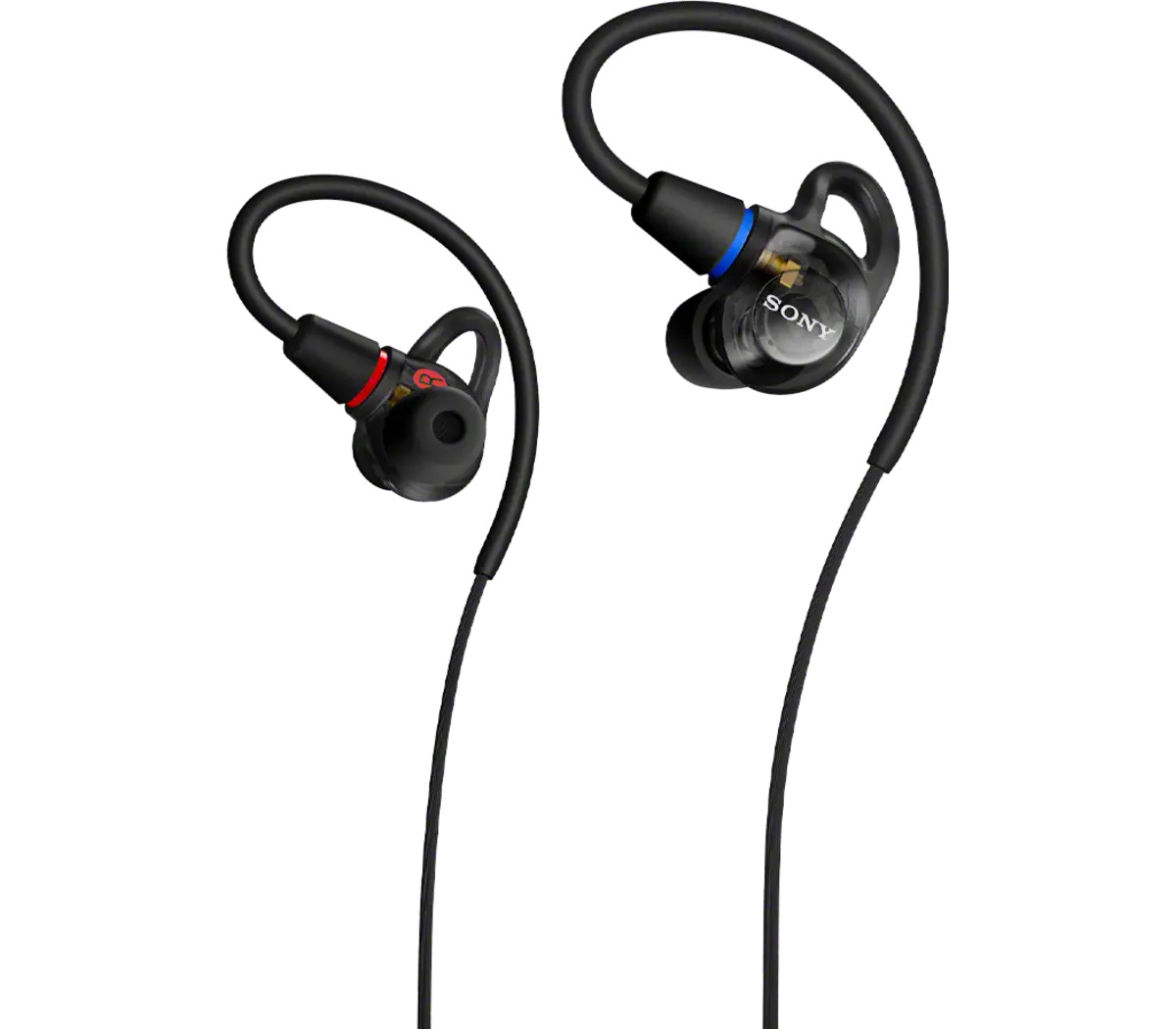
The review samples were a smoky, semitransparent black; Sony also offers a Clear finish and a practical red-and-blue version (red on the right, blue on the left). Which colour a shop stocks depends on the retailer and the region.
How the technology works
A 5 mm single dynamic driver is unusually small. Sony points to a sealed internal acoustic design meant to reduce outside noise and allow balanced monitoring. 16 Ω and 103 dB/mW, 10 Hz to 40 kHz and 6.9 g without the cable come from the official product page (electronics.sony.com, IER-M500/B, retrieved 12 November 2026), as do the L-shaped 3.5 mm plug and the 1.6 m cable length. This analysis has no measurements of its own. Hi-Res Audio is a manufacturer label tied to the frequency response, not a lab judgement on this page.
The carton, according to Sony and Morrison, includes several sizes of isolating foam tips and silicone wings, plus a small case and a clip. Morrison stresses that a tight fit is crucial in loud environments, and that he already found one with the preinstalled parts — “which hardly ever happens.”
What the international specialist press hears
Character
Morrison warns against negative expectations because of the utilitarian look, the low price and the small driver, and then contradicts them: these in-ears sound fantastic. The presentation is uncolored and balanced across the band; he has heard far more expensive earphones with a far less balanced sound. On Gener8ion’s “Storm II” the voices stayed clear, the bass full and well controlled, perhaps with a little more upper bass than perfect neutrality, without muddying the sound. The percussion had snap without the edge that would have made the M500 overly lively or “exciting” — for professional sessions that may last several hours, he thinks that is the right tuning. The treble is clear without being crystalline or, to his ears, annoying.
Tonal balance
On Himiko Kikuchi’s “Look Your Back!” the horns had sharp blasts without being piercing. The slap bass and percussion were tight and full, not boomy. The electric piano blended across its range, the soundstage was decently wide, and heavily panned hits appeared out over the shoulders. Tracy Chapman’s “Give Me One Reason” was nicely warm, perhaps in part because of the extra upper bass; the voice sat dead centre and clear.
Dynamics, bass and stage
In the comparison with the Meze Alba (US$159) — Morrison’s most recent favourite in this price range, though not intended as a stage monitor — the text draws a clear line: for treble lovers the Alba is the better pick, for bass lovers the Sony. In that pairing the IER-M500 remains the more sober, less coloured monitor, the Alba the slightly more treble-friendly everyday in-ear. Both carry the same SoundStage! Solo Sound score of 8.5/10; the Alba also has a Reviewers’ Choice award, which does not raise the same subscore on our list.
Strengths and limits
In the conclusion the IER-M500s are fantastic, inexpensive in-ears and an example of how far clever design and the right tuning can go. You can spend more to get better-looking and better-sounding in-ears, but these sound great for very little money. They may be labelled “for musicians,” but they are for anyone who wants comfortable wired in-ears that deliver neutral sound. Value 9.5/10 underlines exactly that judgement. A limit lies in the utilitarian plastic and the absence of a metal or leather claim; that is a build point, not a sound point, and it explains the gap to the Alba’s V 8.0.
Research consensus
The source is a SoundStage! Solo listening review with high scores, not a second international magazine report of the same depth. The consensus: a light, very comfortable, easy-to-drive monitor with an uncolored presentation, a slightly lifted upper bass, clear treble that is not sharp, and a very strong value judgement at €118.00. The model is eligible. The tier’s value badge stays with the still cheaper Aria 2 (P 9.0). The Sound badge falls to the IER-M500 because, at the same K 7.6 as the Alba, it has the higher raw score. YouTube, forums or retailer copy are not used as a listening pillar.
Features and daily use
Morrison describes four sizes of polyurethane foam (which Sony calls noise-isolating), five sizes of silicone wings, a detachable cable and a small case. The fit was already snug and comfortable with the preinstalled parts, the shell light and small, and long sessions without much pressure easy to imagine. The official page adds the fitting supporter, flexible ear hangers and a clip. The 1.6 m cable (manufacturer figure) reaches a receiver or a pocket; Morrison cited 1.8 m, see the note above.
Thomann listed the black variant on 12 November 2026 at €118.00 as immediately available. That is a snapshot, not a lasting stock guarantee. The official packshot on this page comes from the Sony Electronics product page (the Cloudfront image for model IER-M500/B), not from the retailer’s gallery.
Price and availability
The documented euro price is €118.00 at thomann.de for the black version (12 November 2026). SoundStage! Solo quoted €115 / US$119.99 in early October 2026. This analysis uses the specialist-trade price documented on 12 November 2026 and does not convert the dollar price. Prices change, without guarantee.
In the Premium tier (about €60–250) €118.00 sits in the lower third, above the Aria 2 (€93.50, P 9.0) and below the Alba (€159.00, P 8.4). Value 9.5/10 is the highest value score drawn on in this tier; the P subscore of 8.8 still sits below the Aria 2, because that model’s documented euro price is lower and its listening review is also strong. The value badge therefore stays with the Aria 2.
At the amplifier and on a vinyl system
As a wired in-ear with a 3.5 mm plug, the IER-M500 hangs from typical phono chains with a headphone output. Drive, according to the data sheet and the review, is uncritical. Anyone listening to records should read the report for the uncolored presentation with a slightly lifted upper bass: voices and controlled bass sit in the described strength, an expressly treble-friendly, “exciting” presentation rather not — which is why Morrison steers treble lovers to the Alba and bass lovers to the Sony. A dedicated amplifier or a USB-C dongle is not a requirement; the Alba carton includes such a dongle, the IER-M500 does not.
Who is the IER-M500 for?
The IER-M500 suits listeners who want a light, very comfortable wired in-ear with an uncolored presentation, a secure fit and a low Premium price, including for long sessions or stage-like use. Anyone who wants a metal shell, accessory luxury or a more treble-friendly tuning sits closer to the Alba (index 66, no badge). Anyone looking for the lowest documented Premium price and the value badge will find the value badge with the DUNU Titan S2 (index 67). The IER-M500 itself holds the tier’s Sound badge in rank 1.
How it compares
Morrison compares the IER-M500 mainly with the Alba. On the list of 12 November 2026 the IER-M500 is in rank 1 (index 69, Sound), the Alba in rank 2 (index 68, no badge) and the Aria 2 in rank 3 (index 67, no badge); the value badge sits with the Titan S2. The Sound-badge move does not follow a higher sound-evidence score — both have K 7.6 and Sound 8.5/10 — but the documented tie-break on raw score, after the value badge sits with the Titan S2. The Alba’s Reviewers’ Choice award is recorded and does not create a second badge rule.
How it sits on the opened list
With the IER-M500 the Premium tier grows to ten models and is remapped onto 69–55. The IER-M500 opens the tier at index 69 with the Sound badge. The Alba moves from index 69 / rank 1 / Sound badge to index 68 / rank 2 with no badge. The Aria 2 moves from 66 to 65, rank 3, and keeps the value badge. The IE 200, Pro X10, E5000 and IE 300 shift in rank and in some cases in index, and remain without badges. None of these Premium pages is live; the changes are followed up in the respective analysis packages so that the list and the pages do not disagree.
FAQ
What exactly is the Sony IER-M500?
A wired universal-fit in-ear from Sony with a 5 mm dynamic driver, 16 Ω, 103 dB/mW, a 10 Hz–40 kHz frequency response, about 6.9 g per side without the cable, and a detachable 1.6 m cable with an L-shaped 3.5 mm plug. It is presented as a stage and studio monitor and is available in black, clear, and red-and-blue.
Does the IER-M500 need a headphone amplifier?
Sony quotes 16 Ω and 103 dB/mW. Morrison already reached very high levels on a weak Sony NW-A306. A dedicated amplifier is not a requirement.
Is it suitable for listening to records?
Yes. As a wired in-ear with a 3.5 mm plug it hangs from typical phono chains. The review describes an uncolored presentation with a slightly lifted upper bass and clear, unsharp treble. Anyone looking for a more treble-friendly tuning should read the same comparison with the Alba.
What does the IER-M500 cost?
At thomann.de the black variant was €118.00 on 12 November 2026. SoundStage! Solo quoted €115 / US$119.99. This analysis uses the specialist-trade price and does not convert the dollar price. Prices change, without guarantee.
Why does the IER-M500 hold the Sound badge rather than the Alba, when both have K 7.6?
Both have a SoundStage! Solo Sound score of 8.5/10, and therefore the same sound-evidence score of 7.6. The value badge goes to the Aria 2 (highest P subscore 9.0). Among the remaining models, K 7.6 is the best score and is tied between the IER-M500 and the Alba. The documented tie-break gives the Sound badge to the higher raw score, here 8.2 against 8.1. The Alba’s Reviewers’ Choice award does not change that rule.
Does this page rest on a listening test by the VinylCination team?
No. There was no in-house listening test and no measurement of our own. The assessment draws on Sony’s manufacturer data and the international SoundStage! Solo listening review (Geoffrey Morrison, 15 October 2026). The list figures (Premium, rank 1, index 69, Sound badge) come from the list package of 12 November 2026.
Conclusion
The Sony IER-M500 is a clearly documented wired monitor for the expanded Premium tier: light, comfortable, easy to drive, with a documented euro price and a magazine listening review that records an uncolored presentation and a very strong value judgement. The list record of 12 November 2026 is Premium rank 1, index 69 and the tier’s Sound badge. Anyone planning €118.00 and looking for a sober, long-session tuning on a vinyl system will find a solid source base here. Anyone who wants a metal shell or the tier’s value badge should read the Alba and the Aria 2 in the same field.
About this AI analysis
This section is an AI summary of a published international magazine listening review and Sony’s own data. Vinyl BotPro places the findings and links them to the data sheet, the specialist-trade price and the list record; VinylCination does not have listening tests or measurements of its own, and every source is linked at the end of the page. Prices and availability change (as of 12 November 2026, without guarantee). Subscores and the index come from the list package of the same day.