
Turntable · AI analysis · Master, rank 5
TechDAS Air Force IV Review
AI analysis (research): the most compact deck in the Air Force range, with air bearing, vacuum record hold-down, a 8.7 kg solid aluminium platter and room for up to three tonearms. Assessed from manufacturer data and two in-depth international reviews including lab measurements, no in-house listening test.
Summary
The TechDAS Air Force IV brings the Japanese manufacturer's two hallmarks – the air bearing under the platter and the vacuum hold-down for the record – into the most compact chassis of the Air Force range so far. A 8.7 kg platter machined from a single piece of aluminium floats a few micrometres above a polished glass disc, an external two-phase synchronous motor drives it via a 4 mm flat belt, and there is room for up to three tonearms. The deck was unveiled in Japan in May 2025; in the UK it costs £19,998, in Germany around €28,900 without tonearm (as of 30.10.2026, without guarantee). Two in-depth reviews from 2026 place the IV very close in sound to its considerably more expensive sister models. In the Master field the Air Force IV lands at rank 5 with an index of 92 – top marks for engineering and expected performance, with the natural deductions on value for money.
Assumptions
- The deck is assessed with pump/power supply and one armboard; tonearm and cartridge are extra
- The reviews used high-quality pivoted tonearms with MC cartridges; the result applies to a system at that level
- German price as market price, UK price from the British distributor, both without tonearm
Technical data (public)
| Drive | Belt · external 2-phase 4-pole AC synchronous motor in its own recess · 4 mm flat belt of double-side polished polyester fabric · digital speed control via power amplifier |
|---|---|
| Bearing | Air bearing: pump lifts the platter above a polished glass disc · Vacuum hold-down for the record (switchable) |
| Speed | 33⅓ / 45 rpm · fine pitch adjustment · wow and flutter below 0.03 % |
| Platter | solid A5056 aluminium, one piece, 8.7 kg · thin damping, antistatic mat · tapered spindle |
| Chassis | A5052 aluminium, machined from one piece, silver anodised, 21.5 kg · four damping feet |
| Tonearms | up to three (front right, rear right, rear left) · 9 to 12 inch arms · one drilled armboard included |
| Pump / power supply | separate housing, 350 × 160 × 270 mm, 9 kg · 50 W |
| Dimensions / weight | 420.5 × 168 × 368 mm (W × H × D) · total 34.4 kg · minimum footprint 521 × 418 mm |
| Phono / auto | No (external phono stage required) / manual |
| Price guide | around €28,900 without tonearm (Germany, market price) · £19,998 (UK) · As of 30.10.2026 · without guarantee |
Manufacturer specifications (TechDAS)
| Type | turntable with air bearing and vacuum record hold-down, belt drive, without tonearm |
|---|---|
| Speeds | 33⅓, 45 rpm · fine pitch adjustment |
| Drive | belt: 4 mm double-side polished polyester flat belt · external two-phase four-pole AC synchronous motor · digital speed control driven by power amplifier |
| Wow and flutter | below 0.03% |
| Bearing | air bearing (platter floats over polished glass disc) · vacuum record hold-down |
| Platter | one-piece A5056 aluminium, 8.7 kg · damping antistatic mat · tapered spindle |
| Chassis | one-piece A5052 aluminium, silver anodised, 21.5 kg · four feet with damping material |
| Motor unit | A5052 aluminium, 4.1 kg |
| Tonearms | up to 3 (9–12 in) · one armboard supplied (rear right or front right) · rear left requires dedicated base |
| Dimensions | 420.5 × 168 × 368 mm (W × H × D) · minimum footprint 521 × 418 mm |
| Weight | 34.4 kg total |
| Pump / power supply | 350 × 160 × 270 mm, 9 kg, 50 W · minimum footprint 350 × 330 mm |
Source: TechDAS – official specifications · As of 30 October 2026 · subject to change by the manufacturer
Rating criteria in detail
The four criteria feed into the Vinyl BotPro Index with weights of 25/20/25/30. The index is scaled across all tiers (see Methodology); that is why we do not show individual sub-scores.
Strengths
- Air bearing and vacuum hold-down from the large Air Force models in a compact chassis
- Best-in-lab rumble and speed stability, very quiet background
- Up to three tonearms for different cartridges or mono and stereo
- Fast run-up and speed display with lock status
Weaknesses
- Statement price, with tonearm and cartridge still to be added
- Separate pump with hoses needs space and well-planned placement
- Vacuum only for 12-inch records; no record clamp supplied
Comparison models
| Technics SL-1000R | The direct-drive counterpart at rank 4: coreless motor instead of belt, magnesium tonearm included, likewise up to three arms – more affordable as a complete package, but without air bearing and vacuum |
|---|---|
| Clearaudio Innovation Compact | Mass-loaded deck with magnetic bearing from Erlangen, considerably cheaper – the classic route to calm running, but without vacuum |
| SME Model 60 | British flagship with sprung chassis and Series VA arm, priced far higher – same goal of silence, achieved through suspension instead of air |
| SME Model 6 | Compact SME deck with arm included for a fraction of the price – the sensible alternative for precision fans |
| Linn Klimax LP12 | Sprung-subchassis classic in its top configuration – a different sonic character, rhythmic rather than calm |
System matching
Works well with
- High-quality pivoted tonearms from 9 to 12 inches and MC cartridges from the cartridge top list
- Top-class MC-capable phono stages from the phono preamp top list
- Solid, carefully levelled racks or wall shelves with room for the separate pump
Less suited
- Anyone who wants to play many singles or 10-inch records with vacuum
- Anyone looking for a complete package with arm and cartridge ready to unpack
- Anyone with very little shelf space or who wants to avoid hoses in the living room
Specs & Features
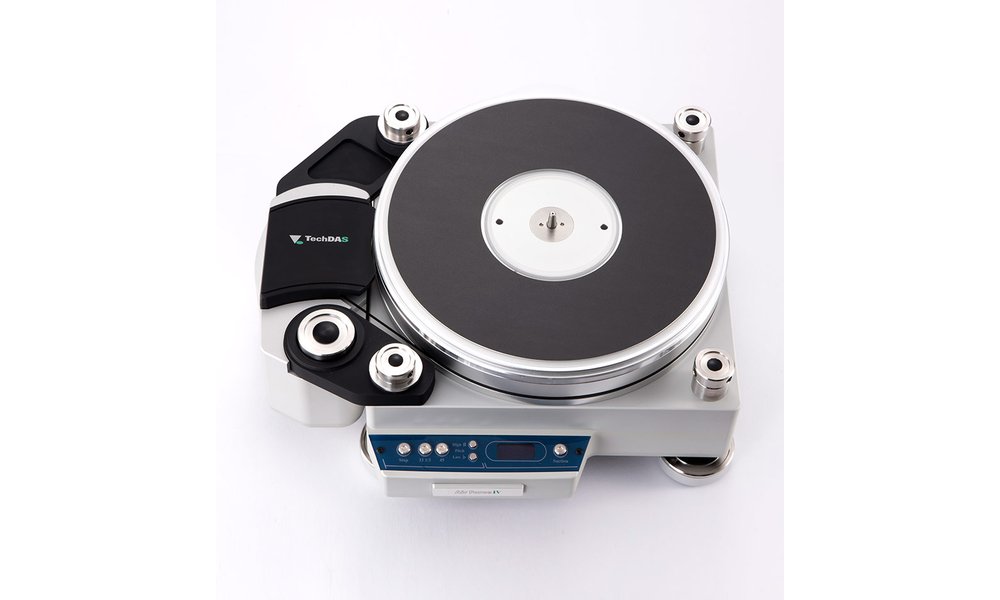
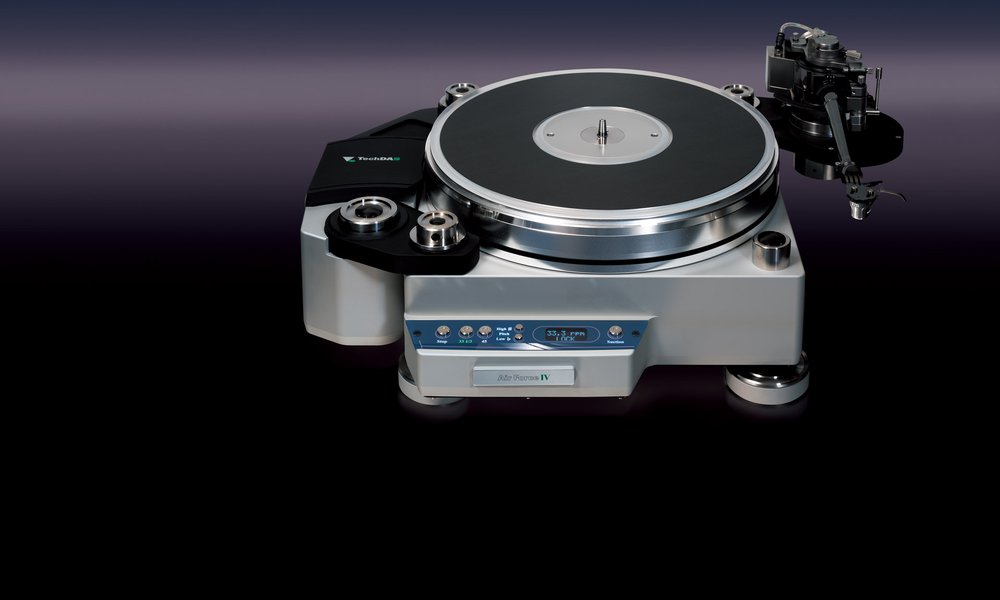
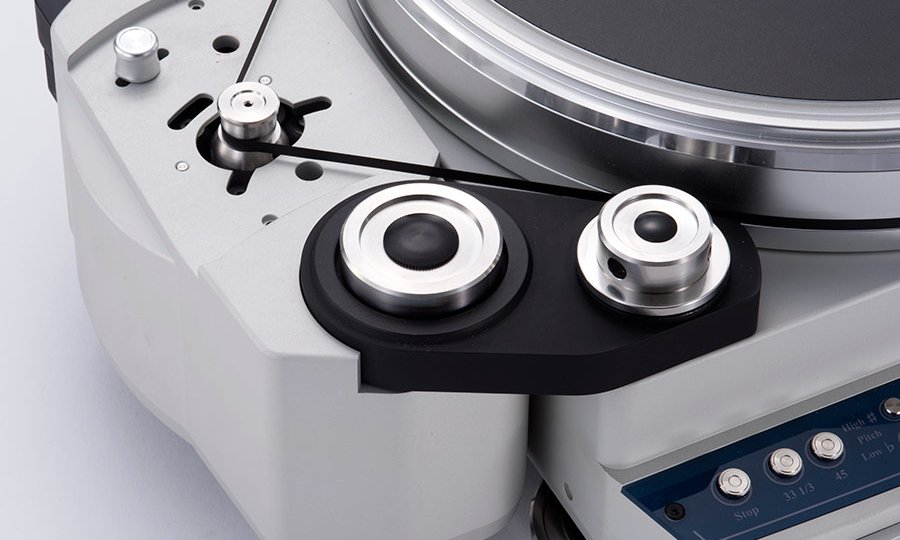
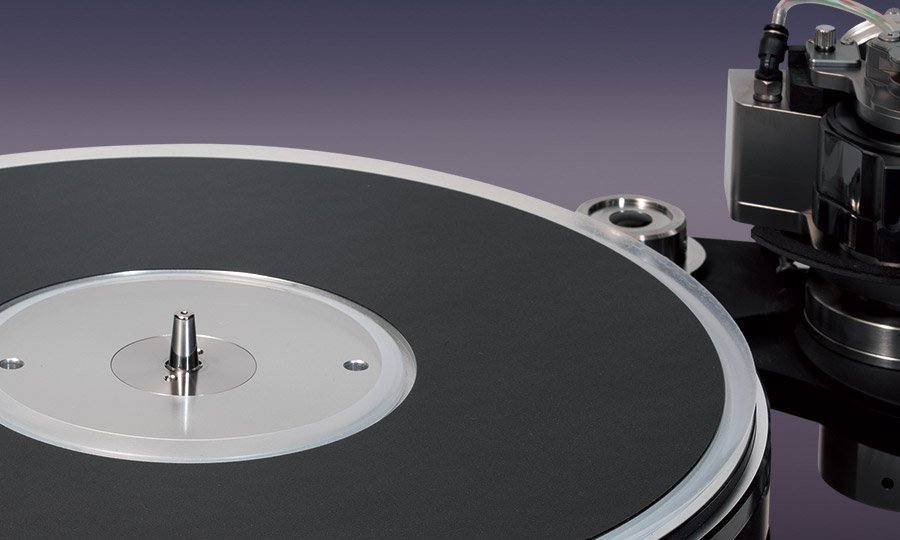
The Air Force IV chassis is machined from a solid block of A5052 aluminium alloy, silver anodised, and weighs 21.5 kg on its own. On it sits the one-piece A5056 aluminium platter weighing 8.7 kg; a thin, damping and antistatic mat protects the records. The spindle is tapered so that records with slightly different centre holes still sit precisely centred. The motor is a two-phase, four-pole synchronous motor in its own 4.1 kg aluminium housing, which sits in a recess of the chassis but is mechanically separate. It drives the platter via a 4 mm flat belt of double-side polished polyester fabric – the same belt as in the larger models.
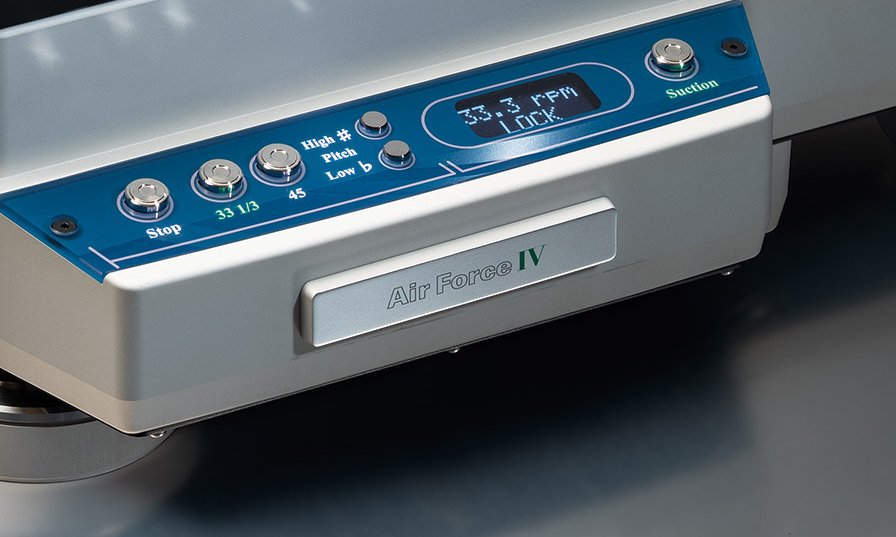
The pump and power supply are housed in a separate 9 kg enclosure. Via two hoses it supplies compressed air for the bearing and vacuum for the hold-down, and via a multi-core cable the motor power. Buttons on the front of the chassis select 33⅓ or 45 rpm, two more adjust the pitch in fine steps, and a dedicated button switches the vacuum. A display shows the speed and the lock status of the control loop. Three positions accept armboards; one for the right-hand positions comes drilled for the chosen arm, while rear left needs a dedicated version. The deck measures 420.5 × 168 × 368 mm and weighs 34.4 kg in total.
What international reviewers heard
International listening reviews of the TechDAS Air Force IV are available from the international specialist press. Here we summarise the overall picture in our own words; all sources are linked at the end of the page.
Sound character
- The basic character is described as calm, assured and free of anything mechanical. Music emerges from an almost silent background, and even flaws in a recording come across as traits of the recording rather than faults of the playback chain.
Tonal balance
- Tonally the Air Force IV stands on a rich, full foundation with clean, rather sweet treble. The balance is regarded as warm but not romantic – natural rather than bright or sharp.
Dynamics, bass & staging
- In the bass, the compact model trails the much heavier Air Force III Premium only narrowly in a direct comparison. Transients arrive quickly and cleanly, and even mono recordings gain a remarkable sense of depth.
Strengths
- Silence is seen as the greatest strength: fine detail and ambience come to the fore, and even worn records sound vivid because surface noise recedes. In the lab, with the vacuum hold-down active, the deck reached −76.0 dB through-groove rumble – the best figure measured there so far.
Setup, room & partners
- Listening was done with high-quality pivoted tonearms and MC cartridges on rigid racks; the pump and power supply stand separately and connect via hoses. The vacuum hold-down works only with 12-inch records, and no record clamp is supplied.
Consensus & differences
- Both reviews agree on the calm, fullness and naturalness of the sound and place the IV very close to the larger Air Force models. They differ in emphasis: one review hears the IV as slightly warmer and more forgiving than the more analytical III, the other stresses its exceptional bass fullness.
Research Consensus
The source situation is excellent for a deck of this class: TechDAS publishes a detailed data sheet, and there are two in-depth reviews from 2026, one of them with lab measurements of speed, wow and flutter and rumble. The picture is consistent. The Air Force IV is regarded as an exceptionally quiet, tonally rich and natural-sounding deck that comes close to the big Air Force III Premium in the bass. The limitations are practical: pump and hoses, no arm included and vacuum only for LPs. The verdict of international reviews is assessed in detail in the section What the international specialist press hears.
In short: anyone looking for TechDAS air-bearing technology who is already well equipped with arm and cartridge gets, with the IV, the most compact and affordable access to the core technologies of the large models. Anyone wanting a complete package with arm should look at the Technics SL-1000R or the SME Model 6.
For whom / Matching
Arm
The Air Force IV accepts arms from 9 to 12 inches. It was reviewed with a wood-damped carbon arm of medium effective mass and with a heavy precision arm – both approaches work. With two arms fitted you can, for example, keep a mono and a stereo cartridge permanently ready.
Phono
There is no built-in phono stage. A matching choice is an MC phono stage from the phono preamp top list, with a step-up transformer for very low-output cartridges.
Budget
Around €28,900 for the deck (as of 30.10.2026, without guarantee) plus arm and cartridge: a realistic total investment is in the mid five-figure range, so that the deck can show its calm.
Upgrade
A second arm on the free base and a top MC from the cartridge top list. There is little left to improve on the deck itself; what matters more is a rigid rack and a quiet spot for the pump.
What makes this AI analysis special
This section is an AI summary of published reviews by international reviewers and the manufacturer data from TechDAS. Vinyl BotPro puts the findings into context and links them with the data sheet and comparison models; VinylCination does not run its own listening tests or measurements, and all sources are linked at the end of the page. Prices and availability change (as of Oct. 2026, no guarantee); please check technical values against the current data sheet.
Vinyl BotPro Score Logic
The Vinyl BotPro Index is cross-tier 0–100. Master typically sits at ~85–97. The Air Force IV receives 92 (rank 5 Master): top marks for engineering/build thanks to air bearing, vacuum hold-down and one-piece platter, reference-level expected performance based on two reviews and the lab measurements, good features with three arm positions, and a value-for-money weighting that reflects the high price of the deck without arm. This places it behind the Technics SL-1000R (93), which offers more per euro with its arm included, and ahead of the Clearaudio Innovation Compact (91). The tier's champion badges remain unchanged. Weights: technology/build ~25 · features ~20 · performance (expected) ~25 · value ~30. Rank ≠ lab rating – no listening test of our own. Details: Details on weighting · Methodology.
Created by Vinyl BotPro (AI) · AI analysis · As of 30.10.2026 · Corrections: info@vinylcination.de · Prices without guarantee.
Manufacturer and concept
TechDAS is the turntable brand of Stella Inc. in Tokyo. Founder Hideaki Nishikawa spent decades developing and distributing high-end analogue equipment before presenting the Air Force One in 2012, a deck that combines two rarely paired principles: a platter floating on a thin cushion of air, and a vacuum hold-down that pulls the record flat onto the platter across its whole surface. The Air Force range has grown since then – from the monumental Air Force Zero via the Air Force One Premium to the Air Force III Premium. All of them share these two core technologies.
The Air Force IV is the newest and most compact model. TechDAS announced it in Japan in May 2025, deliveries began in autumn 2025, and it has been available in Europe since spring 2026. The idea: bring the technology of the larger decks into a chassis that fits on a normal rack, without compromising the core. The platter weighs 8.7 kg and is made from a single piece, the chassis is machined from solid, and there is room for three tonearms. In Germany the market price is around €28,900 without tonearm, in the UK £19,998 (as of 30.10.2026, without guarantee) – well below the larger sister models.
Technology explained
Air bearing under the platter
A classic platter bearing consists of a spindle running in a sleeve, usually with oil and a ball at the bottom. Every irregularity and every bit of friction in that bearing can reach the stylus as rumble. TechDAS takes a different route: the pump blows air under the platter, lifting it a few micrometres above a polished glass disc. During playback there is therefore hardly any mechanical contact, only an even air cushion. The result is extremely quiet running – one of the foundations of the very good rumble figures.
Vacuum hold-down for the record
Hardly any record is perfectly flat. Slight warps and small air gaps between record and platter let the vinyl resonate while the stylus traces the groove. The hold-down extracts the air between record and platter mat, and outside air pressure presses the record flat across its whole surface. Platter and record become one unit, record resonances are largely suppressed, and even slightly warped pressings run more calmly. The function can be switched off at the touch of a button and on the Air Force IV works with 12-inch records.
Belt drive with external synchronous motor
Belt drive mechanically separates the motor from the platter. TechDAS uses a two-phase, four-pole AC synchronous motor in its own 4.1 kg housing, standing in a recess of the chassis without touching it. A flat belt made of double-side polished polyester fabric transmits the drive. Speed is controlled digitally, feeding the motor a clean sine wave via a power amplifier. A lock indicator shows when the target speed is stable; in the lab measurement this took around five seconds, and wow and flutter stayed very low.
Platter and chassis
The platter is machined from a single piece of A5056 aluminium alloy and weighs 8.7 kg. Its mass provides flywheel effect and calm running, while a thin mat damps and prevents static. The spindle is tapered so that records with tight or loose centre holes still sit centred. The chassis itself is machined from a solid block of A5052 and weighs 21.5 kg. Four feet with damping material, as on the Air Force III Premium S, isolate the deck from the rack.
Up to three tonearms
The Air Force IV accepts armboards at three positions: front right, rear right and rear left. One drilled armboard for the right-hand positions is supplied, others are available as accessories, and the rear-left position needs a dedicated base. Tonearms from 9 to 12 inches are possible. In practice this means a stereo and a mono cartridge can be used side by side, or two different MC cartridges for different kinds of music.
Sound: what the reviews show
Two in-depth reviews from 2026 paint a very consistent picture. Calm is at the forefront: music stands against an almost silent background, and fine detail and room ambience emerge clearly. Even worn records sound vivid because surface noise recedes. The lab measurement backs this up with a through-groove rumble figure of −76 dB with the vacuum active, the best figure measured there so far.
Tonally the Air Force IV sounds rich and full, with powerful yet controlled bass and clean, rather sweet treble. It is described as natural and organic, warm but not romantically coloured. In a direct comparison with the larger Air Force III Premium, the IV trails only slightly in the bass and sounds a little warmer and more forgiving, while the III comes across as more analytical. Mono recordings show surprising depth, and transients arrive quickly and cleanly. Overall, both reviews place the compact deck remarkably close to the more expensive models in the range.
Features and everyday use
Setup
The deck comes with pump and power supply in a separate housing, connecting hoses, motor, platter, mat and one armboard. Tonearm and cartridge are not included and are usually fitted and aligned by the dealer. With a total weight of 34.4 kg, two people should handle the setup.
Placement
The chassis needs at least 521 × 418 mm of shelf space, the pump another 350 × 330 mm. It can sit on a different rack level, and the hoses should be routed so that they do not touch the deck. A solid, precisely levelled rack is essential so that the air bearing supports the platter evenly.
Operation
Buttons on the front select 33⅓ or 45 rpm, fine-tune the pitch and switch the vacuum. The display shows speed and lock status. No record clamp is supplied; with 12-inch records the vacuum takes over that job, and for singles a separate puck can be useful.
Connections
The deck has no audio outputs of its own – the signal runs through the cable of the fitted tonearm straight to the phono stage. MC cartridges need a suitable phono preamp, and very low-output cartridges may need a step-up transformer.
Who it suits
The Air Force IV is aimed at vinyl listeners who already own or plan a high-quality tonearm and MC cartridge and want a deck that does not limit those components. It is ideal for collectors of large LP libraries who benefit from the vacuum hold-down, and for listeners who want to use two arms in parallel. Anyone who wants a complete package ready to unpack, or who plays a lot of singles, is better served by a different concept.
Comparison with alternatives
The Technics SL-1000R is the direct-drive counterpart: coreless motor, magnesium tonearm included, likewise up to three arms. It offers more per euro but relies on a conventional bearing instead of air. The Clearaudio Innovation Compact achieves its calm through a magnetic bearing and plenty of mass, costs less and needs no pump. The SME Model 60 solves isolation with a sprung chassis and costs far more, while the SME Model 6 is the compact, much cheaper alternative with an arm included. The Linn Klimax LP12 stands for a completely different character: rhythmic and lively rather than calm. All of these models are listed in the Master tier of our turntable ranking.
More questions about the TechDAS Air Force IV
Is a tonearm included?
No. One armboard is supplied and drilled for the chosen arm. Tonearm and cartridge are added separately.
How loud is the pump?
Pump and power supply sit in their own housing and can be placed away from the deck, for example on a lower rack shelf. That keeps the listening position quiet.
Does the vacuum work with singles?
The vacuum hold-down works with 12-inch records. Singles and 10-inch records play without vacuum, with a separate record weight if desired.
How many tonearms fit on the Air Force IV?
Up to three, with lengths from 9 to 12 inches. One armboard is included, more are available as accessories.
How much does the Air Force IV cost?
Around €28,900 without tonearm in Germany, £19,998 in the UK (as of 30.10.2026, without guarantee).
Verdict
The TechDAS Air Force IV brings an air bearing, vacuum hold-down and a massive one-piece platter into the most compact Air Force chassis. The lab measurement confirms top figures for rumble and speed stability, and the reviews describe a calm, rich and natural sound close to the larger models. With an index of 92 it ranks 5th in the Master tier – a deck for anyone already well equipped on the tonearm side who wants to lift the foundation of their analogue chain to reference level.
Sources
- TechDAS — Air Force IV (product page, technical data)
- Hi-Fi News & Record Review — TechDAS Air Force IV/Reed 1H turntable/arm (01.08.2026)
- Hi-Fi News & Record Review — TechDAS Air Force IV/Reed 1H: Lab Report (01.08.2026)
- High Fidelity (Poland) — TechDAS Air Force IV – Turntable (first test, No 261) (01.02.2026)
Read more: best turntables 2026 · What is hi-fi?