
In-ear headphones · AI analysis · Master, rank 10
THIEAUDIO Monarch MKIV: Analysis
AI analysis (research): tribrid in-ear with 2 dynamic, 6 balanced-armature and 2 electrostatic drivers, tuning switch, 10 Ω – manufacturer data and international listening reviews, no listening test of our own.
Summary
The THIEAUDIO Monarch MKIV is the fourth generation of the brand's best-known in-ear monitor. It was announced in June 2025 and works as a so-called tribrid with three types of transducer: two dynamic drivers for the bass, six balanced-armature drivers for midrange and treble and two electrostatic tweeters for the top octaves. The manufacturer lists it at $1,149; in the European store of the distributor Linsoul it was €1,011 on 7 November 2026. That places it in our Master tier.
The listening reviews we evaluated describe a very high-quality aluminium housing, an easy-to-reach switch with two tunings, deep, controlled bass, lively mids and smooth, airy treble. The main criticisms are the large shells, which will not suit every ear, and rather basic accessories. In our in-ear ranking the Monarch MKIV sits in the Master tier at rank 10 (index 92) and no longer carries a champion badge; the tier's value badge has belonged to the 64 Audio Aspire 3 since the 12 November 2026 list record. That is an AI assessment based on manufacturer data and published listening reviews, not a listening impression of our own; we evaluate further measurements and reviews in the analysis below. The Monarch MKIV is a regular analysis here, not a new release: it has been on the market for around 17 months.
Specs (manufacturer)
| Design | in-ear, wired, tribrid, four-way crossover |
|---|---|
| Drivers | 2 × 8 mm dynamic (isobaric, IMPACT²) + 6 BA (Sonion) + 2 EST (Sonion) |
| Frequency response | 10 Hz – 44 kHz |
| Impedance | 10 Ω ±1 Ω at 1 kHz |
| Sensitivity | 100 dB ±1 dB at 1 kHz |
| THD | < 1 % at 1 kHz |
| Tuning switch | Standard / Rumble (+3 dB sub-bass, +2 dB 200–500 Hz) |
| Shells | T6 aluminium, CNC; Stellashot / Kaleidoglow faceplates |
| Cable | 8-strand, OFC + silver-plated OFC, modular 3.5 / 4.4 mm |
| Announced | 20 Jun 2025 |
| Price | €1,011 in Linsoul EU store, as of 7 Nov 2026; $1,149 (manufacturer) |
Scores in detail
Vinyl BotPro Index 92 (Master 85–97) · sub-scores 0–10, weights 35/20/15/30 · weighted raw score 7.6, mapped within the tier onto 85–97: the index shows the order within the tier, not measured differences in sound. Editorial synthesis, not a lab value · Sub-score rationale.
Manufacturer and concept
THIEAUDIO was founded in 2019 and belongs to the orbit of the online retailer Linsoul, which distributes the brand worldwide. Within a few years THIEAUDIO has made a name for itself with in-ears from entry level to high end. The Monarch line is its flagship. The second generation from 2021 was regarded as balanced and coherent; the third from 2023 introduced a bass system with two dynamic drivers working in tandem and was considerably livelier but less neutral.
With the MKIV, THIEAUDIO wants to combine both. A switch on the back of each earpiece toggles between a neutral base tuning and a mode with more bass and warmer lower mids. One review puts it neatly: in standard mode the MKIV is essentially an MKII with more space, in bass mode a better-balanced MKIII. Also new are aluminium shells instead of resin and smaller bass drivers.
At the time of this analysis the MKIV has been available since June 2025. We are not aware of a fifth generation or an official successor.
The technology explained
Ten drivers, three transducer types
Ten transducers work on each side. Two 8 mm dynamic drivers are arranged isobarically, one behind the other: they move together and act like one driver with twice the motor force. THIEAUDIO calls this IMPACT². Six Sonion balanced-armature drivers handle the midrange and treble, two Sonion electrostatic drivers (EST) the very top. According to one review, the crossover for the EST drivers was reworked so that they mainly operate between 10 and 40 kHz, which is meant to give smoother yet airy treble.
Four-way crossover and separate sound tubes
A passive four-way crossover with nine components splits the signal, and four separate sound tubes carry the sound from the driver groups to the nozzle. That is elaborate but common at the high end. The advantage: each transducer type works where it performs best. The drawback compared with a single driver: the tuning has to manage the transitions cleanly. According to the reviews evaluated it does; the sound is described as coherent and controlled.
The tuning switch
The gold-plated switch sits on the back of the shells and can be flipped with a fingernail. In standard mode the bass is tight and fast and the mid-bass linear. According to the manufacturer, Rumble mode lifts the sub-bass by 3 dB and the 200 to 500 Hz region by 2 dB. One review calls the switch the best implementation it has seen, because it is easier to use than long faceplate switches or recessed micro-switches.
Manufacturer data
THIEAUDIO specifies a frequency response of 10 Hz to 44 kHz, an impedance of 10 ohms and a sensitivity of 100 dB, with THD below 1 per cent at 1 kHz. Going by this comparatively low sensitivity figure, the Monarch would need a little more level than the Starter models in our ranking; the independent measurements we evaluate in the analysis below, however, point to considerably higher sensitivity. At the same time, the low impedance makes it sensitive to the source's output impedance, which can shift the tuning of multi-driver in-ears.
T6 aluminium shells
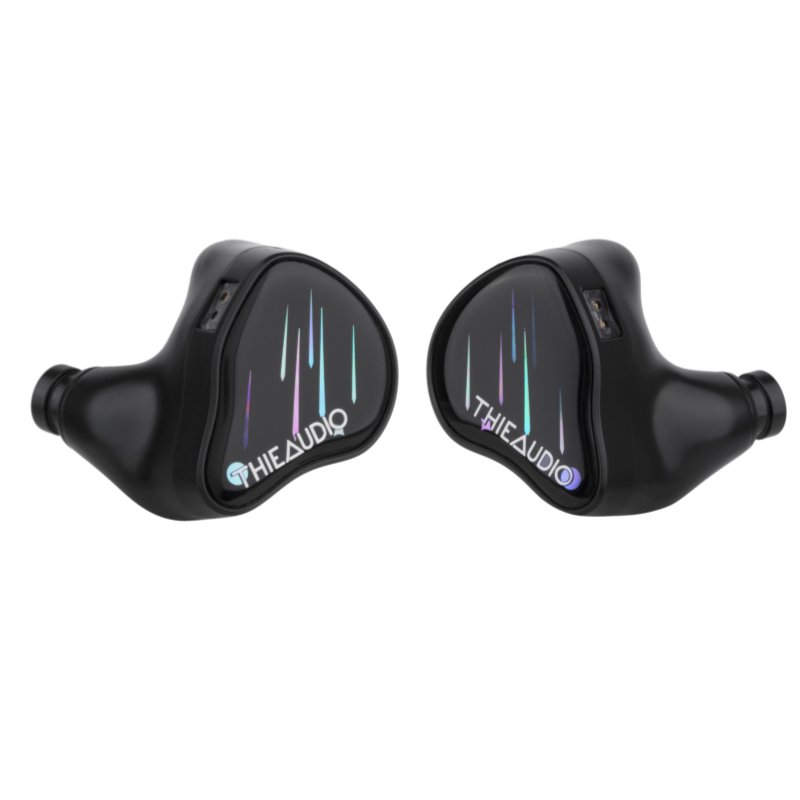
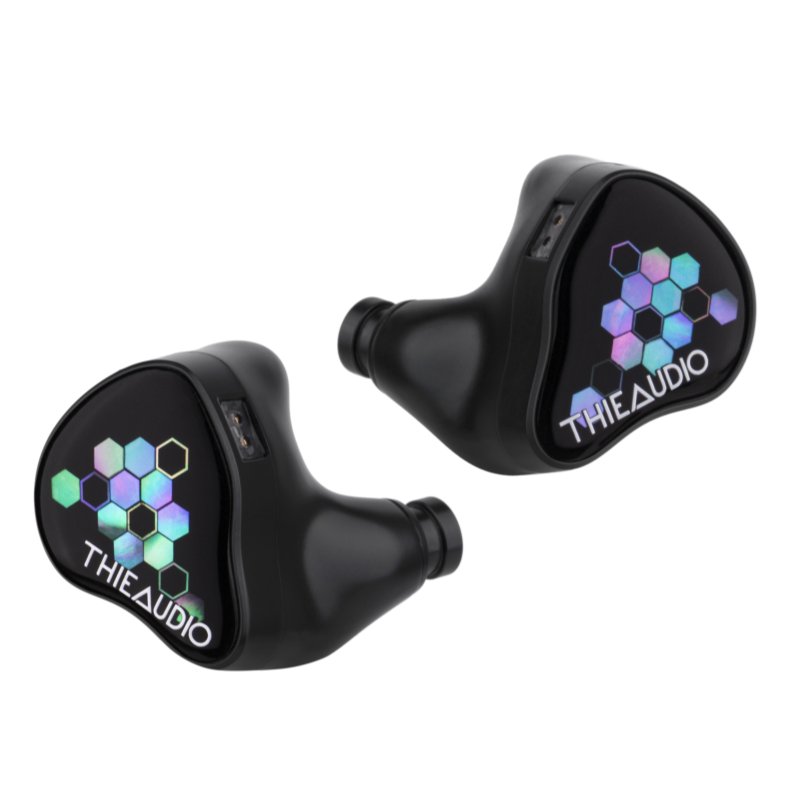
For the first time in the Monarch line the shells are CNC-machined from T6 aluminium. One review describes them as dense, cool to the touch and built to last a lifetime, without adding much weight. Two faceplates are standard: Stellashot with a shooting-star motif and Kaleidoglow with a hexagonal pattern. Further designs are available at extra cost.
What international reviewers hear
Sound character
The two reviews evaluated first, from Headfonia and Major HiFi, see the MKIV as a successful evolution. In standard mode one review describes excellent tonal balance: tight, fast bass, natural mids without unnecessary colouration, smooth but extended treble and overall more space and polish than the MKII. The second review stresses how coherent the sound is: deep bass, lively mids and refined treble with impressive control.
Bass
According to the second review, Rumble mode is one of the most important features. It brings considerably stronger sub-bass that reaches very deep and rumbles with great definition without bleeding into the mids. Without Rumble mode the bass stays clear and detailed, only the lift is gone. Both reviews describe the bass as tight and controlled.
Midrange and vocals
According to the reviews, the mids do not step back despite the strong bass. They are described as lively, clear and very well resolved, with plenty of body in every note. In Rumble mode the lower mids become warmer and fuller, and voices and instruments sound more organic and more forward. The warmth stays subtle and does not turn cloudy.
Treble
The treble is described as smooth, airy and clear, without harshness or piercing peaks. It stays present with a slight shimmer that balances colouration and realism well.
Spatial presentation
Here the impressions differ somewhat. The first review hears more space in standard mode than with the MKII. The second describes the stage as more controlled and closer to a traditional stereo field, less holographic than earlier Monarch generations but with very precise imaging, separation and layering. Anyone looking for a dome-like stage that extends far around the head will find it less pronounced here, according to the second review.
Weaknesses according to the reviews
The main criticism concerns the shells: one review classifies them as large and warns that people with small ears may have trouble with fit and comfort. The other review found the size easy to live with. The first review also criticises the accessories: the small round fabric case feels cheaper and tighter than earlier cases, and the tips are not at the level of the price. The brown cable does not match the black shells visually.
Accessories and everyday use
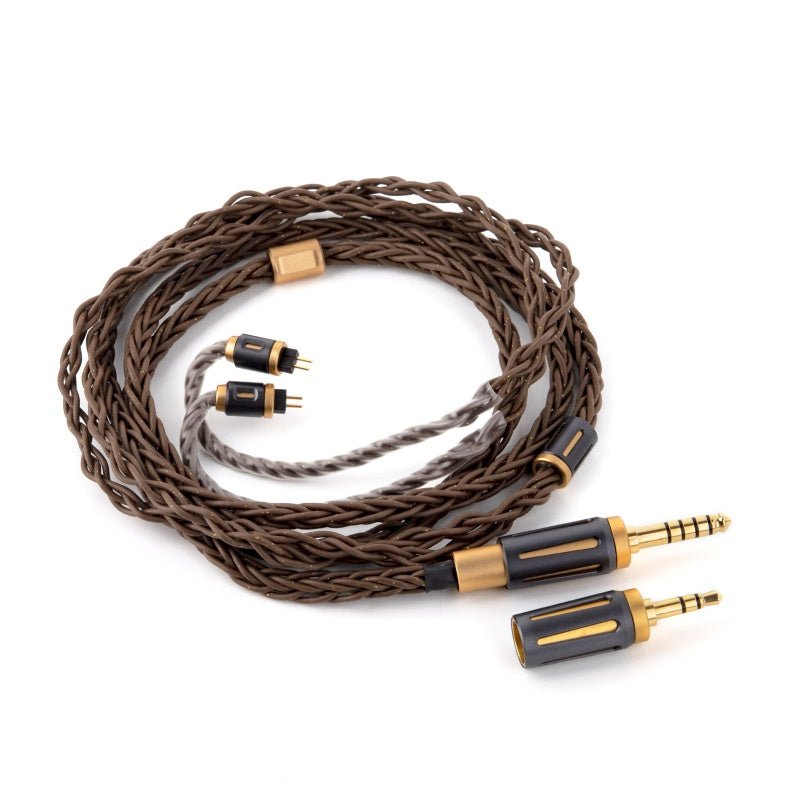
The package includes three sets of tips (wide silicone, narrow silicone and foam, each in three sizes), a modular eight-strand cable of copper and silver-plated copper with interchangeable 3.5 mm and 4.4 mm plugs, a case, a cleaning cloth and, for the first time, nozzle filters. The modular cable is practical: if you listen at home from a balanced headphone output and on the go from a smartphone adapter, you simply swap the plug. According to the review, the new cable is more flexible and less microphonic than its predecessor.
Isolation from outside noise is excellent thanks to the sealed aluminium shell, according to the review. For people with larger ears the MKIV fits surprisingly ergonomically thanks to refined contours and a slightly longer nozzle.
With an amplifier and a vinyl system
At 10 ohms and a specified sensitivity of 100 dB the Monarch MKIV is not a difficult headphone. Going by the manufacturer figure it would need a little more level than very sensitive entry-level in-ears; the independent Reference Audio Analyzer measurements we evaluate in the analysis below, however, show considerably higher sensitivity. In a vinyl system this means a low-noise headphone output matters more than high power, and the volume control tends to sit in the lower part of its range.
More important is the source's output impedance. With low-impedance multi-driver in-ears, a high output impedance shifts the tuning because the headphone's impedance varies with frequency. Many headphone sockets on integrated amplifiers use series resistors and therefore have a high output impedance. For the Monarch a headphone amplifier or DAC with low output impedance is the safer choice; the 4.4 mm plug fits balanced outputs.
Sonically, the combination of controlled bass, natural mids and smooth treble suits records well: Rumble mode can give thinly recorded pressings more foundation, while standard mode stays closer to the original.
Who is the Monarch MKIV for?
The MKIV suits listeners looking for a high-end in-ear with two clearly distinct tunings who have medium to large ears. It suits anyone who wants to switch between neutral and bass-emphasised playback without experimenting with EQ or cables, and who values solid, high-quality construction.
It is less suitable for people with small ears and for anyone who puts a particularly wide, holographic stage first. Those who value premium accessories will need to upgrade the case and tips.
Comparison with alternatives
Our Master tier now contains eighteen models (list record 12 November 2026). The Meze Advar, the 64 Audio Aspire 4 and the 64 Audio Aspire 3 lead on the weighted raw score; the Meze Astru, the Shure SE846 Gen 2 and the Campfire Audio Andromeda 10 remain ahead of the Monarch MKIV. The Andromeda 10 sits ahead of the Monarch at the same rounded raw score of 7.6 because its sound-evidence score is higher (8.4 against 8.0). The Sennheiser IE 900 still has the strongest sound evidence in the tier. The Westone MACH 80 closes the tier. The Monarch MKIV offers the most drivers and two tunings; the lowest documented euro price in the tier belongs to the Aspire 3 (€649.00), so the value badge sits with the Aspire 3, not with the Monarch.
Within THIEAUDIO's range the predecessors MKII and MKIII each anticipated one of the MKIV's two tunings, according to the review. MKII owners mainly gain more space and polish in standard mode.
Images
FAQ
What is the difference between standard and Rumble mode?
According to the manufacturer, Rumble mode lifts the sub-bass by 3 dB and the 200 to 500 Hz region by 2 dB. Standard mode is more neutral with tight bass.
Does the Monarch MKIV need a headphone amplifier?
Not necessarily, but a source with low output impedance makes sense to preserve the tuning. At 100 dB sensitivity it needs a little more level than entry-level in-ears.
Does the Monarch MKIV fit small ears?
One review classifies the shells as large and warns of fit problems with small ears; another found the size easy to live with.
Is the Monarch MKIV a new release?
No. It was announced in June 2025. In our ranking it is a regular analysis.
Which plugs are included?
The modular cable has interchangeable 3.5 mm and 4.4 mm plugs.
How much does the Monarch MKIV cost in Europe?
Linsoul's European store listed it at €1,011 for the standard faceplates on 7 November 2026; custom designs cost more. The manufacturer price is $1,149. All prices without guarantee.
Conclusion
On the evidence, the THIEAUDIO Monarch MKIV combines the strengths of its two predecessors: neutral balance in standard mode, strong, controlled bass in Rumble mode, lively mids and smooth treble, plus a high-quality aluminium shell and a very usable switch. The large shells and basic accessories are the main limitations. In our Master tier it no longer holds a champion badge, as of the 12 November 2026 list record. The basis is manufacturer data, two detailed international listening reviews and the further measurements and reviews evaluated in the analysis below, no listening tests or measurements of our own.
Analysis: the THIEAUDIO Monarch MKIV in depth
What this analysis adds
The sections above rely on the manufacturer's data and on two listening reviews: Yagiz at Headfonia [2] and Alex Schiffer at Major HiFi [3]. For this analysis we evaluated further sources: the three-page review by Nihal at Headfonics [4], the comparison by Caleb Loo (FC Construct) at Headphones.com with his own coupler measurements [5], the Reference Audio Analyzer measurement reports for both switch positions [6][7] together with its amplifier-compatibility report [8], Major HiFi's comparison with the predecessor MKIII [9] and an article by Atsushi Takahashi at PHILE WEB in Japan [10]. On top of that comes THIEAUDIO's current product page, which we retrieved again on 10 November 2026 [1].
Where the review samples came from matters for the assessment. Headfonia and Headfonics received their units from Linsoul, the brand's distributor [2][4]. The Headphones.com author says he helped out at the Linsoul booth at CanJam SoCal [5]. The PHILE WEB article is marked as PR and was provided by the Japanese distributor Naicom [10]; we therefore use it only for data and as an additional voice, not as an independent verdict. We found no statement on the origin of the Major HiFi sample [3]. Reference Audio Analyzer gives no measurement date on its report pages [6][7]. Vinyl BotPro has neither listened to nor measured the Monarch MKIV. Measurements and sound impressions belong to the authors named; we mark our own calculations and conclusions. Rank, index and prices on this page remain unchanged.
Context: a fourth generation with a price rise
Headfonics points out that the first three Monarch generations sold at the same price and that the MKIV, at 1,149 US dollars, is the first price rise in the series [4]. Headfonia also mentions surcharges of 100 to 150 US dollars for special faceplates [2]; besides Stellashot and Kaleidoglow, the product page lists two custom designs with a longer lead time [1]. According to PHILE WEB, the MKIV launched in Japan in August 2025 at an expected street price of around 176,000 yen [10].
Headfonia places the generations as follows: the 2021 MKII was regarded as balanced and coherent, the 2023 MKIII brought the isobaric bass system and a livelier, more V-shaped tuning, and the MKIV is meant to unite both directions [2]. Headfonics describes the MKII as a personal turning point and concludes that the MKIV is a careful rework rather than a mere refresh [4].
Drivers and crossover: what the sources agree on
The product page spells out the split of the ten transducers per side: two ultra-high-frequency drivers, four high-frequency and two midrange drivers and two low-frequency drivers, joined by a four-way crossover with four sound tubes [1]. Headfonics and PHILE WEB describe the same split, with all balanced-armature and electrostatic drivers coming from Sonion [4][10]. According to the manufacturer, the electrostatic drivers are targeted specifically at 10 to 40 kHz to smooth the transition from the balanced-armature tweeters [1]; PHILE WEB describes it the same way [10].
There is one inconsistency regarding the bass drivers. The manufacturer, Headfonia and PHILE WEB state two 8 mm drivers [1][2][10], and Headfonia explicitly notes that the MKIII still used 10 mm drivers [2]. Headfonics mentions a dual 10 mm system in its text but also lists 8 mm in its own specification table [4]. We follow the manufacturer's figure. Impedance also comes in two readings: the product page now says 10/9 ohms [1], PHILE WEB 9 to 10 ohms [10], while Headfonia and Headfonics give 10 ohms [2][4].
What the measurements show: sensitivity and impedance
Reference Audio Analyzer measured the Monarch MKIV in two series labelled "Off" and "On" [6][7]. Our reading is that these correspond to the switch positions without and with Rumble mode; the report pages do not explain the labels explicitly. In the "Off" position, impedance is 10.0 ohms at 1 kHz and varies from 5.0 to 17.3 ohms between 40 Hz and 15 kHz [6]. In the "On" position it is 11.5 ohms at 1 kHz and 5.3 to 22.5 ohms over the same band [7]. That the electrical impedance changes with the switch fits the manufacturer's description that Rumble mode alters the crossover in the bass and lower-mid range [1]; that is our conclusion.
Sensitivity stands out. Averaged between 100 Hz and 10 kHz, Reference Audio Analyzer measures 126.6 dB per volt or 106.5 dB per milliwatt in the "Off" position and 125.6 dB per volt or 106.2 dB per milliwatt in the "On" position [6][7]. Accordingly, around 15 to 17 millivolts are enough for 90 dB sound pressure [6][7]. The manufacturer quotes 100 dB at 1 kHz without a reference unit [1]; Headfonics reads this as 100 dB per volt [4]. Our own calculation: 100 dB per milliwatt would correspond to about 120 dB per volt at 10 ohms; the measurement shows around 125 dB per volt at 1 kHz [6]. On this measurement the Monarch is therefore about 5 dB more sensitive than the manufacturer's figure suggests, assuming that figure is meant per milliwatt. Measurement rigs differ, and a value from a single lab is not a certainty. The statements above about the level required are based on the manufacturer's figure; going by the measurements, the Monarch needs rather little level.
The switch in numbers
THIEAUDIO describes the difference more concretely than most sources: in standard mode the sub-bass sits around 10 dB above the mids with a sharp cutoff around 150 Hz; in Rumble mode it is 13 dB, and the 200 to 500 Hz range is lifted by an additional 2 dB [1]. Caleb Loo measured both positions on an IEC 711 clone coupler and sees about 2 to 3 dB more bass in bass mode, with a gradual rise that already starts in the mids [5]. He himself points out that his rig renders bass and treble less accurately than a B&K 5128 and that the resonance around 8 kHz is a coupler artefact [5]. Headfonics hears around 3 dB more bass [4].
Little is meant to change above the upper mids. PHILE WEB refers to the comparison graph on the packaging, according to which the range from the upper mids upwards barely differs between the two modes, and confirms this in its listening impressions [10]. Headfonics hears the treble as nearly unchanged in Rumble mode [4]. According to PHILE WEB, the side of the switch marked in red is standard mode [10].
Source and output impedance: our own calculation
The large swing in impedance makes the Monarch sensitive to the source's output impedance. For the "On" position, Reference Audio Analyzer states that the frequency response between 20 Hz and 15 kHz changes by 6.3 dB on an amplifier with 10 ohms output impedance, by 8.6 dB at 20 ohms and by 12.2 dB at 100 ohms [8]. Our own calculation using a simple voltage divider and the measured extremes of 5.3 and 22.5 ohms: at 10 ohms the level difference between the frequencies with the lowest and highest impedance is around 6.0 dB, at 2 ohms around 2.0 dB and at 1 ohm around 1.1 dB. In the "Off" position it is also around 1.1 dB at 1 ohm [6]. Anyone who wants to hear the sound as the reviews describe it should therefore use a source with an output impedance well below 1 ohm. That is our conclusion from the measured values, not a measurement of our own.
Headfonics confirms from practice that the Monarch gets loud enough from dongles and smartphones but sounds somewhat more spacious from more powerful sources [4]. On the Lotoo PAW Gold Touch, Nihal needed more than 30 volume steps to reach a comfortable listening level [4]. He prefers sources with a warmer voicing, because very neutral or bright players could push the treble forward [4].
Bass
The sources agree that the bass stays controlled and does not bleed into the mids [2][3][4]. Headfonics calls it the best implementation of the IMPACT² system so far: deeper, with more tangible punch than earlier Monarch models, yet fast and finely articulated [4]. PHILE WEB describes the bass as ample even in standard mode and praises that it does not mask vocals [10]. Major HiFi highlights Rumble mode as one of the most important features [3].
Caleb Loo is more critical. He finds the bass good but unremarkable and sees the IMPACT² system as a limit, as with the Hype series [5]. In bass mode the Monarch tips towards basshead territory for him, the mids step behind the bass, and it feels almost a little stuffy [5]. Headfonics, by contrast, sees Rumble mode as not quite at the level of dedicated bass-heavy in-ears, but close enough for anyone after a fuller foundation [4]. Both statements show how strongly the verdict depends on personal preference and fit.
Mids and vocals
Caleb Loo assigns the mids to a widely used modern target and considers them technically well executed but generic [5]. He finds them somewhat dry and sterile; bass mode only makes them warmer [5]. Headfonics describes the lower mids in standard mode as rather lean; vocals could use a little more body, but in return everything sounds clear and precise [4]. In Rumble mode, male vocals and low strings become fuller and move a little closer [4].
PHILE WEB sounds more positive, describing vocals as natural and not overly smooth, in Rumble mode too [10]. Compared with the MKIII, Major HiFi praises the more organised and controlled mids, while the MKIII sounds more colourful and vivid [9].
Treble
Opinions diverge most on the treble. Headfonics calls it the Monarch's greatest strength: very resolving, airy and sparkling without turning sharp; the electrostatic drivers may be the best in this price class [4]. At the same time Nihal describes the Monarch as fairly treble-forward [4]. Headfonia hears less lower-treble sharpness than with the MKII and more air above it [2]. Caleb Loo measures no major peaks but finds the treble slightly forward in standard mode and hears it as similarly dry as the mids [5]. In bass mode it acts as a counterweight to the stronger bass [5]. Major HiFi describes the MKIV's treble as smoother and less bright than the MKIII's [9].
In practical terms, our assessment is this: anyone sensitive to treble should try Rumble mode and warm-sounding sources, as Headfonics suggests [4].
Stage, imaging and dynamics
On spatial presentation the sources contradict each other. Headfonics experiences a very large, wide stage with depth [4]. Major HiFi instead describes a more traditional stereo field, less holographic than the MKIII but very controlled [3][9]. Caleb Loo mainly notes width and precise imaging but, compared with the Valhalla, misses layering in depth; notes seem to sit on one plane [5]. On resolution and separation all sources agree that the Monarch is among the strengths of its class [2][3][4][5]. Headfonia also highlights timing: the MKIV is as fast and agile as the MKII and copes with dense, fast metal tracks [2].
Fit, cable and accessories
The size of the shells is the most frequent criticism. Headfonics finds them almost as large as the Valhalla's [4]; Caleb Loo even describes the body as slightly thicker and gives a nozzle diameter of 6.3 mm [5]. Headfonics nevertheless reports a secure fit without pressure points or pressure build-up, even when moving the head [4]. Major HiFi considers the size unproblematic [3]. PHILE WEB finds the aluminium shell slightly heavier than earlier resin shells, but the fit as stable as before [10].
Verdicts on the cable are mixed. Headfonics calls the eight-strand cable supple and free of microphonics [4], Headfonia more flexible than the previous cable [2], whereas Caleb Loo finds it a little stiff, though the best cable he has seen from THIEAUDIO [5]. PHILE WEB gives a length of 1.2 metres [10]. As for the case, Headfonics reports that it is the round Alcantara case also supplied with the Origin and Valhalla; earpieces and cable barely fit inside at the same time [4]. Among the tips, Nihal misses the previous white silicone tips; new are one set with a wide bore and one with a narrow bore [4].
Comparisons from the sources
Headfonics compares three models. According to Nihal, the THIEAUDIO Origin offers about as much bass as the Monarch in Rumble mode but hits harder; the Monarch separates better, resolves the treble more finely and sounds wider [4]. The BGVP Solomon has lighter bass and treble that can turn splashy [4]. The Moritz Audio ENZO has more and slower mid-bass, the Monarch the cleaner treble and the wider stage [4]. Headfonics considers the gap to the more expensive Valhalla small [4].
Caleb Loo sees the V16 Divinity as THIEAUDIO's best-tuned model and the Valhalla as the technically strongest, with the Monarch MKIV in between [5]. Most visitors at the CanJam SoCal booth put the MKIV in third place as great but uneventful [5]. Because it is several hundred dollars cheaper, he still calls it the brand's best overall package [5]. Major HiFi recommends the MKIII for a particularly large, holographic stage and the MKIV for control, bass flexibility and the more modern tuning [9].
Our conclusion on the evidence
The body of sources on the Monarch MKIV is broad and agrees on the essentials: high resolution, controlled bass, a well-implemented switch and large shells. Headfonia gives it its recommendation [2], and Headfonics clearly recommends it for its price class [4]. What remains disputed is the tonal colour of the mids, the size of the stage and whether the bass has enough character of its own [3][4][5]. It should be borne in mind that several samples came from the distributor and that one Japanese article is marked as PR [2][4][10].
New compared with the previous version of this page are the Reference Audio Analyzer measurements [6][7][8]: they point to higher sensitivity than specified and to a clear dependence on output impedance. Rank, index and title in our ranking do not change as a result. Our advice to anyone interested: try the fit beforehand if possible, compare both switch positions deliberately and run the Monarch from a source with very low output impedance.
Sources for this analysis
- THIEAUDIO: THIEAUDIO Monarch MKIV (Produktseite, abgerufen/accessed 10.11.2026). https://www.thieaudio.com/products/thieaudio-monarch-mkiv
- Headfonia: ThieAudio Monarch MKIV Review (Yagiz, 11.10.2025, 2 Seiten/pages). https://www.headfonia.com/thieaudio-monarch-mkiv-review/
- Major HiFi: Thieaudio Monarch MKIV Review: Is This the Best Monarch Yet? (Alex Schiffer, 14.05.2026). https://majorhifi.com/thieaudio-monarch-mkiv-review-is-this-the-best-monarch-yet/
- Headfonics: THIEAUDIO Monarch MKIV Review (Nihal, 11.11.2025, aktualisiert/updated 28.02.2026, 3 Seiten/pages). https://headfonics.com/thieaudio-monarch-mkiv-review/
- Headphones.com: Comparing the Best Thieaudio IEMs – Monarch MKIV vs. V16 Divinity vs. Valhalla (Caleb Loo/FC Construct, 16.10.2025). https://headphones.com/blogs/reviews/comparing-the-best-thieaudio-iems-monarch-mkiv-vs-v16-divinity-vs-valhalla
- Reference Audio Analyzer: THIEAUDIO Monarch MK IV Off – Measurement's report (ohne Datumsangabe/undated, abgerufen/accessed 10.11.2026). https://reference-audio-analyzer.pro/en/report-pro-hp-generic.php?id=5996
- Reference Audio Analyzer: THIEAUDIO Monarch MK IV On – Measurement's report (ohne Datumsangabe/undated, abgerufen/accessed 10.11.2026). https://reference-audio-analyzer.pro/en/report-pro-hp-generic.php?id=5997
- Reference Audio Analyzer: THIEAUDIO Monarch MK IV On – Compatibility with amplifier sources (ohne Datumsangabe/undated, abgerufen/accessed 10.11.2026). https://reference-audio-analyzer.pro/en/report-pro-hp-compatibility.php?id=5997
- Major HiFi: Thieaudio Monarch MKIV vs Monarch MKIII: Which Flagship IEM Is Better? (Alex Schiffer, 18.05.2026). https://majorhifi.com/thieaudio-monarch-mkiv-vs-monarch-mkiii-which-flagship-iem-is-better/
- PHILE WEB: THIE AUDIO最新フラグシップイヤホン「Monarch MK IV」レビュー (Atsushi Takahashi, 26.11.2025, als PR gekennzeichnet, bereitgestellt von Naicom/marked as PR, provided by Naicom). https://www.phileweb.com/review/article/202511/26/6261.html
Created by AI (Vinyl BotPro) from the sources listed; no listening tests or measurements of our own. Detailed human fact-check pending.
About this analysis
The euro price comes from the European store of Linsoul, the brand's distributor, and was read on 7 November 2026; the dollar price from the manufacturer's site. According to its disclosure, one review sample was supplied by the distributor; for the origin of the samples behind the further sources, see the analysis above. All images come from the manufacturer's product page and show the Monarch MKIV with both standard faceplates and the supplied cable. The announcement date (20 June 2025) comes from the manufacturer's announcement. The sub-scores and their rationale are listed for every model in the ranking.
Sources
- THIEAUDIO — Monarch MKIV (manufacturer)
- Linsoul EU — THIEAUDIO Monarch MKIV (Vertrieb)
- Headfonia — ThieAudio Monarch MKIV Review (2025)
- Major HiFi — Thieaudio Monarch MKIV Review (14.05.2026)
Created by Vinyl BotPro (AI) · As of 7 Nov 2026 · All information without guarantee.