
In-ear analysis · Premium · as listed
Truthear Hexa Analysis
The Truthear Hexa sits on the in-ear shortlist of 12 November 2026 in the Premium tier, now expanded to thirty-four models, in rank 5 with a Vinyl BotPro index of 67 and no tier badge. This analysis takes the list record as published and does not run a second calculation.
In brief
The Truthear Hexa is a wired hybrid in-ear with one dynamic driver and three balanced-armature drivers, not the Truthear Nova and not the Truthear x Crinacle Zero:Red. The official page lists an impedance of 20.5 Ω ±15 % at 1 kHz, a sensitivity of 120 dB/Vrms at 1 kHz, THD of at most 1 % at 1 kHz and 94 dB, a frequency response of 8–40 kHz (IEC61094, free field) and an effective range of 20–20 kHz (IEC60318-4, −3 dB). The dynamic driver’s diaphragm is given as a PU and LCP composite. On the in-ear shortlist of 12 November 2026 it sits in the Premium tier, now expanded to thirty-four models, in rank 5 with a Vinyl BotPro index of 67 and no tier badge. It shares index 67 with the Moondrop Aria 2, the beyerdynamic DT 30 IE, the SIMGOT EA500LM and the DUNU Titan S2; at the same index the Aria 2 and the DT 30 IE, each with a sound-evidence score of 7.4, sit ahead of the Hexa (7.3), the Hexa precedes the EA500LM because of its lower documented euro price, and the value badge remains with the Titan S2 in rank 7. The subscores and the linear mapping onto the 55–69 band are documented in the list package; this page repeats the list record and does not run a second calculation.
The listening report comes from SoundGuys (Christian Thomas, 17 December 2024): a dated listening review of the exact model in an independent international online specialist outlet of the same class already used for other in-ears on this list. The text covers the exact Hexa. The Nova and the Zero:Red are different models and are not used here as substitute pillars. Laboratory figures and MDAQS values in the review are SoundGuys’ work, not measurements by this page. An Amazon price on the pillar page is not used. Under the single badge rule of 12 November 2026 — including addendum t647s3962 — the Truthear Hexa is eligible; its pillar here is the written review. The documented euro price is €89.91 at Audiophonics.fr (Audiophonics SARL, Floirac (Bordeaux), Intra-Community VAT FR30484107412, €89.91 tax incl., schema.org/InStock, “Add to cart”, productAvailableForOrder=true, allowBuyWhenOutOfStock=true, quantityAvailable=0, shipping date 13 November 2026, can be ordered, retrieved 12 November 2026). The Sound badge in the tier remains with the Sony IER-M500, and the value badge with the DUNU Titan S2.
Technical data (published)
| Design | Wired universal in-ear, one dynamic driver plus three balanced-armature drivers (official Hexa page). Not the Nova and not the Zero:Red. |
|---|---|
| Impedance | 20.5 Ω ±15 % at 1 kHz (official page) |
| Sensitivity | 120 dB/Vrms at 1 kHz (official page) |
| Frequency response | 8–40 kHz (IEC61094, free field); effective range 20–20 kHz (IEC60318-4, −3 dB) |
| THD | at most 1 % at 1 kHz, 94 dB (official page) |
| Weight | 4.8 g per side (SoundGuys, product figure in the review) |
| Connection | 0.78 mm 2-pin, cable to a 3.5 mm jack (SoundGuys) |
| Price | €89.91 tax incl. at Audiophonics SARL, can be ordered, 12 November 2026. An Amazon price on the pillar page is not used. |
Amplifier compatibility
Truthear lists 20.5 Ω ±15 % at 1 kHz and 120 dB/Vrms at 1 kHz. SoundGuys states expressly that a separate amplifier is not needed and that an ordinary telephone dongle already supplies a usable level.
The drive subscore of 8.6 follows that official easy driveability. It matches the DUNU KIMA 2 and the Titan S2 in the same tier, and sits below the 8.8 models such as the Pure.
A low-noise output remains useful, because a sensitive design can pass hiss on. A large surplus of power is not an end in itself according to the pillar.
The official sensitivity is referenced to 1 Vrms. This page does not convert the figure into 1 mW.
On a phono amplifier with a headphone output, 20.5 Ω and 120 dB/Vrms are not a heavy load. The practical limit lies more in the fit of the angular shell than in level.
Scoring criteria in detail
The Vinyl BotPro index on this page is not a second calculation, but the list record of 12 November 2026. The Premium tier now holds thirty-four models; the mapping uses the 55–69 band linearly across the unrounded raw score. With a raw score of 8.065 the Truthear Hexa sits at index 67 and rank 5. It shares index 67 with the Moondrop Aria 2, the beyerdynamic DT 30 IE, the SIMGOT EA500LM and the DUNU Titan S2; at the same index the Aria 2 and the DT 30 IE, each with a sound-evidence score of 7.4, sit ahead of the Hexa (7.3), the Hexa precedes the EA500LM because of its lower documented euro price, and the value badge remains with the Titan S2 in rank 7. Shared indices are allowed; rank remains unique. The mapping follows the decision of 12 November 2026: the unrounded raw score is placed linearly on the tier band, strongest model at the ceiling, weakest at the floor, with no required gap between places. Shared indices within a tier are allowed; rank remains unique (higher index first, then higher sound-evidence score, then lower documented euro price, then alphabetical name).
The subscores are sound 7.3, build 7.6, drive 8.6 and value 9.0. The sound-evidence score matches the KIMA 2 and the EA500LM (each 7.3), sits below the Aria 2 and the DT 30 IE (each 7.4) on the shared index 67, and above the Titan S2 (7.2). The build score of 7.6 follows SoundGuys’ account of a very light, over-ear fit with strong isolation from foam tips, with the clearly named limit that smaller ears will not accept the angular shell. The drive subscore of 8.6 reflects 20.5 Ω and 120 dB/Vrms. The value score of 9.0 follows the documented price of €89.91; it stays below the 9.2 of the Titan S2 and does not take the tier’s badge.
The manufacturer and the concept
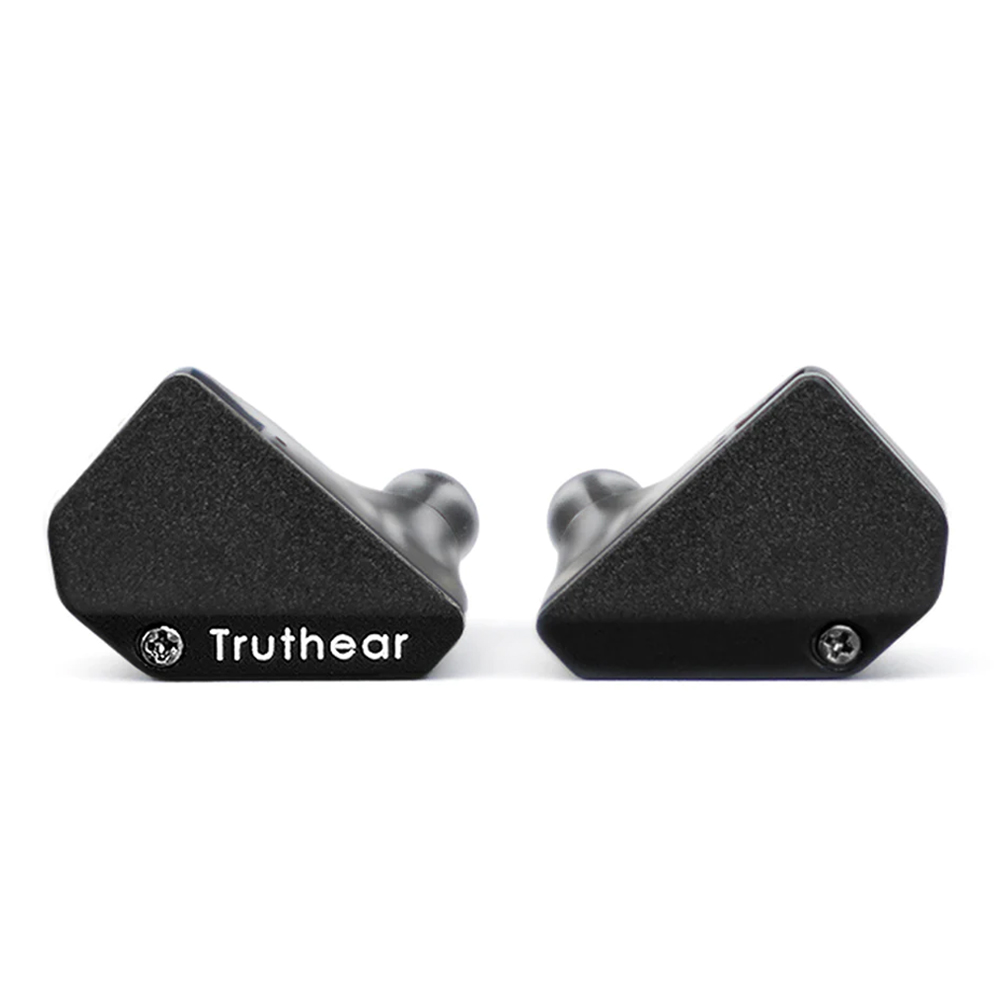
Truthear presents the Hexa as a hybrid with one dynamic driver and three balanced-armature drivers in an angular, light shell. The official page stresses a DLP-printed cavity and a PU and LCP composite diaphragm.
Christian Thomas at SoundGuys bought the review sample and listened to the Hexa over several days. The text covers the Hexa expressly, not the later Nova and not the Zero:Red in the Starter tier.
Truthear later names the Nova as a further step in treble performance with the same hybrid idea. This page does not carry a Nova score over to the Hexa, and no Hexa score over to the Nova.
A laboratory programme and MDAQS figures belong to the pillar and are marked as SoundGuys’ work, not as a measurement by this page.
On the official page Truthear names the DLP-printed cavity and the PU and LCP composite diaphragm as fixed figures. This page takes them as manufacturer statements, not as a measurement of its own.
The technology, explained
One dynamic driver plus three balanced-armature drivers share the stated range. The official impedance of 20.5 Ω ±15 % at 1 kHz and 120 dB/Vrms at 1 kHz is fixed; SoundGuys repeats the same figures and concludes that a separate amplifier is not needed.
In the pillar’s frequency-response account the Hexa sits remarkably close to SoundGuys’ own preference curve, with a little more energy in the highs or a little less emphasis in the lows, depending on how one reads it. Without equalisation it sounds “pretty normal”, not dazzling, but a safe base to trim.
Foam tips isolate particularly strongly in the review, including deep in the bass; narrow and wide silicone tips remain good, but sit below that. That feeds the build score, not a measurement curve of this page.
The cable hooks over the ear and uses a 0.78 mm 2-pin with a 3.5 mm jack. SoundGuys notes that a replacement cable of the same gauge keeps the earphone usable if the stock cable wears.
No IP rating or water resistance is stated. The pillar advises keeping the Hexa away from the shower and heavy rain.
What the international specialist press hears
SoundGuys — Truthear Hexa review (Christian Thomas, 17 December 2024)
Thomas calls the Hexa a standout in-ear under $100 and a reliable, clearly priced companion for listeners and producers. Out of the box the tuning meets a wide audience.
Without equalisation a little bass is missing against the house curve, but overall the Hexa sounds as music “should” sound: not dazzling, but a calm foundation. A single mild cut around 1 kHz is named as a possible, not mandatory, trim.
The shell is angular, but curved inside to the ear. Smaller ears, according to the review, will not find a fit; anyone with room wears the light earphone comfortably for hours. With foam, isolation is outstanding.
The MDAQS figures and laboratory numbers in the pillar remain SoundGuys’ work. This page does not take them as a measurement of its own or as a subscore.
Research consensus
One pillar of the same class is on hand, describing the Hexa as an easy-to-drive, well-priced hybrid whose tuning sits close to a known preference curve. The clearest limits are the fit in smaller ears and a slightly lean bass without equalisation.
The sound-evidence score of 7.3 follows that placement as a convincing but not leading Premium model, level with the KIMA 2 and below the Aria 2. Laboratory figures from the pillar do not enter the score as a measurement of this page.
The Nova in the same tier is a different model with its own pillar and its own price and is not heard here as a substitute.
Accessories and use
SoundGuys describes foam tips and two silicone sets with different bores, each in three sizes, and an over-ear, replaceable 2-pin cable with a 3.5 mm jack.
With foam, isolation in the review is particularly high, including deep in the bass; the silicone tips remain good, but sit below that. The weight of 4.8 g per side is perceived as very low.
The main practical limit is the fit in smaller ears at the angular shell. No microphone is provided. No water resistance is stated.
The replaceable cable is, for the pillar, an advantage for service life. This page does not judge aftermarket cables itself.
Price and availability
The documented euro price is €89.91 tax incl. (€74.92 tax excl.) at Audiophonics.fr, retrieved on 12 November 2026. The seller is Audiophonics SARL, 10 Rue Marcelin Berthelot, 33270 Floirac (Bordeaux), with Intra-Community VAT number FR30484107412 and SIRET 484 107 412 00039, shown on the “About us” page.
The product page sets schema.org/InStock, shows an “Add to cart” button and names 13 November 2026 as the shipping date, with the note that orders placed before 12:00 (GMT+1) usually leave the same working day. At the same time the shop scripts show quantityAvailable=0 with allowBuyWhenOutOfStock=true and productAvailableForOrder=true. This page therefore treats the Hexa as an item that can be ordered and discloses the zero quantity and the back-order flag; it does not claim a visible warehouse stock.
The VAT number FR 22 424 761 419 with a Roubaix address that appears in some theme footers belongs to the shop platform, not to Audiophonics, and is not used. An Amazon price on the pillar page is not used.
In the Premium tier, €89.91 sits beside the Aria 2 (€93.50) and the EA500LM (€93.49). The subscore of 9.0 follows that frame and does not take the value badge of the Titan S2 (9.2 at €66.25).
On an amplifier and on a vinyl system
On a typical phono amplifier with a headphone output, 20.5 Ω and 120 dB/Vrms are undemanding. Level is easy to reach; a low-noise output remains the closer care than extra power.
Anyone who takes the pillar as the basis will find, at the record player, a tuning that sits close to a known preference curve and supports quiet, even records. A little less bass without equalisation is the named limit, not a hard colouration.
The angular shell can spoil long sessions in smaller ears, regardless of the system’s output. Foam tips improve isolation in the review, even if less outside noise sits beside the turntable than on the move.
This page has no measurement programme of its own. Remarks on the response curve come from the published pillar and remain marked as its work.
Who is the Truthear Hexa for?
According to SoundGuys the Hexa suits listeners who want an even, unforced tuning at a clearly documented price under €90, and also producers who want a reliable, light in-ear for work.
It is a poorer match for very small ears, for a wish for strong bass without equalisation, or for use with a built-in microphone. No water resistance is provided for.
As a sister model beside the Pure and below the Nova in the same tier, the pillar supports the Hexa. It does not put it in the place of the IER-M500 or the Titan S2, and not in the place of the Zero:Red in Starter.
Anyone who wants to equalise will find a light-handed suggestion in the review, not an obligation. The subscores stay tied to the unaltered listening report.
How it compares
Against the Moondrop Aria 2 on the shared index 67 (rank 3, sound 7.4, €93.50) the Hexa remains the model with the slightly lower sound-evidence score of 7.3 at a slightly lower price and the same value score of 9.0.
Against the beyerdynamic DT 30 IE (rank 4, index 67, sound 7.4, €119.00) the same index meets a higher sound-evidence score and a higher price on the DT 30 IE’s side; the Hexa follows in rank 5.
Against the SIMGOT EA500LM (rank 6, index 67, sound 7.3, €93.49), at the same sound-evidence score the lower documented Hexa price of €89.91 decides the precedence in rank 5.
Against the DUNU Titan S2 (rank 7, index 67, sound 7.2, €66.25) the leading value score of 9.2 and the tier’s badge stay with the Titan S2, despite the Hexa’s higher value score of 9.0 at €89.91.
Against the DUNU KIMA 2 (rank 8, index 66, sound 7.3, €96.89) the Hexa shares the sound-evidence score and sits below it in price, with a higher value score of 9.0 against 8.8.
Place on the expanded list
The in-ear shortlist of 12 November 2026 carries, after this expansion, 80 wired models: eight in Starter, thirty-four in Premium, seventeen in Expert and twenty-one in Master. The Truthear Hexa belongs in the Premium tier and does not move the badges of that tier.
The Premium mapping still uses the 55–69 band. There is no required gap between places. The Truthear Hexa, at a raw score of 8.065, sits at index 67 and rank 5. It shares index 67 with the Moondrop Aria 2, the beyerdynamic DT 30 IE, the SIMGOT EA500LM and the DUNU Titan S2; at the same index the Aria 2 and the DT 30 IE, each with a sound-evidence score of 7.4, sit ahead of the Hexa (7.3), the Hexa precedes the EA500LM because of its lower documented euro price, and the value badge remains with the Titan S2 in rank 7.
This analysis is reachable from the shortlist. The package remains an isolated product package without list, sitemap or kb.js files. Upload is not approved; automatic submission of new URLs is not provided for.
FAQ
Is the Hexa the same as the Nova or the Zero:Red?
No. The Hexa is a hybrid model of its own, with one dynamic driver and three balanced-armature drivers. The Nova and the Zero:Red are different designs; the Zero:Red sits in the Starter tier of this list.
Which shop price applies?
On 12 November 2026, €89.91 tax incl. at Audiophonics SARL is documented, with VAT number FR30484107412 shown, schema.org/InStock and “Add to cart”. The shop scripts also show quantityAvailable=0 with back-orders allowed; the Hexa is treated here as an item that can be ordered, with a shipping date of 13 November 2026. An Amazon price is not used.
Does the Hexa take a Premium-tier badge?
No. The Sound badge remains with the Sony IER-M500, and the value badge with the DUNU Titan S2, which sits on the shared index 67 in rank 7.
Are the SoundGuys laboratory figures measurements by this page?
No. MDAQS values and frequency-response figures in the review are SoundGuys’ work and are marked as such.
Conclusion
In the review to hand, the Truthear Hexa remains an easy-to-drive hybrid under €90 with a tuning close to a known preference curve, strong isolation through foam and the clear limit that smaller ears will not accept the angular shell. A little less bass without equalisation is named, not as a hard colouration.
On the shortlist of 12 November 2026 it sits in the Premium tier, now expanded to thirty-four models, in rank 5 with index 67, with no badge, at €89.91 at Audiophonics SARL, where it can be ordered, with VAT number FR30484107412 shown. It shares index 67 with the Aria 2, the DT 30 IE, the EA500LM and the Titan S2; the value badge remains with the Titan S2 in rank 7.
The analysis takes the list record and the published pillar as they stand; this page does not conduct in-house listening tests or measurements.
About this AI analysis
This section is an AI summary of published international listening reviews and the manufacturer’s published figures. Vinyl BotPro places those findings against the data sheet, a documented euro price and the list record; VinylCination does not conduct in-house listening tests or measurements, and every source is linked at the end of the page. Prices and availability change (as of 12 November 2026, without guarantee). Subscores and the index come from the list package of the same day. The Vinyl BotPro index maps the unrounded raw score linearly onto the tier band; equal or closely spaced raw scores may share an index.