
In-ear headphones · AI analysis · Starter, rank 1
Truthear x Crinacle Zero:Red: Analysis
AI analysis (research): two-way in-ear with two dynamic drivers, 17.5 Ω, 117.5 dB/Vrms, tuned with Crinacle – manufacturer data and an international listening review, no listening test of our own.
Summary
The Truthear x Crinacle Zero:Red is a wired in-ear with two dynamic drivers, tuned by the Chinese manufacturer Truthear together with the well-known IEM curator Crinacle. According to the listening review we evaluated, it launched in May 2023 at $54.99; in Truthear's official store it was listed at $64.99 on 7 November 2026. We could not find an official euro store; in Germany it is mainly available through international online retailers. The euro price is therefore without guarantee and sits just below the limit of our Starter tier.
The review describes a bass-rich, crowd-pleasing sound, very good isolation with foam tips, a detachable cable, a good case and several ways to adjust the sound. The only clear criticism is the missing microphone. In our in-ear ranking the Zero:Red sits in the Starter tier at rank 1 (index 53) and carries the title Sound Vinyl BotPro Champion because it has the strongest sound evidence among the models without the Value title. That is an AI assessment based on manufacturer data and the SoundGuys review, not a listening impression of our own; we evaluate further measurements and reviews in the analysis below.
Specs (manufacturer)
| Design | in-ear, wired, two-way |
|---|---|
| Drivers | 10 mm (bass) + 7.8 mm (mids/treble), dynamic, LCP composite diaphragm |
| Impedance | 17.5 Ω ±15 % at 1 kHz |
| Sensitivity | 117.5 dB/Vrms at 1 kHz |
| Frequency response | 20 Hz – 20 kHz (IEC 60318-4); 20 Hz – 40.5 kHz (free field) |
| Cable | 1.2 m, silver-plated copper, 2-pin, 3.5 mm |
| Accessories | 10 Ω bass adapter, foam and 2 kinds of silicone tips, pouch |
| Microphone | no |
| Released | 19 May 2023 (per review) |
| Price | $64.99 in Truthear store, as of 7 Nov 2026 (launch $54.99); no official euro price |
Scores in detail
Vinyl BotPro Index 54 (Starter 40–54) · sub-scores 0–10, weights 35/20/15/30 · weighted raw score 7.9, mapped within the tier onto 41–53: the index shows the order within the tier, not measured differences in sound. Editorial synthesis, not a lab value · Sub-score rationale.
Manufacturer and concept
Truthear is a young Chinese brand specialising in in-ear monitors, USB headphone amplifiers and now also over-ear headphones. The company frequently works with well-known voices from the headphone community. The Zero:Red is one such collaboration: Crinacle, who has published in-ear measurements for years and developed his own target curves, set the tuning, and Truthear built the headphone.
The Zero:Red is the successor to the original Truthear Zero, but not just a facelift. According to the manufacturer both drivers are built differently, the crossover was recalculated and the target curve changed. In the bass the Zero:Red follows a curve with more low end than neutral; above 1 kHz it follows Crinacle's neutral target. Truthear's stated goal: plenty of bass impact without compromising midrange and treble, and a tuning suited to long listening sessions.
Important for context: Truthear itself writes that the Zero:Red is somewhat less dynamic than the Zero but better suited to long sessions. That fits the review, which describes the sound as pleasing rather than spectacular.
The technology explained
Two dynamic drivers with a crossover
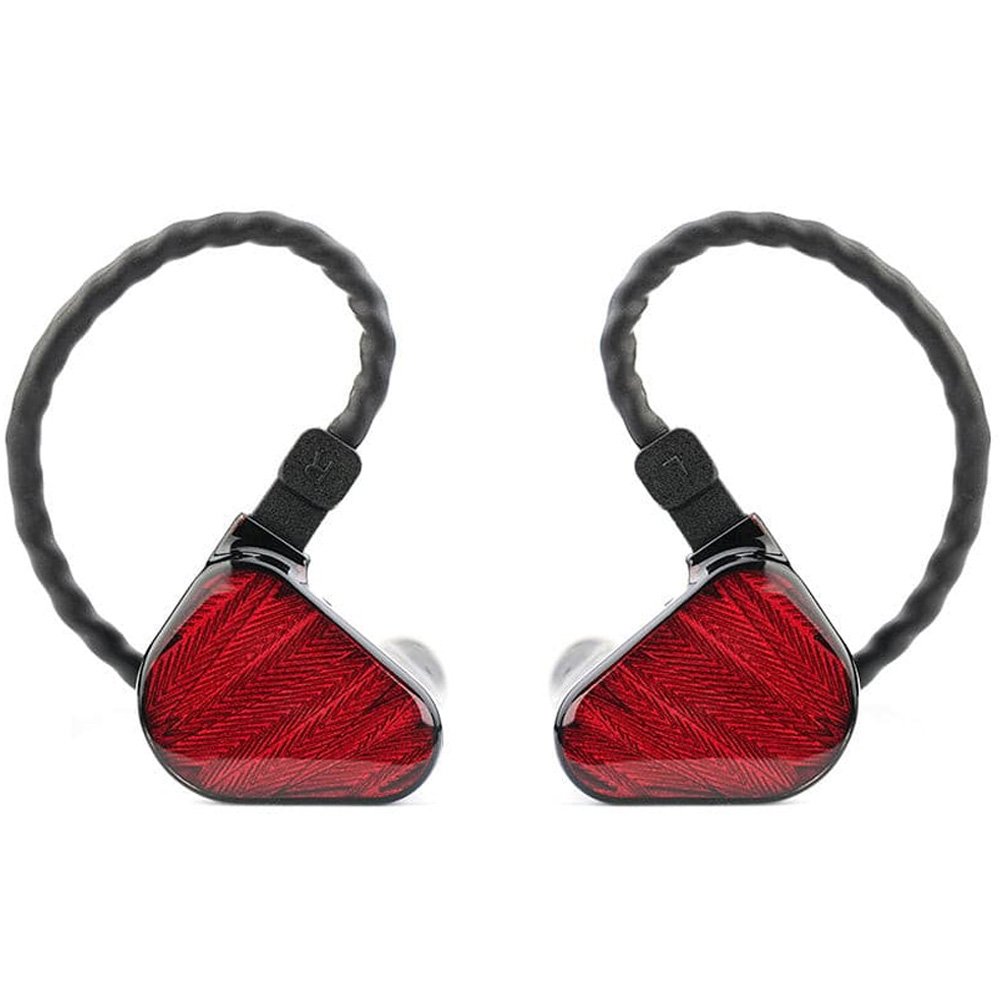
Each earpiece contains two dynamic drivers: a 10 mm unit for the bass and a 7.8 mm unit for midrange and treble. According to the manufacturer both use a composite diaphragm with a liquid-crystal dome and a polyurethane surround, driven by N52 magnets. The smaller driver has a particularly light voice coil so that its resonance sits closer to the target curve. The split is handled by a combination of an electrical RC crossover and an acoustically filtering nozzle made by 3D printing. Truthear calls this hybrid double frequency division.
Impedance and sensitivity
The manufacturer states 17.5 ohms and 117.5 dB per volt, with a frequency response of 20 Hz to 20 kHz (per IEC 60318-4) and up to 40.5 kHz in free field. In practice: the Zero:Red is easy to drive. According to the review it needs no amplifier with most sources, even with the supplied bass adapter.
The Bass+ adapter
The box includes a small in-line adapter with a 10-ohm resistor. It raises the source impedance the headphone sees and so changes the interaction of crossover and drivers: the bass gets a little louder. The review describes the change as audible but moderate. For vinyl listeners the adapter is interesting for another reason too, more on that below.
Housing, nozzle and cable
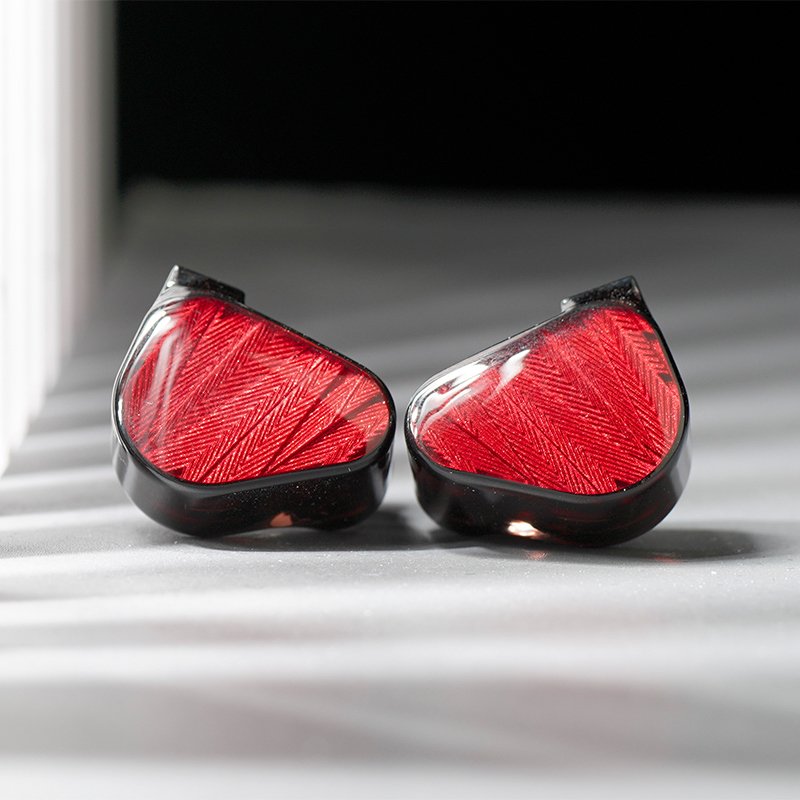
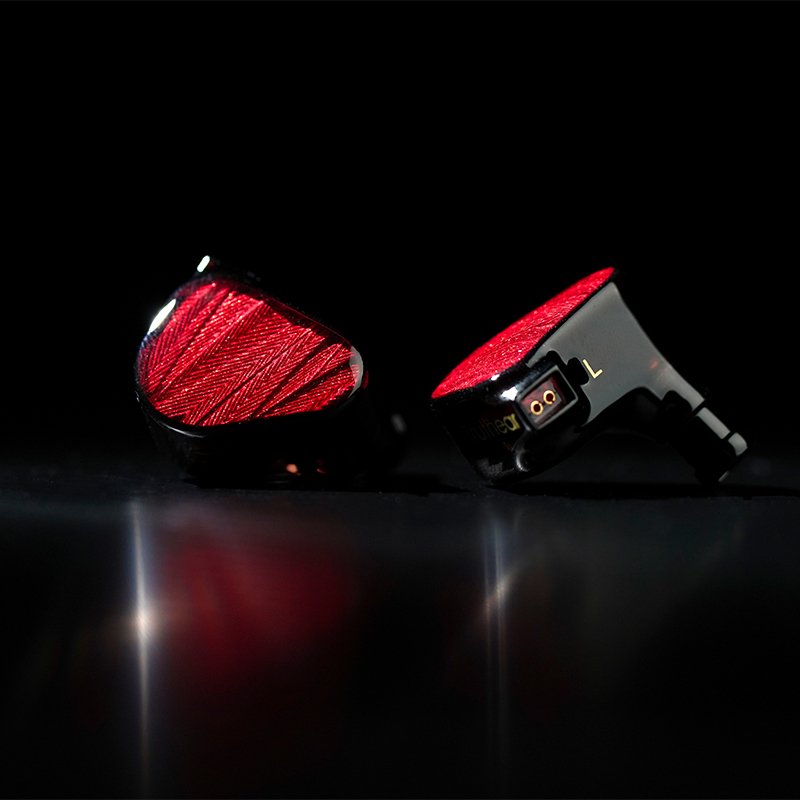
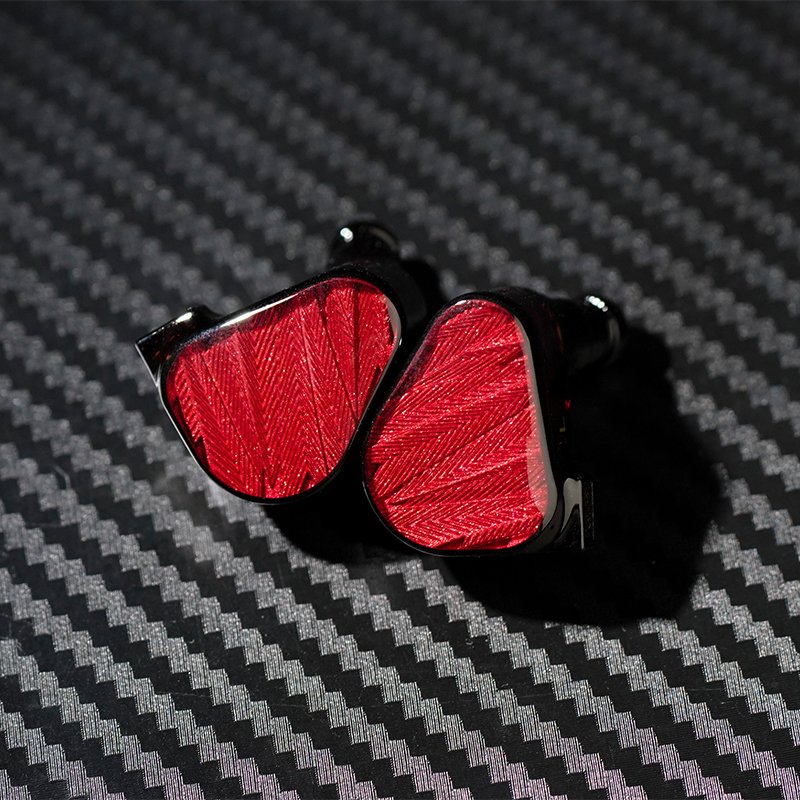
The housing is made by DLP 3D printing, a process otherwise used mainly for expensive multi-driver and custom in-ears. The faceplate has a glossy red pattern. At 6 mm the nozzle is fairly wide, which according to the review makes it easy to fit third-party tips. The 1.2-metre braided silver-plated copper cable attaches with 2-pin connectors, ends in a 3.5 mm plug and is stiffened at the ear hooks.
What international reviewers hear
Sound character
The review describes the Zero:Red as clearly good-sounding and pleasing to most people without any tweaking. The tuning is considerably bassier than the reviewing lab's reference curve and a little more restrained in the treble. That makes the sound livelier and more entertaining than a strictly neutral tuning, without the review describing any disturbing colouration.
Bass
Bass is the defining feature. It sits noticeably above neutral but, according to the review, not to a worrying degree. Those who prefer a more sober balance can pull it back slightly with EQ; those who want more can plug in the bass adapter. The lab's sound-quality rating (a statistical model of the average listener's verdict) is above 4 out of 5 in every category, according to the review.
Midrange and vocals
With the silicone tips the measurement shows a small dip around 500 Hz, a feature found in many current in-ears. Above that the Zero:Red follows the neutral curve. The review praises the timbre as pleasing; voices stay intelligible, even if the strong bass makes the upper registers seem a little quieter.
Treble
The treble is tuned more conservatively. Depending on the tip, mainly the top octave changes: with the wide silicone tips there is a deeper dip around 10 kHz, after which the level rises again. The review notes that younger listeners might find this return somewhat bright. For most it remains unobtrusive.
Spatial presentation
The review explicitly praises immersiveness, i.e. the perceived width and localisation of sound sources. The distortion rating is also good. For an in-ear at this price, the review says, that is as good a result as you could hope for.
Weaknesses according to the review
The review names just one real weakness: there is no microphone and no remote on the cable. Further notes come without a deduction: the earpieces are somewhat chunky, and isolation in the low frequencies is, as with almost all in-ears, much lower than in the mids and highs. Anyone who prefers a more neutral tuning will want to pull the bass back.
Accessories and everyday use
For a headphone at this price the accessories are generous: three types of tips (foam plus narrow and wide silicone, each in three sizes), the bass adapter and a soft faux-leather pouch with snap buttons that the review explicitly praises. It protects less than a hard shell but barely adds bulk in a trouser pocket.
The Zero:Red surprised the reviewer positively on fit: despite the fairly large housings it sat comfortably, and with the foam tips the right fit was found immediately. Isolation is very high with foam and still very good with the silicone tips. Measured differences in sound between the tips are small, so the choice should depend mainly on fit.
Price and availability
The Zero:Red launched in May 2023 at $54.99. In Truthear's official store it was listed at $64.99 on 7 November 2026, about ten dollars more than at launch. Converted, that is just under €60, the limit of our Starter tier; depending on retailer, shipping and import charges the actual euro price may be higher. We found no official store with euro pricing, neither at Truthear nor at Linsoul's European store. Availability in Germany is therefore given, but less convenient than for models with their own EU distribution.
For the assessment this means: the Zero:Red's value sub-score is lower than that of the two Starter models at around €20, even though it offers a lot for the money. That reflects the price gap, not a weak return. On sound evidence and build it leads.
With an amplifier and a vinyl system
From the headphone socket of an integrated amplifier or a headphone amplifier the Zero:Red plays loud without difficulty. Like all sensitive in-ears, however, it also makes the source's noise floor audible. Especially in turntable systems with a phono stage, hiss can become noticeable in quiet passages and between tracks that would never be heard through loudspeakers.
The supplied 10-ohm adapter has a side effect here: a series resistor lowers the level a little, and with it the audible hiss, and allows more travel on the amplifier's volume control. At the same time it lifts the bass slightly. Whether you like that is a matter of taste; as a simple fix for noisy headphone outputs it is practical. With amplifiers that have a high output impedance, the tuning of a two-way in-ear changes even without the adapter – in the same direction as with it.
For quiet evening sessions at the turntable the bass-rich, non-fatiguing character is a good basis. Anyone who wants to analytically track down flaws in pressings will not find the last bit of sparkle in the treble.
Who is the Zero:Red for?
According to the review, the Zero:Red is a good starting point for anyone discovering in-ears as a hobby: it sounds good, can be adjusted and costs little. It suits listeners who like strong bass but do not want a boomy tuning, and commuters who want high isolation with foam tips.
It is less suitable for people who make a lot of calls, because there is no microphone, and for anyone seeking a strictly neutral tuning. Those with very small ears should keep the size of the housings in mind.
Comparison with alternatives
In our Starter tier the Moondrop Chu II is the much cheaper alternative: one driver, more neutral tuning, less bass, weaker isolation and hardly any accessories. It holds the tier's Value title. The 7Hz Salnotes Zero also costs only about a third as much but, according to the review evaluated, sounds brighter. The Zero:Red review names the Truthear Hexa, with more treble and less bass, and the heavier magnesium Moondrop Aria 2 as alternatives; neither is part of our ranking.
Compared with the original Truthear Zero, the Zero:Red is, according to the manufacturer, less dynamic but lower in distortion at high levels and tuned for long sessions.
Images
FAQ
Does the Zero:Red need a headphone amplifier?
No. At 17.5 ohms and 117.5 dB per volt, any common source is enough according to the review, even with the bass adapter. Some adapters mixed across brands may limit output.
What does the bass adapter do?
It adds 10 ohms in series. This raises the bass audibly but moderately. As a side effect the level drops slightly, which can help with noisy outputs.
Does the Zero:Red have a microphone?
No. The standard cable has neither a microphone nor a remote.
Is the cable replaceable?
Yes, it attaches to the earpieces with 2-pin connectors.
Where can I get the Zero:Red in Germany?
We found no official euro store. Truthear refers to international retailers; the euro price is therefore without guarantee.
Why is the Zero:Red ranked first but not the Value Champion?
It has the highest weighted total in the Starter tier. The Value title goes to the Chu II, which leads on the value sub-score. The Sound title goes to the best sound evidence among the remaining models – that is the Zero:Red.
Conclusion
On the evidence, the Truthear x Crinacle Zero:Red is a thoughtfully tuned two-way in-ear with strong bass, good accessories, very good isolation with foam tips and easy drive. The missing microphone and the somewhat large housings are the main limitations. In our Starter tier it heads the ranking and holds the Sound title. The basis is manufacturer data, one detailed international listening review and the further measurements and reviews evaluated in the analysis below, no listening tests or measurements of our own.
Analysis: the Truthear x Crinacle Zero:Red in depth
What this analysis adds
The sections above rely mainly on the manufacturer's data and on Christian Thomas's review at SoundGuys [2]. For this analysis we evaluated six further sources: the measurements and listening notes by Amir Majidimehr at Audio Science Review [3], two articles from Headphones.com, one by Fc-Construct [4] and one by Griffin Silver [5], the review by R. Putnins at Headphonesty [6], the review by The Headphoneer from July 2024 [7] and a retrospective by Kazi at Music For The Masses from February 2024 [8]. We also re-checked Truthear's current product page on 10 November 2026 [1]. The review samples came from different places: SoundGuys bought its unit [2], Audio Science Review received it from the manufacturer [3], and Headphones.com, Headphonesty and Music For The Masses received theirs from the retailer Shenzhen Audio [4][6][8]. Vinyl BotPro has neither listened to nor measured the Zero:Red. Measurement and sound statements belong to the authors named; we mark our own calculations and conclusions. Rank, index and prices on this page remain unchanged.
Origins: a new target rather than a facelift
The first Truthear x Crinacle Zero followed the statistically derived Harman in-ear target as closely as possible. Crinacle himself does not consider that target ideal, and the Zero:Red is his attempt to realise his own idea; during development it was called Project Red [4][5]. According to Music For The Masses, the Zero:Red was announced in May 2023 at the High End show in Munich [8]. Truthear describes the target like this: in the bass similar to a public preference curve, above 1000 hertz Crinacle's IEF Neutral curve [1]. Griffin Silver therefore calls the Zero:Red the logical conclusion of IEF Neutral 2020 with a bass boost [5].
The shell and the basic idea of two dynamic drivers stay the same, but Fc-Construct reports that the voice coils and crossover were extensively reworked [4]. The 10 mm driver works as a subwoofer with a crossover around 160 to 180 hertz [4]. Kazi considers the bass driver in particular improved, while the 7.8 mm driver for mids and treble seems unchanged to him [8]. The manufacturer speaks of a specially adjusted, ultra-fine voice coil for the smaller driver [1]. The available sources do not allow these two statements to be checked conclusively against each other.
What the measurements show
Audio Science Review measured the Zero:Red in detail. Amir Majidimehr sees a very good match to his target, with a little less bass [3]. In a later edit he writes that he first used the wrong target; with the correct one, a small bass deficit appears [3]. By his measurement, the original Zero had slightly more energy between 2 and 5 kilohertz [3]. He was particularly pleased with distortion: it dropped noticeably compared with the predecessor and is incredibly low even at 114 decibels of sound pressure [3]. That fits the manufacturer's statement that nonlinear distortion was further optimised above 94 decibels [1].
Measurements on IEC 711-type couplers paint a similar picture. Fc-Construct describes a clean bass shelf below 200 hertz and an upper-midrange rise of 8 to 9 decibels [4]. Kazi measures a curve that is nearly flat up to 1 kilohertz and then rises by about 8 decibels [8]. Griffin Silver puts the bass shelf at roughly 7 decibels [5]. Our own context: such an upper-midrange rise reproduces the natural resonance of the outer ear and ear canal and is part of practically every common in-ear target. It is therefore not an exaggeration but the point of reference.
Why the treble remains uncertain in the measurements
Above a few kilohertz the measurements diverge, and the authors say so themselves. Fc-Construct calls the peak around 8 kilohertz in his measurement an artefact of the rig; a peak around 13 to 14 kilohertz does not appear in Headphones.com's measurements on the B&K 5128 [4]. Griffin Silver advises simply ignoring his own curve above 4 kilohertz [5]. He also describes a peak around 11.8 kilohertz in two comparison models that is not visible on IEC 711 couplers but clearly audible [5]. Our conclusion: for the top octave of the Zero:Red, the listening reports are more informative than individual curves, and they too depend heavily on ear shape and ear tips.
The bass adapter: how 10 ohms shift the sound
The included 10-ohm adapter is the most striking accessory. Amir Majidimehr shows that the two drivers and the crossover create a frequency-dependent impedance [3]. A resistor in series causes the greatest losses where the impedance is low; the result is less treble or, seen the other way round, more bass, at a somewhat lower volume [3]. Our own calculation of the order of magnitude: with a nominal impedance of 17.5 ohms and a source with negligible output impedance, 10 ohms in series lower the level at 1 kilohertz by just under 4 decibels. The Headphoneer puts the bass increase at about 3 decibels [7], SoundGuys calls it audible but modest [2].
Opinions on its usefulness differ. Fc-Construct sees it as a way to fill the slight mid-bass dip and emphasise the sub-bass further [4]. Putnins found the sound markedly darker with the adapter and the bass less controlled; the adapter is useful with hissy sources, but awkward on the move because it extends the plug [6]. Kazi did not like the extra bass because it casts a haze over the lower mids [8]. Amir Majidimehr would not use the adapter at all [3], and Griffin Silver deliberately left it out [5].
Bass: strong sub-bass with a small dip above it
On bass the sources largely agree. Fc-Construct describes a true sub-bass boost with a small dip in the mid-bass. It makes the bass agile and incisive, but can make it feel a little light at times [4]. With synths, kick drum and floor tom, however, the low end comes to life [4]. On quality he writes that the bass is among the best a neutrally tuned dynamic-driver in-ear offers below the expensive exotic models [4]. Griffin Silver praises the balance between sub-bass size and enough mid-bass force; only in low male voices does he miss some warmth [5]. Putnins misses nothing with bass-heavy music [6].
The Headphoneer is more reserved: the bass is balanced, but with some amplifiers and at low volume it lacks presence and punch [7]. None of the sources considers the Zero:Red a bass monster; Fc-Construct explicitly says it is not an in-ear for bassheads [4].
Midrange and vocals: where the verdicts split
On the midrange the assessments differ more than on the bass. Griffin Silver finds the range between 200 and 2000 hertz tilted too far towards the treble. Snare drums sound too hard to him and male voices lack weight, while high female voices sound very realistic [5]. Fc-Construct hears a slight hump around 1.5 kilohertz that makes male vocals stand out a little; otherwise he calls the mids tonally correct and free of romanticising colour [4]. Kazi, by contrast, finds that the tuning balances male and female vocals well; only baritone voices did not sound quite right to him [8]. Putnins describes the mids as neutral and clean, and strongly dependent on the quality of the recording [6].
Several authors call the timbre of the mids somewhat dry. Griffin Silver speaks of a slightly thinned-out decay [5], The Headphoneer of a dry, occasionally metallic note that improves with well-matched amplifiers [7]. Kazi, on the other hand, explicitly lists natural timbre as a strength [8].
Treble: exceptionally smooth or too tame?
For Griffin Silver the treble is the Zero:Red's greatest strength. He is not sure he has ever heard smoother treble in an in-ear; voices are neither scratchy nor sibilant [5]. Fc-Construct describes the treble as very tightly controlled: sibilance comes right to the brink but never crosses it. He does, however, miss some room for cymbals to shimmer after the initial attack [4]. Kazi hears muted treble with a noticeable lack of response around 10 kilohertz, which costs sparkle and air but avoids fatigue [8]. Putnins calls the treble well extended and fatigue-free, but behind more expensive models [6].
Amir Majidimehr found the sound a little closed and raised the region around 3 kilohertz by 1 to 2 decibels with an equaliser. That clearly improved the spatial effects but brought some brightness at times [3]. Our assessment: anyone who is sensitive to treble peaks will find the Zero:Red a safe choice according to the sources. Anyone looking for plenty of sparkle and air is more likely to want to adjust it.
Soundstage, resolution and dynamics
In spatial presentation the sources place the Zero:Red in the middle of the field. Fc-Construct calls the stage fairly constrained, with little height and a not particularly focused centre image [4]. Griffin Silver describes an average stage, firmly in-head [5]. Putnins hears a fairly wide headstage but would like more precise imaging [6]. Kazi calls stage and imaging average [8].
On resolution, Fc-Construct calls the Zero:Red class-leading in its price range, without it replacing more expensive references [4]. Putnins sees its technical abilities as decent but not a highlight [6], and Kazi gives tonality an A but technical performance only a C [8]. On dynamics the verdicts differ: Griffin Silver considers the Zero:Red the most dynamic in-ear under 100 US dollars [5], Kazi praises macrodynamic punch but misses microdynamics [8], and Truthear itself writes that the Zero:Red is less dynamic than the Zero [1].
Amplifier and source: one report stands out
According to the manufacturer, the Zero:Red has 17.5 ohms and 117.5 decibels per volt [1]. Our own conversion: that corresponds to just under 100 decibels per milliwatt. Audio Science Review therefore counts it among the less sensitive in-ears [3]. SoundGuys sees no need for an amplifier [2], and Kazi calls it fairly easy to drive [8]. Headphonesty lists 10 ohms and 120 decibels per volt as well as 102 decibels per milliwatt in its data table [6]; these values differ from the current manufacturer specification, and we follow the manufacturer.
The Headphoneer's report reads quite differently. The author describes the Zero:Red as unusually picky about amplification [7]. On the Topping A90 and at low volume it sounds flat to him, on a smartphone decent but below its potential [7]. With the Sparkos Labs Gemini hybrid tube amplifier at around 1000 US dollars, all his complaints vanish, and it also plays very well with some USB dongles [7]. Other sources report nothing of the kind. Our assessment: the report offers no measurement-based explanation. It is plausible that a higher volume improves the impression, which the author himself describes several times [7]. With amplifiers of high output impedance the tuning also shifts towards the adapter sound, as described for vinyl systems above.
Fit and nozzle: the most disputed point
The wide nozzle of more than 6 millimetres is the most frequently mentioned criticism [4][5][6]. According to Fc-Construct, Crinacle explained the size by the space the two large drivers need [4]. Fc-Construct himself finds the insertion angle very ergonomic and achieves a deep, tight seal [4]. Griffin Silver, by his own account with rather small ears, feels discomfort after about 30 minutes and needs a break after about three hours [5]. Putnins, by contrast, wore the Zero:Red for an entire twelve-hour shift on a film set without problems [6]. The Headphoneer finds the nozzles so long that the shell does not rest in the outer ear and sticks out [7]; Kazi calls fit, comfort and isolation excellent [8].
Two details from the reports: the nozzles have metal grilles against earwax, and two spare sets are included, though without instructions for replacing them [6]. The authors disagree about the surface: Putnins sees hardly any fingerprints [6], while Kazi calls the shells smudge-prone and slippery [8].
Comparisons from the sources
Against the original Zero, every source that knows both puts the Zero:Red ahead. Amir Majidimehr narrowly prefers it because of the lower distortion [3], Griffin Silver considers the predecessor worse in every respect [5], and Kazi regards the old Zero as outdated after the improvements in bass and mids [8]. Truthear still lists the Zero:Red; alongside it there is now a model called ZERO:BLUE2 [1].
Griffin Silver also compares it with the 7Hz Salnotes Zero and the Truthear Hola. Both have an annoying peak around 11.8 kilohertz; the Hola has warmer mids, a more comfortable fit and a better cable, the Zero:Red the better bass and treble [5]. Kazi prefers the Final E3000 for its timbre and more spacious presentation, but sees the Zero:Red ahead in midrange clarity and sub-bass [8]. The Headphoneer finds the Simgot EW200, at around 35 US dollars, more consistent and more musical overall, and the Kiwi Ears Cadenza more natural in timbre but less precise [7].
Our verdict on the evidence
The body of sources on the Zero:Red is unusually broad for a model in this price class, and it is in strong agreement on one point: the tonality is considered a major strength. Audio Science Review adds it to its recommended list [3], Fc-Construct gives it a strong recommendation [4], Griffin Silver considers the hype around it warranted [5], and Headphonesty sees it as a benchmark for affordable, neutrally tuned in-ears [6]. The sources also agree that soundstage and fine resolution are only average. Still disputed are the fit with the wide nozzle, the dryness of the mids and the dependence on the source, which only one report describes [7].
For its placement in our ranking nothing changes: rank, index and title continue to rest on the existing assessment. The additional sources do, however, support the Sound classification and make its limits visible. Our advice to anyone interested: if you have sensitive or small ears, check the retailer's return policy and try both the foam and silicone tips before judging the Zero:Red for good.
Sources for this analysis
- Truthear: TRUTHEAR x Crinacle ZERO:RED In-ear Monitor (Produktseite, abgerufen/accessed 10.11.2026). https://truthear.com/products/zero-red
- SoundGuys: Truthear x Crinacle Zero: Red review (Christian Thomas, 29.10.2024, aktualisiert/updated 11.12.2025). https://www.soundguys.com/truthear-x-crinacle-zero-red-review-126764/
- Audio Science Review: Truthear x Crinacle Zero:RED IEM Review (Amir Majidimehr, 20.05.2023). https://www.audiosciencereview.com/forum/index.php?threads/truthear-x-crinacle-zero-red-iem-review.44865/
- Headphones.com: Truthear x Crinacle ZERO: RED: Dissecting the Hype (Fc-Construct, 30.05.2023). https://headphones.com/blogs/reviews/truthear-x-crinacle-zero-red-dissecting-the-hype
- Headphones.com: IEF Neutral’s Logical Conclusion? A look at the Truthear x Crinacle Zero: RED (Griffin Silver, 12.07.2023). https://headphones.com/blogs/reviews/truthear-x-crinacle-zero-red-ief-neutral-s-logical-conclusion
- Headphonesty: Review: Truthear x Crinacle ZERO: RED – Hype, Delivered (R. Putnins, 02.07.2023). https://www.headphonesty.com/2023/07/review-truthear-x-crinacle-zero-red/
- The Headphoneer: TRUTHEAR x Crinacle Zero:RED Review (Chris – Mr.Headphoneer, 18.07.2024). https://www.headphoneer.com/truthear-x-crinacle-zero-red-review/
- Music For The Masses (audioreviews.org): Truthear X Crinacle Zero Red Review – New Benchmark Or Another Rehash? (Kazi, 18.02.2024). https://www.audioreviews.org/truthear-x-crinacle-zero-red-review/
Created by AI (Vinyl BotPro) from the sources listed; no listening tests or measurements of our own. Detailed human fact-check pending.
About this analysis
The SoundGuys review contains lab measurements with all three tip types; we report its findings and those of the further measurements and reviews evaluated in the analysis above without producing any measurements of our own. The price comes from Truthear's official store on 7 November 2026 and is given in US dollars; no official euro price was available to us. All images come from the manufacturer's product page and show the Zero:Red. The sub-scores and their rationale are listed for every model in the ranking.
Sources
- Truthear — ZERO:RED (manufacturer)
- SoundGuys — Truthear x Crinacle Zero: Red review (29.10.2024, aktualisiert 11.12.2025)
Created by Vinyl BotPro (AI) · As of 7 Nov 2026 · All information without guarantee.