
In-ear analysis · Expert · as listed
Westone MACH 30 Analysis
The Westone MACH 30 sits on the in-ear shortlist of 12 November 2026 in the Expert tier, now expanded to seventeen models, in rank 17 with a Vinyl BotPro index of 70 and no tier badge. This analysis takes the list record as published and does not run a second calculation.
In short
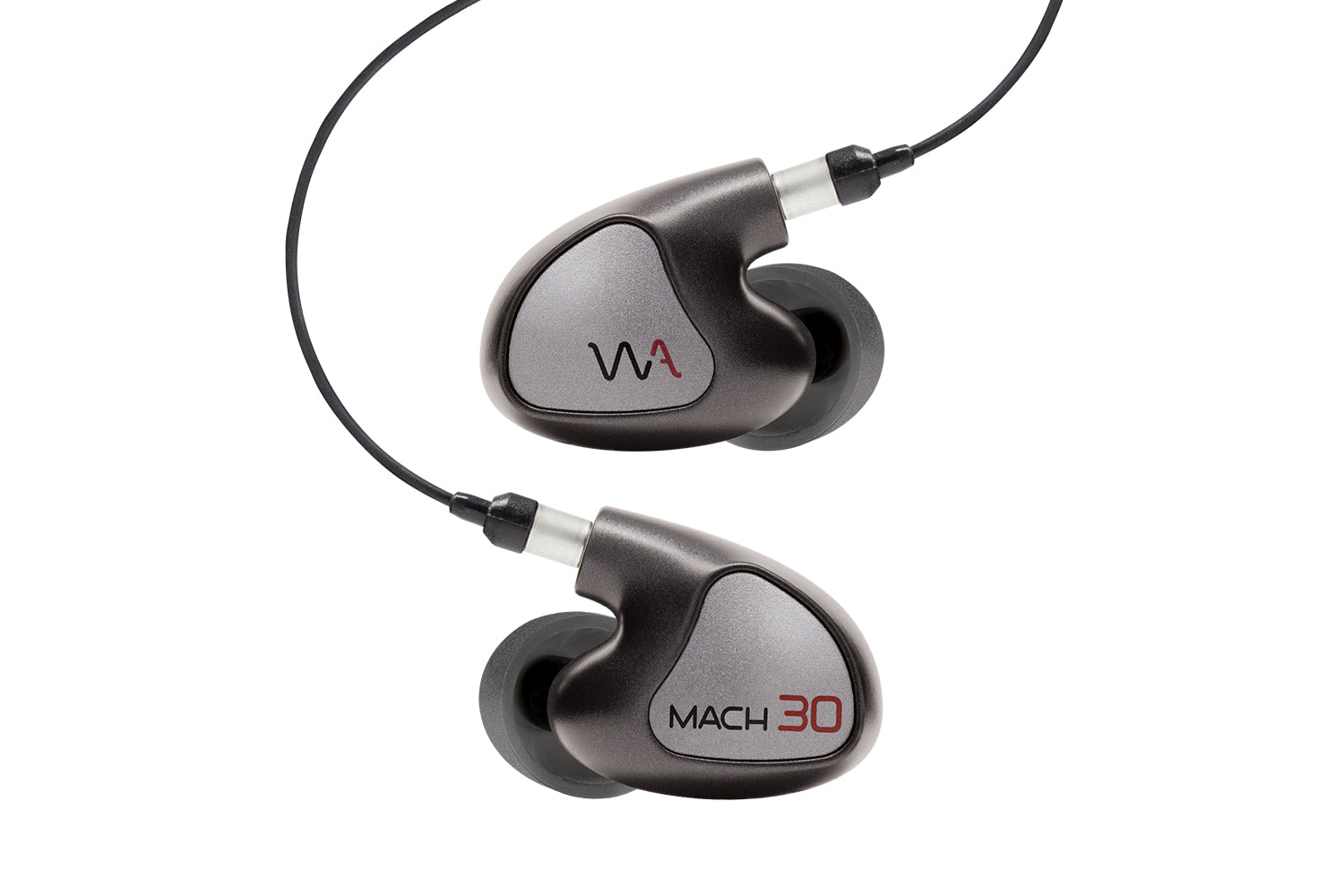
The Westone MACH 30 is a wired three-way in-ear with three balanced-armature drivers, a T2 connector and the slim Linum Estron SuperBaX cable. On the in-ear shortlist of 12 November 2026 it sits in the Expert tier, now expanded to seventeen models, in rank 17 with a Vinyl BotPro index of 70 and carries no tier badge. The subscores and the mapping onto the 70–84 band are documented in the list package; this page repeats the list record and does not run a second calculation.
The listening report is Headfonics (James, 30 January 2023), a combined piece on the MACH 30 and MACH 20: a dated review of both exact models in an independent international online specialist outlet. Headfonics belongs to the same editorial class as Headfonia, which already supports the live Monarch MKIV pillar; under the single badge rule of 12 November 2026 the MACH 30 is therefore eligible. The documented euro price is €549.99 in the official Westone EU shop (12 November 2026). Headfonics quoted £499 at the time; that figure is not converted into euros.
Technical data (public)
| Type | Universal-fit in-ear, wired, three balanced-armature drivers, three-way crossover |
|---|---|
| Impedance | 91 Ω at 1 kHz (Westone / Headfonics) |
| Sensitivity | 110 dB at 1 kHz (Westone / Headfonics) |
| Frequency response | 20 Hz–18 kHz (Westone / Headfonics) |
| Connection | T2, Linum Estron SuperBaX, 3.5 mm plug |
| Housing | MACH-series polycarbonate, metallic faceplate, scratch-resistant finish |
| Price as documented | €549.99 at westoneaudio.eu, 12 November 2026 |
Amplifier compatibility
At 91 Ω at 1 kHz the impedance sits well above typical in-ears, even though sensitivity is quoted at 110 dB at 1 kHz. Headfonics is clear that these models are not easy to drive: higher gain and more voltage lift bass density and resolution. At the same time a Shanling M7 and a FiiO M11 Plus ESS already sound dynamic and firm at higher gain, and even a MacBook headphone jack, in the review, delivers a clean impression with adequate dynamics. The higher resistance also suppresses background hiss and sibilance on noisy outputs, such as a guitar-amp headphone jack. A dedicated amplifier is therefore not an absolute requirement, but it is described as the way to unlock the MACH 30’s bass. On a typical vinyl chain with a 3.5 mm headphone output the supplied cable hangs directly; whether the level satisfies you remains device-dependent.
Rating criteria in detail
The Vinyl BotPro index on this page is the list record of 12 November 2026, not a second calculation. The Expert tier now holds seventeen models on the 70–84 band. The Iris leads with a raw score of 7.9 and index 84. The Aspire 1 (raw 7.8, index 81, value badge) and Aspire 2 (raw 7.7, index 78) sit directly behind the Iris. The MACH 30, MACH 20 and Final A5000 all round to 7.4; order follows the documented rule that, when rounded raw scores are equal, the higher K subscore ranks higher: MACH 30 (K 7.4, index 75) ahead of MACH 20 (K 7.2, index 72) and the A5000 (K 7.0, index 70). The earlier mid-band opening for the A5000 (index 74 as the only Expert model) lapses.
The sound-evidence score of 7.4 rests on Headfonics: the MACH 30 is the more comprehensive, less coloured design of the two, with better tonal balance and more precisely defined instruments than the MACH 20, a little more air and resolution, but limited bass depth. Build/comfort 8.4 follows from the fit, isolation and tough, slim cable described as excellent. Drive 7.6 follows from the high impedance and the explicit note that more voltage pays off, while portable sources remain usable. Value 6.6 follows from €549.99 at the top of the Expert frame; the tier’s value badge therefore sits with the cheaper Iris (P 7.6), whose review is clearer on value. The Sound badge falls to the MACH 30 as the best remaining K subscore.
Manufacturer and concept
Westone Audio builds in-ear monitors for the stage and for music listening. The MACH series shares a slim polycarbonate shell with a metallic faceplate from the more affordable models up to the expensive ones; Headfonics stresses that the MACH 20 and MACH 30 are intended not only for music appreciation but also for professional use, while at the then £399 and £499 they were much more approachable than the MACH 40, 50 or 80. What sets them apart in the line is impedance: 96 Ω and 91 Ω at 1 kHz, roughly three times the figures on the higher models. Sensitivity remains 110 dB at 1 kHz, so loudness is still reachable. Headfonics reads this as a way to suppress noise and sibilance on wireless receivers and other noisy sources.
The MACH 30 uses three balanced-armature drivers and a three-way crossover: one driver each for bass, mids and treble. The MACH 20 splits bass and the rest of the band across only two drivers. The shell itself stays the same across the series; the differences lie in driver count, crossover, impedance, and the thinner SuperBaX cable on the two more affordable models compared with the heavier cable from the MACH 40 up.
How the technology works
Balanced-armature drivers use an armature in a magnetic field and a small diaphragm. Several drivers plus a crossover let individual bands be handled separately; they also make drive more dependent on the crossover and on the source’s output impedance. Westone quotes 91 Ω at 1 kHz for the MACH 30 — unusually high for an in-ear. Headfonics confirms that the tuning stays consistent across sources and that the high resistance suppresses hiss, while bass quality and density increase on desktop amplifiers. This analysis has no measurements of its own.
The connector is T2, a slim Westone system that keeps the shell profile low. The supplied Linum Estron SuperBaX cable is, according to Headfonics, tougher and slimmer than older stock cables and thinner than the SuperBaX on the dearer MACH models. A slider with a lock can be worked with one hand and further tames cable noise. The official EU page also lists 20 Hz to 18 kHz and 110 dB at 1 kHz; those are manufacturer figures, not a lab judgement of what you will hear.
What the international specialist press hears
Character
Headfonics describes the MACH 20 and MACH 30 as something of their own in the series, not only in sound but in how they respond to power. Both already sound clean, with adequate dynamics, on portable sources, and the tuning stays reliable when the source changes — an advantage for professional use. More voltage and higher gain open up more excitement, especially on the MACH 30, which tilts slightly towards the low end. The MACH 20, by contrast, is more focused on the vocal range.
Tonal balance
The MACH 30 articulates bass smoothly into the vocal range, which itself is slightly forward and clearly imaged without becoming aggressive, even on powerful, hoarse voices. The mid-treble is slightly lifted for clarity; beyond that a roll-off suppresses unwanted sibilance and sweetens voices. Sharper voices and high-pitched instruments arrive in a relaxed way without covering the layers beneath. Overall the MACH 30 shows the bigger picture: better tonal balance and more precisely defined instruments, while the MACH 20, with stronger vocal colouring and a fuller vocal body, puts singing further forward. The preamble lists limited bass depth as the MACH 30’s main limit.
Dynamics, bass and stage
The MACH 20’s stage, in the review, is not exaggerated; it feels like a small, treated room with intense bass attacks. The MACH 30 gains resolution, defines the treble more clearly and brings more air and naturalness. Both need more power to sound lively; on an ADI-2 Pro instruments sit more accurately on the MACH 30, and the vocal image becomes denser and more powerful. The MACH 30’s bass makes the larger leap when the source supplies enough voltage. Headfonics notes that many professional monitors sound too flat or too bright; both MACH models instead keep control, dynamic bass and firmer transients, remaining neutral yet full and airy, especially in the low end — always with the reservations of limited bass depth on the MACH 30 and limited treble extension on the MACH 20.
Strengths and limits
The review lists the MACH 30’s clarity, the MACH 20’s fatigue-free treble, and excellent comfort and isolation on both as strengths. In the verdict the MACH 30 is the more comprehensive, uncoloured design, while the MACH 20 lets you focus more on the vocal performance. The high impedance leaves room for power-sufficient pairings with very good bass. DAPs already sound satisfactorily dynamic; the professional look and tough cable make a reliable package for the stage, and the fit and seal come close to some custom monitors.
Research consensus
This analysis rests on the combined Headfonics listening review, not a second international magazine report of the same depth. The consensus is therefore that finding, read against the data sheet and the euro price: a slim, very comfortable three-way BA in-ear with deliberately high impedance, an uncoloured, clear tuning, limited bass depth, and a drive requirement that already works on portable sources at higher gain but audibly benefits from stronger outputs. Badge eligibility follows the single rule. YouTube, forums or retailer copy are not used as a listening pillar.
Features and daily use
The MACH-series shell is, according to Headfonics, extremely slim, light and comfortable, with a scratch-resistant finish and a metallic faceplate. The slightly tilted nozzle seats immediately and does not need to be adjusted even after hours. The thin cable can be worn behind the neck; cable noise stays low even without tightening the slider, and glasses barely interfere. The carton includes five pairs of silicone tips and five pairs of True-Fit foam, an impact-resistant case, a cleaning tool, a cable binder and a cloth bag. The tips are longer than usual, spread the weight and improve the seal and bass. With foam, isolation comes close to some custom monitors in the review, and bass is more prominent than with silicone.
The Linum SuperBaX cable is treated as an unusually successful stock cable: slim, tough, not prone to tangling and without a strong memory effect, plus a slider that can be worked with one hand. For stage or sport Headfonics describes that as practical. The official EU page confirms T2 and the SuperBaX cable in the MACH 30 carton.
Price and availability
In the official Westone EU shop westoneaudio.eu the price on 12 November 2026 was €549.99. Headfonics quoted £499 at publication, and £399 for the MACH 20; this analysis does not convert pound or dollar prices into euros and uses the shop price documented on 12 November 2026. Whether a shop has stock is a snapshot and is not guaranteed here. Prices change, without guarantee.
€549.99 sits at the upper edge of the Expert tier (about €250–600). Headfonics places the model as a more approachable MACH relative to the MACH 40 and 50, not as a bargain across the whole Expert field. That is why the P subscore is 6.6, below the Iris at 7.6 and the MACH 20 at 7.0, and why the tier’s value badge sits with Blessing 3.
At the amplifier and on a vinyl system
As a wired in-ear with a 3.5 mm plug, the MACH 30 hangs from typical phono chains with a headphone output. The high impedance means a quiet output can make the bass sound flatter than a stronger one. Headfonics already hears satisfactory dynamics on DAPs, and denser bass and more resolution on desktop amplifiers. A dedicated headphone amplifier is not a rigid requirement, but it is described exactly for that gain. The review names no specific phono stage. Anyone listening to records should read the report for the limited bass depth and for the slight mid-treble lift with a subsequent roll-off; quiet pressings and an output with reserves fit the described tuning better than an under-driven headphone jack.
Who is the MACH 30 for?
The MACH 30 suits listeners who want a very comfortable, strongly isolating wired in-ear with an uncoloured, clear tuning, who have professional or stage-like use in mind, and who can or will provide a source with enough voltage. Anyone expecting maximum deep bass or an expressly warm V-shaped signature will find the bass-depth limit in the same review, and in the Iris of the same tier the more musical alternative with the value badge. Anyone who mainly wants vocals further forward sits, according to Headfonics, closer to the cheaper MACH 20, which follows on this list without a badge at index 72.
How it compares
In the Headfonics piece the MACH 30 sits beside the MACH 20 and, on page 2, beside the MACH 40 and MACH 50. The MACH 40 (then US$599, four drivers) is lusher, more immersive and easier to drive, with a wider, airier stage and more brilliant treble; the smaller models feel more damped, as in a treated recording room, yet keep more control with sharp instruments and voices. The MACH 50 (32 Ω, 110 dB, five drivers) is much more sensitive; the MACH 30 comes closer to it in bass detail retrieval than the MACH 20 does, but does not catch the MACH 50’s treble transients and shifts the focus towards the mid-lows and a more natural vocal body.
On the list of 12 November 2026 the Iris is in rank 1 (index 84, Sound badge), the MACH 30 in rank 17 (index 70, no badge), the MACH 20 in rank 7 (index 71) and the Final A5000 in rank 8 (index 71, no badge). The Iris, in the Headfonia review, has the warmer musical V with stronger bass and an upper treble that can turn sharp; the MACH 30, in the Headfonics text, is the more sober, comprehensive monitor, though more demanding to drive and dearer.
How it sits on the opened list
With the Iris, MACH 20 and MACH 30 the Expert tier had grown from one model to four; with the Edge, the SA6 MK2, Blessing 3, the Aspire 1 and the Aspire 2 it now holds nine models. The MACH 30 receives no badge: after the value badge goes to the Aspire 1 (highest P subscore 8.0), the Sound badge goes to the Iris (K 7.6), ahead of the Aspire 2 (K 7.5) and the MACH 30 (K 7.4). All four models are eligible under the single rule; Headfonics counts as the same class as Headfonia. The A5000 loses the mid-band opening of 74 and moves to index 70, still without a badge.
FAQ
What exactly is the Westone MACH 30?
A wired universal-fit in-ear from Westone with three balanced-armature drivers, a three-way crossover, 91 Ω and 110 dB at 1 kHz, a 20 Hz–18 kHz frequency response, a T2 connector and a Linum Estron SuperBaX cable. The shell is MACH-series polycarbonate.
Does the MACH 30 need a headphone amplifier?
Westone quotes 91 Ω at 1 kHz and 110 dB at 1 kHz. Headfonics describes it as not easy to drive: higher gain and more voltage improve bass and resolution, while portable players at higher gain and even a MacBook output already work adequately. A dedicated amplifier is not a rigid requirement, but it is recommended exactly for that gain.
Is it suitable for listening to records?
Yes. As a wired in-ear with a 3.5 mm plug it hangs from typical phono chains with a headphone output. The review describes an uncoloured, clear tuning with limited bass depth and a slight mid-treble lift plus roll-off. On quiet outputs the bass can sound flatter; an output with reserves fits the described presentation better.
What does the MACH 30 cost?
In the official Westone EU shop the price on 12 November 2026 was €549.99. Headfonics quoted £499 at publication. This analysis does not convert the pound price into euros. Prices change, without guarantee.
Why does the MACH 30 no longer hold the Sound badge?
Under the single rule the value badge goes to the highest P subscore among eligible models, now the 64 Audio Aspire 1 (P 8.0). The Sound badge goes to the best remaining K subscore, the Campfire Iris at 7.6, ahead of the Aspire 2 (7.5) and the MACH 30 (7.4). The MACH 30 therefore carries no badge in this list record.
Does this page rest on a listening test by the VinylCination team?
No. There was no in-house listening test and no measurement of our own. The assessment draws on Westone’s manufacturer data and the international Headfonics listening review (James, 30 January 2023). The list figures (Expert, rank 17, index 70, no badge) come from the list package of 12 November 2026.
Conclusion
The Westone MACH 30 is a clearly documented three-way BA in-ear for the expanded Expert tier: very comfortable, strongly isolating, with deliberately high impedance and a listening review that records an uncoloured, clear tuning with limited bass depth. The list record of 12 November 2026 is Expert rank 2, index 76 and no tier badge. Anyone planning €549.99 and looking for a sober monitor on a source with reserves will find a solid source base here. Anyone who wants maximum deep bass or the tier’s stronger value proposition should read the Iris and the note on bass depth in the same review.
About this AI analysis
This section is an AI summary of a published international listening review and Westone Audio’s own data. Vinyl BotPro places the findings and links them to the data sheet, the shop price and the list record; VinylCination does not have listening tests or measurements of its own, and every source is linked at the end of the page. Prices and availability change (as of 12 November 2026, without guarantee). Subscores and the index come from the list package of the same day.