
In-ear analysis · Master · as listed
Westone MACH 60 Analysis
The Westone MACH 60 sits on the in-ear shortlist of 12 November 2026 in the Master tier, now expanded to twenty-one models, in rank 18 with a Vinyl BotPro index of 88 and no tier badge. This analysis takes the list record as published and does not run a second calculation.
In short
The Westone MACH 60 is a wired three-way in-ear with six balanced-armature drivers (two each for bass, mids and treble), a T2 connector and a Linum SuperBaX cable. On the in-ear shortlist of 12 November 2026 it sits in the Master tier, now expanded to twenty-one models, in rank 18 with a Vinyl BotPro index of 88 and no tier badge. The subscores and the mapping onto the 85–97 band are documented in the list package; this page repeats the list record and does not run a second calculation.
The listening report is SoundStage! Solo (Geoffrey Morrison, 1 October 2026): a dated review of the exact model in a t646u magazine, Sound 7.5/10, Value 6.0/10. Under the single badge rule the MACH 60 is eligible; both Master badges sit with other models (Advar value, IE 900 Sound). The documented euro price is €1,209.99 in the official Westone EU shop (12 November 2026). SoundStage! Solo quoted €1,285 or US$1,210 in late September 2026; the shop price documented on 12 November 2026 is the one used here, and the dollar price is not converted.
Technical data (public)
| Type | Universal-fit in-ear, wired, six balanced-armature drivers, three-way crossover |
|---|---|
| Impedance | 35 Ω at 1 kHz (Westone EU) |
| Sensitivity | 100 dB at 1 kHz (Westone EU) |
| Frequency response | 8 Hz–20 kHz (Westone EU) |
| Connection | T2, Linum Estron SuperBaX, 127 cm, cable impedance 0.75 Ω (Westone EU) |
| Accessories | Pelican case, five pairs of foam and five of silicone, cloth bag (SoundStage! Solo / Westone) |
| Price as documented | €1,209.99 at westoneaudio.eu, 12 November 2026 |
Amplifier compatibility
At 35 Ω at 1 kHz the impedance sits far below the MACH 20 and MACH 30 (96 Ω / 91 Ω); sensitivity at 100 dB at 1 kHz is lower than their 110 dB. Morrison writes that the weak amplifier in a Sony NW-A306 already reached levels higher than comfortable for extended listening. A dedicated headphone amplifier is not a requirement on this record. The supplied cable, at 127 cm or the 50 inches named in the review, is sized more for portable sources; at an amplifier beside the desk Morrison had little slack. On typical vinyl chains the 3.5 mm plug hangs directly.
Rating criteria in detail
The Vinyl BotPro index on this page is the list record of 12 November 2026. The Master tier holds twenty-one models on 85–97. The MACH 60, with a raw score of 7.4, sits at index 88, rank 11, ahead of the Grand Luna (87) and the MACH 80 (85). Above it sit the IE 600 (86) and the IE 900 (87, Sound badge); both round to a raw score of 7.5, and the IE 900’s higher K subscore decides the order.
The sound-evidence score of 7.4 rests on Sound 7.5/10: a strong midrange, slightly laid-back treble, less bass than Morrison typically prefers and a little below strict neutrality, an impressively wide stage, and high strings that can sit on the edge of being overly crisp. Build/comfort 8.4 follows from the fit described as extremely comfortable, the Pelican case and the generous tip kit (five pairs of foam and five of silicone). Drive 8.4 follows from 35 Ω, 100 dB and the explicit ease in the review, despite the lower dB figure than on the MACH 20/30. Value 6.2 follows from €1,209.99 and Value 6.0/10; Morrison asks whether the mids and treble justify the higher price against the Astru. That is why this page carries no badge.
Manufacturer and concept
Westone, according to Morrison, describes the MACH 60 as best for vocals, guitar, keyboard, engineers, horn sections and studio reference, “extremely neutral.” Whether that holds is the question of the review. Six balanced-armature drivers in a fairly small shell, two per band, with a passive three-way crossover: that is the series’ technical answer to a higher driver count without a dynamic bass way. Morrison notes that these are the first multi-BA-only in-ears he has reviewed recently; many of his recent favourites mixed BA drivers with other principles.
The shell follows the MACH design language, the connector is T2, the cable Linum SuperBaX. Unlike the MACH 20 and 30, impedance at 35 Ω is closer to typical in-ears. The official EU page also lists 8 Hz–20 kHz and 100 dB at 1 kHz.
How the technology works
Six balanced-armature drivers plus a three-way crossover split bass, mids and treble across a pair of drivers each. Without a dynamic woofer, the amount of bass depends on the tuning and the seal, not on a large diaphragm area. Morrison hears exactly that: enough upper bass for warmth, little below it. This analysis has no measurements of its own.
35 Ω and 100 dB at 1 kHz describe a different drive situation from the high-impedance MACH 20/30. The review confirms easy drive on a weak player. The 127 cm cable at 0.75 Ω (Westone EU) is sized for mobile use; Morrison found the length tight at the desk.
What the international specialist press hears
Character
Morrison describes a strong midrange and slightly laid-back treble. Bass is lighter than he typically prefers, but there is enough to fill in the sound. He listened with a Schiit Magni, an iFi Hip-dac2 and a Sony NW-A306. On José González’s “The Forest” the acoustic guitar took centre stage, delicate plucks felt effortless, the breathy flute smooth. There was enough upper bass for the guitar to have warmth, but little below that range.
Tonal balance
On America’s “Ventura Highway” the soundstage was impressively wide, the opening notes appearing well out over the shoulders. The guitars had a natural realness, but they sat higher in the mix than they would on a flatter, more neutral headphone, as did the snare and cymbals. The weaker bass made the kick drum feel small. Morrison calls this less than strictly neutral, but not unbalanced: anyone who is not a bass fan, or who prefers a bit more mids and treble, will be happy. On Bach’s Brandenburg Concerto No. 3 the balance shifted, because the cellos fall right in the upper-bass and lower-midrange region the MACH 60 boosts a little; the piece sounded fuller than expected, yet the lack of lower bass was still disappointing, while the other strings sounded smoothly lifelike.
Dynamics, bass and stage
Compared with the Meze Rai Penta (described as discontinued) Morrison found a surprisingly similar profile: both a little down in the bass overall, with a boost in that upper bass and lower midrange. The Pentas sounded a little better balanced across the range, with smoother treble; on the MACH 60, higher-pitched strings could start bordering on overly crisp. On the Smashing Pumpkins’ “1979” the cymbals and electric guitars stood out, and the percussion had a great, immediate snap; the Pentas were more balanced as a result. The Astru, by contrast, was very bass-heavy, almost as if the orchestra had wheeled in subwoofers; its mids did not have the liveliness of the MACH 60, but the sound was a lot fuller.
Strengths and limits
In the closing line: after the bass-friendly Astru for much less money, Morrison does not feel there is enough to love about the mids and treble to justify the MACH 60’s higher price. If mids and treble are your thing and you have deep enough pockets, these are very comfortable universal in-ears. The published scores are Sound 7.5/10 and Value 6.0/10.
Research consensus
The source is a SoundStage! Solo listening review with published scores, not a second international magazine report of the same depth. The consensus: an extremely comfortable six-BA in-ear with a mid-forward, rather bass-light tuning, a wide stage, easy drive, and a price that the same author would justify against the Astru only with an explicit preference for mids and treble. The model is eligible; both Master badges sit with other subscores. YouTube, forums or retailer copy are not used as a listening pillar.
Features and daily use
Morrison describes a waterproof hard-shell Pelican case with foam, space for the cable, five pairs of silicone and five of foam, and a small carabiner, plus a soft bag. The fit in his ears was perfect and extremely comfortable. The smooth cable is thinner than on some high-end in-ears, which he sees as a plus for daily use. The length is more suitable for a portable device than for an amplifier at arm’s length.
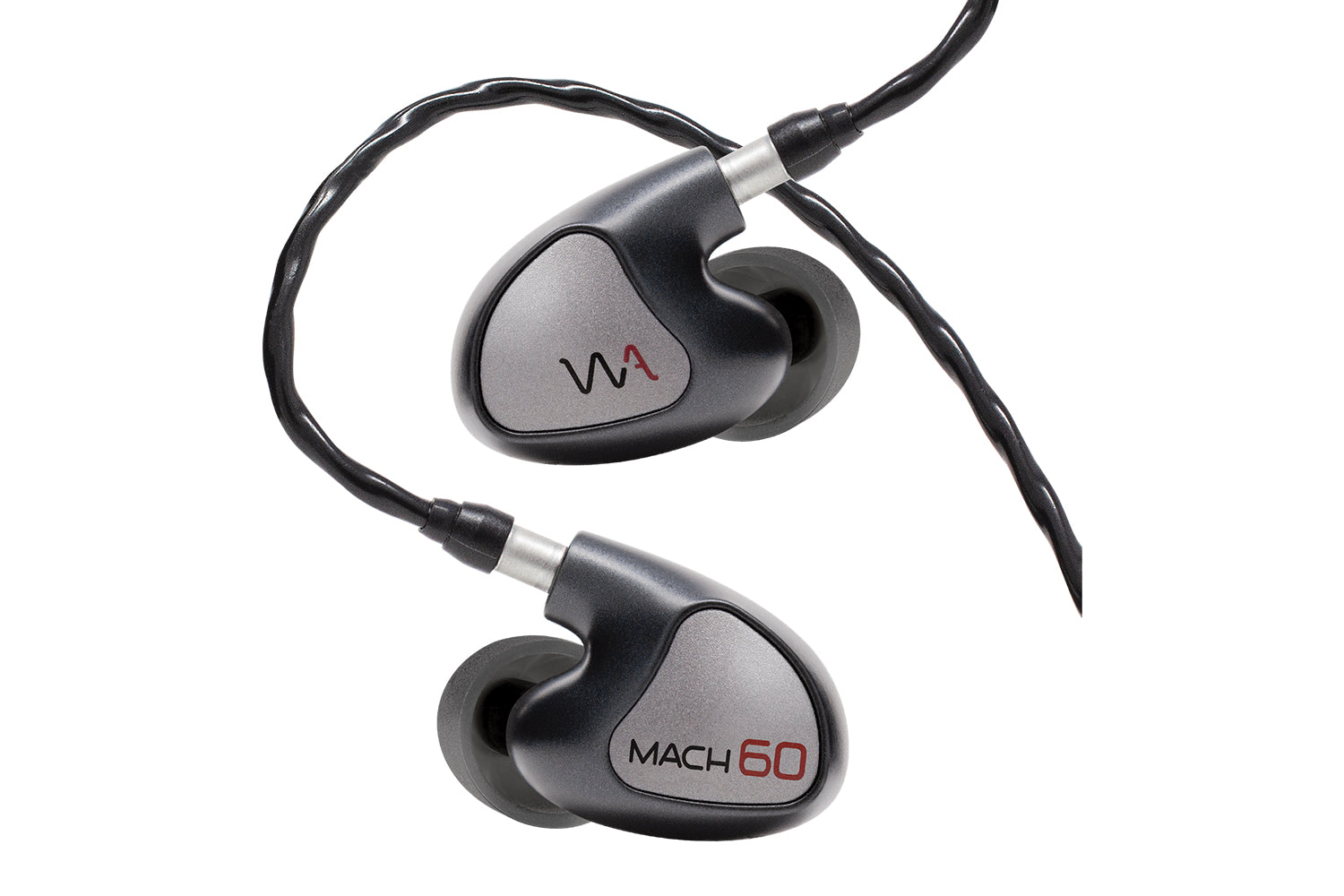
The official EU page confirms six BAs, a three-way crossover, T2, SuperBaX 127 cm, a Pelican case and five pairs each of foam and silicone. The official packshot on this page shows the black MACH shell of the series.
Price and availability
In the official Westone EU shop the price on 12 November 2026 was €1,209.99. SoundStage! Solo quoted €1,285 / US$1,210 in late September 2026. This analysis uses the documented shop price and does not convert the dollar price. Stock is not guaranteed here. Prices change, without guarantee.
€1,209.99 sits in the upper Master field, above the Advar (€699.00), the Astru (€899.00) and the IE 600, close to the SE846. Value 6.0/10 and the question of the premium over the Astru support the P subscore of 6.2, below the SE846 at 6.6 and the IE 600 at 6.8, above the IE 900 at 5.8.
At the amplifier and on a vinyl system
As a wired in-ear with a 3.5 mm plug, the MACH 60 hangs from typical phono chains. Drive, in the review, is uncritical; the limited cable length can get in the way at a desk. Anyone listening to records should read the report for the light bass and the emphasised midrange: acoustic guitar, voices and strings sit in the described strength, kick-drum-heavy pressings in the described limit. The Astru in the same list tier offers, in the same author’s comparison, the opposite, bass-heavy picture at the lower price.
Who is the MACH 60 for?
The MACH 60 suits listeners who want an extremely comfortable universal-fit in-ear with a mid-forward, rather bass-light tuning and a wide stage, who are planning €1,209.99, and who will use typical outputs. Anyone who prefers punch and warm bass sits, according to the same author, closer to the Astru. Anyone looking for the tier’s Sound badge will find it on the IE 900 in rank 9, justified by the higher sound-evidence score, not by a lower price. The MACH 60 remains without a badge, but it is eligible and clearly documented in the tier, ahead of the Grand Luna and the MACH 80.
How it compares
Morrison compares the MACH 60 with the Rai Penta and the Astru. On the list of 12 November 2026 the Astru is in rank 4 (index 94), the MACH 60 in rank 18 (index 88). The Advar leads the tier (97, value), the IE 900 holds the Sound badge (87). The index gap follows the raw scores of 7.4 against 7.8 (Astru) and 8.0 (Advar), not a second calculation on this page.
How it sits on the opened list
With the Astru and the MACH 60 the Master tier had grown to eight models; with the Aspire 3, Grand Luna, Andromeda 10 and MACH 80 it now holds twelve and is remapped onto 97–87 and 85. Live pages whose rank changes are updated in the same list package: the Monarch MKIV in rank 6 (index 92, no badge), the IE 900 in rank 9 (index 90, Sound badge kept). The list package as a whole still removes the Master value badge the Monarch previously carried live; that does not change again because of the MACH 60.
FAQ
What exactly is the Westone MACH 60?
A wired universal-fit in-ear from Westone with six balanced-armature drivers, a three-way crossover, 35 Ω and 100 dB at 1 kHz, an 8 Hz–20 kHz frequency response, a T2 connector and a 127 cm Linum SuperBaX cable.
Does the MACH 60 need a headphone amplifier?
Westone quotes 35 Ω and 100 dB at 1 kHz. Morrison already reached levels higher than comfortable for extended listening on a weak Sony NW-A306. A dedicated amplifier is not a requirement.
Is it suitable for listening to records?
Yes. As a wired in-ear with a 3.5 mm plug it hangs from typical phono chains. The review describes a strong midrange, slightly laid-back treble and less bass than neutrality. The cable length is sized more for portable sources. Anyone who wants strong bass should read the same comparison with the Astru.
What does the MACH 60 cost?
In the official Westone EU shop the price on 12 November 2026 was €1,209.99. SoundStage! Solo quoted €1,285 / US$1,210. This analysis uses the shop price and does not convert the dollar price. Prices change, without guarantee.
Why does the MACH 60 have no tier badge even though it is eligible?
Eligibility and badges are separate. The value badge goes to the Aspire 3 (P 8.2), the Sound badge to the IE 900 (K 8.6). The MACH 60 sits behind both at P 6.2 and K 7.4.
Does this page rest on a listening test by the VinylCination team?
No. There was no in-house listening test and no measurement of our own. The assessment draws on Westone’s manufacturer data and the international SoundStage! Solo listening review (Geoffrey Morrison, 1 October 2026). The list figures (Master, rank 18, index 88, no badge) come from the list package of 12 November 2026.
Conclusion
The Westone MACH 60 is a clearly documented six-BA in-ear for the expanded Master tier: extremely comfortable, easy to drive, with a documented shop price and a magazine listening review that records a strong midrange, light bass and a wide stage, but would justify the premium over the Astru only with an explicit preference for mids and treble. The list record of 12 November 2026 is Master rank 18, index 88, with no badge. Anyone planning €1,209.99 and looking for exactly that presentation will find a solid source base here. Anyone who wants punch at the lower Master price should read the Astru in rank 4.
About this AI analysis
This section is an AI summary of a published international magazine listening review and Westone Audio’s own data. Vinyl BotPro places the findings and links them to the data sheet, the shop price and the list record; VinylCination does not have listening tests or measurements of its own, and every source is linked at the end of the page. Prices and availability change (as of 12 November 2026, without guarantee). Subscores and the index come from the list package of the same day.