
Bookshelf speaker · AI analysis · Premium, rank 3
Wharfedale EVO4.2 Review
AI analysis (research): 3-way bookshelf with AMT-tweeter, 87 dB / 8 Ω (min. 4 Ω), 25–120 W — specs/prices, no listening test.
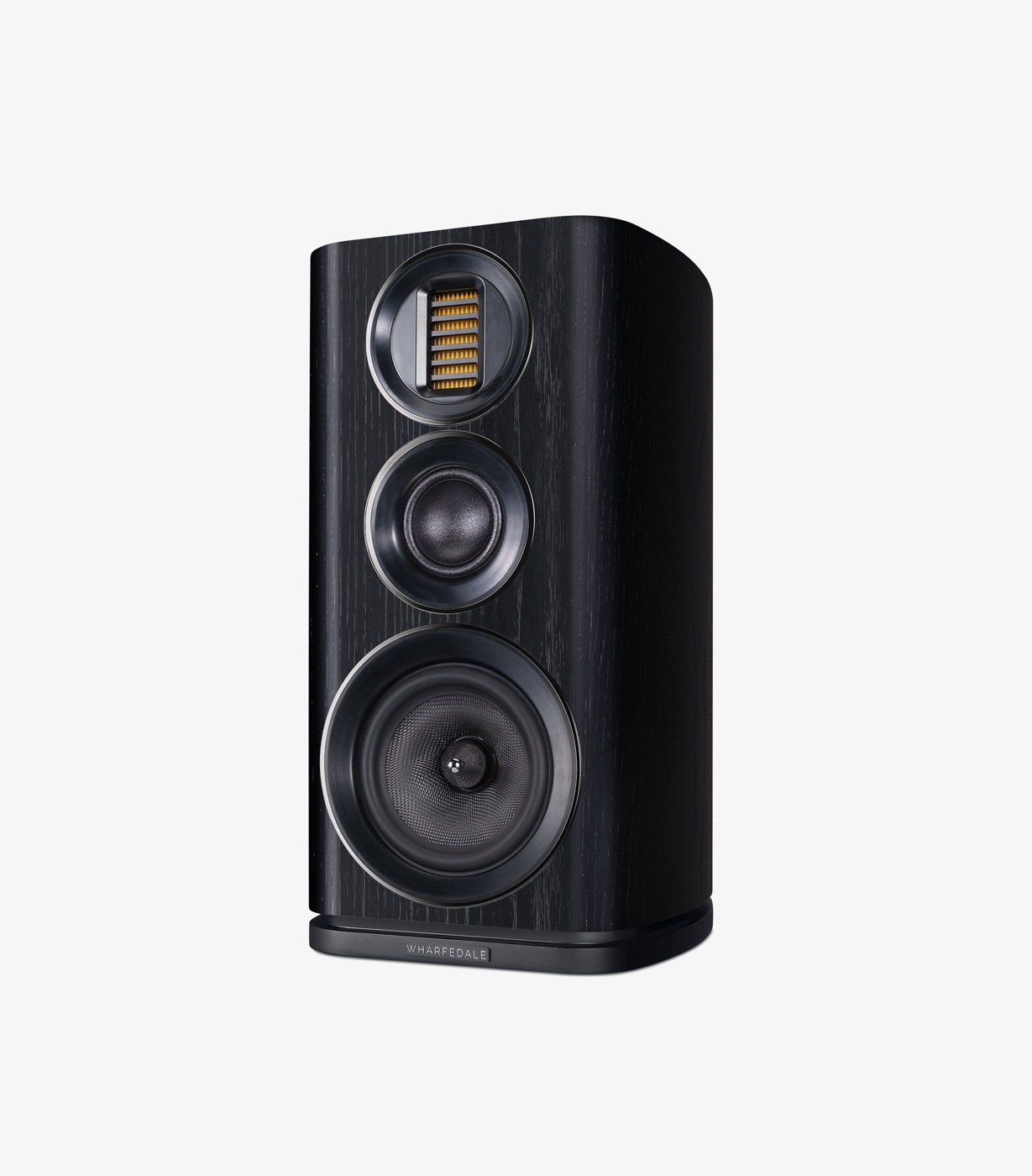
Summary
The EVO4.2 combines 165 mm Kevlar bass, 50 mm soft-dome midrange and 30×60 mm AMT: 87 dB, 8 Ω (min. 4 Ω), 25–120 W, 54 Hz–22 kHz. Market price approx. €799–999/pair. Specialist press (The Audio Beatnik, Pursuit Perfect System, 2020): wide soundstage, smooth treble, plenty of bass for the size. The cabinet is large for a shelf; the manual recommends sturdy stands. Details and sources in the analysis below.
Assumptions
- Price per pair Sept 2026
- Stand recommended (large bookshelf speaker)
- Amplifier 25–120 W, note the 4 Ω minimum
- No measurements of our own
Specs (public / manufacturer)
| Type | 3-way compact speaker · bass reflex |
|---|---|
| Sensitivity | 87 dB (2.83 V/1 m) |
| Impedance | 8 Ω compatible (min. 4 Ω) |
| Rec. Amplifier power | 25–120 W |
| Frequency range | 54 Hz–22 kHz (±3 dB) |
| Chassis | 165 mm Kevlar · 50 mm soft dome · 30×60 mm AMT |
| Dimensions / weight | 455 × 250 × (340 + 10) mm · 13.4 kg/piece |
| Price guide | Market price approx. €799–999/pair · Sept 2026 |
Manufacturer specifications (Wharfedale)
| Type | 3-way compact speaker, bass reflex |
|---|---|
| Drivers | 30 × 60 mm AMT · 2″ (50 mm) soft-dome midrange · 6.5″ (165 mm) Kevlar woofer |
| Frequency response | 54 Hz–22 kHz (±3 dB) · bass extension 48 Hz (−6 dB) |
| Sensitivity | 87 dB |
| Impedance | 8 Ω compatible (min. 4 Ω) |
| Recommended amplifier power | 25–120 W |
| Max. SPL | 105 dB |
| Crossover frequency | 1.4 kHz / 3.9 kHz |
| Dimensions | 455 × 250 × (340 + 10) mm (H × W × D) |
| Weight | 13.4 kg each |
Source: Wharfedale – official specifications · As of 16 October 2026 · subject to change by the manufacturer
Scores in detail
Vinyl BotPro Index: 65 · Index band Premium 55–69 · Guidance only, not a lab value.
Strengths
- AMT resolution at fair price
- Real 3-way division
- Strong value for money profile
Weaknesses
- Large and heavy for the shelf
- Note the 4 Ω minimum
- Finish below high-end veneers
Comparison models
| vs. LS50 Meta | More value for money, less icon |
|---|---|
| vs. Oberon 3 | Complex construction, more expensive |
| vs. DBR62 | More technology, higher market price |
System matching
Works well with
- Premium integrated amplifier with 4-Ω stability
- Space for stands
- Vinyl listeners focused on value for money
Less suited
- Tiny shelves without stands
- Very weak amps
- Minimalists with mini-speakers
Analysis: the Wharfedale EVO4.2 in depth
What this is: an AI analysis, not a listening test
This page summarises what can be documented about the Wharfedale EVO4.2 from manufacturer material and international specialist publications. Vinyl BotPro has neither listened to nor measured the loudspeaker. We paraphrase sound descriptions in our own words as the named publications formulated them under their own conditions. Our own assessments are marked as such. This section does not change the rating, rank or index: the EVO4.2 remains at index 65 in third place in the Premium tier and holds the value-for-money champion award.
Model separation matters here. According to Wharfedale, the EVO4 series comprises the EVO4.1 and EVO4.2 bookshelf speakers, the EVO4.3 and EVO4.4 floorstanders and centre and surround models [1][2]. Wharfedale now also sells a separate EVO 5 series [1]. This page covers only the EVO4.2. Where sources refer to other models, such as awards for the EVO4.4, we say so explicitly. We quote prices only as dated press prices; they are not current euro market prices.
Background: Wharfedale and the EVO4 series
According to the manufacturer, Wharfedale was founded in 1932 by Gilbert Briggs in Yorkshire [7]. The Audio Beatnik notes that almost everything in a Wharfedale speaker is designed and made in-house, from drivers and crossovers to the multi-layer cabinet materials [4]. It names Peter Comeau as lead designer [4]. According to The Audio Beatnik, his own reference speaker is the well-known Quad ESL electrostatic [4].
According to Wharfedale, the EVO4 series grew out of the development work for the ELYSIAN flagship range and borrows much of its technology [1]. The manufacturer puts the AMT tweeter at the centre, together with cabinet technology similar to ELYSIAN and the SLPP bass reflex system [1].
The timeline according to the sources:
- Launch (May 2019): What Hi-Fi? reported on the launch at High End Munich on 9 May 2019; the range was due on sale in July, with no prices announced yet [3].
- Reviews in 2020: The Audio Beatnik published a review on 12 June 2020 at a price of $999 [4]. Pursuit Perfect System published a review in July 2020 at £599 [5].
- Manual: The user manual we evaluated is dated December 2022 [2].
Construction: a three-way bookshelf speaker
According to Wharfedale, the EVO4.2 is a three-way bookshelf speaker with a bass reflex cabinet [1]. That is unusual at this size: the smaller EVO4.1 is, according to What Hi-Fi?, a two-way speaker with a 5-inch bass driver and AMT [3]. Only the EVO4.2 adds a midrange driver with a 50 mm dome [1][3].
The manufacturer's specifications:
- Bass driver: 165 mm (6.5 in) with a black woven Kevlar cone [1].
- Midrange driver: 50 mm (2 in) soft dome [1].
- Tweeter: 30 × 60 mm AMT [1].
- Sensitivity: 87 dB at 2.83 V and 1 m [1].
- Impedance: 8 ohm compatible, minimum 4 ohms [1].
- Recommended amplifier power: 25 to 120 watts [1].
- Peak SPL: 105 dB [1].
- Frequency response: 54 Hz to 22 kHz (±3 dB), bass extension to 48 Hz at −6 dB [1].
- Crossover frequencies: 1.4 kHz and 3.9 kHz [1].
- Dimensions and weight: 455 × 250 × (340 + 10) mm (H × W × D), 13.4 kg each [1].
From the two crossover frequencies, our reading is that the midrange dome covers roughly the band between 1.4 and 3.9 kHz. Wharfedale does not describe the split in detail.
Place in the EVO4 range
The manual lists the specifications of the four stereo models side by side [2]. According to that table, the frequency response (±3 dB) reaches 64 Hz for the EVO4.1, 54 Hz for the EVO4.2, 48 Hz for the EVO4.3 and 44 Hz for the EVO4.4 [2]. Peak SPL rises from 104 dB for the EVO4.1 to 105 dB for the EVO4.2 and EVO4.3 and 107 dB for the EVO4.4 [2]. Recommended amplifier power also grows with size, from 25 to 100 watts for the EVO4.1 to 30 to 200 watts for the EVO4.4 [2].
The EVO4.2 therefore sits between the small two-way model and the floorstanders. According to What Hi-Fi?, the EVO4.3 and EVO4.4 floorstanders use the same combination of AMT and 2-inch dome with 5- or 6.5-inch bass drivers [3]. For the bookshelf models, Wharfedale offers dedicated stands, listed on its site as EVO4.2 Stands [1].
The AMT tweeter
AMT stands for Air Motion Transformer. According to Wharfedale, development focused on this tweeter, which is meant to reproduce high frequencies in a radically different, efficient and accurate way [1]. At launch, What Hi-Fi? wrote that the technology replicates a point source and aims to shift more air to lower distortion [3].
Pursuit Perfect System describes the AMT as a folded diaphragm with a large surface area; because the large area needs only small movements, it offers good transient response with low distortion [5]. That is the publication's explanation, not a measurement of ours.
Midrange and bass drivers
According to The Audio Beatnik, the 50 mm dome is the most eye-catching part of the EVO4.2; similar dome midrange drivers are otherwise found mainly in much more expensive speakers [4]. Pursuit Perfect System describes the midrange as fast, wide-bandwidth and widely dispersing [5].
One conflict in the sources: in its 2019 launch news, What Hi-Fi? called the 2-inch dome a "tweeter" alongside the AMT [3]. Wharfedale lists it in the specifications as a midrange driver [1]. We follow the manufacturer.
For the 165 mm bass driver with Kevlar cone, Wharfedale gives only material and size [1]. According to The Audio Beatnik, Comeau developed three different drivers for the EVO4 range: the AMT, the Kevlar bass drivers and, from the EVO4.2 upwards, the dome midrange [4].
SLPP bass reflex and cabinet
According to The Audio Beatnik, SLPP stands for Slot Loaded Profiled Port [4]. Wharfedale says the system was developed for ELYSIAN and carried over to the EVO4 range [1]. The Audio Beatnik describes a slot about 0.4 inch high on the underside through which the lowest bass exits; this is meant to lower distortion, extend bass and ease placement [4]. Pursuit Perfect System describes the port as hidden in the base plate [5].
According to Wharfedale, a cabinet using technology similar to ELYSIAN forms the base for the drivers; radiused edges are meant to help integrate the output with the room [1]. Pursuit Perfect System mentions curved side walls intended to reduce internal reflections, magnetically attached grilles and high-quality binding posts [5]. The Audio Beatnik describes rounded edges, a matte black base plate and rubber trim rings around the drivers against diffraction [4].
Terminals and finishes
According to Pursuit Perfect System, the EVO4.2 has enough binding posts for bi-wiring and bi-amping [5]. For bi-wireable crossovers, the manual describes four terminals: the upper pair feeds the treble section, the lower pair the bass section; as supplied, removable metal straps link the two pairs [2].
On the product page, Wharfedale lists Black Oak, Walnut and White Oak finishes [1]. In 2019 What Hi-Fi? named black, white and walnut [3]. The Audio Beatnik had walnut samples and praised the build and veneer [4].
Placement according to the manual
According to the manual, the EVO4.1 and EVO4.2 should be stand or wall mounted; a rigid shelf is possible [2]. The quality of the stands greatly influences performance, and flimsy products should not be used [2]. Closer to the rear wall bass extension improves; too close to the walls the bass increases but may become boomy and indistinct [2].
If the speakers stand away from the walls, the manual says the toe-in may be increased by up to 40 per cent, although this can narrow the best listening area [2]. As a rule of thumb, it suggests a listening distance about equal to the distance between the speakers; the tweeters should be roughly at ear level for a seated listener [2].
Pursuit Perfect System measured a very smooth frequency response in its own room but a steep treble roll-off off-axis in the vertical plane, which it attributes to the AMT [5]. It concludes that the correct height is particularly important and that some toe-in is a good starting point [5]. That is the publication's measurement in its room with room correction, not ours.
Amplifier choice
Wharfedale recommends 25 to 120 watts and states a minimum impedance of 4 ohms [1]. The Audio Beatnik listened to the EVO4.2 with several integrated amplifiers, including a 35-watt-per-channel valve amplifier; even then there was enough power for a room-filling sound, although attack sounded slightly softened [4]. The publication also writes that the speaker clearly reveals the character of the amplifier and benefits from powerful, high-current amplifiers [4].
In detail, The Audio Beatnik describes the pairings as follows [4]: with a Norma Audio IPA-140 the EVO4.2 sounded relaxed, with the most holographic midrange and the strongest bass. With a Cambridge Audio Azur 851A the treble was more present and the overall balance flatter, similar to powered studio monitors. A Sony TA-A1ES brought, in the publication's impression, more inner detail and air in the treble. These differences describe the amplifiers as much as the speaker and apply only to that system.
For cabling, the manual recommends speaker cable of adequate cross-section, because cable that is too thin can limit dynamics and bass, and equal cable lengths for left and right [2].
Dated prices
The following prices come from the respective review and apply only to that date and market:
- The Audio Beatnik, June 2020: $999 [4].
- Pursuit Perfect System, July 2020: £599 [5].
- Hi-Fi Choice, March 2020: according to Wharfedale's press compilation, the EVO4.2 cost £50 more than the B&W 606, which had previously won a group test [6]. We have not seen the original article.
The price guide at the top of this page (as of Sept 2026) is not affected.
How the reviews were made
The review conditions differ. Pursuit Perfect System assessed the EVO4.2 as the first of nine standmount speakers under £650 in a group test [5]. According to the publication, the listening room was heavily treated acoustically, and Terry Ellis used Dirac Live room correction, including to match the bass of both comparison speakers [5]. He named Atacama Apollo Cyclone 6 as the stands [5]. In the end, by his own account, he bought a pair as a reference for further comparisons [5]. As his only main speakers, budget permitting, he would rather have chosen the EVO4.4, because its additional bass driver delivers more bass and suits his listening preferences better [5]. That is his personal preference, not a verdict on the EVO4.2.
The Audio Beatnik listened without room correction using four different integrated amplifiers [4]. The sound descriptions of the two publications are therefore not directly comparable.
Further awards appear only in Wharfedale's press compilation, such as "Recommended & Best Deal" from the Czech magazine Stereo & Video in December 2019, a Writer's Award from The Audio Beatnik for 2020 and "Just Buy This" from Gear Patrol in 2021 [6]. We have not checked these in the original.
What the specialist press writes about the sound
The following statements paraphrase the respective publication; they are not our own listening results.
The Audio Beatnik (June 2020): Drew Gagliano describes a wide, holographic soundstage and seamless integration of dome and AMT. He calls the treble delicate and never harsh, and the voicing slightly on the warm side of neutral. He describes the bass as surprisingly deep and clean, with no port noise. He notes that not everyone will like this rather warm, musical voicing [4].
Pursuit Perfect System (July 2020): Terry Ellis compared the EVO4.2 with the more expensive Wharfedale Linton Heritage. He describes a wider, deeper soundstage with more space between instruments and better vocal resolution; he describes the Linton as bigger and fuller-sounding, with the better bass in his room [5]. He calls the EVO4.2 technically more transparent and the Linton more relaxed [5].
Hi-Fi Choice (March 2020): according to Wharfedale's press compilation, the magazine gave a "Recommended" award [6].
Hi-Fi World (March 2020): according to the press compilation, the magazine awarded five globes and described a strong, projective sound with super-smooth highs [6].
We have not checked the press compilation entries in the original; we list them only as manufacturer claims. What the reviews share is the picture of a speaker with a wide soundstage, smooth treble and plenty of bass for its size. This is a summary of other people's impressions, not a measurement.
Distinction: EVO4.2, EVO4.4 and EVO 5
The EVO4.2 is the larger bookshelf speaker of the EVO4 series [1][3].
The EVO4.4 is the larger floorstander of the same series. According to Wharfedale's press compilation, What Hi-Fi? named it the best floorstanding speaker between £1,000 and £1,500 in 2020 and 2021 [6]. These awards apply to the EVO4.4, not to the EVO4.2.
The EVO 5 series is a separate, newer range with its own models [1]. Reviews of EVO 5 models do not apply to the EVO4.2; we have not evaluated any.
Sources and conflicts
- Midrange dome: What Hi-Fi? called it a tweeter in 2019 [3]; Wharfedale lists it as a midrange driver [1].
- Finishes: the product page lists Black Oak, Walnut and White Oak [1]; in 2019 What Hi-Fi? named black, white and walnut [3]. Both probably describe the same variants; we have not verified this.
- Missing main source: we did not find a full What Hi-Fi? review of the EVO4.2 and therefore did not use one.
Limits and compromises
- Large for a shelf: 455 mm tall and 13.4 kg [1]; the manual recommends sturdy stands [2].
- Height matters: Pursuit Perfect System describes a clear treble roll-off off the vertical axis [5].
- Wall proximity: according to the manual, bass can become boomy too close to the wall [2].
- Voicing: The Audio Beatnik considers the rather warm voicing a matter of taste [4].
Who the EVO4.2 suits
This assessment is guidance, not a buying recommendation.
Based on the sources reviewed, the EVO4.2 suits people looking for a large three-way bookshelf speaker with an AMT who plan for sturdy stands at the right height. The reviews describe a wide soundstage, smooth treble and plenty of bass for the size. Anyone looking for a small speaker for a shelf should, going by its dimensions and the manual, look at smaller models.
Sources for this analysis
- Wharfedale: EVO4.2 (Produktseite/product page). https://www.wharfedale.co.uk/products/evo4-2
- Wharfedale: EVO4 User Manual (PDF, 12/2022). https://www.wharfedale.co.uk/cdn/shop/files/EVO4_User_manual_221216_R2_Rain.pdf
- What Hi-Fi? (09.05.2019, Joe Cox): Wharfedale Evo 4 promise evolution of affordable hi-fi speakers. https://www.whathifi.com/news/wharfedale-evo-4-promise-evolution-of-affordable-hi-fi-speakers
- The Audio Beatnik (12.06.2020, Drew Gagliano): Review: Wharfedale EVO4.2 Bookshelf Speakers. https://theaudiobeatnik.com/review-wharfedale-evo4-2-bookshelf-speakers/
- Pursuit Perfect System (19.07.2020, Terry Ellis): Wharfedale EVO 4.2 HiFi Speakers Review. https://www.pursuitperfectsystem.com/wharfedale-evo-4-2-hifi-speakers-review/
- Wharfedale: Reviews, Awards & Features (Pressespiegel/press compilation, PDF). https://www.wharfedale.co.uk/cdn/shop/files/WH_Review_Awards_Features_Jun-Oct_261028_I8.pdf
- Wharfedale: History. https://www.wharfedale.co.uk/pages/history
Created by AI (Vinyl BotPro) from the sources listed; no listening tests or measurements of our own. Detailed human fact-check pending.
Created by Vinyl BotPro (AI) · As of Sept 2026 · Corrections: info@vinylcination.de
Read more: best bookshelf speakers 2026 · Improve your hi-fi system · What is hi-fi?