
Integrated amplifier · AI analysis · Starter, rank 3
Yamaha A-S301: Analysis
AI analysis (research): smaller brother of the A-S501 with 60 W RMS, MM phono stage and digital inputs — specification guidance.
Summary
According to Yamaha, the A-S301 delivers 60 W + 60 W RMS (8 Ω) plus an MM phono stage and digital inputs. Market price approx. €330–360. Less reserve than the 501, but the clearest value-for-money window for vinyl starters with a DAC.
Assumptions
- MM at the Phono-In
- Efficient to medium-sized speakers
- Check the price date
Specs (public / manufacturer)
| Type | Stereo integrated amplifier |
|---|---|
| Power | 60 W + 60 W RMS (8 Ω, 20 Hz–20 kHz, 0.019% THD) · maximum power 95 W + 95 W (4 Ω, 1 kHz, 0.7% THD, Europe) |
| Phono | MM · Yes |
| Digital | 1× optical · 1× coaxial |
| Features | Pure Direct · Sub-Out · Speaker A/B · Remote control |
| Price guide | approx. €330–360 · Sept 2026 · Check the price date |
Manufacturer specifications (Yamaha)
| Minimum RMS output power (8 Ω, 20 Hz–20 kHz, 0.019% THD) | 2 × 60 W into 8 Ω |
|---|---|
| Maximum power (4 Ω, 1 kHz, 0.7% THD, Europe) | 2 × 95 W |
| High dynamic power per channel (8/6/4/2 Ω) | 100 / 120 / 140 / 150 W |
| Damping factor | 210 |
| Frequency response | 10 Hz–100 kHz ±1.0 dB |
| Total harmonic distortion (CD to speaker out, 20 Hz–20 kHz) | 0.019% (50 W into 8 Ω) |
| Signal-to-noise ratio (CD) | 99 dB (input shorted, 200 mV) |
| Inputs | 8 audio inputs incl. phono (MM), optical, coaxial |
| Features | Subwoofer out, Pure Direct, ToP-ART |
| Standby power consumption | 0.5 W |
| Dimensions (W × H × D) | 435 × 151 × 387 mm |
| Weight | 9.0 kg |
Source: Yamaha – official specifications · As of 16 October 2026 · subject to change by the manufacturer
Scores in detail
Vinyl BotPro Index: 52 · Index band Starter 40–54 · Guidance only, not a lab value.
Strengths
- Phono and DAC in a cheap band
- Pure Direct / Sub-Out
- Wide availability EN
Weaknesses
- Less continuous power than 501
- No BT onboard
- No MC
Analysis: Yamaha A-S301 in detail
How the cited material is used
This analysis adds manufacturer data and dated independent listening reports on the Yamaha A-S301 to the short overview above. Vinyl BotPro compiled it from the sources named below; VinylCination has not carried out its own listening session or measurement of this unit. The basis is Yamaha’s European product page (retrieved 12 November 2026) [1], the What Hi-Fi? listening report (25 February 2019, bylined to the magazine rather than to a named writer) [2] and Indiana Lang’s listening report for HomeTheaterHifi.com / Secrets (3 February 2021) [3].
Both specialist texts meet the requirement of an international independent listening report: What Hi-Fi? includes a dedicated Sound section with listening notes and awards four out of five overall (Sound 4, Features 5, Build 5). Lang describes extended sessions with B&W 603 S2 floorstanders. Forum threads, thin guide pages and German texts that closely follow the What Hi-Fi? report are left aside. Awards do not count as a listening test.
Background and place in the range
The A-S301 belongs to Yamaha’s current A-S line of classic stereo integrated amplifiers. The European product page presents it as an entry model with the ToP-ART circuit approach, Pure Direct, moving-magnet phono and digital inputs, below the A-S501 and A-S701 and above the plainer A-S201 [1]. The existing page note calls it the smaller brother of the A-S501 at 60 watts RMS — that follows the manufacturer data, and the table is left unchanged. This analysis covers only the A-S301, not the A-S201, the A-S501 or later R-N network receivers.
What Hi-Fi? placed the unit in 2019 in a then thinly populated field below about £200 and compared it expressly with the Onkyo A-9010 and, a step up in price, the Marantz PM6006 UK Edition [2]. Lang (2021) sees it as an entry-level integrated amplifier in a classic Yamaha look, at a list price of about $350 [3]. The price band has since moved; see below. Its place in our list — Starter, value for money, Index 52, rank 3 — is an AI assessment based on the available data, not a listening seat of our own.
Casework, controls and connections
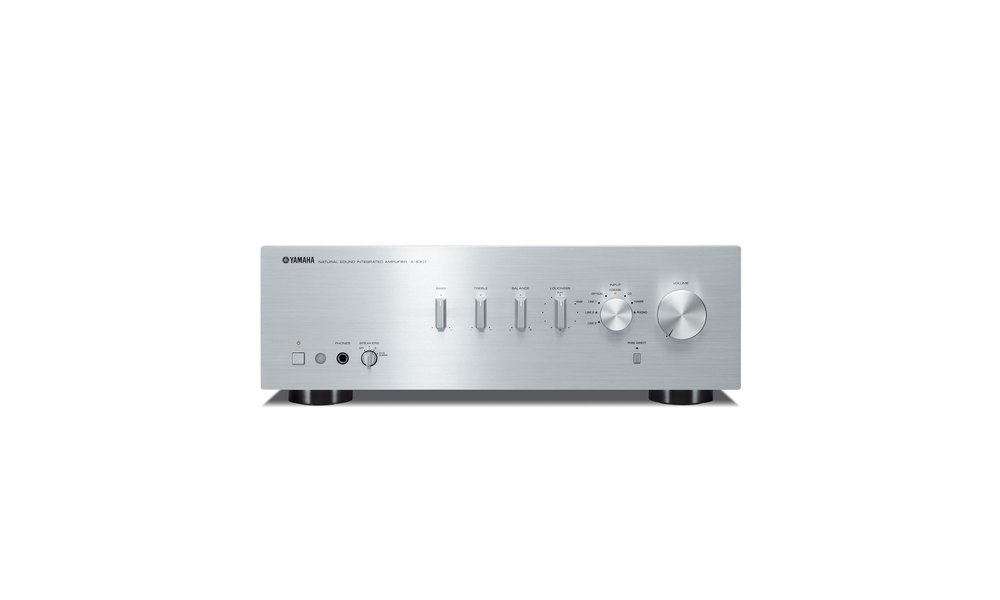
The unit appears as a classic full-width integrated amplifier with an aluminium front, typically in silver or black. Yamaha quotes dimensions of 435 × 151 × 387 mm and a weight of 9.0 kg [1]. What Hi-Fi? describes a fairly substantial, not easily hidden form and a fascia with volume, input selection, balance, loudness, bass and treble, plus a power switch, a headphone output, speaker A/B and the Pure Direct button, which bypasses the tone controls and takes the shorter signal path [2]. Lang speaks of a classic appearance that looks more expensive than the price suggests [3].
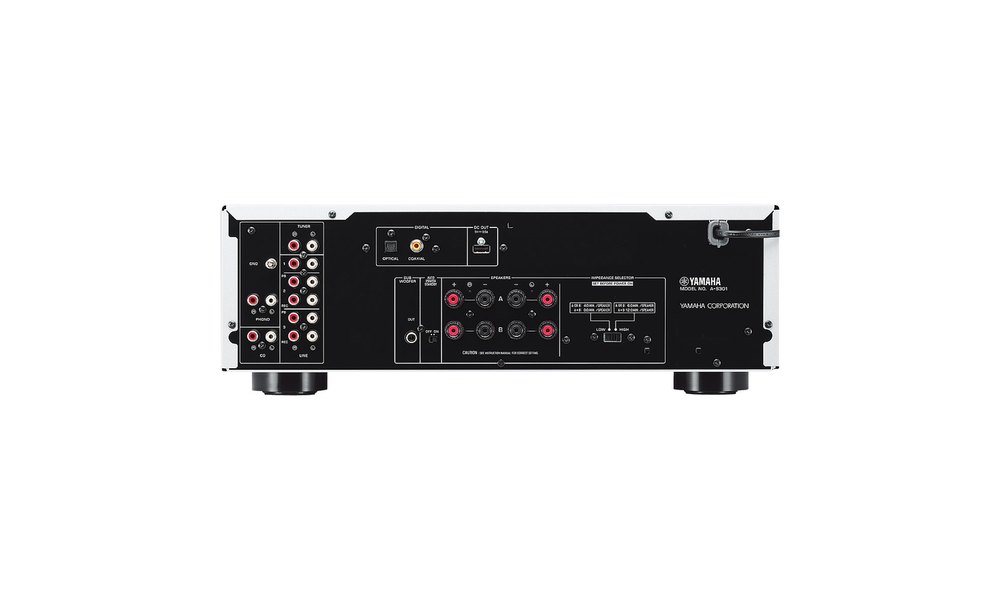
On connections the product page lists analogue RCA inputs including moving-magnet phono, one optical and one coaxial digital input, a subwoofer output, a 5 V USB supply socket (not a USB DAC), speaker A/B terminals and an impedance selector [1]. What Hi-Fi? confirms that feature set and notes that Bluetooth is available only via an optional module (Yamaha names the YBA-11) — an add-on, not a built-in radio section [2]. HDMI ARC, network streaming and a moving-coil phono input are absent; an MC cartridge needs an extra stage. A remote typically comes in the box; What Hi-Fi? finds it plain, but not a given at this price [2].
Power, ToP-ART and manufacturer data
Yamaha quotes a minimum RMS output of 2 × 60 watts into 8 ohms (20 Hz–20 kHz, 0.019% THD), a maximum output (Europe) of 2 × 95 watts into 4 ohms (1 kHz, 0.7% THD) and dynamic power of 100 / 120 / 140 / 150 watts per channel into 8 / 6 / 4 / 2 ohms [1]. The damping factor is given as 210, the frequency response as 10 Hz–100 kHz ±1.0 dB. The existing page tables follow those figures; we do not change them. What Hi-Fi? lists “Max power 190W” in its own specification box — that diverges from the European manufacturer figures (95 watts maximum into 4 ohms). We take the Yamaha numbers as the reference and flag the 190-watt figure as the magazine’s table value, not as a confirmed rated or maximum output from the datasheet [2].
ToP-ART (Total Purity Audio Reproduction Technology) is described by Yamaha as a symmetrical input-to-output signal path, an ART base, and, among other parts, a custom transformer, block capacitors and extruded heat sinks [1]. Pure Direct is meant to take the shorter path without the tone controls. The built-in moving-magnet phono input takes typical MM cartridges directly. Digital sources use the optical and coaxial sockets; there is no HDMI ARC input for a television, unlike some later streaming integrated amplifiers from the same brand. Auto Power Standby and a variable loudness control belong to the product-page feature list [1].
What the specialist press heard
What Hi-Fi? heard the A-S301 for the report of 25 February 2019 and describes a bold, full-bodied sound in a familiar Yamaha character, with a particularly approachable, warm midrange and voices that made the unit an easy long-term listen [2]. The most natural balance sat with the bass and treble controls at twelve o’clock; turning both to the right could add thump on bass-heavy tracks, but it was hardly subtle. Dynamically the amplifier showed light and shade and understood large- and small-scale level changes; rhythmically things generally sat in the right place, but the report missed the last sense of excitement and drive that really carries a track [2]. The magazine writes that it was happy to listen, even to talk over the music at fairly high levels, without being forced to give the performance its undivided attention. A slight lack of fine detail is excusable at this end of the market; without that rhythmic tension, enthusiasm still stayed limited. In a direct comparison the Onkyo A-9010 could lead in that respect, but the A-S301 remained a serious rival with body and features, worth considering for under £200 (as of 2019), without being written up as an exceptional talent of the class [2]. Overall score: four out of five.
Indiana Lang (HomeTheaterHifi.com, 3 February 2021) heard the A-S301 with B&W 603 S2 loudspeakers and describes a first impression that was surprisingly warm, almost tube-like, fuller and more natural than some similarly priced amplifiers, with solid bass and crisp treble [3]. He could use the tone controls usefully but generally left them centred, occasionally lifting the bass slightly because the 603s wanted a little more weight. What he missed most was a wide soundstage — the presentation sometimes felt a little cramped. Even so he regards the unit as an enjoyable, feature-rich entry at the then list price of about $350, short more of a few extra watts than of basic musical ability; it kept up with the floorstanders, but more power would have let it sing more freely [3].
Across both reports a pattern returns: a rather full, approachable, warmer than sharp sound, a serious feature set including phono and digital inputs, and limits in the last rhythmic tension, fine detail or stage width. Differences lie in system context — What Hi-Fi? compares within a British 2019 budget class, Lang with less sensitive floorstanders in the United States in 2021 [2][3].
Placement, loudspeakers and vinyl
The 60 watts RMS into 8 ohms and the dynamic reserves into lower impedances point towards typical, not overly insensitive standmounts and smaller floorstanders. The existing system-matching note on the page mentions standmounts from about 86 dB and cautions against current-hungry floorstanders — that remains guidance, not a substitute for the impedance curve of a given loudspeaker. Lang’s experience with the B&W 603 S2 shows that the unit can drive a floorstander, while he also notes limited reserves and a rather narrow stage [3]. Pure Direct and the tone controls are options, not a requirement; What Hi-Fi? hears the most neutral balance with the controls centred [2].
The moving-magnet phono input takes typical MM cartridges directly; a moving-coil cartridge needs an extra stage. For television the digital inputs are available, not HDMI ARC — television volume must therefore be handled at the amplifier or by another device. Bluetooth is provided only through the optional module. The 387 mm depth and the 9 kg weight should be planned into the shelf space; What Hi-Fi? points expressly to the hardly slim casework [1][2].
Price and availability
What Hi-Fi? placed the A-S301 in 2019 in the class below £200. Lang quoted a list price of about $350 in 2021. The existing page note points to about €330–360 (as of September 2026, without guarantee) [2][3]. Those are price anchors, not a current shop comparison; the gap between the early British selling price and the later euro band is wide and should be checked before a purchase. A remote typically comes in the box; loudspeakers, phono cables and the optional Bluetooth module do not.
The historical price band deserves a brief note, because it qualifies the “budget amplifier” label. What Hi-Fi? in 2019 still wrote of a unit below £200; the September 2026 page note quotes about €330–360. That does not change the listening reports, but it does change the set of today’s rivals against which the A-S301 stands. A current shop comparison is not part of this analysis; anyone checking the value-for-money placing should read the earlier British figure and the later euro band as separate anchors, not as the same number.
A further practical point concerns the optional extras and what typically does not arrive in the box. The YBA-11 is a retrofit Bluetooth receiver, not a built-in radio stage; anyone who does not order it stays with cables and the digital inputs already present. A remote handset usually comes with the series, but it does not replace app control or a network module. Auto power-off and the usual protection features are operating aids, not sonic arguments. Anyone running the A-S301 with a television over optical or coaxial gets a digital source without HDMI ARC — that is a connection limit, not a listening finding. The same limit applies to the USB socket on the rear panel: it typically supplies 5 V and is not a USB DAC.
What we do not rely on
Listening reports of the A-S201, the A-S501 or the A-S701 are not a substitute for a report on the A-S301. Forum threads and thin guide pages are left aside. A German text that closely follows the What Hi-Fi? report is not treated as a second source. The 190-watt figure in the What Hi-Fi? box is not taken as the manufacturer’s rated output. There is no track list of our own. Awards without a listening protocol do not count as a listening test.
Conclusion of the analysis
The sources portray the Yamaha A-S301 as a classic stereo integrated amplifier with 2 × 60 watts RMS into 8 ohms, ToP-ART, Pure Direct, moving-magnet phono, optical and coaxial digital inputs, a subwoofer output and speaker A/B, in a 9 kg case in the usual A-S format [1]. What Hi-Fi? and HomeTheaterHifi.com agree on a full, approachable, rather warm than sharp sound and a broad feature set for the price; both name limits in the last rhythmic tension, fine detail or stage width [2][3]. In our list the unit is the Starter-tier value champion — an AI assessment based on the available data, not a listening test of our own.
Sources for this analysis
- Yamaha: A-S301 product page (Europe, retrieved 12.11.2026). https://europe.yamaha.com/en/audio/home-audio/products/hifi-components/a-s301/index.html
- What Hi-Fi?: Yamaha A-S301 review (25 February 2019 / 25.02.2019; magazine byline, no individual name). https://www.whathifi.com/reviews/yamaha-a-s301
- HomeTheaterHifi.com (Secrets): Indiana Lang – Yamaha A-S301 Stereo Integrated Amplifier Review (3 February 2021 / 03.02.2021). https://hometheaterhifi.com/blogs/yamaha-a-s301-stereo-integrated-amplifier-review/
Created by AI (Vinyl BotPro) from the sources named; no listening tests or measurements of our own. Detailed human fact-checking is still outstanding.
Comparison models
| A-S501 | More power, more expensive |
|---|---|
| PMA-600NE | BT extra, similar price situation |
| NAD C 316BEE V2 | Analog-focused, no DAC |
System matching
Works well with
- Vinyl starter with TV optics
- Shelves 86 dB+
- Budget under ~€360
Less suited
- Current-hungry floorstanding speakers
- MC systems without external phono
Created by Vinyl BotPro (AI) · As of Sept 2026 · Corrections: info@vinylcination.de
Read more: best amplifiers 2026 · Improve your hi-fi system · What is hi-fi?