
Integrated amplifier · AI analysis · Premium, rank 1
Yamaha A-S801: Analysis
AI analysis (research): Stereo-Integrated Amplifier with 100 W/8 Ω RMS, MM-Phono and ESS-USB-DAC (PCM/DSD) — specs/retailer prices, no listening test.
Summary
The A-S801 combines Yamaha 100 W+100 W RMS (8 Ω), ToP-ART, MM-Phono and ESS Sabre USB-DAC (PCM to 384 kHz / DSD 5.6 MHz) plus opt/coax. Market price often approx. €750–899 (price as of check). Makes sense as Vinyl+PC/Streamer centrepiece — not as a replacement for separate high-end phono at low-MC.
Assumptions
- MM system at the phono-in (no MC-low without external stage)
- Speaker 4–8 Ω, Living room — no own power/clirr measurements
- Check the German price as of Sept 2026
Specs (public / manufacturer)
| Type | Stereo-integrated amplifier (2 channel) |
|---|---|
| Power | 100 W + 100 W RMS (8 Ω, 20 Hz–20 kHz, 0.019% THD) · maximum power 160 W + 160 W (4 Ω, 1 kHz, 0.7% THD, Europe) |
| Phono | MM · Yes |
| Digital | USB-B (ESS) · 1× Opt · 1× Coax |
| Features | ToP-ART · Pure Direct · CD Direct Amp · Sub-Out · A/B |
| Price guide | market price approx. €750–899 (without guarantee) · Sept 2026 · Check the price date |
Manufacturer specifications (Yamaha)
| Minimum RMS output power (8 Ω, 20 Hz–20 kHz, 0.019% THD) | 2 × 100 W into 8 Ω |
|---|---|
| Maximum power (4 Ω, 1 kHz, 0.7% THD, Europe) | 2 × 160 W |
| High dynamic power per channel (8/6/4/2 Ω) | 140 / 170 / 220 / 290 W |
| Damping factor | 240 |
| Frequency response | 10 Hz–100 kHz ±1.0 dB |
| Total harmonic distortion (CD to speaker out, 20 Hz–20 kHz) | 0.019% (50 W into 8 Ω) |
| Signal-to-noise ratio (CD) | 99 dB (input shorted, 200 mV) |
| Inputs | 8 audio inputs incl. phono (MM), optical, coaxial, USB-B |
| Features | Subwoofer out, Pure Direct, ToP-ART, CD Direct Verstärker |
| Standby power consumption | 0.5 W |
| Dimensions (W × H × D) | 435 × 152 × 387 mm |
| Weight | 12.1 kg |
Source: Yamaha – official specifications · As of 16 October 2026 · subject to change by the manufacturer
Scores in detail
Vinyl BotPro Index: 69 · Index band Premium 55–69 · Guidance only, not a lab value.
Strengths
- Real 100 W-RMS specification
- ESS-USB-DAC incl. DSD
- MM-Phono onboard
Weaknesses
- No MC-Phono
- No Bluetooth onboard
- Enclosure aesthetics rather classical
Analysis: Yamaha A-S801 in detail
How the cited material is used
This analysis adds manufacturer data and two dated independent listening reports on the Yamaha A-S801 to the short overview above. Vinyl BotPro compiled it from the sources named below; VinylCination has not carried out its own listening session or measurement of this unit. The basis is Yamaha’s European product page (retrieved 12 November 2026) [1], Gene DellaSala’s listening and measurement article for Audioholics (1 November 2015) [2], and Glen Wagenknecht’s longer listening report for 6moons (2015; the exact calendar day could not be recovered from the archive) [3].
Both press sources meet the requirement of international independent listening reports. Audioholics remains the primary dated URL: DellaSala describes listening chains, recordings and a measurement section, and states expressly that he did not listen to the phono stage. 6moons is the extended director’s cut of Wagenknecht’s own shorter Canada HiFi piece; we therefore do not count Canada HiFi as a second, independent report by the same author, and rely on the 6moons text. Forums are left aside. The SKU is the A-S801, not the A-S501 and not the A-S3000; 6moons also writes “AS-801” in the title.
Background and place in the range
The A-S801 is the USB-DAC step in Yamaha’s classic A-S line. The European manufacturer page states 100 watts + 100 watts RMS into 8 ohms (20 Hz–20 kHz, 0.019% THD) and, for Europe, a maximum figure of 160 watts + 160 watts into 4 ohms (1 kHz, 0.7% THD). Added to that are ToP-ART, a moving-magnet phono input, optical and coaxial digital inputs, and a USB-B converter based on the ESS ES9010K2M, which accepts native DSD at 2.8/5.6 MHz and PCM to 384 kHz/32-bit (Windows; macOS 24-bit) [1]. That same 100-watt RMS figure is shared by the table, the manufacturer and both listening reports. Bluetooth remains optional through the YBA-11 adaptor; 6moons once writes “YMA-11”, while the manufacturer page and Audioholics say YBA-11. We follow the official name.
In our list the unit is the Premium-tier value champion (Index 69, rank 1). The SVG line on the live page states Index 68 in one place; the visible score row and the body text stay at 69. We do not change the table, and we leave the contradiction open. The champion placing is an AI assessment based on the available data, not a listening seat of our own. The existing short overview remains in substance: a sensible vinyl-plus-computer or streamer centrepiece, not a substitute for a separate high-end phono stage on a low-output moving-coil cartridge.
Casework, connections and operation
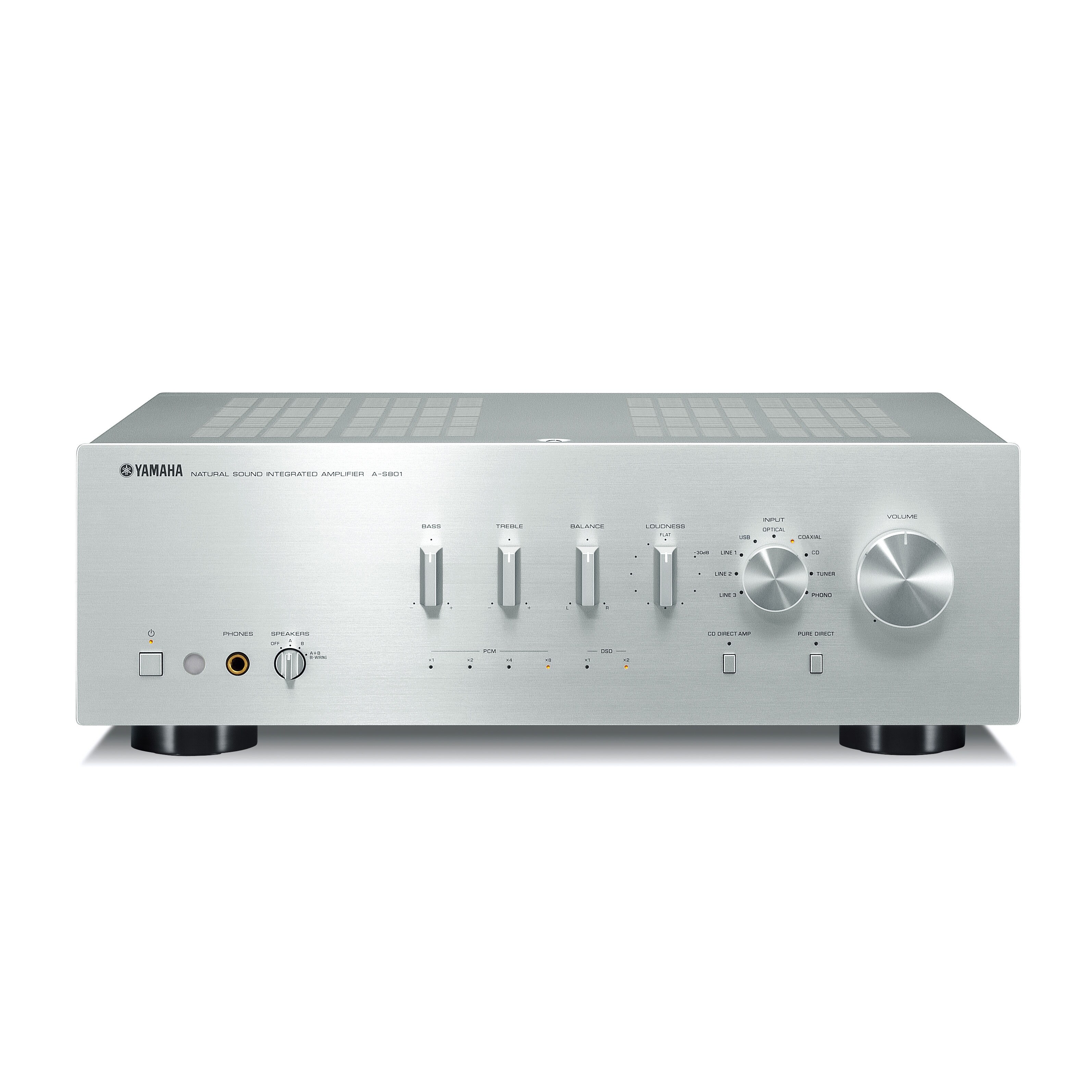
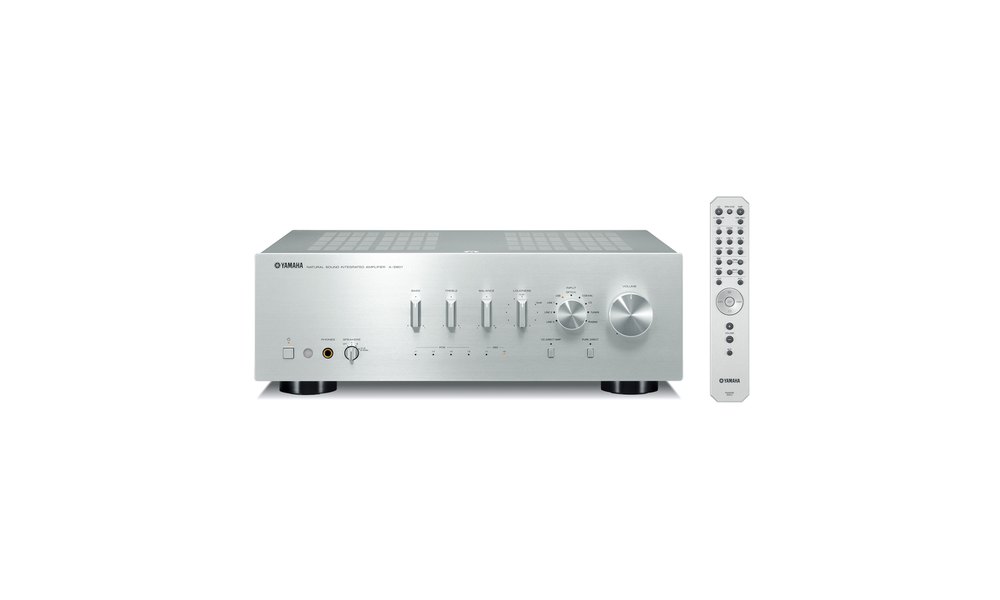
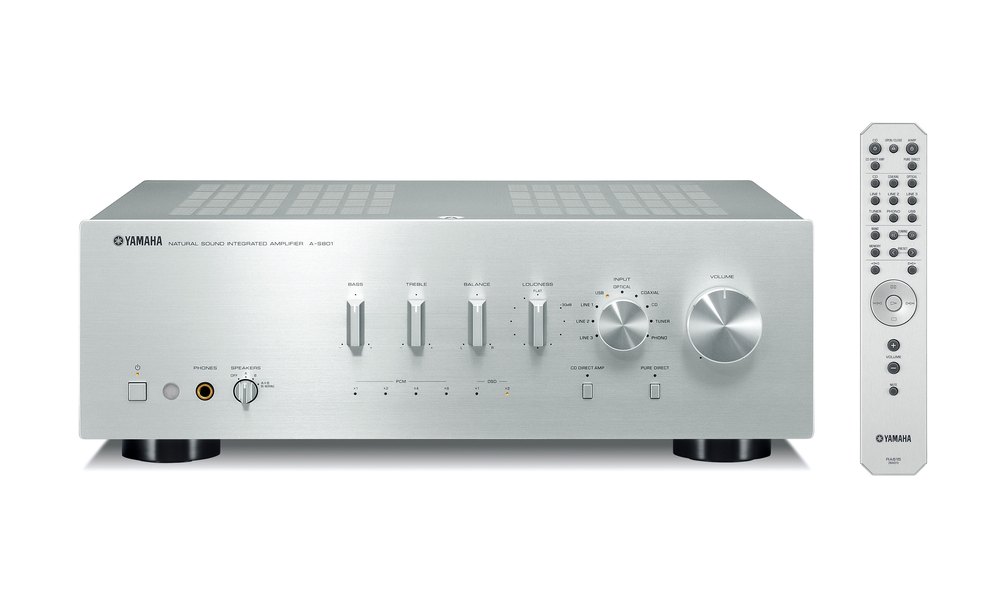
DellaSala describes a sturdy chassis with a brushed-aluminium fascia, a double-bottom construction and gold-plated speaker and RCA terminals; Wagenknecht gives 435 × 152 × 387 mm and 12.1 kg, matching the manufacturer page, and a slender remote. Silver and black are the finishes. The front is deliberately plain: amber LEDs for power, input and DAC sample rate, and buttons for Pure Direct and CD Direct. DellaSala misses an LED on the volume knob, because the indent is hard to see; the bundled RAS15 remote does the job, but without backlighting it is difficult to read in a dark room [2][3].
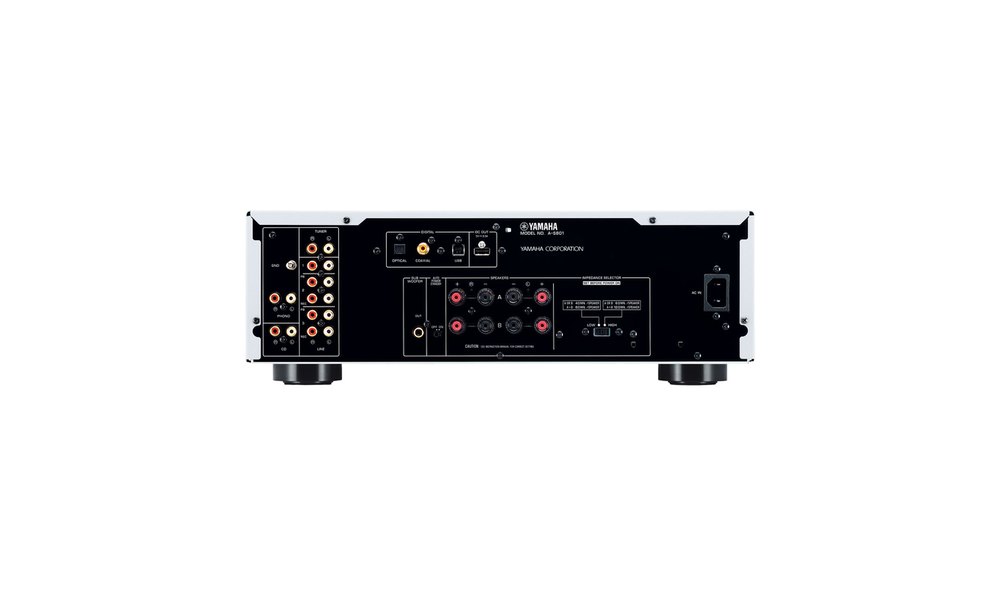
Analogue provisions include moving-magnet phono with a ground terminal, several line inputs, two record outs, headphones, a subwoofer output and speaker A/B. The digital side carries optical, coaxial (both 24/192) and USB-B. A row of LEDs shows PCM and DSD formats and sample rates. The optional YBA-11 hangs from a supply jack on the rear. The IEC power inlet is detachable. Yamaha documents a high/low impedance selector on the back; DellaSala expressly advises leaving the switch at the factory “high” setting regardless of the loudspeakers attached — otherwise the output stage is needlessly starved merely to satisfy a thermal listing test. Two pairs of speakers are wired in parallel; anyone using both pairs at once should, DellaSala writes, choose nominal 8-ohm loads, because the amplifier then sees 4 ohms [2].
A practical reservation concerns the subwoofer output. DellaSala lists as a drawback that there is no independent level control and that the mono signal is fixed by a second-order low-pass filter just shy of 100 Hz; the main channels remain unfiltered. He set the crossover on his Velodyne MiniVee to about 60 Hz and advises keeping the sub’s crossover roughly 20 Hz away from Yamaha’s built-in corner, so that the filters do not stack. Wagenknecht writes of 90 Hz. That is an open point for fact-checking; we do not change the live table. There are no preamp outputs: anyone later wanting to use the A-S801 only as a preamp will find no path for that [2][3].
Engineering, DAC and manufacturer data
ToP-ART, ART Base, a double-bottom chassis, a custom transformer, 12,000 µF block capacitors and extruded heat sinks belong to the manufacturer description. DellaSala adds a heat sink per channel, four output devices, a large E-core transformer and a pair of 12,000 µF reserves, and stresses that the 100-watt rating is “honestly” specified: 8 ohms, full audio band, both channels driven, 0.019% THD. The 160 watts into 4 ohms remain the European maximum rating at 1 kHz and 0.7% THD — a different condition, not a contradiction the table needs to resolve [1][2].
The ESS ES9010K2M is the central difference from the A-S501. Yamaha cites its own clocking scheme to reduce jitter and a display of format and sample rate. USB accepts native DSD at 2.8/5.6 MHz and PCM to 384/32 (Windows; macOS 24-bit); optical and coaxial stop at 24/192. DellaSala played 192/24 on both S/PDIF sockets without truncation. CD Direct shortens the path from the CD input by bypassing the tone and balance controls; Pure Direct applies to all inputs and also bypasses the buffer. Wagenknecht calls Pure Direct the decisive switch. Variable loudness, DellaSala writes, does not apply a fixed bass boost; it turns the midrange down in a level-dependent way, and with a subwoofer in the chain he rarely used it [2][3].
The phono stage is fixed and moving-magnet only. Anyone wanting to play a low-output moving-coil cartridge needs an external stage — exactly the limit already named on the existing page. More important for this analysis: neither listening report describes the sound of that phono stage. DellaSala says expressly that he did not spin any vinyl. Wagenknecht mentions the moving-magnet input as a feature, not as a source he heard. We therefore must not write a sonic claim about the phono section.
What the specialist press heard
DellaSala heard the A-S801 mainly in his office system on a customised pair of RBH 41-SE/B (4-inch mid-woofers, Scan-Speak 9500 tweeter) with a Velodyne MiniVee and Kimber 8PR cables, and also on NHT Absolute Towers in the larger Showcase room. The source was USB-B from a desktop computer running JRiver (high-resolution FLAC and SACD ISO files), plus Toslink from an Oppo BDP-95. Against the EMP VT-40.2 tube amplifier he had been using, the Yamaha was an immediate step forward: not only louder and cleaner, but meatier and more focused. On Bruce Cockburn’s Stealing Fire (24-bit FLAC) the vocals were crystal clear, and the stereo image on “Making Contact” seemed wider and more pronounced than he remembered [2].
Michael Jackson’s Thriller (96/24) served him as a test of reserves: with the sub switched off he listened for how much bass the output stage could still extract from the RBH; on the NHT in the larger room he reached levels well beyond comfort, and Jackson’s voice stayed composed, with no sense of harshness. “Lady in My Life” he describes as pure sonic bliss. On Steven Wilson’s Hand Cannot Erase (96/24) he emphasises drums with snap and definition and enough reserves even in long progressive passages such as “Home Invasion/Regret #9”. On 2L recordings (The Nordic Sound) he praises the sense of ambience — the soundstage extending well beyond the plane of the loudspeakers — and ties that expressly to the quality of the built-in DAC; “Sigurd Ilandsmoen – Requiem Lacrymosa” sent a chill down his spine. He also listened to the headphone output, including an Oppo PM-1 and RBH EP3 IEMs, and calls the stage very good, not an afterthought. The phono stage, as noted, remains unheard [2].
Wagenknecht listened at greater length, and mainly into the difficult Apogee Duetta Signature. Even without Pure Direct he reports good detail and dynamic agility; the ribbons were unproblematic to drive, bass control was surprisingly good, and he left the Paradigm Servo 15 subwoofer aside. Tone, balance and loudness he found subtle. Pure Direct is what changes the picture for him: much higher resolution, far more dynamic nuance, a large gain in ambient recovery — the step that lifts the A-S801 from solid mid-fi into territory that warrants a high-end hearing. From then on the report assumes Pure Direct for every path, headphones included. At first there was a touch of grain and some extra texture on female vocals, which disappeared with time; a initially spectacular but rather overt, data-heavy presentation settled into a more integrated one. That observation over time stands as his report, not as a run-in instruction of ours [3].
Wagenknecht describes the tonal balance as close to engineering-neutral: very clean midrange without extra warmth in the lower mids, smooth and articulate on top with no sizzle, and a powerful, detailed bass register as far as the full-range Apogees could go. Tube listeners may read the character as a little dry; solid-state listeners as bang on the money. The stage is wide (“Cinerama”) with excellent lateral placement; depth is only good, with a little imprecision in the far plane next to his large reference chain. Sustained louder levels on the insensitive Apogees let distortion and compression creep in; up to that point the Yamaha had taken his big rig surprisingly seriously. He also treats the headphone stage as a serious performer: against a DA&T headphone amplifier/DAC the Yamaha was quicker, more transparent, more articulate and less load-sensitive; against a Burson, the Burson played smoother, warmer and more dimensional, the Yamaha wider, more transparent and a touch more nuanced, and it decoded formats the Burson was never designed for [3].
In a product comparison Wagenknecht sets the A-S801 beside the Wyred 4 Sound mINT: the Yamaha emphasises resolution, is mildly leaner below the lower midrange and unusually transparent through the midband; the Wyred has the edge in depth and dimensionality, with width about equal. The mINT has no phono and limits USB to 24/96, without DSD or 32/384; on price the Yamaha comes in at about a third less. Against a standalone Wyred DAC-2 plus preamp and power amp (Tortuga passive / Bel Canto), the Pure Direct path, Wagenknecht writes, comes appreciably close — at a wholly different price. Those are his chains, not group comparisons of this analysis. DellaSala also measured the A-S801, including frequency response in Pure Direct; we do not lift individual figures into the body here, because the listening sources decide the sonic account.
Placement, loudspeakers and the phono limit
The loads that were heard run from compact monitors with a subwoofer through floorstanders (NHT Absolute Towers) to the low-impedance, insensitive Apogee Duetta Signature. That is not a licence for every difficult loudspeaker at sustained high level: Wagenknecht himself marks the power limit exactly there. The existing system-matching note (vinyl-plus-computer or streamer centrepiece, not a substitute phono stage for low-output moving-coil) therefore stays. Impedance switch left at “high”, sub crossover kept away from the chassis’s fixed low-pass corner, Pure Direct as the shortest path — those are the practical pointers of the two texts, not listening rules of our own [2][3].
For everyday use the A-S801 is the step in the A-S line that takes a computer directly. Anyone who only wants to feed a television or an S/PDIF player will already find the same optical and coaxial path on the A-S501; anyone who needs PCM to 384 kHz or native DSD needs the 801. The optional YBA-11 remains an accessory, not built-in network streaming. There are no preamp outputs. And once more: the listening reports in hand contain no sonic account of the moving-magnet phono stage. Anyone buying the A-S801 first and foremost as a vinyl centrepiece is relying on feature data, not on a heard phono protocol.
The comparison rows on the existing page (including the A-S501) are overview lines, not extra listening sources. A report on the A-S501 or the A-S701 may not stand in for a report on the A-S801. We do not count DellaSala’s companion YouTube film, or Wagenknecht’s shorter Canada HiFi piece, as further independent sources.
Price and availability
In 2015 DellaSala named a US MSRP of 999 dollars, Wagenknecht 999 Canadian dollars. The page note gives a market price for September 2026 of often around €750–899, without guarantee. Those are different markets and years, not a converted spot rate. Loudspeakers, sources and cables are not typically in the box. A later street price does not change the listening notes, but it does change the field of today’s rivals. Before a purchase, the specification and the current price should be checked; the A-S801 is easily confused with the A-S501 or with larger A-S models.
The long market life of the line explains why the 801 is still offered, even though both listening reports date from 2015. For this analysis that sets a clear limit. Continuity of the casework may stand as a manufacturer and press statement; it may not be used to lift related models quietly into the source list. Anyone looking for the sonic account of this chassis will find it in Audioholics of 1 November 2015 and in 6moons from the same year, including the RBH/NHT and Apogee Duetta Signature chains — and including the open phono gap [2][3].
What we do not rely on
Listening reports on the A-S301, A-S501, A-S701 or older Yamaha integrated amplifiers are not a substitute for a report on the A-S801. Forums, comment threads and shop modules are left aside. Canada HiFi does not count as a second independent source beside 6moons. There is no track list of our own and no measurement. The phono stage remains unheard in the texts at hand; specifications do not stand in for a listening report there.
Conclusion of the analysis
The sources portray the Yamaha A-S801 as a ToP-ART integrated amplifier with 100 watts RMS into 8 ohms, a fixed moving-magnet phono stage, an ESS ES9010K2M USB DAC (PCM to 384 kHz, DSD 5.6 MHz), optical and coaxial inputs, Pure Direct and CD Direct — according to the manufacturer page and the existing table [1]. Audioholics (Gene DellaSala, 1 November 2015) describes, on RBH 41-SE/B, a Velodyne MiniVee and NHT Absolute Towers, a meaty, composed, DAC-strong presentation with an honestly rated output section, without having heard the phono stage [2]. 6moons (Glen Wagenknecht, 2015) highlights Pure Direct as the decisive step: high resolution, a neutral balance, a wide stage, limited depth and an audible power limit on difficult Apogees [3]. In our list the unit is the Premium-tier value champion — an AI assessment based on the available data, not a listening test of our own.
Sources for this analysis
- Yamaha Europe: A-S801 product page (retrieved 12.11.2026). https://europe.yamaha.com/en/audio/home-audio/products/hifi-components/a-s801/
- Audioholics: Gene DellaSala – Yamaha A-S801 Integrated Amplifier Review (1 November 2015 / 01.11.2015). https://www.audioholics.com/amplifier-reviews/yamaha-a-s801-amplifier-review
- 6moons: Glen Wagenknecht – Yamaha A-S801 (2015; exact calendar day not recovered from the archive; extended cut of his Canada HiFi text). https://6moons.com/audioreviews2/yamaha/1.html
Created by AI (Vinyl BotPro) from the sources named; no listening tests or measurements of our own. Detailed human fact-checking is still outstanding.
Comparison models
| Yamaha A-S501 | Starter: less continuous power, without USB-ESS |
|---|---|
| Cambridge CXA81 | Stronger digital/BT, but without phono |
| Marantz PM8006 | Analog/MM-MC focus, without USB-DAC |
System matching
Works well with
- MM turntable + efficient to medium-weight speakers
- PC/Notebook via USB-DAC
- TV/streamer via Opt/Coax
Less suited
- Low output MC without external phono
- difficult 2-Ω monster with continuous volume
Created by Vinyl BotPro (AI) · As of Sept 2026 · Corrections: info@vinylcination.de
Read more: best amplifiers 2026 · Improve your hi-fi system · What is hi-fi?