
Streaming Amplifier · AI Analysis · Premium, Rank 1
Yamaha R-N1000A: Analysis
AI analysis (Research): Stereo network receiver with 2 × 100 W, ESS-Sabre-DAC, MM-Phono input, HDMI ARC, YPAO room measurement, MusicCast, AirPlay 2 and Roon Ready. Based on manufacturer data and press reviews, no listening test.
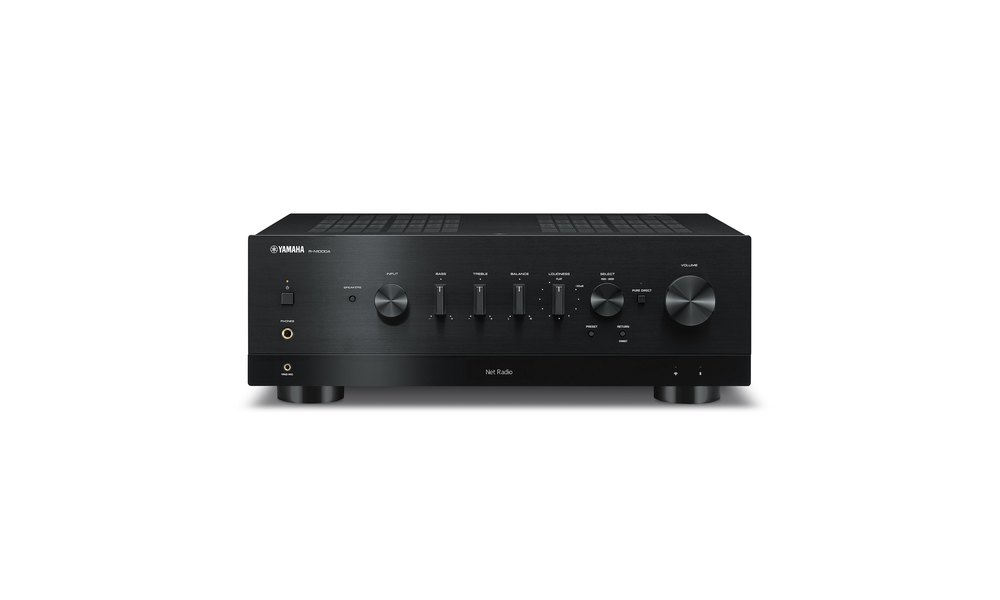
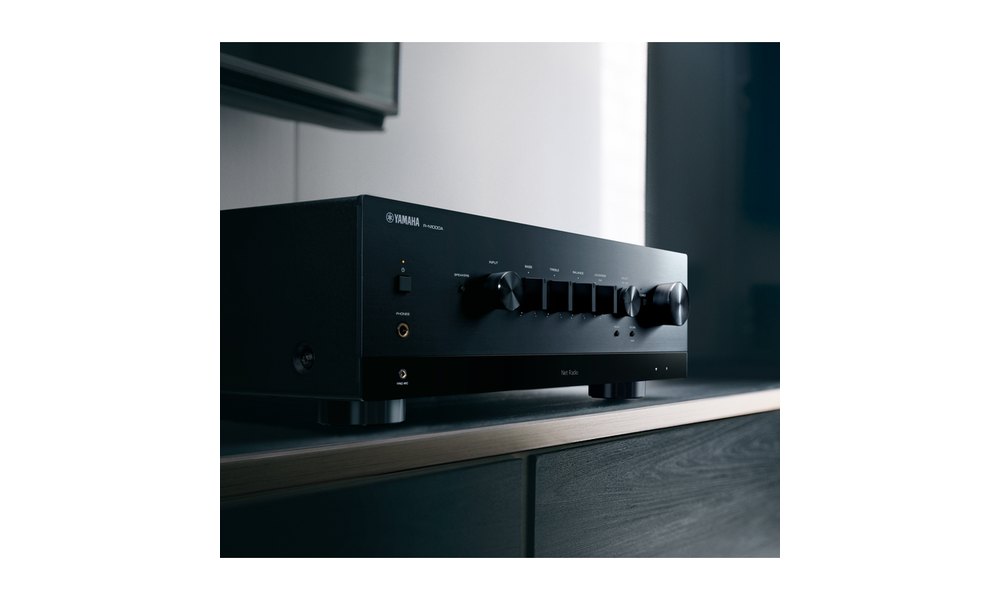
Summary
Value-for-money Vinyl BotPro Champion Best value-for-money estimate of the tier on the data basis (no listening test).
The Yamaha R-N1000A takes over technology from Yamaha's larger analog amplifiers and complements MusicCast streaming, HDMI ARC and YPAO space measurement. Yamaha refers to 2 × 100 W at 8 Ohm from a Class AB power amplifier, an ESS-Sabre-DAC up to 384 kHz and DSD 11.2 MHz, and an MM-Phono input. He's been Roon Ready since a firmware update. Sound+Image (Jez Ford, 30 August 2024, on What Hi-Fi?) calls it an easy recommendation with strong sound and broad features and praises performance, precision and operation. MSRP is available at 1,599 €, on sale from around 1,480 € (as of Oct. 2026, without guarantee).
Assumptions
- Price per device according to the manufacturer or DE-Market price; UK/US-prices rounded, Stand Oct. 2026, no guarantee
- Operation with passive speakers; vinyl via the phono input of the device or an external phono stage at the line input
- Streaming via WLAN or Ethernet; available services can change via firmware
- No in-house measurements or listening tests
Specifications (manufacturer)
| Type | Stereo network receiver · Class AB · YPAO with R.S.C. |
|---|---|
| Power | Rated power 2 × 100 W into 8 Ω (20 Hz–20 kHz, 0.07% THD) · Dynamic power 2 × 220 W into 4 Ω (IHF) · manufacturer |
| DAC | ESS Sabre ES9080Q · PCM up to 384 kHz · DSD 11.2 MHz (USB) |
| Phono | MM (3.5 mV / 47 kΩ) |
| Streaming | MusicCast · AirPlay 2 · Spotify and Tidal Connect · Qobuz · Amazon Music · Deezer · Roon Ready · Bluetooth (transmitter/receiver) |
| Inputs | HDMI ARC · Phono · 3 × line · 2 × optical · Coaxial · USB-B |
| Outputs | 2 speaker pairs · Pre-Out · Subwoofers · Headphones |
| Dimensions / weight | 435 × 152 × 395 mm · 12.3 kg |
| Price guide | MSRP €1,599 · market price approx. €1,480 (without guarantee) · UK 1,299 £ · as of Oct. 2026 · without guarantee |
Manufacturer specifications (Yamaha)
| Rated output power (20 Hz–20 kHz, 0.07% THD) | 2 × 100 W into 8 Ω |
|---|---|
| High dynamic power per channel (8/6/4/2 Ω) | 140 / 170 / 220 / 290 W |
| Frequency response | 10 Hz–100 kHz (0 ±1.0 dB) · 20 Hz–20 kHz (0 ±0.5 dB, Pure Direct on) |
| Signal-to-noise ratio (CD) | 100 dB (Pure Direct on) |
| Analogue inputs/outputs | Phono, CD, line 1, line 2 / pre out, subwoofer out |
| Digital inputs | Optical 1, optical 2, coaxial |
| USB input | USB DAC (USB-B) |
| HDMI (ARC) | Yes |
| Network | Wi-Fi · Ethernet · AirPlay 2 |
| Bluetooth | Yes (SBC/AAC) |
| File formats | MP3, WMA, MPEG-4 AAC, WAV, FLAC, AIFF, DSD |
| Headphone / subwoofer / trigger output | Yes / yes / yes |
| Pure Direct / ToP-ART | Yes / Yes |
| FM 50 dB quieting sensitivity (IHF, mono) | 3 µV (20.8 dBf) |
| FM signal-to-noise ratio (mono/stereo) | 69 dB / 68 dB |
| Standby power consumption | 0.1 W (network standby/Wi-Fi: 1.8 W) |
| Dimensions (W × H × D) | 435 × 151 × 395 mm (antenna up: 435 × 232 × 395 mm) |
| Weight | 12.3 kg |
Source: Yamaha – official specifications · As of 16 October 2026 · subject to change by the manufacturer
Rating criteria in detail
The four criteria feed into the Vinyl BotPro Index with weights of 25/20/25/30. The index is scaled across all tiers (see Methodology); that is why we do not show individual sub-scores.
Strengths
- Strong sound quality and very good app/remote control
- MM-Phono, HDMI ARC and YPAO measurement
- Class AB power amplifier with 4 Ohm reserves
- Roon Ready, AirPlay 2 and MusicCast
Weaknesses
- Small front display
- No MC-Phono
- No Chromecast
- No ring core transformer like the R-N2000A
System matching
Works well with
- Living rooms with TV and Turntable
- Stand loudspeakers with power requirements
- MusicCast and Roon Households
Less suited
- MC pickups without external phono stage
- Small desk setups
- Chromecast users
Specs & Features
The R-N1000A relies on a Class-AB power amplifier with its own transformer and large screen capacitors. Yamaha calls 2 × 100 W at 8 Ohm; Audioholics certifies good to very good values and reserves at 4 Ohm in the laboratory. That is a bench report, not a listening pillar.
The DAC is an ESS Sabre ES9080Q up to 384 kHz and DSD 11.2 MHz. The YPAO measurement with R.S.C. works with 64-bit precision; bass management for a subwoofer is on board. Connections: HDMI ARC, MM-Phono, three line inputs, two optical, one coaxial and USB-B.
Research Consensus
One international review calls the R-N1000A an easy recommendation: Yamaha brings everything in this class, the app and remote control always led to the target, and the sound keeps up. Criticism: small display, no info button on the remote control. A further review praises the mix of connectivity, performance and stable operation.
Audioholics tested the receiver in the laboratory and awarded it as a product of the year in its category; that is a bench and awards remark, not a listening pillar. VinylCination summarizes this as AI summary of the specialist press, without its own listening test.
Analysis: Yamaha R-N1000A in detail
Scope and sources
On the existing VinylCination page the Yamaha R-N1000A carries the title Value-for-Money Vinyl BotPro Champion in the Premium tier, with Vinyl BotPro Index 68 and rank 1 (analysis 09/2026). A sentence in the running text that calls it the Sound champion of the same tier contradicts the badge and summary; this analysis follows the badge: value for money, not Sound. That ranking stays the live page’s. VinylCination has neither listened to the R-N1000A nor measured it.
The pillar is Sound+Image (Jez Ford), published on What Hi-Fi? on 30 August 2024 (datePublished 2024-08-30T00:35:02Z), with its own Listening sessions heading and a verdict that calls the unit an easy recommendation. Ford was editor of Sound+Image for many years; the report is a specialist-magazine listening test of the exact R-N1000A, not the R-N2000A or R-N800A, and not a forum, a video channel or a retailer page.
Yamaha’s product page (R-N1000A, retrieved 12 November 2026) quotes 2 × 100 W into 8 ohms (20 Hz–20 kHz, both channels, 0.07% THD) from a Class-AB output stage, an ESS Sabre converter, MM phono, HDMI ARC, YPAO, MusicCast, AirPlay 2 and Roon Ready. The live page gives an MSRP of €1,599 and a street guide of about €1,480, plus £1,299 (as of October 2026, without guarantee).
Place in the range
The R-N1000A sits in Yamaha’s network-receiver line below the R-N2000A and above the R-N800A. Yamaha calls it a network receiver but means a two-channel integrated amplifier with radio and streaming, not a multichannel AV receiver. Ford describes the descent from the larger analogue amplifiers, with MusicCast, HDMI ARC and YPAO added, at a more approachable price than the 2000 series.
In the Premium tier of streaming amplifiers it is the value-for-money champion with Index 68 and rank 1. The table includes the Yamaha R-N800A (Index 61), the Lyngdorf TDAI-1120 (Index 67, Sound champion of this tier) and, one tier up, the Yamaha R-N2000A (Index 83). This analysis keeps that order and does not recalculate the index.
Design and manufacturer data
According to the live table and the manufacturer, the Class-AB stage delivers 2 × 100 W into 8 ohms, fed from its own transformer and large reservoir capacitors. The ESS Sabre ES9080Q converts PCM to 384 kHz and DSD to 11.2 MHz, including over USB-B — a socket Ford specifically welcomes because many rivals omit it. HDMI ARC distinguishes the unit from lower models without that socket and, for Ford, makes it a complete answer for music and television sound for music and television sound.
Also listed: MM phono, three line inputs, two optical and one coaxial digital input, Ethernet and Wi-Fi, MusicCast (including Roon Ready after a platform update), AirPlay 2, Bluetooth with SBC and AAC, DAB+ and FM, two speaker pairs, pre-out, subwoofer out and a headphone socket. YPAO with Reflected Sound Control is the room measurement; Ford switched it off in his room because it removed much of the bass and made things sound swampy, while leaving open that it may help in awkward rooms. Pure Direct is not on the remote; the display is very small. Those are Ford’s reservations, not a design ranking of our own.
What the specialist press heard and measured
Sound+Image (Jez Ford, 30 August 2024) starts the listening sessions with YPAO off and Tidal Connect at CD resolution. Joni Mitchell’s “Both Sides Now” (2000 version) opened emotionally with its familiar strings. Seth Sentry’s “Dear Science” gave Ford beats with fair definition and, at the same time, a stage in which syllables and small production gags had space. The same familiar recording sounded less crisp and clean over Tidal than the team knows it; switching to USB-B (also 16-bit/44.1 kHz) made the event more open, dynamic and thrilling in every way, from properly sibilant vocal edges to better layering. Ford’s conclusion: enjoy streaming, but discs, rips and studio files often still win.
The verdict places the R-N1000A in a line 5000, 3000, N2000, N1000 and notes healthy competition from Cambridge, Denon, Marantz and NAD. Yamaha brings everything to the party, the app and remote always get you where you need, and it holds up on sound quality. It is an easy recommendation. Reasons to buy: solid sound for the price, great facilities, MusicCast, input selection on the remote. Reasons to pause: Pure Direct not on the remote, a very small display.
The live page already carries unnamed wording about an easy recommendation, strong app and remote operation, and criticism of the small display. That is exactly Jez Ford’s Sound+Image text of 30 August 2024, which has its own Listening sessions heading and calls the unit an easy recommendation. The German live wording “leichte Empfehlung” is an awkward rendering of that phrase; Ford means a straightforward recommendation, not a lukewarm one. We now attribute those sentences by name.
Audioholics measured the R-N1000A on the bench and named it Product of the Year in its category. That is a laboratory and awards text, not a listening pillar of the same kind. The live page mentions good to very good bench figures and 4-ohm reserves; that can stay visible as a pointer to that bench report, but it does not replace Ford. StereoNET forum threads and retailer copy are not used. Coverage of the dearer R-N2000A concerns a different product with a different transformer and phono stage.
Dimensions 435 × 152 × 395 mm and 12.3 kg, and the socket list, are taken from the live table and the manufacturer page and are not re-counted on a unit in front of us. Prices remain a guide: MSRP €1,599, street price about €1,480, and in Ford’s text £1,299, US$1,800 and AU$2,299, each as of its own source, without guarantee and without currency conversion. This analysis is source work, not a purchase appeal and not a substitute for listening with the speakers someone will actually use.
Ford also notes that MusicCast is updated regularly and that Roon Ready was added to this model. That is a platform remark in his text, not a standing promise about later software. Anyone checking the current firmware does so on the unit and in the app, not in this analysis. The listening session itself remains tied to Ford’s speakers, his room and his decision to switch YPAO off; other rooms may judge the correction differently, and we do not restage that here.
Setup and system
The R-N1000A is a full-width unit for a classic rack and, with HDMI ARC, for a living room with a television. Two speaker pairs, a sub output and YPAO aim at ordinary rooms, not at laboratory calibration. Ford stresses getting MusicCast running early, because firmware updates arrive that way and unused services can be hidden — useful, since the small display and the lack of an Info key on the remote give little technical feedback.
The MM phono input will take typical MM cartridges from the list; MC remains a job for an external stage. USB-B is the path for the highest file resolutions from a computer. Anyone who mainly streams will stay with MusicCast, AirPlay 2 or the Connect services; in a direct comparison Ford found the USB path sonically stronger, without turning that into a ban on streaming.
Operation is from the front panel, the remote and the app. Ford praises input selection on the remote and the way app and handset reliably reach the destination. Pure Direct only on the fascia and the very small display remain the reservations. Those are the magazine’s handling notes.
Price and availability
The existing page quotes an MSRP of €1,599 and a street guide of about €1,480, plus £1,299, as of October 2026, without guarantee. Ford’s £1,299, US$1,800 and AU$2,299 are prices of his text. This analysis does not recalculate Index 68 and does not make a purchase appeal.
In the Premium tier the R-N1000A remains the value-for-money champion and rank 1. The Lyngdorf TDAI-1120 stands beside it as Sound champion of the same tier, with a different emphasis (RoomPerfect, lower rated power). The R-N800A is cheaper on a similar platform; the R-N2000A sits in the Expert tier. That is list logic, now supported by the named listening report, not by a session of our own.
What we do not use
VinylCination has not listened to the R-N1000A and has not measured it. Audioholics is a bench and awards text, not a listening pillar. Forums and retailer pages do not replace Sound+Image. Coverage of the R-N2000A or R-N800A does not replace the report on the 1000 model. German specialist press alone would not have been enough; Ford carries the international pillar.
This long analysis does not change the table or the index and does not add new socket values to the live page. It makes clear which magazine text carries the listening judgements, and it keeps laboratory or awards remarks — which may still appear unnamed on the live page — separate from that pillar. Where such sentences are rewritten, existing links outside the analysis block stay in place so the live page’s outbound-link set is not altered by accident.
Figures for power, conversion, phono, HDMI, room correction and streaming come from the manufacturer page and the live table, supplemented by the named magazine’s listening observations in its own room and system. Where both layers touch the same point, the origin stays visible. VinylCination does not put its own measuring chain or listening session in their place.
Conclusion of the analysis
The Yamaha R-N1000A is a stereo network receiver with 2 × 100 W Class AB, an ESS Sabre converter, MM phono, HDMI ARC, YPAO and MusicCast. Sound+Image (Jez Ford, 30 August 2024) hears solid sound for the price, praises features and operation, prefers USB-B to straight streaming, criticises the small display and the lack of Pure Direct on the remote, and calls the unit an easy recommendation.
This long analysis supports the existing value-for-money champion placing in the Premium tier (Index 68, rank 1) with that named international listening report, without in-house measurement and without a purchase appeal. Limits remain Ford’s system, his treatment of YPAO, and the deliberate decision not to read the Audioholics bench report as a listening pillar.
Sources
- Sound+Image (Jez Ford), Yamaha R-N1000A, published on What Hi-Fi? on 30 August 2024: https://www.whathifi.com/reviews/yamaha-r-n1000a
- Yamaha, R-N1000A product page, retrieved 12 November 2026: https://europe.yamaha.com/en/audio/home-audio/products/hifi-components/r-n1000a/index.html
- VinylCination, existing Yamaha R-N1000A product page (MSRP €1,599, street guide about €1,480, UK £1,299, as of October 2026; champion placing Premium value for money, Index 68, rank 1).
Created by AI (Vinyl BotPro) from the sources named; no in-house listening tests or measurements. A detailed human fact-check is still outstanding.
Specialist press in detail
Summaries in own words (AI), per magazine with source; no quotes, no listening test of our own.
Sound+Image (Jez Ford, 30 August 2024)
Sound+Image (Jez Ford) calls the R-N1000A an easy recommendation: wide features, app and remote control without hurdles, strong sound. Criticism: small display. In Ford’s room YPAO stayed off; USB-B sounded more open there than the straight stream. For the report
Wired
Wired praises the combination of connectivity, performance and stable operation. Wired is the existing linked text here, not the international listening pillar. For the report
Audioholics (bench, not a listening pillar)
Audioholics tested the receiver in the laboratory, found good to very good values and reserves at 4 ohms and awarded it as Product of the Year in its category. That remains a bench and awards remark, not a listening pillar. For the report
Placement, use & Room
The R-N1000A has classic HiFi format (43.5 × 15.2 × 39.5 cm, 12.3 kg) and belongs in a rack or sideboard with sufficient depth. Two pairs of speakers allow a second dream or a second pair in the same room.
YPAO measures the room via the included microphone and balances out mainly bass reverberations; with Pure Direct the signal runs without sound control.
Matching Speaker, Turntable & Cartridge
- Speaker: 100 W at 8 Ohm with reserves at 4 Ohm are enough for floorstanding speakers from the Top list Floorstanding speaker and for bookshelf speakers with subwoofers.
- Turntable: Decks from the top list Turntable come directly to the MM input (3.5 mV / 47 kΩ).
- Cartridge: MM systems fit directly; for MC systems, an external phono stage belongs to one of the three line inputs.
Streaming platform & app practice
The MusicCast app bundles Qobuz, Tidal, Spotify, Amazon Music, Deezer, Internet Radio and Multiroom with other MusicCast devices, including AirPlay 2 and Roon Ready. Chromecast is missing.
Ford praises app and remote control, which always lead to the target; he is critical of the small front display.
In comparison: direct competitors from the list
| Model | Key data | Difference to Yamaha R-N1000A |
|---|---|---|
| Yamaha R-N800A | Premium · Index 61 · approx. €1,100–1,300 · phono MM · HDMI ARC | Same platform, HDMI ARC and YPAO, but simpler construction; weaker on order and timing. Cheaper. |
| Lyngdorf TDAI-1120 | Premium · Index 67 · approx. €2,100 · phono MM · HDMI eARC | Compact, with RoomPerfect and Chromecast, less performance; slightly more expensive. |
| Yamaha R-N2000A | Expert · Index 83 · approx. €2,800–3,300 · phono MM · HDMI ARC | Expert level with toroidal transformer and Class AB; more refined but barely more power and considerably more expensive. |
Budget & Upgrade Path
With around 1,480–1,600 €, the R-N1000A is the Value champion of the premium stage. The next step with ring core transformer and stronger phono stage is the Yamaha R-N2000A.
Typical buyer questions
Does the R-N1000A have HDMI ARC?
Yes, the TV is connected via HDMI ARC.
Can I connect an MC-Cartridge?
Not directly; the phono input is designed for MM. MC systems need an external phono stage.
Is the R-N1000A Roon Ready?
Yeah, since a firmware update.
What makes this AI analysis special
This section is an AI summary from Manufacturer data and reports from international specialist media. Vinyl BotPro had no physical access, no measurement of our own chain and no listening test. The basis are the manufacturer specifications of Yamaha as well as the tests in international magazines. The expected performance is derived from construction, datasheet and the judgements of the Specialist press. Prices and availability change (as of Oct. 2026, no guarantee); please check technical values against the current data sheet.
Vinyl BotPro Score Logic
The Vinyl BotPro Index runs from 0–100 across all tiers and weights build/technology, features, expected performance and value for money at 25/20/25/30. Premium typically sits at ~55–69. Yamaha R-N1000A receives 68 (Rank 1 Premium). Highest expected performance of the premium level after the value for money champion; very wide features. In the stage, the model bears the title Value for money Vinyl BotPro Champion. Rank is not Laboratory Evaluation — no Listening test. Details on weighting · Methodology.
Sources
- Yamaha — R-N1000A (Manufacturer's website)
- What Hi-Fi? — Yamaha R-N1000A review
- WIRED — Yamaha R-N1000A Review
- Audioholics — Yamaha R-N1000A Network Receiver Bench Test Results
Created by Vinyl BotPro (AI) · AI analysis · As of 11.10.2026 · Corrections: info@vinylcination.de · Prices without guarantee.