
Integrated amplifier · AI analysis · Expert, rank 6
Arcam A50 Signature Review
AI analysis (research): anniversary integrated amplifier for Arcam's 50th birthday — dual-mono Class G with 2 × 150 W, Class A phono stage for MM and MC with loading selectable by remote control, ESS DAC, HDMI eARC and USB-C. Guidance from specs & press coverage, not a listening test.
Summary
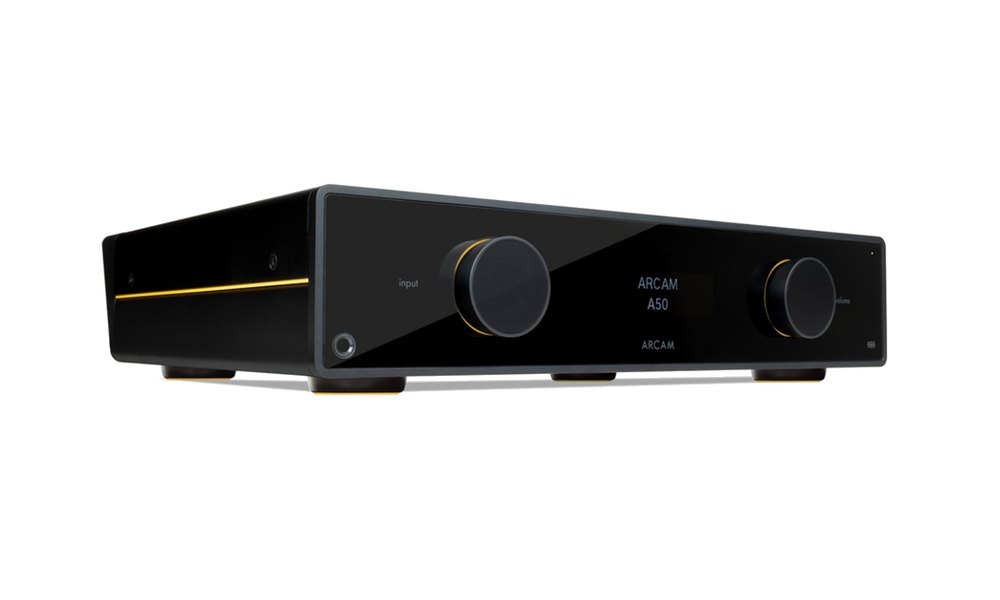
The Arcam A50 Signature is the new flagship of the Radia Series and Arcam's anniversary model: in 1976 the company started out as A&R Cambridge with the A60 integrated amplifier; in 2026 the A50 Signature was created together with co-founder John Dawson, whose signature appears on the rear panel and the circuit boards. Unveiled at HIGH END Vienna (June 2026), in stores since the third quarter. German MSRP 2,799 € (UK £2,499 / US $2,999.95; as of Oct. 2026, without guarantee). For VinylCination, the key feature is the built-in Class A phono stage with separate MM and MC inputs and loading selectable in the menu. In the Expert field it lands at rank 5 with Index 81 — a feature package that is rarely this complete at this price.
Assumptions
- MM or MC cartridges in the usual output range; MC loading 70–470 Ω according to the owner's manual
- Loudspeakers with a normal to moderately demanding impedance curve (manufacturer rating 220 W into 4 Ω)
- No own listening protocol; source base = manufacturer data + specialist press
Technical data (public)
| Type | Stereo integrated amplifier · dual-mono Class G · Class A region up to approx. 10–20 W (according to John Dawson) |
|---|---|
| Power | 2 × 150 W into 8 Ω (20 Hz–20 kHz, 0.5 % THD) · 2 × 220 W into 4 Ω (1 kHz) · THD 0.002 % (80 % power, 8 Ω) |
| Phono | MM/MC · Yes · Class A · Separate inputs · MM 47 kΩ, capacitance 50/150/270 pF · MC loading 70/100/220/470 Ω (menu) |
| Analogue | 3 × RCA (line) · 1 × XLR balanced · pre-out for a power amplifier or active subwoofer |
| Digital | ESS ES9039Q2M · HDMI eARC/ARC · USB-C up to 384 kHz · 2 × coaxial · 1 × optical (PCM stereo only) |
| Wireless | Bluetooth 5.4 receive and transmit · aptX, aptX HD, aptX Lossless, AAC · LE Audio · Auracast |
| Headphones | 6.3 mm jack · 2.5 V into 32 Ω / 5 V into 300 Ω · 16 Ω–2 kΩ |
| Control | RS232 · trigger in/out (3.5 mm) · service USB · Remote control |
| Case / dimensions | 431 × 344 × 99 mm · Approx. 12 kg · Aluminium · plastic-free packaging |
| Price guide | MSRP 2,799 € (DE) · £2,499 (UK) · 2,999.95 $ (US) · as of Oct. 2026 · without guarantee |
Manufacturer specifications (Arcam)
| Power output | 2 × 150 W into 8 Ω (20 Hz–20 kHz, 0.5% THD) · 2 × 220 W into 4 Ω (1 kHz, 0.5% THD) |
|---|---|
| Design | dual mono, Class G |
Source: Arcam – official specifications · As of 16 October 2026 · subject to change by the manufacturer
Rating criteria in detail
The four criteria feed into the Vinyl BotPro Index with weights of 25/20/25/30. The index is scaled across all tiers (see Methodology); that is why we do not show individual sub-scores.
Strengths
- Class A phono with separate MM and MC inputs and loading options
- Dual-mono Class G with 150 W into 8 Ω
- HDMI eARC, USB-C up to 384 kHz, XLR and Bluetooth transmitter
- Strong headphone-output specs (up to 5 V into 300 Ω)
Weaknesses
- No built-in network streaming (external streamer)
- Phono gain not quantified in the specification sheet
- More expensive than the Expert leader NAD C 399
Comparison models
| NAD C 399 | Index 84, rank 1 Expert — more power and cheaper, but MM phono only; streaming via MDC2 module |
|---|---|
| Yamaha A-S1200 | Index 82, Sound Champion Expert — MM/MC and VU meters, but no DAC |
| Hegel H190v | Index 81, rank 4 — streaming onboard and broad test coverage, MM only, higher price |
| Rotel RA-1592MKII | Index 80, rank 6 — 200 W Class AB, MM phono, similar price band |
System matching
Works well with
- Turntables with MM or MC that should work without an external phono stage
- Living-room systems with a TV via HDMI eARC and music from a computer via USB-C
- Headphone listeners, wireless included (Bluetooth transmitter, Auracast)
Less suited
- Anyone who wants streaming services directly in the amplifier (then Hegel H190v or add a streamer)
- Multichannel home cinema (the digital inputs only handle PCM stereo)
- Budget clearly below ~2,000 € — then consider the NAD C 399 or Musical Fidelity M6si
Specs & Features
The A50 Signature measures 431 × 344 × 99 mm and weighs around 12 kg; the casework is thick aluminium. The heart of it is the power amplifier: Arcam calls it the brand's first integrated amplifier with a dual-mono Class G design. Each channel has its own circuit board, output stage, Class G lifters, voltage regulation, reservoir capacitors and heatsink as well as its own transformer windings; the speaker terminals therefore sit at opposite ends of the rear panel. Arcam rates the output at 2 × 150 W into 8 Ω across the full audio band and 2 × 220 W into 4 Ω, with distortion of 0.002 % at 80 % power.
How Class G works here was explained by John Dawson to SoundStage! Global: the output transistors normally run on low supply rails of around ±30 V and deliver about 30 W into 8 Ω — the power of the original A60. At higher levels, additional transistors on ±60 V lift the supply in step with the signal. This keeps the output transistors cooler, efficiency is roughly twice that of conventional Class AB, and up to about 10–20 W the amplifier operates in Class A. According to Dawson, the transformer was shielded and the phono stage placed as far away from it as possible.
For VinylCination, with vinyl there are two separate phono inputs, one for MM and one for MC, both in Class A. According to the owner's manual, MC loading can be set in the audio menu to 470, 220, 100 or 70 Ω and MM capacitance to 50, 150 or 270 pF at 47 kΩ; switching is done conveniently by remote control, with no DIP switches under the chassis. There are also three RCA inputs, a balanced XLR input and a preamp output for a power amplifier or active subwoofer. Digital conversion is handled by an ESS ES9039Q2M in a differential configuration; connections include HDMI eARC/ARC, USB-C up to 384 kHz, two coaxial and one optical input. Bluetooth 5.4 receives and transmits — with aptX Lossless (Snapdragon Sound), LE Audio and Auracast. A 6.3 mm headphone output, RS232, triggers and a processor mode for integration into a home cinema round off the package.
Research Consensus
The source base consists of the manufacturer documents — product page, specification sheet and owner's manual — and coverage of the launch by established specialist media. The international specialist press places the A50 Signature above the award-winning Radia models A5+ and A15+ as the top of the series. Several reviews confirm features, prices and the market launch in the third quarter. Another review provides the most technical context in its conversation with John Dawson: a newly developed Class G stage, dual mono from the transformer windings onwards, a Class A phono stage with loading selectable by remote control and a very solid aluminium chassis.
Recurring patterns across the sources: the A50 Signature is not a retro remake of the A60 but a modern hub for vinyl, CD, TV and streaming sources. The coverage highlights the channel separation of the dual-mono design, the reserves of the Class G circuit and the versatility of the connections. Where individual reports differ — for example on the power rating or the German price — VinylCination follows the manufacturer's specification sheet and the Arcam press release (150 W into 8 Ω, MSRP 2,799 €). The amplifier is available at this price (as of Oct. 2026). VinylCination summarises these patterns as an AI summary of the specialist press — without its own track list and without any partnership claim.
In short: anyone looking in 2026 for an integrated amplifier that loads MC cartridges properly without an external phono stage while also serving the TV, computer and headphones will come across the A50 Signature in research. If you want streaming services directly in the unit, look at the Hegel H190v; if you want maximum power per euro, look at the NAD C 399.
For whom / Matching
Cartridges
The separate inputs simplify matching: MM cartridges such as the Ortofon 2M or Audio-Technica VM run at 47 kΩ, and capacitance can be set to 50, 150 or 270 pF — choose sensibly including the turntable's cable capacitance. For MC cartridges, 70 to 470 Ω are available; many low-output MCs sit within the usual window at 100 or 220 Ω. Arcam does not quantify the phono gain in the specification sheet. With very quiet MCs below about 0.3 mV, a try-out on your own turntable is therefore recommended.
Loudspeakers & chain
150 W into 8 Ω and 220 W into 4 Ω are enough for most bookshelf and floorstanding speakers in this price class, even with moderate sensitivity. Via the pre-out, an active subwoofer or later a power amplifier can be added. Via HDMI eARC, the amplifier becomes the stereo hub for the TV.
Budget
At 2,799 € MSRP (as of Oct. 2026), the A50 Signature sits in the middle of Expert, close to the Naim NAIT XS 3 and the Rotel RA-1592MKII. Budget for a suitable streamer if Spotify, Tidal or Qobuz should play directly; the amplifier then accepts their signal via USB-C, coaxial or optical.
Upgrade
Above it in the VinylCination top list are the NAD C 399, the Musical Fidelity M6si, the Yamaha A-S1200 and the Hegel H190v. Anyone who later moves to an external high-end phono stage can use one of the line inputs or the XLR input; then take a look at the phono preamp top list.
What makes this AI analysis special
This section is an AI summary of manufacturer data and specialist-press reports from summer 2026. Vinyl BotPro had no physical access, no measurement chain of its own and no listening test. The expected performance is derived from architecture, specification sheet and the Radia Class G line; as soon as detailed lab tests appear, VinylCination will incorporate them. Prices and availability change (as of Oct. 2026). Please verify the menu values for MM and MC loading against the current owner's manual and with your dealer.
Vinyl BotPro Score Logic
The Vinyl BotPro Index is scaled 0–100. Expert is typically ~70–84. The Arcam A50 Signature receives 81 (rank 6 Expert): high technology/build shares thanks to the dual-mono Class G design and the current ESS converter, the strongest feature set in the tier thanks to MM and MC phono with loading options, XLR, eARC, USB-C and Bluetooth transmitter, a cautiously set expected performance and a solid value-for-money weighting at 2,799 €. On the Index it is level with the Hegel H190v (81); the Hegel sits just ahead at rank 4 thanks to its broad test coverage. The A50 Signature ranks ahead of the Rotel RA-1592MKII (80) thanks to MC phono and a modern digital section. Weights: technology/build ~25 · features ~20 · performance (expected) ~25 · value for money ~30. Champion seals deliberately not reassigned: Sound remains Yamaha A-S1200, Value for money Audiolab 8300A. Rank is not Laboratory Evaluation — no Listening test. Details: Details on weighting · Methodology.
Sources
- Arcam — A50 Signature (product page, technical data)
- Arcam — ARCAM celebrates 50 years with A50 Signature and unveils CD25 (press release, 04.06.2026)
- Arcam — A50 Signature Specification Sheet (PDF)
- What Hi-Fi? — Arcam celebrates 50 years of hi-fi with a new signature amplifier (04.06.2026)
- SoundStage! Global — Arcam Co-Founder John Dawson and the New A50 Signature (05.06.2026)
- StereoNET — ARCAM A50 Signature & CD25 Break Cover At HIGH END Vienna (04.06.2026)
- AVForums — Arcam announces A50 Signature integrated amp and CD25 CD player (04.06.2026)
Created by Vinyl BotPro (AI) · Novelty of the Day 05.10.2026 · Updated on 05.10.2026 · Version 1.0 · Corrections: info@vinylcination.de · Prices without guarantee.
Read more: best amplifiers 2026 · Improve your hi-fi system · What is hi-fi?